
No. Nothing clears brain fog instantly, and any page promising it in ten minutes is usually selling a capsule. A few things can genuinely shift how you feel within an hour: water if you are short of it, food after a long gap, twenty minutes of moving, and getting off a screen. None of them fix a cause.
Listen to this article, about 10 minutes. A synthetic voice reads the article and announces each section title as it begins; tables are read row by row and the questions at the end are left out.
Recorded 10 October 2026 from the article as published that day. Press a chapter to jump there; the highlighted line is what is playing. A play button sits beside every section heading, and once you scroll past this player a bar at the bottom of the screen keeps the controls in reach. Tap or click any sentence to hear the reading start from there.
On this page: a comparison table of fast fixes, a timeline of caffeine withdrawal, and a checklist of red flag symptoms that require urgent medical attention.
Think you already know this? Five questions, one minute.
Every answer is on this page. Answer from what you know now; the page fills in the rest.
-
1. What did a federal court order the makers of the memory supplement Prevagen to do in December 2024?
In December 2024, a federal court ordered the makers of Prevagen to stop making claims that the Federal Trade Commission said misled Americans worried about memory loss. Read the section
-
2. What did the analysis of national survey data find regarding hydration and cognition in men?
According to an analysis of national survey data published in the European Journal of Nutrition, hydration status and water intake had no significant association with attention or processing speed in men. Read the section
-
3. What did the 2024 meta-analysis find regarding the effect size of a single bout of activity on cognition?
The pooled results from a 2024 systematic review and Bayesian meta-analysis in Communications Psychology found a small positive effect on cognition with a standardised effect size of 0.13. Read the section
-
4. When do caffeine withdrawal symptoms typically begin after a regular consumer’s last dose?
According to the StatPearls review of caffeine withdrawal, withdrawal symptoms in regular consumers start 12 to 24 hours after the last dose. Read the section
-
5. Which of these is a factor behind persistent brain fog that moves on a scale of weeks rather than hours?
Persistent fog that lasts for weeks is often driven by factors like sleep, recovery from illness, thyroid function, or sustained stress, which require clinical evaluation rather than instant fixes. Read the section
That is the honest version. If you have landed here at three in the afternoon with a deadline and a head full of wet wool, the useful question is not how to clear the fog. It is what can realistically change in the next hour, and what is simply being sold to you.
Why does everything you search promise an instant fix?
Because the word instantly is a buying signal, and the pages competing for it know that. Search it and you get countdowns: clear brain fog in five minutes, three tricks, one weird morning ritual. Around the third scroll there is a capsule.
This is not a hypothetical concern. In December 2024, after seven years of litigation, a federal court ordered the makers of the memory supplement Prevagen to stop making claims that the Federal Trade Commission said misled Americans worried about memory loss. The regulator had argued the company’s own study failed to beat placebo on any measure of cognitive function. The adverts had run on national television for years.
None of which makes every product a fraud. It does mean the confidence in the marketing is not coming from the evidence, because there is not enough evidence to be that confident with. When a bottle is more certain about your brain than the research is, the certainty was added in the marketing department.
What can genuinely change within an hour?
Here is the realistic list. The column that matters most is the last one.
| What people reach for | What can plausibly change inside an hour | What it will not do | How solid the evidence is |
|---|---|---|---|
| A glass of water | Thirst, and a headache that came with it | Do much if you were already drinking normally | Mixed, and weaker than the wellness aisle implies |
| Food, after five or six hours of nothing | Shakiness and the irritable wobble of a long gap | Touch fog that turns up whether or not you have eaten | Reasonable for the long gap, thin for fog in general |
| Ten to twenty minutes of moving | Reaction time, and a small lift in alertness | Produce a noticeably sharper version of you | Good quality evidence for a genuinely small effect |
| Coffee, if you drink it every day | Withdrawal you may not have known you were in | Take you above your own ordinary baseline | Well documented, and often misread as a boost |
| Twenty minutes away from the screen | Aching eyes and the strain of close focus | Clear fog that was there before you opened the laptop | Thin. Small studies that do not agree with each other |
| A capsule sold for focus | Your bank balance, reliably and at speed | What the label promises, in the one case a court has tested | One product was ordered to stop making the claim |
Notice what none of them do. They may change how the next hour feels. They do not touch whatever has been producing the fog for three weeks. If you have not been through the causes worth checking first, that is a better use of an afternoon than another quick fix.

Does drinking water clear brain fog straight away?
Probably not, and the evidence is messier than the internet suggests. an analysis of national survey data published in the European Journal of Nutrition found that hydration status and water intake were only moderately associated with attention and processing speed in older women, with no significant association in men, and that both dehydration and overhydration tracked with lower scores.
The authors were blunt about the wider literature: existing research has not consistently supported the idea that dehydration meaningfully impairs cognition in daily life. They also pointed out a problem with much of the earlier work. A lot of it induced dehydration through heat and exercise, both of which affect thinking on their own, which makes it hard to know what the water was doing.
So drink the glass of water. It costs nothing, and if you have not had a drink since breakfast you will feel better for it. Just do not expect it to lift the fog, and be wary of anyone who says dehydration is your answer without having met you.
Does eating something help when the fog arrives late in the day?
If you last ate at eight in the morning and it is now three, eating something will probably take the edge off. The shakiness and the sense of everything being slightly too much are familiar to anyone who has skipped lunch to finish a task, and they resolve with food.
That is a smaller claim than it sounds. It says a long gap makes you feel bad, which is not the same as saying food clears brain fog. Fog that shows up regardless of when you last ate is not a snack problem. And the pattern itself is information: if the fog reliably tracks with meals, or reliably ignores them, that is worth writing down. It is exactly the sort of detail that makes a ten minute appointment useful, which is the whole subject of how to describe it so a doctor takes you seriously.
Does moving around work, and how fast?
This is the one with the best evidence, and the evidence is still modest. a 2024 systematic review and Bayesian meta-analysis in Communications Psychology pooled 113 studies covering 4,390 people and found a small positive effect of a single bout of activity on cognition, with a standardised effect size of 0.13. The authors put an 80 percent chance on the true effect sitting somewhere between 0 and 0.2, and noted it was driven mainly by faster reaction times rather than more accurate answers.
Translated: a walk may make you a bit quicker for a while. It will not make you sharp. That is still a better return than most things you can do in twenty minutes. Set the expectation at slightly better and it delivers.
Is coffee clearing your fog or just topping you back up?
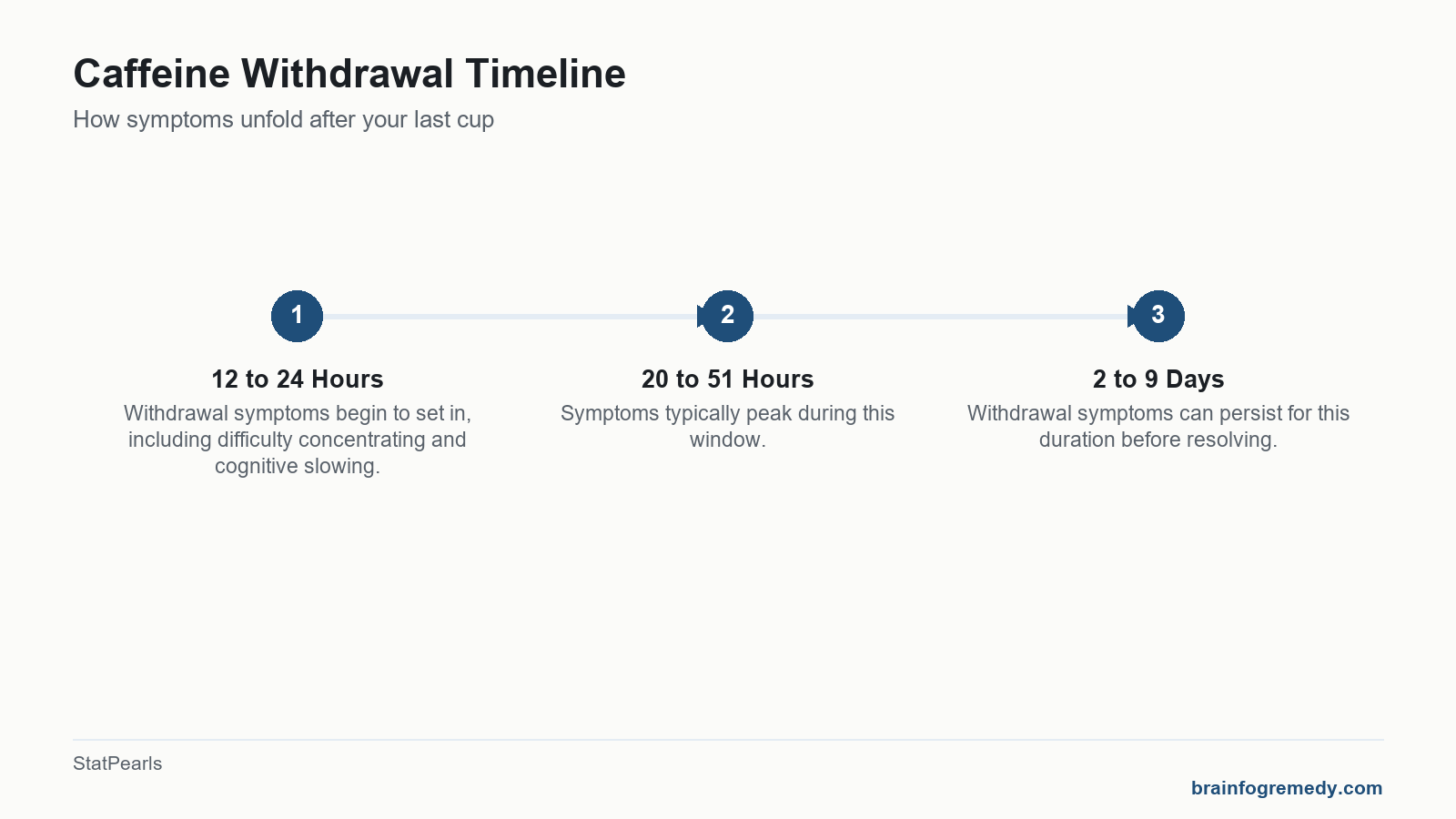
Worth knowing which. According to the StatPearls review of caffeine withdrawal, withdrawal symptoms in regular consumers start 12 to 24 hours after the last dose, peak between 20 and 51 hours, and can last from 2 to 9 days. Difficulty concentrating and cognitive slowing are among the hallmark symptoms, and a small dose of 50 to 100 milligrams reverses them quickly.
So for a daily coffee drinker, that lift at eleven in the morning may be a return to baseline rather than a climb above it. This is not a reason to change what you drink, and it is not a suggestion to stop. It is a reason to be careful about reading the return to normal as proof that coffee sharpens you, because those are different things and only one of them is on the packaging. The flip side, how a late or missed cup can itself leave you foggy, is laid out in the caffeine withdrawal clock and what the research found. Alcohol runs on a similar but slower version of the same logic: the published elimination rate clears a heavy night from the blood within hours, yet measured memory and attention deficits often outlast it, which is unpacked in alcohol brain fog: what clears fast and what lingers.

Does stepping away from the screen do anything?
For your eyes, plausibly. Close focus for hours is uncomfortable, and looking at something further away for a while relieves that. For the fog itself, the honest answer is that nobody has shown it clearly. The trials on scheduled screen breaks are small, short and awkward to run properly, since you cannot blind someone to whether they took a break, and the results disagree.
So take the break if you want the break. It is pleasant, it is free and it will not hurt. Just note that get off your screen has become the advice given for every symptom anyone has ever had, which is usually the point at which nobody checks the evidence any more.
What will not lift in an hour, whatever the label says?
If the fog has been there for weeks, nothing in this article is going to end it this afternoon. The things that sit behind persistent fog move on a scale of weeks: sleep, recovery from illness, thyroid or blood results, medication effects, sustained stress, and a long list of others. Working out which, if any, applies to a particular person is a clinical job.
That is the trade the instant fix industry makes. It offers a fast answer in place of a slow one, and the fast one has nothing behind it. If you want the slower version, what actually helps over weeks rather than minutes is the more useful read, along with fog that follows a run of bad nights and which vitamins have evidence behind them and which do not.
When is sudden brain fog not something to wait out?
Some things should not be managed with a glass of water and a walk. Seek urgent medical help if confusion or fogginess comes on suddenly and is unlike your usual experience, or comes with any of the following: weakness or numbness on one side of the body, drooping on one side of the face, difficulty speaking or understanding speech, a sudden severe headache, changes in vision, a high temperature with confusion, a seizure, or a recent blow to the head.
This is not a list of things you are likely to have. It is a list of situations where waiting to see whether it passes is the wrong call. Anyone unsure should treat that uncertainty as a reason to ask a clinician rather than an article.
Sudden Brain Fog Red Flags
Seek urgent medical care if sudden fogginess is accompanied by any of these warning signs:
Ticks are saved on this device only.
Frequently asked questions
Can you clear brain fog in five minutes?
No. Five minutes is not long enough for anything in the evidence base to take effect. What five minutes can do is interrupt a task you are getting nowhere with, which sometimes feels like an improvement and is not the same thing.
Does drinking water get rid of brain fog straight away?
It relieves thirst and any headache that came with it. Beyond that the evidence is inconsistent, and one analysis of national survey data found only moderate associations with attention in older women and none in men. Drink the water, but expect less of it.
What is the fastest thing that actually helps?
Movement has the best supporting evidence of anything measurable in under an hour, and even that is a small effect on reaction time rather than a transformation. A pooled analysis of 113 studies put the standardised effect at 0.13.
Do focus supplements work instantly?
This site does not recommend supplements. What can be said is that in one case a US federal court ordered a memory supplement maker to stop making cognitive improvement claims, after regulators argued the company’s own study did not beat placebo.
Why does brain fog lift for an hour and then come back?
Fluctuation through the day is commonly described and is not, on its own, evidence about the cause. A temporary lift after a walk or a meal tells you what changed in that hour, not what has been producing the fog for weeks.
When should sudden brain fog be checked urgently?
Sudden confusion that is unlike your usual experience needs urgent medical attention, especially alongside weakness or numbness on one side, facial drooping, trouble speaking, a sudden severe headache, vision changes, a high temperature, a seizure, or a recent head injury.
Finished the page? The same five questions from the top, to see what stuck.
This article is general information, not medical advice, and is not a substitute for care from a qualified healthcare professional. Speak to your doctor about your own situation.
Leave a Reply