
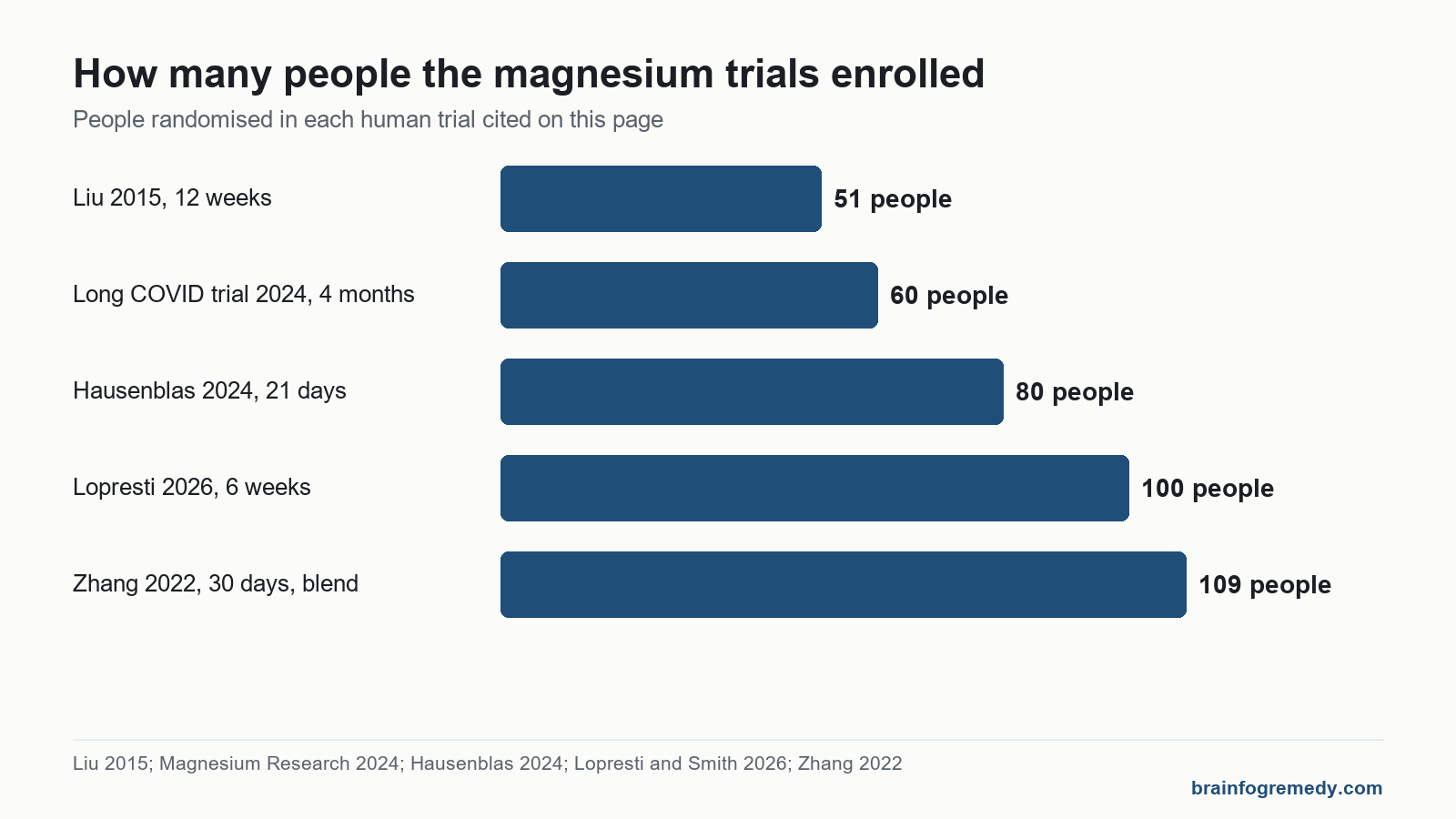
Magnesium for brain fog has never been tested in any trial found for this page. Four small trials of magnesium L-threonate products, each tied to the ingredient’s maker, reported gains on some thinking, memory or alertness measures in 51 to 109 people. A 2024 review called the trial evidence insufficient, and low magnesium is a blood test for a doctor.
Listen to this article, about 12 minutes. A synthetic voice reads the article and announces each section title as it begins; tables are read row by row and the questions at the end are left out.
Recorded 15 October 2026 from the article as published that day. Press a chapter to jump there; the highlighted line is what is playing. A play button sits beside every section heading, and once you scroll past this player a bar at the bottom of the screen keeps the controls in reach. Tap or click any sentence to hear the reading start from there.
On this page: a table of every human magnesium trial on thinking this page could verify, with who took part, how long it ran, what changed and who paid, the trial sizes drawn as a chart, and what 14 forum accounts reported.
Think you already know this? Five questions, one minute.
Every answer is on this page. Answer from what you know now; the page fills in the rest.
-
1. In the 2024 Advances in Nutrition review, which blood magnesium level sat at the low point of the U shaped link with dementia risk?
The 2024 systematic review found people below 0.75 and above 0.95 mmol/L both did worse than people near 0.85 mmol/L. It is an observational pattern, not proof that supplements help. Read the section
-
2. How many randomised trials of magnesium and cognition did the 2024 review find in its search up to May 2024?
The review included three randomised trials and 12 cohort studies, and said the trial evidence was insufficient to draw conclusions on magnesium supplements. Read the section
-
3. In the 2015 Liu trial, which measure was the study sized around?
The 2015 trial based its power calculation on an anxiety measure, which did not differ from placebo; the combined thinking score did. Read the section
-
4. Who funded the 2026 Lopresti and Smith trial of magnesium L-threonate?
The 2026 trial paper states it was funded by Threotech, which supplied the product and was involved in the study design. Read the section
-
5. What was the main outcome of the 2024 long COVID trial of magnesium plus vitamin D?
The trial in Magnesium Research measured depression scores over four months and had no placebo group; thinking and memory were not reported in its abstract. Read the section
Search for magnesium and brain fog and the results fill up with confident bottles. Somewhere a label promises focus by Friday. This page does something duller and more useful: it lists the human trials, who was in them, how long they ran, what moved and what did not, and who paid. It does not recommend magnesium, a form of it or a dose. If you want the wider picture first, our look at whether brain supplements work at all covers the rest of the shelf.
Why do people link magnesium to brain fog in the first place?
The idea has a real starting point. Magnesium is involved in hundreds of chemical reactions in the body, including in nerve signalling, and early signs of deficiency include fatigue and weakness, according to the NIH Office of Dietary Supplements. The same fact sheet says symptomatic deficiency from diet alone is uncommon in otherwise healthy people, because the kidneys hold on to magnesium when intake is low.
The strongest human signal comes from observation, not trials. A systematic review in Advances in Nutrition in 2024 pooled 12 cohort studies and found a U shaped link between blood magnesium and later dementia or cognitive impairment: people below 0.75 and above 0.95 millimoles per litre both did worse than people near 0.85. That is a pattern in groups, followed for years. It says nothing about whether a capsule changes how clearly anyone thinks next month, and it is about dementia risk, which is not the same thing as brain fog.
What did the human trials of magnesium actually test?
The same 2024 review searched four databases up to May 2024 and found just three randomised trials of magnesium and cognition. Its verdict, in its own words, was that evidence from the limited number of trials “was insufficient to draw conclusions on the effects of Mg supplements.” Since then a few more have appeared. Here is every human trial this page could verify, with what each one measured.
| Trial | Who took part | What they took | How long | What changed, and what did not | Paid for by |
|---|---|---|---|---|---|
| Liu and colleagues, Journal of Alzheimer’s Disease, 2015 | 51 randomised, 44 finished; aged 50 to 70 with memory complaints, poor sleep and anxiety | Magnesium L-threonate product or placebo | 12 weeks | A combined thinking score improved more than placebo. Working memory, attention and episodic memory did not differ. Sleep and anxiety did not differ either | Neurocentria, the developer |
| Zhang and colleagues, Nutrients, 2022 | 109 healthy adults aged 18 to 65 in China | A blend of magnesium L-threonate, phosphatidylserine and vitamins C and D, or starch placebo | 30 days | Higher scores on one memory test, the Clinical Memory Test. A blend, so no single ingredient can take the credit | AIDP, which sells the ingredient |
| Hausenblas and colleagues, Sleep Medicine: X, 2024 | 80 adults aged 35 to 55 with self reported sleep problems | Magnesium L-threonate or placebo | 21 days | Better self rated sleep and daytime alertness on questionnaires. No formal thinking tests | Run with an investigator from Threotech, the maker |
| Lopresti and Smith, Frontiers in Nutrition, 2026 | 100 adults aged 18 to 45 unhappy with their sleep | Magnesium L-threonate or rice flour placebo | 6 weeks | Total cognition score up 8.40 points against 5.60 on placebo. The fluid and crystallised scores did not differ | Threotech, the maker |
| Long COVID trial, Magnesium Research, 2024 | 60 adults with long COVID, low magnesium, low vitamin D and mild to moderate depression | Magnesium chloride plus vitamin D, against vitamin D alone, no placebo | 4 months | Depression scores fell further with magnesium. Thinking and memory were not reported in the abstract | Not stated in the abstract |
Read across the rows and three things stand out. All four thinking or sleep trials used the same branded ingredient, magnesium L-threonate, so they say nothing about the cheaper forms most people buy. None ran longer than 12 weeks. And none recruited people because they had brain fog: the volunteers were older adults with memory complaints, healthy adults, or people who slept badly.

How strong are the results once you read past the headline?
The oldest trial is the one most often quoted. In the 2015 Liu trial, 44 people finished, and the combined thinking score improved more on the supplement than on placebo, with a large effect size of 0.91. But the individual tests behind that score mostly did not separate from placebo, and the study had been sized around an anxiety measure that also showed no difference. Placebo effects on sleep and anxiety were large, the authors noted.
The newest one, the 2026 Lopresti and Smith trial, is bigger and better designed. Its main result was a gain on the NIH Toolbox total cognition score, 8.40 points against 5.60 on placebo, with a p value of 0.043, which is only just inside the usual line. Its fluid and crystallised sub scores did not differ. The paper also converts the result into about 7.5 years of what it calls cognitive rejuvenation, which is the kind of number that ends up on a label and deserves the raised eyebrow.
The sleep trial by Hausenblas and colleagues reported better self rated sleep, mood and mental alertness over 21 days, but alertness here was a questionnaire answer, not a test. For more on how sleep feeds into foggy days, our page on brain fog after poor sleep sets out what the sleep research measured.
Who paid for the magnesium trials, and does it matter?
Every one of the four L-threonate trials was funded by, or run with, the company that develops or sells the ingredient. The 2015 trial was funded by Neurocentria, which also helped design it. The 2022 trial was funded by AIDP. The 2026 trial was funded by Threotech, which supplied the product and was involved in the design. That does not make the results false. Industry funding is common in supplement research. It does mean no independent team has yet repeated the findings, and it is a reason to want that before treating any of them as settled.
Compare that with how the evidence is often presented: a single trial in a press release, rounded up into a promise. The honest summary is short. Small, short, sponsored trials of one form of magnesium found modest changes on some tests and none on others. That is not a verdict that magnesium does nothing. It is a verdict that nobody has yet run the trial that would answer the question people actually type into search bars at midnight.
Has magnesium been tested for long COVID brain fog?
Not directly, as far as this page could find. The closest is a four month open label trial published in Magnesium Research in 2024, in 60 adults with long COVID who also had low magnesium, low vitamin D and depression. Those given magnesium chloride plus vitamin D saw depression scores fall from 28.8 to 9.2, against 28.4 to 21.6 on vitamin D alone. There was no placebo, everyone knew what they were taking, and the people in it had a measured deficiency. Thinking and memory were not reported in the abstract. Our page on COVID brain fog covers what the long COVID research has measured so far.
What do people who tried magnesium for brain fog report?
These are reports, not findings. On 15 October 2026 this page read about 14 first hand accounts from the past year across two Reddit threads in r/BrainFog and a search of r/covidlonghaulers comments. They ranged from dramatic relief to feeling worse, and one pattern ran through most of the detailed ones: magnesium was rarely taken on its own.
In May 2026 the author of a thread titled Magnesium Threonate said their fog had dropped sharply and that they felt better within one or two days, much faster than any trial above measured. In the same post they described treatment for another suspected cause running at the same time. In the replies, one person said a magnesium product gave them headaches and possibly worse fog, and a user who described themselves as a doctor said they could not recall a single patient helped by a magnesium supplement. Their credentials could not be checked.
In July 2026, in a thread asking whether glycinate or citrate helped more, one reply said the threonate form helped for a few days and then things went back to normal, and another said simply that neither helped. In August 2026 one person in r/covidlonghaulers listed two forms of magnesium among more than a dozen things tried without improvement. In September 2026 another credited a combination of magnesium, fish oil and several other remedies at once, so nobody, including them, could say which part did what.
Where the accounts agree with the trials: the people reporting benefit mostly used the same L-threonate form the trials tested. Where they part company: the trials ran for weeks, while several people described changes in days, and the forum stacks make any single ingredient impossible to judge. Feeling better after starting something, at the same time as changing three other things, is exactly what placebo controlled trials exist to untangle.
Is magnesium safe, and what should a doctor check first?
Even the official limits disagree. The US NIH consumer fact sheet puts the adult upper limit for magnesium from supplements and medicines at 350 mg a day, while Food Standards Scotland, using UK wording, says 400 mg or less a day from supplements is unlikely to cause any harm. Both figures are ceilings for safety, not targets, and neither covers magnesium in food. High doses can cause diarrhoea, and Food Standards Scotland says there is not enough evidence on taking high doses for a long time.

Brain fog that is new, getting worse or affecting work or safety needs a doctor before it needs a supplement. Magnesium leaves the body through the kidneys, so anyone with kidney disease should speak to their doctor before taking it, and a pharmacist can check whether it affects any medicine you already take. A low magnesium result is a blood test read by a clinician, not something to work out from symptoms, and the NIH fact sheet notes that blood levels have little correlation with the total amount of magnesium in the body. The causes a GP tends to check first are in our guide to what causes brain fog, and the vitamins page covers the deficiencies with stronger evidence behind them.
Questions to take to a GP or pharmacist before any supplement
A list to tick off as you ask. It scores nothing and recommends nothing; the answers come from the professional, not from this page.
Ticks are saved on this device only. This list is general information, not medical advice.
Frequently asked questions
Which form of magnesium is best for brain fog?
No trial found for this page compared forms for brain fog. The thinking and sleep trials all used magnesium L-threonate products, so they cannot say whether other forms would do the same, better or worse.
How long did the magnesium trials run?
The trials of thinking and sleep ran from 21 days to 12 weeks. The long COVID trial, which measured depression rather than thinking, ran for four months.
Can a blood test show low magnesium?
The usual test measures magnesium in the blood, which the NIH notes has little correlation with the total magnesium in the body. A doctor decides whether to test and how to read the result.
Does magnesium help sleep, and could that clear brain fog?
One 2024 trial reported better self rated sleep over 21 days, while the 2015 trial found no difference from placebo on sleep. Whether better sleep would clear any one person’s fog is not something the trials tested.
Can people get enough magnesium from food?
Food Standards Scotland says adults should be able to get the magnesium they need from their diet, giving 300 mg a day for men and 270 mg a day for women as the amounts needed.
Can magnesium make brain fog worse?
The trials did not report that, but some forum users say a magnesium product gave them headaches or worse fog. High doses can cause diarrhoea. Anyone who feels worse after starting a supplement should tell their doctor or pharmacist.
Finished the page? The same five questions from the top, to see what stuck.
This article is general information, not medical advice, and is not a substitute for care from a qualified healthcare professional. Speak to your doctor about your own situation.
Leave a Reply