Sleep loss is the most common cause of brain fog, the easiest to confirm, and the most annoying to fix, because the fix takes longer than the damage did.
Listen to this article, about 11 minutes. A synthetic voice reads the article and announces each section title as it begins; tables are read row by row and the questions at the end are left out.
Recorded 9 October 2026 from the article as published that day. Press a chapter to jump there; the highlighted line is what is playing. A play button sits beside every section heading, and once you scroll past this player a bar at the bottom of the screen keeps the controls in reach. Tap or click any sentence to hear the reading start from there.
On this page: why one bad night costs the day after and part of the next, the study that put four hours in bed against eight broken hours, how long recovery actually took in the trial that measured it, the three free changes worth doing at once, and the airway problem that no bedtime fixes.
Think you already know this? Five questions, one minute.
Every answer is on this page. Answer from what you know now; the page fills in the rest.
-
1. What does this page say is the second thing to go with sleep loss?
The first thing to go is working memory, the workspace you use knowledge in. Attention, reaction speed and emotional regulation degrade together, which is why sleep loss so often looks like irritability first and fog second. Read the section
-
2. In the 2014 Sleep Medicine pilot study of 61 adults aged 20 to 29, how did four hours in bed compare with eight hours interrupted by four prolonged awakenings?
The study was one night, in young adults, against four hours rather than six, so the six hour comparison on this page is an inference from it. It still points firmly in one direction: time in bed is a poor measure of sleep you actually got. Read the section
-
3. In the 2021 PLOS ONE study, after ten days of restricted sleep and seven days of recovery, how many attention measures had returned to baseline?
The trial is why the second row of the recovery table may be generous. A week off the late nights is a reasonable first test, not a guarantee, and a second foggy week is not a sign that something else is wrong. Read the section
-
4. What did Drake and colleagues find in 2013 about 400 mg of caffeine?
The Journal of Clinical Sleep Medicine study measured both what people reported and a home sleep monitor. The authors concluded that avoiding substantial caffeine for at least six hours before bed is supported, which for someone asleep at eleven puts the last big coffee before five. Read the section
-
5. How does the NHS band an AHI score, the number of breathing interruptions per hour?
The NHS page on obstructive sleep apnoea lists difficulty concentrating, mood swings and waking with a headache among the daytime symptoms, which is brain fog in clinical language, and says not to drive until symptoms such as feeling very tired are under control. Read the section
One bad night costs most people the following day and part of the day after. That asymmetry is the single most useful thing to understand about it, because it explains why a run of late nights leaves you foggy for a week after you start sleeping properly again.
What sleep loss actually does to thinking
The first thing to go is working memory, which is the ability to hold information while you do something with it. That is precisely what brain fog feels like from the inside. You have not lost knowledge, you have lost the workspace you use it in.
The second thing to go is the ability to notice that you are impaired. People who are short on sleep consistently rate their own performance as better than it measures. That is worth knowing if you are deciding whether you are fit to drive or to make a decision that matters.
Attention, reaction speed and emotional regulation all degrade together, which is why sleep loss so often looks like irritability first and fog second. If you want the wider list, what actually causes brain fog covers the other seven common causes.
Broken sleep is worse than short sleep
This surprises people. Six hours of unbroken sleep generally leaves someone sharper than eight hours interrupted four times. Interruptions cut cycles short before they finish, and the deeper stages are the ones you lose.
It explains a pattern that otherwise looks contradictory: parents of small children and people with untreated sleep apnoea describe identical fog despite very different amounts of time in bed. Both have fragmented sleep. Neither has a shortage of hours.
The cleanest test of this is smaller than the idea deserves, so it is worth saying what it actually measured. In a 2014 pilot study in Sleep Medicine, 61 healthy adults aged 20 to 29 spent one night either restricted to 4 hours in bed or given 8 hours in bed with four prolonged awakenings. The effects on sustained attention and mood the next day were indistinguishable between the two. That is one night, in young adults, compared against four hours rather than six, so the six hour comparison above is an inference from it rather than a result, but it points firmly in one direction: time in bed is a poor measure of sleep you actually got.
If you snore heavily, wake with a dry mouth or a headache, and feel unrefreshed no matter how long you were in bed, that combination is worth raising with a doctor specifically rather than treating as ordinary tiredness. Grogginess that clears within the first hour or so is a different thing, and how long morning brain fog lasts in the sleep inertia studies gives the timings to compare against.

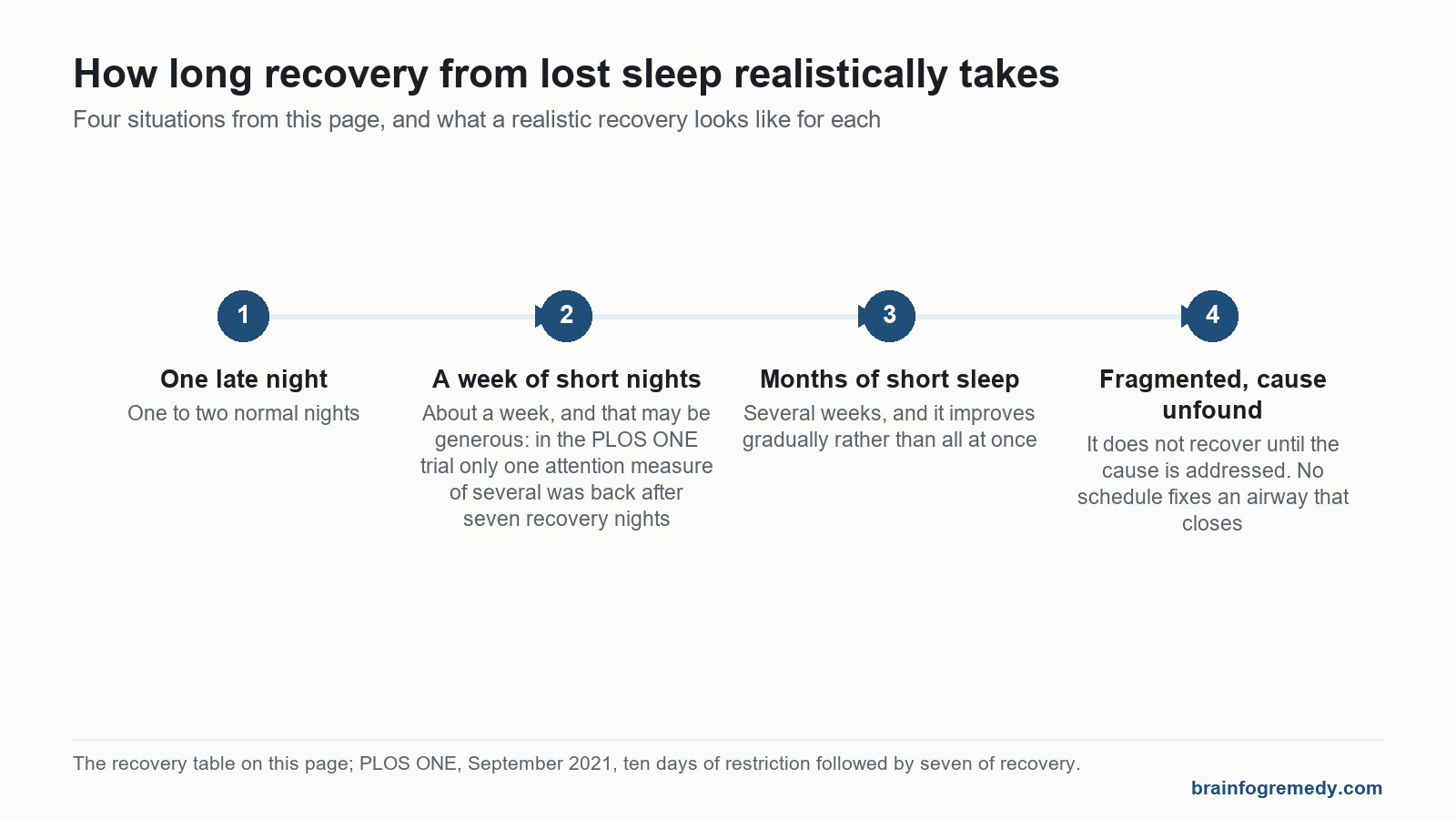
How long recovery actually takes
| What happened | Realistic recovery |
|---|---|
| One late night | One to two normal nights |
| A week of five or six hours | About a week of consistent sleep |
| Months of chronic short sleep | Several weeks, and it improves gradually |
| Fragmented sleep from an untreated cause | It does not recover until the cause is addressed |
The last row is the one that traps people. If something is waking you repeatedly and you have not identified it, no amount of going to bed earlier fixes the fog, because the problem is not the schedule.
If anything, the second row may be generous. In a small study published in PLOS ONE in September 2021, healthy adults went through 10 days of deliberately restricted sleep and then 7 days of unrestricted recovery sleep. Attention measures fell during the restriction, and after the recovery week only one of them, reaction time on a colour naming task, had returned to baseline. A week off the late nights is a reasonable first test, not a guarantee, and a second foggy week is not a sign that something else is wrong.
The three changes that carry most of the effect
- Fix the wake time, not the bedtime. It is the anchor everything else hangs off, and it is the one you can actually control. Hold it seven days a week, including weekends, for two weeks before judging it.
- Get daylight within an hour of waking. Ten minutes outdoors beats any indoor lighting by a wide margin, and it sets the timer that decides how sleepy you are that night. This does more for sleep quality than anything done at bedtime.
- Move the last caffeine earlier. It has a long tail. The cup at four in the afternoon is still measurably present at midnight, and it reduces deep sleep even when you fall asleep without difficulty.
None of that is novel and all of it is free. The reason to do all three at once for a week is that it turns a vague suspicion into a clean test. If you want that week laid out day by day, with the caffeine cut off worked out for an eleven o’clock bedtime, the four day reset for getting rid of brain fog sets it out in order.
On the caffeine point, the study most often cited is Drake and colleagues in the Journal of Clinical Sleep Medicine, 2013. Participants took 400 mg of caffeine, roughly two to three cups of coffee, at bedtime, three hours before or six hours before, and all three timings significantly disrupted sleep compared with a placebo, measured both by what people reported and by a sleep monitor at home. The authors concluded that avoiding substantial caffeine for at least six hours before bed is supported. For someone asleep at eleven, that puts the last big coffee before five, which is earlier than most offices assume.
The two week test, as this page sets it out
Three free changes, done together for a fortnight, turn a suspicion into a clean test. Tick what has been true every day so far.
Ticks are saved on this device only. The page above says what follows when all of this has held for two weeks and the fog is unchanged: the next places to look need a blood test, and that is a conversation with a doctor, not a box here.
Sleep apnoea, which is missed for years
This deserves its own section because it is common, treatable, and frequently goes undiagnosed for a very long time while the person is told they have brain fog.
In obstructive sleep apnoea the airway partially or fully closes during sleep, repeatedly, and each event briefly rouses you enough to resume breathing. You will usually have no memory of any of it. What you get is a night that looks like eight hours and delivers something much less restorative.
- Loud snoring, often reported by someone else rather than noticed by you
- Waking with a dry mouth or a headache
- Feeling unrefreshed regardless of how long you slept
- Daytime sleepiness, particularly falling asleep when inactive
- Someone having observed you stop breathing or gasp
- Waking suddenly with a sensation of choking
Two of those together is worth raising with a doctor specifically. It is more common than people assume, it can occur without obesity and in slim people, and the fog it produces is severe and completely resistant to going to bed earlier.
If you have been told you snore heavily and you wake unrefreshed after adequate hours, do not spend another year on sleep hygiene advice. That combination is worth a conversation, because no behaviour change fixes an airway that closes.
What a sleep study actually involves
People delay asking because they imagine a hospital ward. Increasingly it is not.
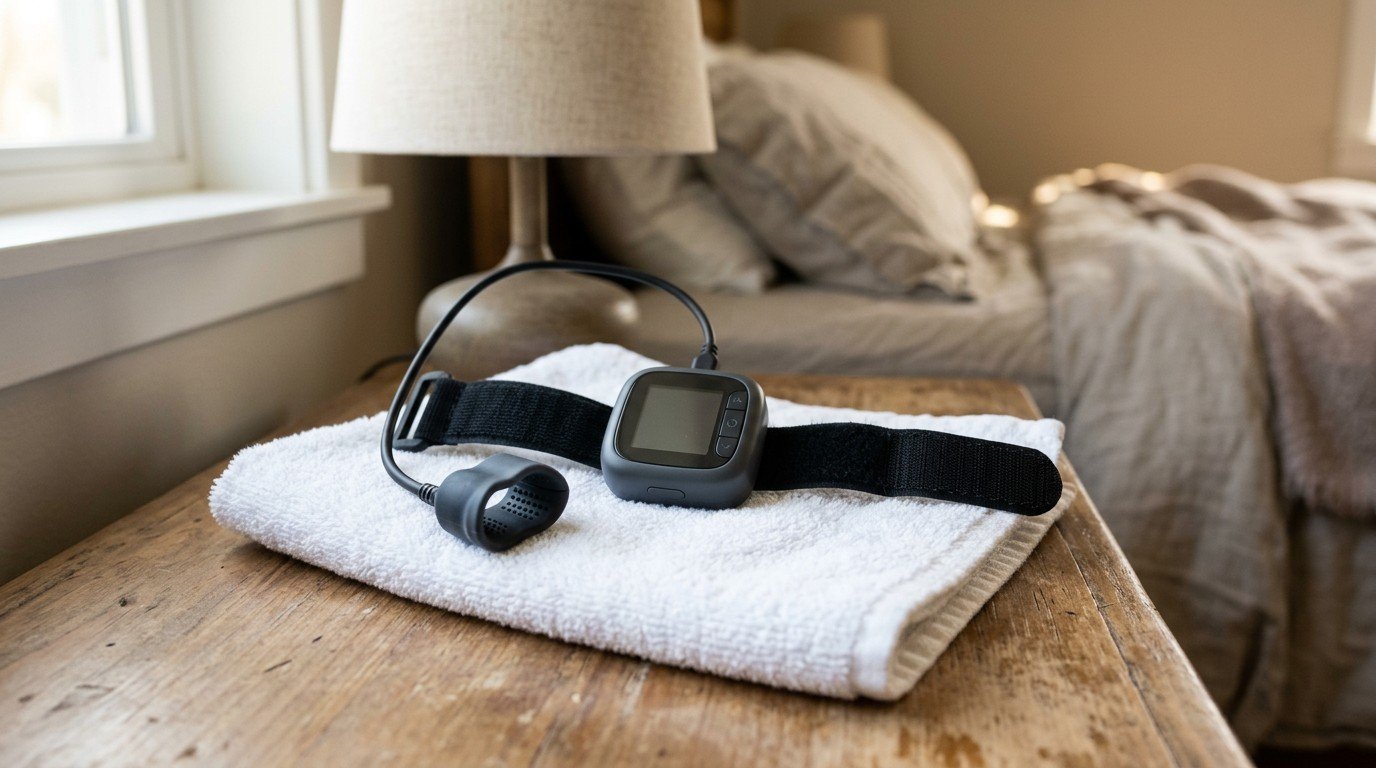
Many assessments now begin with a home test: a small device worn overnight in your own bed, usually measuring breathing, oxygen and heart rate. You return it, and the recording is analysed. An in laboratory study is more detailed and is generally reserved for cases where the home test is inconclusive or more information is needed.
The point of describing it is simply that the barrier is lower than most people picture, and the alternative is continuing to attribute the problem to something else.
The NHS page on obstructive sleep apnoea, last reviewed in May 2026, describes the same thing: a device worn overnight at home or in a clinic that records breathing and heartbeat. The result is usually given as an AHI score, the number of times breathing is interrupted per hour, and the NHS bands it as 5 to 14 mild, 15 to 30 moderate and over 30 severe. The same page lists difficulty concentrating, mood swings and waking with a headache among the daytime symptoms, which is brain fog described in clinical language.
The NHS page also says you must not drive until symptoms such as feeling very tired are under control, and that in the UK you should check the GOV.UK guidance on whether you need to tell the DVLA. Rules differ in other countries, so check the rules where you live.
Shift work and irregular hours
If your schedule rotates, most standard sleep advice does not apply to you, and being told to keep a fixed wake time is unhelpful when your start time moves.
The realistic goals are different. Not perfect sleep, but protecting what you can get.
- Keep the sleep period as consistent as the roster allows, even if the clock time varies.
- Make the sleeping environment genuinely dark, because daytime sleep is far more light sensitive.
- Use light deliberately: bright exposure when you need to be alert, avoidance when you are heading for sleep.
- Be strategic with caffeine early in a shift rather than throughout it.
- Treat the days after a rotation as reduced capacity rather than as a personal failing.
Shift work makes cognitive symptoms considerably more likely, and that is a known effect of the schedule rather than something wrong with you. It also does not mean the other causes can be ignored, so it is still worth having bloods done rather than attributing everything to the roster.
What does not work
Catching up at the weekend helps with sleepiness and not much else, and it pushes your body clock later, which makes the start of the week harder. Alcohol as a sleep aid is actively counterproductive: it shortens the time to fall asleep and fragments the second half of the night, which is the worst possible trade for brain fog.
Sleeping longer is also not the answer when the problem is quality. If nine hours leaves you as foggy as seven, adding a tenth will not help and the question is what is interrupting you.
When it is not the sleep
If you have held a consistent schedule for two weeks, sleep seven or eight hours without waking, and still feel foggy, sleep is not your cause. That is genuinely useful, because it removes the biggest item from the list. The next places to look are iron, thyroid and blood sugar, all covered in what actually causes brain fog, and all requiring a blood test rather than a behaviour change.
If the fog comes with exhaustion that rest does not touch, fatigue that comes with it is the more relevant read, because that pattern points somewhere different. And if what you feel is less sleepy than drained, what mentally tired actually means separates the two. Where the exhaustion is the flat, drained kind rather than sleepiness, our piece on emotionally exhausted symptoms covers what has been measured alongside it.
Frequently asked questions
How long does it take to recover from sleep deprivation?
One bad night usually resolves after one or two normal nights. A sustained stretch of short sleep takes longer, and most people need a week or more of consistent sleep before thinking feels normal again. Recovery is slower than the damage.
Does catching up at the weekend work?
Partly. A weekend lie in reduces the immediate sleepiness but it does not undo everything, and it shifts your body clock later, which makes Monday and Tuesday worse. Consistency beats catch up.
Is broken sleep as bad as short sleep?
Often worse. Six unbroken hours generally leaves people sharper than eight hours interrupted several times, because the interruptions cut the longer cycles short. This is why new parents and people with untreated sleep apnoea report such heavy fog.
Why do I feel foggy even after eight hours?
Either the eight hours were not good quality, or sleep is not your cause. Snoring loudly and waking unrefreshed points at a breathing problem during sleep. Consistently unrefreshing sleep is worth raising with a doctor rather than adding more hours.
Can naps help with brain fog?
A nap of ten to twenty minutes early in the afternoon helps most people without harming that night. Longer naps and later naps tend to leave you groggier and make the following night worse.
Can I train myself to need less sleep?
No, and the belief that you have usually means you have adapted to feeling impaired rather than stopped being impaired. People short on sleep consistently rate their own performance better than it measures, which is precisely why the deficit is so easy to live with and so damaging.
Finished the page? The same five questions from the top, to see what stuck.
This article is general information, not medical advice, and is not a substitute for care from a qualified healthcare professional. Speak to your doctor about your own situation.
Leave a Reply