
Describe events, not sensations. A clinician can work with the sentence you lost halfway through, the month it started, and the shift you dropped. The word foggy on its own gives them almost nothing to act on. Detail, dates and consequences are what move a vague complaint into something a consultation can hold.
Listen to this article, about 11 minutes. A synthetic voice reads the article and announces each section title as it begins; tables are read row by row and the questions at the end are left out.
Recorded 25 September 2026 from the article as published that day. Press a chapter to jump there; the highlighted line is what is playing. A play button sits beside every section heading, and once you scroll past this player a bar at the bottom of the screen keeps the controls in reach. Tap or click any sentence to hear the reading start from there.
On this page: why fluent doctors with the same symptoms still got dismissed, how many minutes an appointment actually holds, the five things a clinician can work with, what 16,889 tiredness test requests actually found, and what to say when the results come back normal.
Think you already know this? Five questions, one minute.
Every answer is on this page. Answer from what you know now; the page fills in the rest.
-
1. In the 2021 study that interviewed thirteen doctors living with persistent symptoms after COVID, what did they report?
The Health Expectations study found people fluent in the language of medicine, seen by colleagues, still struggled to be heard. Worth knowing before you conclude the problem is your vocabulary. Read the section
-
2. Among general practice appointments in England with a recorded duration, which band was most common in the 2025 figures?
Roughly one in seven ran beyond twenty minutes. The figures cover all practice staff and are recorded inconsistently enough that NHS Digital flags the data quality itself, so treat the split as indicative. The order you say things in matters more than completeness. Read the section
-
3. Which of the five things does this page say carries more weight than most people expect?
Losing a shift, dropping a hobby or handing over the driving are facts, and facts survive the retelling. The left hand column of the table is not wrong; it is unfinished. Read the section
-
4. In the 2025 audit of 16,889 primary care test requests mentioning tiredness, how often did thyroid stimulating hormone come back outside the normal range?
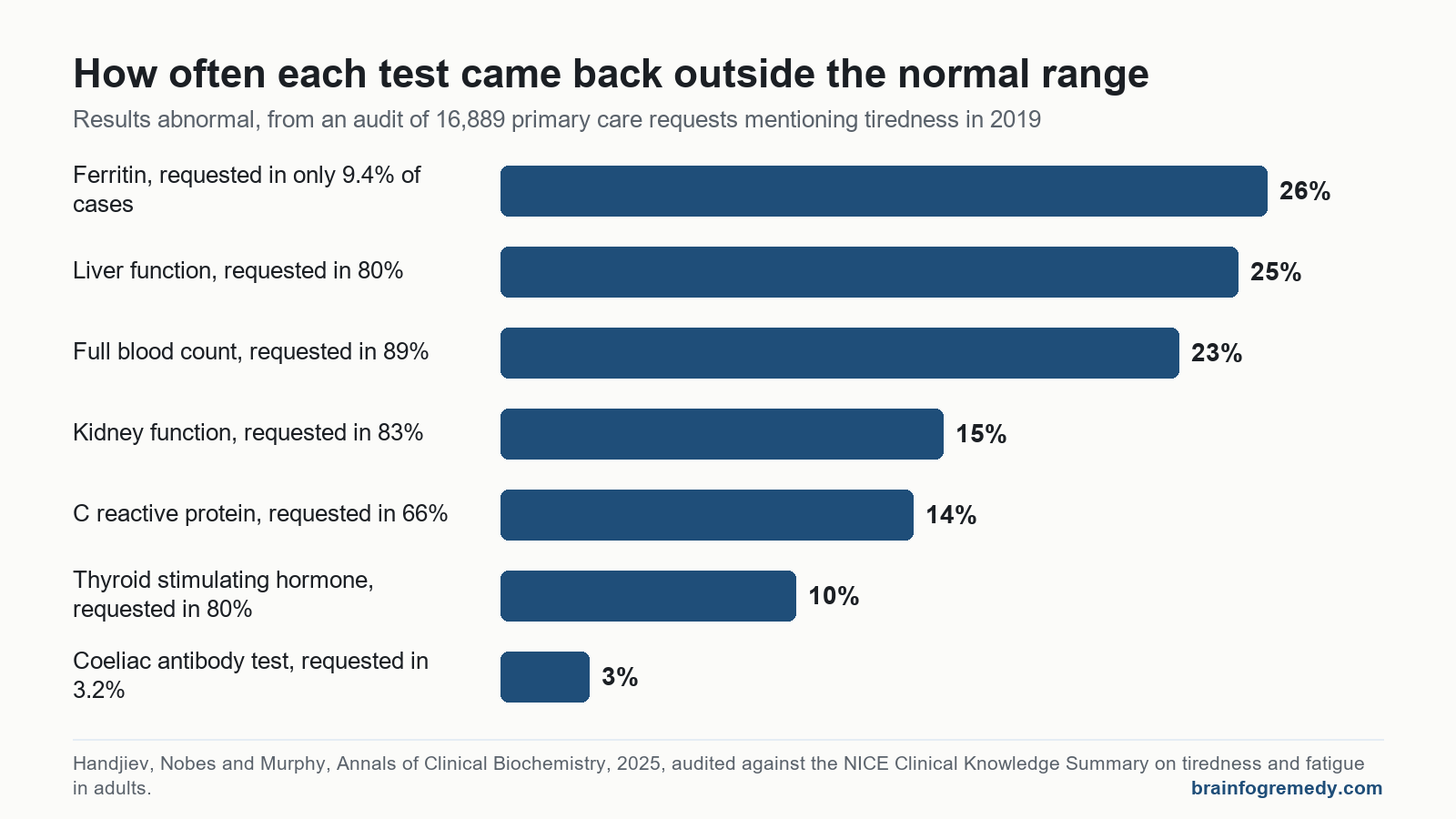
The Annals of Clinical Biochemistry audit, checked against the national primary care summary on tiredness and fatigue, found ferritin requested in only 9.4 percent of cases yet abnormal in 26 percent of those, which partly reflects better targeting rather than a missed opportunity. Which tests suit any individual is a clinical judgement. Read the section
-
5. What does this page say a normal panel changes?
Normal results rule some things out and do not rule out the experience. A symptom that is persistent, worsening or interfering with your life stays worth taking back, and one disappointing appointment is not evidence the next will go the same way. Read the section
Why does brain fog get dismissed so often?
Partly because there is nothing to point at. Brain fog is not a diagnosis, it has no agreed definition and no validated scale, which we go into when explaining what brain fog means. A clinician is being handed a word that has no fixed meaning and asked to do something with it inside a very short appointment.
That is not the whole story though, and it would be dishonest to pretend the problem sits entirely with the patient. A qualitative study published in 2021 interviewed thirteen doctors living with persistent symptoms after COVID. Most were GPs and most were out of work at the time. They described being dismissed by their own clinicians anyway. One recalled a GP whose tone was, in her words, almost tick box. Another admitted deliberately withholding a symptom because she was worried it would be written off as anxiety. People fluent in the language of medicine, seen by colleagues, still struggled to be heard. Worth knowing before you conclude the problem is your vocabulary.
How much time do you actually get?
Less than the problem deserves. NHS figures for England reported in 2025 showed that among general practice appointments with a recorded duration, the most common band was six to ten minutes, with roughly one in seven running beyond twenty. Those figures cover all practice staff, not GPs alone, and practices record duration differently enough that NHS Digital flags the data quality itself. We could not open the underlying publication, so treat the split as indicative.
The rough shape holds either way. You are describing something diffuse and months old in about the time it takes to boil a kettle twice. That is why the order you say things in matters more than the completeness of what you say.
What does a doctor actually need from your description?
Roughly five things, and none of them is the word fog. When did it start, and did it start suddenly or creep in. What is the pattern across a day and across a week. What else is going on in your body, including sleep, mood, weight, periods and pain. What medicines and other substances you take. And what you have stopped being able to do. On that first point about pattern, it is worth saying whether you would actually fall asleep if you lay down, because sleepiness and mental tiredness are separate states with separate tests. If flatness, dread and irritability arrived with it, say that too, because the cognitive part of emotionally exhausted symptoms is the piece most guides bury in a single bullet.
That last one carries more weight than most people expect. Function is the closest thing to an objective measure available here. A cognitive test in a clinic room often comes back normal in people whose lives have visibly narrowed, so the narrowing itself becomes the evidence. Losing a shift, dropping a hobby or handing over the driving are facts, and facts survive the retelling.
| What people tend to say | What the same thing sounds like with detail attached | Why the second version travels further |
|---|---|---|
| My head feels foggy. | Since about March I lose the thread of a sentence halfway through saying it, several times a day. | An onset, a frequency and an event, not a sensation. |
| I cannot concentrate. | I read the same paragraph four times before it goes in, and I stopped reading at night in April. | Names a task that changed and when it changed. |
| I am forgetful. | I have driven to the wrong place twice, and last week I left the hob on. | Incidents carry weight the word forgetful does not. |
| It is worse some days. | It is worst from about two in the afternoon, and much worse the day after a bad night. | A pattern is information. Variability sounds like noise. |
| It is affecting my work. | I have moved to four days because I could not finish the fifth, and my manager has noticed. | Consequences are checkable. Adjectives are not. |
The left hand column is not wrong. It is unfinished. Most people arrive with it because that is genuinely how the thing feels from the inside, which is the same reason that fuzzy head feeling is so hard to put into words at all. The right hand column is the same experience with a time, a frequency and a consequence attached.

Say it with dates, events and consequences
Five prompts, one line each. The tool assembles them into the version that travels further in a ten minute appointment. Nothing leaves this page unless you copy it.
Kept on this device only. This arranges what you typed; it does not interpret it, and it is not a substitute for the consultation it is written for.
What tests are usually run, and what do they find?
This is the part most often imagined in advance and least often understood afterwards. A 2025 audit in the Annals of Clinical Biochemistry examined 16,889 primary care test requests from 2019 where the notes mentioned tiredness, fatigue or tired all the time, checked against the NICE Clinical Knowledge Summary for tiredness and fatigue in adults. It is the first study of its kind.
| Test | Requested in what share of cases | Came back outside the normal range |
|---|---|---|
| Full blood count | 89 percent | 23 percent |
| Kidney function | 83 percent | 15 percent |
| Liver function | 80 percent | 25 percent |
| Thyroid stimulating hormone | 80 percent | 10 percent |
| C reactive protein | 66 percent | 14 percent |
| Ferritin | 9.4 percent | 26 percent |
| Coeliac antibody test | 3.2 percent | 3 percent |
Two things stand out. Thyroid function, the test patients most often expect to explain everything, came back outside the normal range in only about one case in ten. And ferritin, an iron store marker, was requested in fewer than one in ten cases yet was abnormal in more than a quarter of those. That gap is interesting rather than instructive. Tests ordered less often are ordered when there is already a reason to suspect something, so a high abnormal rate partly reflects better targeting, not a missed opportunity.
The larger point is one this site keeps returning to. An abnormal number is not an explanation, and a normal panel is not the same as nothing being wrong. Which tests suit any individual is a clinical judgement made with the full history in front of someone qualified to make it, not something to settle from a table on a website. We cover that ground in the causes worth checking first.
What is worth preparing beforehand?
The NHS advice on getting the most from an appointment is unglamorous and it works. Write down two or three questions rather than a long list. Bring a list of everything you take, including vitamins and anything bought over the counter. Note when symptoms started and what makes them better or worse. Ask what a test is for, when the result comes back, and who to contact if things get worse. Take someone with you if remembering the conversation is part of what is difficult, which for this complaint it very often is.
One addition specific to fog. Because the symptom interferes with recall, many people keep a short note on their phone for a fortnight beforehand, one line a day, rather than reconstructing three months in the waiting room. For a starting vocabulary, our piece on what brain fog actually feels like lists the descriptions people reach for most.
And lead with the thing that frightens you most. Not the polite warm up, not the apology for wasting anyone’s time. If the concerning part is that this arrived suddenly, or is getting worse, or is sitting alongside something like extreme fatigue alongside fog, that belongs in the first sentence rather than the last. Anything that came on abruptly, or comes with weakness, numbness, changes in speech or vision, is a reason to seek medical help promptly rather than wait for a routine slot.

What happens if the tests come back normal?
This is where most people in this position end up, and it is the moment the conversation is most likely to stall. Normal results rule some things out. They do not rule out the experience, and the research on persistent post viral symptoms repeatedly finds normal investigations used as grounds to close the file rather than as one piece of information. Authors in this area have argued that clinicians would do better to name their own uncertainty out loud than reach for a psychological explanation.
Practically, a normal panel changes what the next appointment is about rather than ending it. Reasonable things to raise include whether anything has changed since the last set of results, whether a review after a defined interval makes sense, and whether the pattern warrants a referral. If the fog followed an infection, the picture is better mapped than most, which we cover in long COVID brain fog. A symptom that is persistent, worsening or interfering with your life stays worth taking back to a doctor, and one disappointing appointment is not evidence the next will go the same way.
What is genuinely unknown here?
More than the confident advice elsewhere on this subject admits. Nobody has run a trial testing whether one way of describing cognitive symptoms leads to better outcomes than another, so everything above is reasoning from how consultations are structured and from what patients report, not from evidence that it works. The audit numbers come from one region and from requests made in 2019. The appointment duration figures are recorded inconsistently by the practices that produce them. And there is still no validated way to measure brain fog itself, which is the root of nearly every difficulty in this article.
What can be said with more confidence is narrower and still useful. Specific beats vague. Function beats sensation. Dates beat impressions. And being disbelieved once is common enough in the published accounts that it should not be read as a verdict on whether something real is happening.
Frequently asked questions
How do I explain brain fog to my doctor?
Describe events rather than sensations. Say when it started, how often it happens, what a bad day looks like compared with a good one, and what you have stopped being able to do. Concrete examples with dates attached are easier to act on than the word foggy.
Will a doctor take brain fog seriously?
Many do, and some do not. Published interviews with people who have persistent symptoms after infection, including doctors describing their own care, record being dismissed often enough that it is a known problem in the literature rather than an individual failing.
What tests are usually done for tiredness and brain fog?
An audit of 16,889 primary care requests found full blood count, kidney function, liver function and thyroid stimulating hormone were each requested in 80 to 89 percent of cases. Which tests suit any individual is a clinical judgement, not something to decide from an article.
What if all my blood tests come back normal?
Normal results rule some things out and do not rule out the experience. They change what the next conversation is about, including whether to review after an interval or consider a referral. A symptom that persists or worsens remains worth taking back to a doctor.
How long is a GP appointment for something like this?
NHS figures for England reported in 2025 showed most appointments with a recorded duration fell in the six to ten minute band, with about one in seven running past twenty minutes. Practices record duration inconsistently, so treat the split as indicative.
Should I write things down before the appointment?
The NHS suggests noting two or three questions, listing everything you take including supplements, and recording when symptoms started and what changes them. For fog specifically, a short daily note kept for a fortnight beforehand avoids relying on the memory that is affected.
Finished the page? The same five questions from the top, to see what stuck.
This article is general information, not medical advice, and is not a substitute for care from a qualified healthcare professional. Speak to your doctor about your own situation.
Leave a Reply