
MS brain fog, which people with multiple sclerosis call cog fog, is the slowed thinking, word finding trouble and short term memory slips that the MS Trust says affect around half of people with MS. In a 2021 interview study, 85 percent of 109 people reported slowed processing. Four forum threads from the past year describe it from the inside.
Listen to this article, about 13 minutes. A synthetic voice reads the article and announces each section title as it begins; tables are read row by row and the questions at the end are left out.
Recorded 12 October 2026 from the article as published that day. Press a chapter to jump there; the highlighted line is what is playing. A play button sits beside every section heading, and once you scroll past this player a bar at the bottom of the screen keeps the controls in reach. Tap or click any sentence to hear the reading start from there.
On this page: a cited table of which thinking skills four MS sources found most affected, the 2021 interview study’s percentages drawn as a chart, the September 2025 UK MS Register finding of a cognition first subtype, the four things NICE says a review should include, and 116 posts from an MS forum on what cog fog feels like.
Think you already know this? Five questions, one minute.
Every answer is on this page. Answer from what you know now; the page fills in the rest.
-
1. In the 2018 study of 107 people newly diagnosed with relapsing remitting MS, what share were within normal limits on every cognitive domain?
DiGiuseppe and colleagues reported that only 37 patients, 34.6 percent, were within normal limits on all cognitive domains, with processing speed the most frequently impaired. Read the section
-
2. In the 2021 Cognitive Assessment Interview study of 109 people with MS, which problem was reported by the largest share?
Eilam-Stock and colleagues found processing speed problems reported by 85 percent, ahead of working memory at 80 percent, with reasoning and problem solving at 28 percent. Read the section
-
3. How many UK MS Register members took part in the Nature Communications study published on 3 September 2025?
Lerede and colleagues tested 4,526 UK MS Register members online over three stages and found a prevalent subtype with significant cognitive deficits and minimal motor impairment. Read the section
-
4. Which of these does the NICE guideline on MS in adults list as able to affect cognition?
NICE NG220 tells clinicians to be aware that anxiety, depression, difficulty sleeping, fatigue and medication can affect cognition, and to assess for and manage them. Read the section
-
5. Who does NICE suggest considering a referral to when cognitive impairment in MS persists?
NICE NG220 says to consider referring people with MS and persisting cognitive impairments to an occupational therapist and/or a neuropsychologist, and did not recommend any specific treatment because the evidence was too limited. Read the section
The charity pages explain cog fog clearly and the clinical reviews count it carefully, but neither puts the two beside each other, and neither says much about living inside it. This page compiles what the research found about which thinking skills MS affects most, quotes what the NICE guideline says a review should include, and reports what 116 posts on an MS forum said the fog feels like, dated and linked. It will not tell anyone whether their own fog is MS, a medicine or a bad night. That is for the MS team, and our overview of the causes of brain fog a doctor checks first shows how long the list is.
What is MS brain fog, and how common is it?
Cog fog is the community’s word for the thinking side of MS, and a better one than brain fog, since it names what goes wrong. The MS Trust says that “problems with thinking and memory affect around half of all people with MS” and that “for most people their cognitive symptoms are relatively mild and can fluctuate from day to day”. Other charities quote up to seven in ten, and the spread is honest rather than careless: the studies behind the numbers used different tests and different cut offs, so they counted different things.
How early it shows depends on how hard anyone looks. DiGiuseppe and colleagues tested 107 people within a year of a relapsing remitting diagnosis and found that “only 37 patients (34.6%) were within normal limits on all cognitive domains”, with processing speed the most frequently impaired, at 35.5 percent. One caution travels with that: scoring outside the normal range on one test is not the same as noticing a problem in daily life, and the study did not ask how anyone felt. The word fog has no agreed clinical definition either, as our plain explanation of what brain fog means admits.
Which thinking skills does MS affect most?
Processing speed, in every source that measured it. Here is what each one found, with what it actually asked.
| Source | Who and how | Which thinking skills came out on top |
|---|---|---|
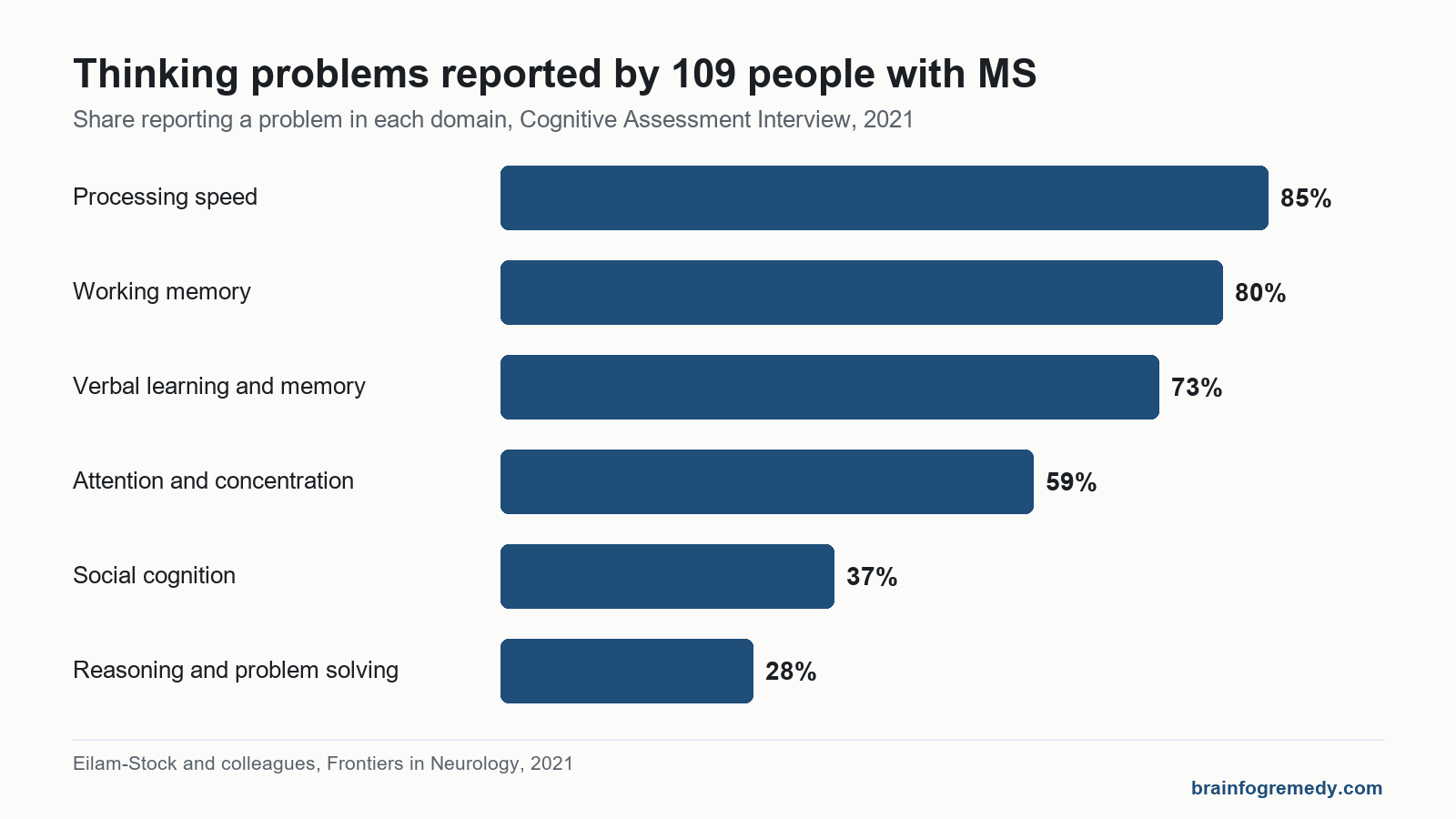
| Eilam-Stock and colleagues, Frontiers in Neurology, 2021 | 109 people with MS, mean age 50, interviewed with a structured Cognitive Assessment Interview; 71 had a family member or friend interviewed too | Processing speed, reported by 85 percent; working memory 80 percent; verbal learning and memory 73 percent; attention and concentration 59 percent; social cognition 37 percent; reasoning and problem solving 28 percent |
| DiGiuseppe and colleagues, International Journal of MS Care, 2018 | 107 people newly diagnosed with relapsing remitting MS, tested on a standard battery within a year of diagnosis | Processing speed was the most frequently impaired domain, at 35.5 percent, and only 34.6 percent were within normal limits on every domain |
| MS-UK community survey, published 3 August 2023 | People with MS asked which cognitive problem affected them most; the respondent count is not given | Short term memory 26 percent, finding words 22 percent, concentration 15 percent, decision making 11 percent, processing information 8 percent, long term memory 5 percent |
| Imperial College London, 5 September 2025 | Release for the UK MS Register study of 4,526 members tested online from home | Describes cognitive impairment in MS as commonly affecting information processing speed, working memory and sustained attention |
Three things stand out. Speed tops both the interview study and the test study, which is rare agreement between what people report and what a battery scores. Language itself is on no list; finding the word is, a speed and retrieval problem wearing a vocabulary costume. And in the 2021 interview study people rated themselves as more impaired than their family member did on working memory, memory and speed, while the family member saw more trouble with mental flexibility and reading social situations that the person did not report at all. The authors called the agreement fair. A less polite reading is that the two of you keep different lists, and both belong at the appointment.
None of this is what the nootropic adverts sell. Focus by Friday is a promise about attention, which sits fourth on the interview list. Speed, the thing at the top, is not something a capsule with a Latin sounding name has been shown to give back, and this site does not recommend supplements for it or for anything else.

Can thinking problems show up with little physical disability?
Yes, and a large study published in September 2025 is why this question now has a clear answer. Lerede and colleagues, Nature Communications, 3 September 2025 took 4,526 members of the UK MS Register through online thinking tasks from home, in three stages, and found what the abstract calls “a prevalent MS subtype exhibiting significant cognitive deficits with minimal motor impairment”. The authors wrote that disability in this group is “currently unrecognised and untreated”. In the Imperial College release of 5 September 2025, first author Dr Annalaura Lerede said the team “found examples of people with this unrecognised subtype across all ages, no matter how long they’d had the disease”, and the release notes that routine pathways prioritise motor signs.
The MS Society reported the group as about one in four people with MS, a proportion we could not confirm against the paper, which sits behind a publisher login, so it is quoted as reported. Why it matters is dull and important: the standard disability scale leans on walking. If the clinic measures legs, the fog goes unrecorded, and a person can be told they are doing well while quietly losing the thread of every meeting.

What do people with MS say cog fog feels like?
We read four threads on the r/MultipleSclerosis forum in full, 116 posts and comments posted between December 2025 and October 2026, plus a dated blog on the MS Society of Ireland site. These are what people report, not findings. Nobody on a forum can know what is causing anyone else’s symptoms, and nothing below replaces the MS team.
In an August 2026 thread with 42 comments, a man diagnosed two months earlier described misspelling words as he typed, losing what he meant to say mid sentence at work, and calling rooms by the wrong name at home. One reply, from someone diagnosed ten years ago, said they can no longer hold a long conversation. Another described two settings: full speed, or a slow mode where basic things slip past and everything needs a note. A third said the fog is worst when overheated or stressed, with words leaving as soon as they arrive.
In a December 2025 thread, the original poster recounted a conversation in which the name of a famous actor’s condition would not surface, though he knew he knew it. A software developer who once remembered almost every line of code he had written said everything since 2019 is fuzzy. In a January 2026 thread, one person said they had not been out of the fog for almost a year; another said fog and fatigue tracked the weather. In an October 2026 thread, a 28 year old described bad days of forgetting where she was or how to get home, with good days between, and someone in their 27th year with MS called fog and fatigue the most debilitating things it had done. Off the forum, Christina McDonald wrote for the MS Society of Ireland on 9 March 2023 that her brain feels tired, sluggish, heavy and disconnected, that people talking over each other and music during a conversation set it off, and that the rule which helps her most is “one task at a time”.
Where the accounts meet the official pages, they agree: fluctuation, heat, stress, poor sleep and fatigue are the forum’s triggers and the MS Trust’s. They also cut both ways. Two people said the fog after a first flare faded within about two months. One said thinking improved after starting disease modifying therapy; another said their therapy made no difference. Where the forum and the guidance part is on what helps. The most repeated answer was a prescription stimulant, usually off label, and several replies described side effects strong enough to stop. No guideline recommends that, NICE says the evidence on interventions is too limited to recommend any, and a medicine question belongs with the neurologist. The second most repeated answer was a full neuropsychological assessment, which one commenter described as four to six hours long, up to 3,000 dollars without insurance in the United States, and the thing that finally got their cognitive problems documented. That one does match the guideline. The threads also carried the usual parade, a mushroom powder, a nootropic with a gorilla on the label, a water fast, none of which appears in the NICE guideline or on any MS charity page we read.
What makes MS cog fog worse on a given day?
The official lists are short and they overlap almost entirely with the forum’s. The MS Trust names fatigue or poor sleep, heat, “tense or exciting situations”, stress, anxiety and depression, and some medicines, “including some that are commonly used to treat MS symptoms”, such as those for bladder problems, spasticity and pain. The NICE guideline on MS in adults puts it in one line: “be aware that anxiety, depression, difficulty sleeping, fatigue and medication can affect cognition”, and tells clinicians to assess for those and offer management.
That overlap is the useful part of this page. Every item on both lists is something a clinic can check, and several change. A thinking problem that arrived with a new bladder medicine, a run of bad nights or a heatwave is a different conversation from one that did not, and our page on what the cognitive fatigue studies found explains why tiredness and slowed thinking are so hard to tell apart.
What does the NICE guideline say should happen?
Four things, worth knowing before a review so that none is skipped. NICE NG220 tells clinicians to be aware that MS can cause cognitive problems, including memory problems the person may not link to their MS; to assess cognition as part of the comprehensive review, tailored to the person, which can mean a clinic interview, a brief formal assessment, or referral for a full neuropsychological assessment if needed; to check for anxiety, depression, poor sleep, fatigue and medication effects; and to consider referring people with persisting cognitive impairment to an occupational therapist and/or a neuropsychologist. The committee did not recommend any specific treatment for the fog, because it judged the evidence too limited and variable, and made a research recommendation instead.
A guideline that says assess it and then admits it cannot yet say what treats it is not a satisfying read. It is an honest one, which is more than the quiz that diagnoses your fog in six questions can say for itself. The MS Trust adds the practical route: “your GP or MS specialist nurse should be the first port of call if cognitive issues are making life difficult”, and the neurologist can refer on. The same shape appears in what the rheumatoid arthritis studies measured and in what lupus patients reported: the counting is better than the treating.
When should someone with MS raise cog fog with their team?
Any new or worsening change in thinking is worth telling the MS nurse or neurologist about, because the guideline says it should be assessed at the review and because the same symptoms can come from sleep, mood, a relapse or a medicine, all of which can be checked. Sudden confusion, not knowing where you are, or a thinking change arriving with new weakness, a change in vision or a fever needs urgent medical advice, since it may be a relapse or an infection. A family member’s observation counts, as the 2021 study showed, so bring theirs too. The checklist on this page lists what to note before the appointment. It scores nothing and interprets nothing, and nothing on this page can tell anyone what is causing their own symptoms.
What to note before an MS nurse or neurologist appointment
The NICE guideline says cognition should be assessed at the comprehensive review. These are the things that make that assessment quicker and more useful. Tick what you have written down; nothing here is scored or interpreted.
This list records what to bring. It does not score anything, it cannot say what is causing any symptom, and it is not a substitute for the assessment the guideline describes.
Frequently asked questions
Is MS brain fog the same thing as MS fatigue?
They overlap and people on the forum often described them as one thing, but the guideline lists fatigue as something that affects cognition rather than the same symptom. Both are worth raising at the review so each can be assessed.
Does cog fog mean the MS is getting worse?
Not on its own. The MS Trust describes cognitive symptoms as fluctuating from day to day, and several forum accounts described fog that faded after a flare. A change that persists is what the NICE guideline says should be assessed.
Can disease modifying therapy clear cog fog?
No study on this page measured fog before and after a therapy, and the forum accounts pointed both ways. Disease modifying therapies are prescribed to reduce relapses and slow progression, and what to expect from one is a question for the neurologist.
Will MS brain fog turn into dementia?
The MS Trust says most people’s cognitive symptoms are relatively mild. This page cannot say what will happen to any one person; a neuropsychological assessment gives a documented baseline to compare against later, which is one reason the guideline allows referral for one.
Can brain fog be the first sign of MS?
This page is about cognitive symptoms in diagnosed MS. Brain fog on its own has a long list of causes, most of them not MS, and the 2025 UK MS Register study looked only at people already diagnosed. Someone worried about new symptoms should see a GP.
Is there a quick test for MS cognition?
The 2018 study of newly diagnosed people used a symbol digit test for processing speed, and the NICE guideline allows a brief formal assessment at the review. A full neuropsychological assessment takes hours and is what the guideline suggests when problems persist.
Finished the page? The same five questions from the top, to see what stuck.
This article is general information, not medical advice, and is not a substitute for care from a qualified healthcare professional. Speak to your doctor about your own situation.
Leave a Reply