
Can too much caffeine cause brain fog? It can, chiefly by cutting into sleep, even from a large dose six hours before bed. But the fog can also come from the opposite problem: difficulty concentrating is a recognised symptom of caffeine withdrawal, starting 12 to 24 hours after a missed or smaller dose and lasting up to nine days.
Listen to this article, about 12 minutes. A synthetic voice reads the article and announces each section title as it begins; tables are read row by row and the questions at the end are left out.
Recorded 10 October 2026 from the article as published that day. Press a chapter to jump there; the highlighted line is what is playing. A play button sits beside every section heading, and once you scroll past this player a bar at the bottom of the screen keeps the controls in reach. Tap or click any sentence to hear the reading start from there.
On this page: a timeline of withdrawal symptoms, a comparison table of caffeine effects, and findings from sleep and withdrawal studies.
Think you already know this? Five questions, one minute.
Every answer is on this page. Answer from what you know now; the page fills in the rest.
-
1. How much does measured sleep drop when taking 400 mg of caffeine six hours before bedtime?
According to the study by Drake and colleagues, 2013, taking 400 mg of caffeine six hours before bedtime reduced measured sleep by more than an hour. Read the section
-
2. What is the maximum daily caffeine intake generally cited as safe for most adults by major health authorities?
The FDA and the European Food Safety Authority both cite 400 mg a day as an amount not generally linked to dangerous effects in healthy adults. Read the section
-
3. According to official diagnostic criteria, which of the following is recognized as a symptom of caffeine withdrawal?
Under the DSM 5 criteria for caffeine withdrawal, difficulty concentrating is formally listed alongside symptoms like headache and fatigue. Read the section
-
4. How long can caffeine withdrawal symptoms, including foggy thinking, typically last?
While onset begins within 12 to 24 hours, the overall duration of withdrawal symptoms is 2 to 9 days according to StatPearls, updated December 2025. Read the section
-
5. What did Rogers and colleagues conclude about caffeine’s effect on alertness in regular consumers?
In their study, Rogers and colleagues found that going without caffeine lowered alertness, and the subsequent dose merely returned regular drinkers to their baseline. Read the section
How does too much caffeine lead to brain fog?
Mostly through the night before. Caffeine does not wear off at bedtime just because you would like it to. StatPearls puts its average half life at about five hours, with a range from 1.5 to 9.5 hours between people, so an afternoon coffee is still partly in circulation when the lights go out.
The study most often quoted here is a small one. In Drake and colleagues, 2013, 12 healthy sleepers took 400 mg of caffeine at bedtime, three hours before or six hours before, and all three disrupted sleep. At six hours, measured sleep fell by more than an hour, yet the American Academy of Sleep Medicine summary notes that participants’ own reports suggested they were unaware of it. That is the sneaky part: the fog arrives the next day with no obvious culprit attached.
A newer trial slightly disagrees with the official line. Gardiner and colleagues, in Sleep in 2024, found 100 mg four hours before bed made no significant difference in 23 young men, while 400 mg disrupted sleep even 12 hours before bed. The European Food Safety Authority says a single 100 mg dose may affect sleep in some adults near bedtime. Both can be true; people vary. Our guide to brain fog from lack of sleep covers why a short night shows up as foggy thinking.
How much caffeine counts as too much?
The FDA cites 400 mg a day as an amount not generally linked to dangerous effects in most adults, about two to three 12 ounce cups of coffee. Its own ranges show why counting cups is guesswork: a 12 ounce brewed coffee carries 113 to 247 mg, an energy drink 41 to 246 mg. Its signs of too much include palpitations, insomnia, anxiety and jitters. EFSA reached the same daily figure and sets 200 mg a day in pregnancy. These are safety ceilings, not a line below which nobody feels foggy.

| Too much caffeine | Less caffeine than usual | |
|---|---|---|
| What drives the fog | Shorter, lighter sleep, which can go unnoticed (AASM) | Withdrawal, which lists difficulty concentrating as a symptom (DSM 5 criteria) |
| When it shows | The day after a late or large dose | 12 to 24 hours after the last dose (StatPearls) |
| What tends to come with it | Jitters, anxiety, palpitations, insomnia, upset stomach (FDA) | Headache, fatigue, low mood, irritability, flu like aches (Juliano and Griffiths) |
| Amount involved | The FDA cites 400 mg a day as generally safe for most adults | Stopping as little as 100 mg a day produced symptoms in the reviewed studies |
| What another cup does | Adds to the problem | Relieves it, which is exactly why it is easy to miss |
Mechanisms of Caffeine-Related Brain Fog
Explore how caffeine consumption patterns can lead to cognitive fog, according to clinical research.
This comparison is based on clinical research findings.
Can cutting back on caffeine cause brain fog?
Yes, and this is the half of the story the pages selling focus capsules tend to leave out, possibly because the answer involves buying less of something. The most thorough account is a 2004 review in Psychopharmacology by Laura Juliano and Roland Griffiths at Johns Hopkins, which pulled together 57 experimental and 9 survey studies. Of the symptoms people had reported, it judged 10 categories valid, and one of them is described, in almost exactly the words a reader might type into a search bar, as “foggy/not clearheaded”.
The DSM 5 criteria for caffeine withdrawal make it formal. After prolonged daily use, an abrupt stop or reduction followed within 24 hours by at least three of five symptoms counts, and one of the five is listed simply as “Difficulty concentrating”. The others are headache, marked fatigue or drowsiness, low or irritable mood, and flu like symptoms. To meet the diagnosis the symptoms also have to cause real distress or get in the way of daily life, and must not be better explained by something else, such as migraine or a virus.
The amount needed is smaller than most people assume: symptoms followed stopping doses as low as 100 mg a day. A weekend lie in past your usual coffee time or a fasting blood test are ordinary ways to land in it without deciding to quit anything.
How long does caffeine withdrawal fog last?

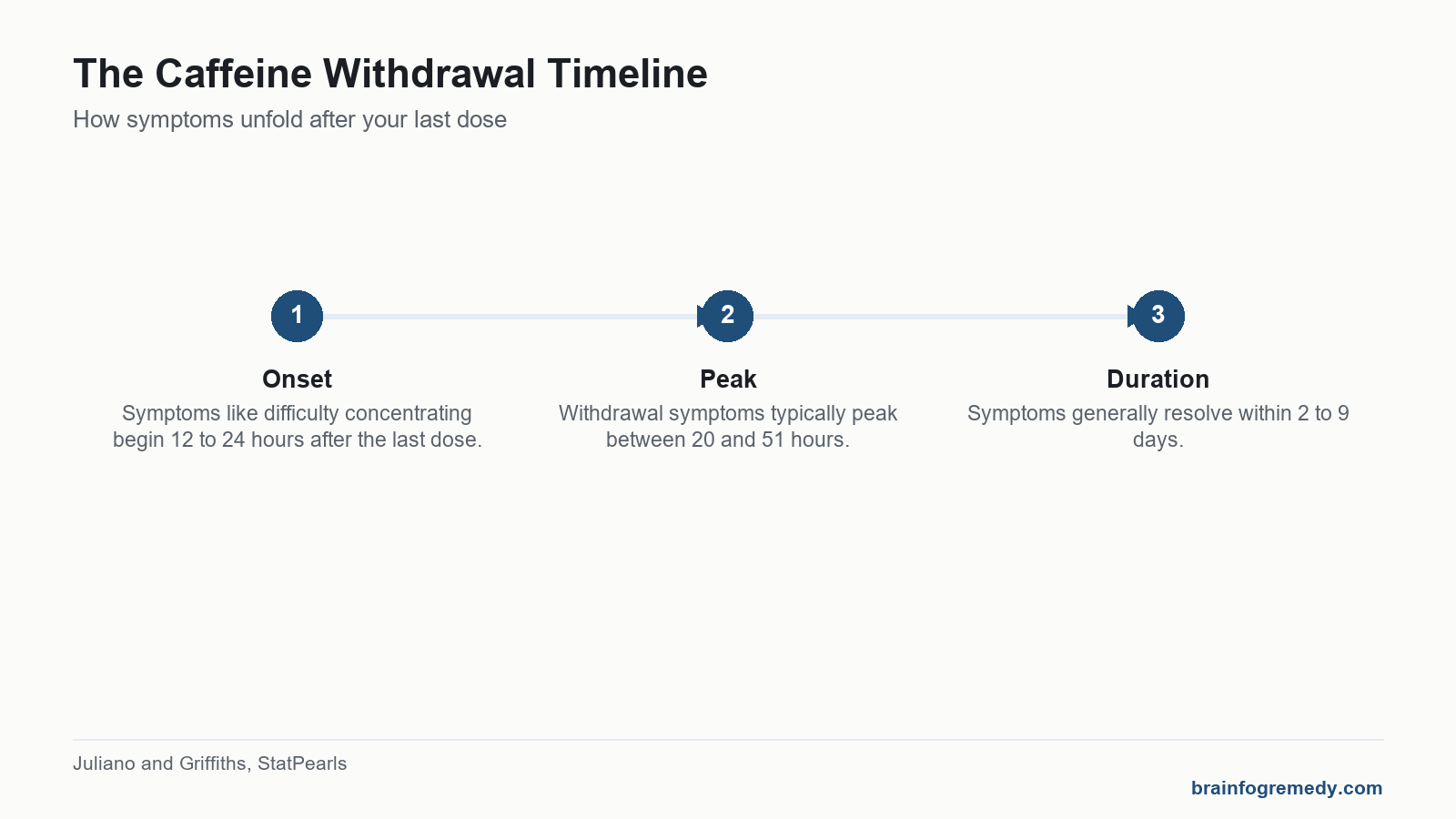
Here is the clock as the research describes it. Every row links to where the figure came from.
| Stage | What the research found | Source |
|---|---|---|
| Onset | 12 to 24 hours after the last dose | Juliano and Griffiths, Psychopharmacology, 2004 |
| Peak | Between 20 and 51 hours | Juliano and Griffiths, 2004 |
| Duration | 2 to 9 days | StatPearls, updated December 2025 |
| How many get a headache | About 50% of people in the studies reviewed | Juliano and Griffiths, 2004 |
| How many are clinically affected | About 13% had clinically significant distress or impaired functioning | Juliano and Griffiths, 2004 |
| Lowest daily dose that produced symptoms | 100 mg a day, less than a typical 12 ounce brewed coffee | Juliano and Griffiths, 2004 and FDA cup ranges |
| Fog specifically | “Foggy/not clearheaded” was one of 10 symptom categories the review judged valid | Juliano and Griffiths, 2004 |
The FDA says withdrawal is not considered dangerous but can be unpleasant, and suggests that people who want to cut back do it gradually. How to do that is a conversation for a doctor or pharmacist who knows what else you take, not a schedule from an article.
Is your morning coffee clearing the fog or just undoing withdrawal?
This is where the researchers genuinely disagree, and it is worth knowing both sides. In a 2010 study in Neuropsychopharmacology, Rogers and colleagues tested 379 people after 16 hours without caffeine. In regular drinkers, going without lowered alertness and the dose merely returned it to baseline, with no net gain. James and Rogers, 2005 had argued that caffeine’s apparent benefits are almost wholly withdrawal reversal.
Other teams found the opposite. Haskell and colleagues, 2005 gave caffeine to 24 regular consumers and 24 non consumers and concluded their results did not support a withdrawal alleviation model. Smith, Christopher and Sutherland, 2006 and Hewlett and Smith, 2006 reached similar conclusions. So the honest answer is that nobody has settled it. What both camps accept is that regular drinkers who go without get worse, which is enough to explain why the first cup can feel like the fog lifting. Our piece on clearing brain fog quickly looks at the same trap from the other direction.
What do people who quit caffeine actually report?
What follows is testimony, not evidence. It comes from five public Reddit threads, four in r/decaf and one in r/BrainFog, about 55 posts and replies in all, read on 15 September 2026. Nobody below is a finding, and no cause a poster reports for their own fog applies to anyone else.
- In a Reddit r/decaf post from around March 2026, a 26 year old who had taken about 300 mg a day for five years described two years of fog so heavy that work nearly stopped, with normal blood tests. They cut down over four days, reported clearer thinking by day three despite a headache, and said the fog was gone six weeks later. One commenter doubted a person wrote the post at all.
- In an August 2026 r/decaf thread, someone who had drunk two cups a day for 15 years before switching to matcha was 30 days past stopping and described fog and tiredness heavy enough to feel like flu. The replies gave recovery times of two to three weeks, about two months, and 60 to 90 days, one describing it as roughly 1% better each day.
- A February 2026 r/decaf post described day 8 of stopping what the poster put at about 25 mg a day, with fog for most of the day, dizziness and queasiness. They noted they were giving up something else at the same time and could not tell the two apart. A day later they reported the symptoms slowly easing.
- In an August 2026 r/decaf update, a long term drinker of two to eight cups a day reported a few days of headache and fatigue, then intermittent fog still present at two and a half weeks, alongside deeper sleep and much less anxiety.
- Cutting against the pattern, a July 2026 r/BrainFog post came from someone tracking their fog in detail who had already reduced caffeine from at most one drink a day. Their fog still peaked every early afternoon, and they were taking their records to a GP. The only reply asked whether coffee was the culprit.
Where the accounts agree with the research: symptoms began within a day or two, headache and tiredness came first, and fog was named repeatedly, matching the DSM 5 list. Where they do not: several people described fog lasting weeks to around three months, far beyond the 2 to 9 days the review found. These threads cannot say why. r/decaf gathers people who chose to quit, so it rarely hears from anyone caffeine suits, and several posters changed other habits at once. The threads also recommended supplements and sleeping less, neither of which this site recommends; answering too much stimulant with a nootropic stack is a bold plan.
Fog still present weeks after stopping is not something to wait out on the strength of a forum thread.
When is brain fog not about caffeine at all?
Often. Poor sleep, low iron, thyroid problems, menopause, depression, medicines and long covid can all produce fog, and our overview of what causes brain fog covers the shortlist a doctor usually checks. If the basics are new to you, what brain fog actually is is the place to start. Hydration is the other everyday suspect people reach for, and how much fluid loss it takes to cause brain fog puts the trial numbers on it. Changing your caffeine intake is not a test that rules anything out.
Speak to a GP if fog lasts more than a couple of weeks, is getting worse, or is affecting work, driving or daily life. Some prescription and over the counter headache medicines contain caffeine; do not stop a prescribed medicine without talking to the doctor or pharmacist who gave it. If you are pregnant, ask your midwife or doctor about caffeine. Sudden confusion, trouble speaking, weakness on one side or a severe headache needs emergency help straight away, and so do thoughts of harming yourself.
Frequently asked questions
How long does caffeine stay in your body?
StatPearls gives an average half life of about five hours, ranging from 1.5 to 9.5 hours between people. That means roughly half of a mid afternoon coffee can still be circulating in the early evening, and some at bedtime.
Can one small coffee a day cause withdrawal fog?
The 2004 Johns Hopkins review found withdrawal symptoms after stopping doses as low as 100 mg a day, and an ordinary 12 ounce brewed coffee can carry more than that. Not everyone who stops gets symptoms.
Is caffeine withdrawal dangerous?
The FDA says caffeine withdrawal is not considered dangerous but can be unpleasant. Symptoms that are severe, unusual for you or still present after the usual window of about nine days are worth raising with a doctor.
Why does coffee make some people foggy and others sharp?
Nobody fully knows. The FDA notes wide variation in sensitivity and in how fast people clear caffeine, and a 2010 study linked differences in anxiety response to variation in an adenosine receptor gene.
Can energy drinks cause brain fog?
They work through the same caffeine, and the FDA lists 12 ounce energy drinks at 41 to 246 mg. A large late dose can shorten sleep, and a regular habit can bring withdrawal when it stops, just as with coffee.
How much caffeine is considered safe in pregnancy?
The European Food Safety Authority says habitual intake up to 200 mg a day raises no safety concerns for the fetus. Advice varies by country and by pregnancy, so speak to a midwife or doctor about your own situation.
Finished the page? The same five questions from the top, to see what stuck.
This article is general information, not medical advice, and is not a substitute for care from a qualified healthcare professional. Speak to your doctor about your own situation.
Leave a Reply