
Alcohol brain fog from one heavy night usually clears within about a day, tracking how fast the liver removes ethanol from blood. The fog some people report weeks after quitting is a different problem: disrupted sleep and inflammation that take far longer to settle, and the evidence for each stands on very different ground.
Listen to this article, about 9 minutes. A synthetic voice reads the article and announces each section title as it begins; tables are read row by row and the questions at the end are left out.
Recorded 1 October 2026 from the article as published that day. Press a chapter to jump there; the highlighted line is what is playing. A play button sits beside every section heading, and once you scroll past this player a bar at the bottom of the screen keeps the controls in reach. Tap or click any sentence to hear the reading start from there.
On this page: the published ethanol clearance rate worked through for one example, set against the sleep study that found measurable differences in people sober for up to two years, plus two dated personal accounts of how long fog actually took to lift.
Think you already know this? Five questions, one minute.
Every answer is on this page. Answer from what you know now; the page fills in the rest.
-
1. What did the 2018 Addiction systematic review find about cognitive performance the day after heavy drinking?
The review pooled trials measuring cognition in hungover drinkers at breath alcohol under 0.02 percent, essentially sober, and still found deficits across those four domains. Addiction, Gunn et al 2018 Read the section
-
2. What is the average published rate at which the body removes alcohol from the blood?
Jones’s often cited figure, summarised in a 2005 clinical review, is an average of 15 mg/100 mL/h with a measured range of 10 to 35. BMJ clinical review Read the section
-
3. In the sleep study of people abstinent for up to 719 days, what persisted compared with controls?
The polysomnography study found slow wave sleep still reduced and REM percentage still altered in people abstinent up to about two years. American Academy of Sleep Medicine Read the section
-
4. What do the two dated accounts this article cites report about their own timelines?
Gillian Tietz described clear thinking returning around day 60 of her own sobriety; Benya Clark reported weaker fog and fatigue lingering just over a year. Sober Powered, Exploring Sobriety Read the section
-
5. According to NICE guidance, what can unmanaged alcohol withdrawal lead to in people with severe dependence?
NICE states that acute withdrawal without medical management can be hazardous in severe dependence, including seizures, delirium tremens and death, and that high risk people should be offered hospital admission. NICE CG115 Read the section
Does alcohol actually cause brain fog?
Yes, though “alcohol brain fog” is really two different complaints wearing one name, and mixing them up is why so much advice on this topic contradicts itself. The first is the familiar morning after slowness. A 2018 systematic review in the journal Addiction pooled the available trials and found short term memory, long term memory, sustained attention and psychomotor speed all measurably worse the day after a heavy session, even in people whose breath alcohol had already fallen below 0.02 percent, essentially sober by a roadside test. The second complaint belongs to people weeks or months into not drinking at all, describing a dullness that has nothing to do with yesterday’s dose. Alcohol sits on this site’s own list of eight most checked causes of brain fog, but it gets one line there; the two timelines below are the deeper look.
How long does the fog from one heavy night actually last?
Ethanol leaves the blood at a fairly steady rate once drinking stops, and that rate has actually been measured. The figure most often cited traces to Jones’s 1988 forensic data, summarised in a clinical review in the BMJ: an average of 15 mg of alcohol per 100 mL of blood per hour, with a measured range of 10 to 35 mg/100 mL/h depending on the person, whether they had eaten, and whether they drink heavily enough for their liver enzymes to have adapted.
Here is the arithmetic that matters. A heavy session that peaks around 150 mg/100 mL clears to zero in about 10 hours at the average rate, or in as little as 4 hours at the fast end of the range, seen mostly in habitual heavy drinkers whose metabolism has sped up, or in as long as 15 hours at the slow end. Even at the slow end, for almost everyone, the alcohol itself is gone well before lunchtime the next day. That is worth sitting with, because the Addiction review’s cognitive deficits above were measured in people who were, by this arithmetic, already essentially sober. The drug has left. The fog has not. That gap is the real story of the morning after: it points to dehydration, a night of badly structured sleep and the breakdown product acetaldehyde, rather than to alcohol still circulating.
Sleep carries more of the blame than most hangover advice admits. A 2024 systematic review and meta-analysis of 27 studies, indexed on PubMed, reports that even a low dose, around two standard drinks, measurably shortens REM sleep, with the reduction growing larger as the dose rises. Shortened, fragmented REM sleep the night before is a specific, checkable reason a brain feels slow the next day, separate from the alcohol itself.
None of this is good news for the hangover recovery industry, which is why it sells the one thing arithmetic cannot give: speed. An IV drip bar charging for electrolytes and a vitamin cocktail is mostly rehydrating you, a step your own tap water does for free, and no trial of an intravenous hangover product has shown it restores short term memory or attention any faster than time and water do. It is the same instant fix logic taken apart in why nothing clears brain fog instantly. The clearance time above does not move for a drip, a patch or a pill, because it is set by liver enzymes, not by what is marketed next to the till.

| Feature | The morning after fog | The weeks after quitting fog |
|---|---|---|
| Timescale | Hours to about a day | Weeks to, in some reported cases, over a year |
| What has actually been measured | Memory, attention and psychomotor speed deficits below 0.02 percent breath alcohol (Addiction, 2018) | Reduced slow wave sleep and altered REM percentage in people abstinent up to about two years (AASM) |
| Leading explanation | Dehydration, disrupted sleep and acetaldehyde, not residual alcohol | Slow settling sleep architecture, commonly described as neuroinflammation though less directly measured |
| Strength of the evidence | Multiple controlled trials, pooled in a published review | One polysomnography cohort plus dated personal accounts, not a clinical trial base |
How long would that take to clear?
Pick a rough peak blood alcohol reading and see how long the published elimination rate says it takes to reach zero. This is population arithmetic, not a reading of your own body, and it says nothing about whether drinking that much was safe.
Figures use the elimination range reported by Jones 1988 and summarised in a 2005 BMJ clinical review. They describe population averages, not a measurement of your own blood.
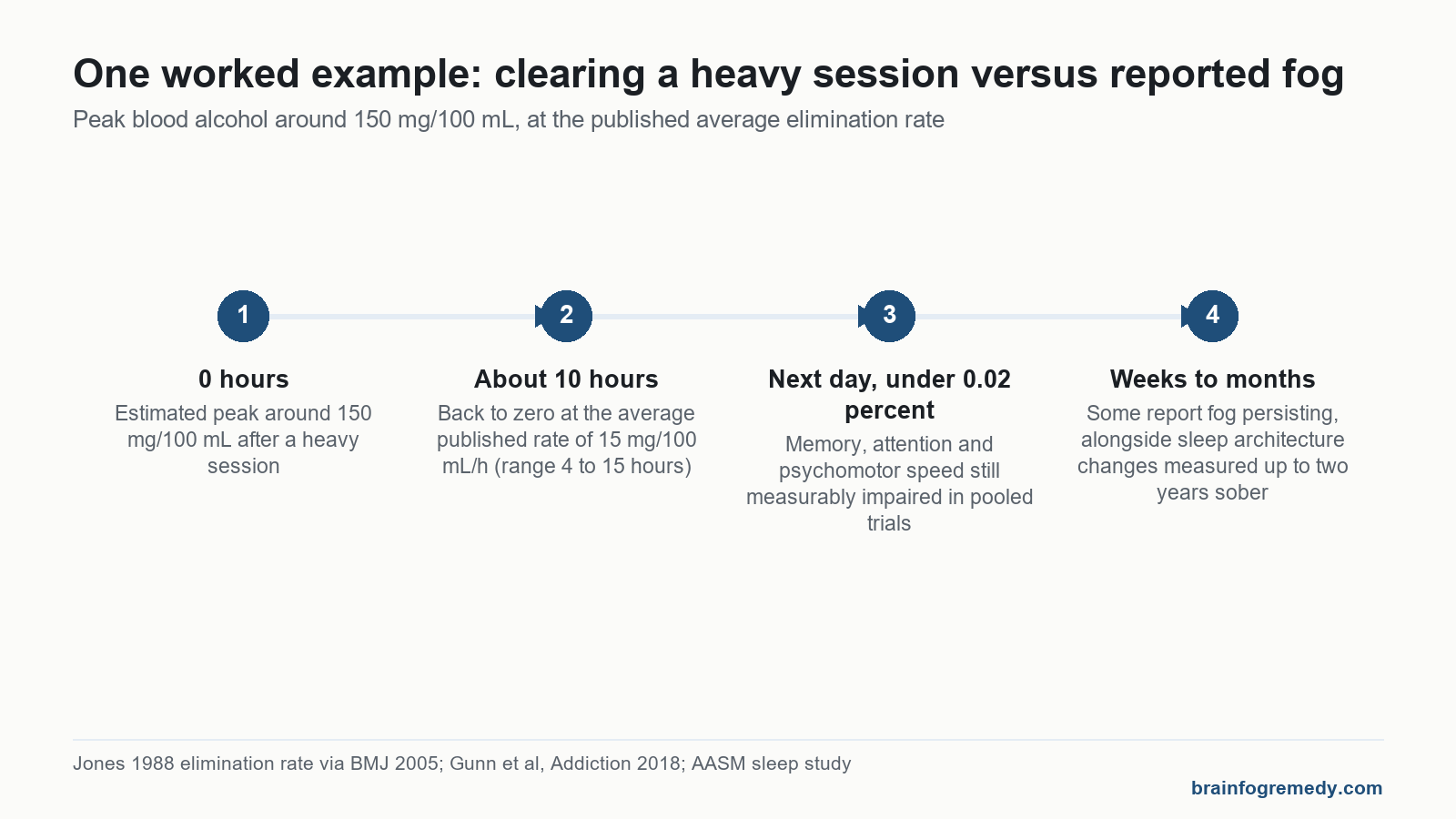
Why does fog turn up weeks after someone stops drinking?
This is a different mechanism on a different clock, and the clearest evidence for it is a sleep laboratory finding rather than a blood test. A polysomnography study summarised by the American Academy of Sleep Medicine measured sleep directly in people who had not had a drink for up to 719 days, roughly two years, and found slow wave sleep still reduced, 6.6 percent in men and 11.1 percent in women who had been heavy drinkers, against 12.0 and 12.1 percent in people who had never drunk heavily, plus REM sleep still running at an altered percentage. That is a measured, structural difference persisting long after any blood alcohol reading would be zero, and it sits beside the duration ranges for other triggers set out in how long brain fog can last by cause.
The explanation reached for most often in recovery writing is neuroinflammation settling slowly in a brain that spent a long time adapting to regular alcohol. That is plausible and widely repeated, but the sleep study above is the one number in this section with a trial behind it; treat the inflammation story as the likely mechanism rather than a separately measured fact, because this article could not verify a dated primary figure for it inside its research budget.

What do people who have quit actually report?
Clinical research on this specific timeline is thin, so this section leans on two dated, named accounts rather than an anonymous pattern, and both are reported experience, not a finding. Gillian Tietz, who hosts the Sober Powered podcast and has been sober since 2019, has described feeling able to think clearly for what felt like the first time around day 60 of her own sobriety, after what she describes as weeks of fatigue and haze. Benya Clark, writing on the Exploring Sobriety newsletter in September 2024 from just over two years sober, described early mental haziness, walking into a room and forgetting why, losing a sentence halfway through, and reported that the most severe fog passed within days but weaker versions lingered for just over a year.
Two accounts is a small sample, and the honest range between them is wide: one person’s sharpest clarity arrived within two months, the other’s full settling took more than a year. Where they agree is the shape of the thing, not a single day count. Both describe fog that was worse, not better, than while they were still drinking, before it lifted, and neither describes a fixed schedule. That agrees with what the sleep study above would predict, slow and individual, and it disagrees with the tidy day by day timelines sold by recovery blogs that are really marketing a programme.
When is stopping drinking itself the dangerous part?
For someone who drinks heavily and daily, stopping suddenly is not a safe way to find out whether the fog lifts. NICE guidance states that acute alcohol withdrawal without medical management can be hazardous in people with severe dependence, with seizures, delirium tremens and, in some instances, death among the risks, and that people assessed to be at high risk should be offered hospital admission for medically assisted withdrawal rather than left to manage it alone.
Nothing in this article is a reason to stop drinking without support if that applies to you, and nothing in it is a reason to keep drinking either. The honest next step for daily heavy drinking is a conversation with a GP or an alcohol service before changing anything, so that withdrawal, if it happens, happens somewhere that can manage it.
Frequently asked questions
Does tolerance change how foggy someone feels the next day?
Reported tolerance to alcohol’s sedative effects does not reliably protect against the next day cognitive deficits found in the Addiction review; the pooled trials included regular heavy drinkers and still measured impairment.
Is hangxiety the same thing as brain fog?
No. Hangxiety describes next day anxiety and low mood after drinking, which is a separate, though often co-occurring, effect from the memory and attention deficits this page covers. The two are frequently reported together but measured separately.
Can one heavy night cause fog that lasts more than a few days?
The elimination arithmetic and the cognitive trials above cover the first day or two. There is no trial evidence in this research that a single session on its own produces fog lasting weeks; the weeks long pattern described here is reported mainly by people who had stopped a longer run of regular heavy drinking.
Does drinking water the morning after fix the fog completely?
Water addresses dehydration, one contributing mechanism, but the cognitive trials measured deficits that water alone has not been shown to fully reverse; sleep and time appear to matter at least as much.
Is brain fog after quitting alcohol a sign something has gone wrong?
This article cannot tell an individual reader what their own fog means. The sleep study and the two personal accounts above describe it as a commonly reported, slow settling experience, but anyone worried about their own memory or concentration should raise it with a doctor rather than guess from an article.
How is alcohol withdrawal confusion different from everyday brain fog?
Withdrawal confusion in someone who drinks heavily and daily can be a medical emergency, covered in the guidance on seizures and delirium tremens above, and is a different, more urgent picture than the slow, non emergency fog this article otherwise describes.
Finished the page? The same five questions from the top, to see what stuck.
This article is general information, not medical advice, and is not a substitute for care from a qualified healthcare professional. Speak to your doctor about your own situation.
Leave a Reply