
How to get rid of brain fog starts with finding what is causing it, because brain fog is a symptom rather than a condition. The causes that respond fastest are the least glamorous: sleep, water, food, daylight and movement. Fixing those first is free, often helps within days, and tells you quickly whether a doctor needs to look further.
Listen to this article, about 14 minutes. A synthetic voice reads the article and announces each section title as it begins; tables are read row by row and the questions at the end are left out.
Recorded 9 October 2026 from the article as published that day. Press a chapter to jump there; the highlighted line is what is playing. A play button sits beside every section heading, and once you scroll past this player a bar at the bottom of the screen keeps the controls in reach. Tap or click any sentence to hear the reading start from there.
On this page: a four day reset in the order to try it, the caffeine cut off a 2023 review of 24 studies calculates, what two meta-analyses say a glass of water and a single walk actually do, and a table matching sleep patterns to what is worth trying first.
Think you already know this? Five questions, one minute.
Every answer is on this page. Answer from what you know now; the page fills in the rest.
-
1. In the 2018 meta-analysis of 33 dehydration studies, which ability was least affected?
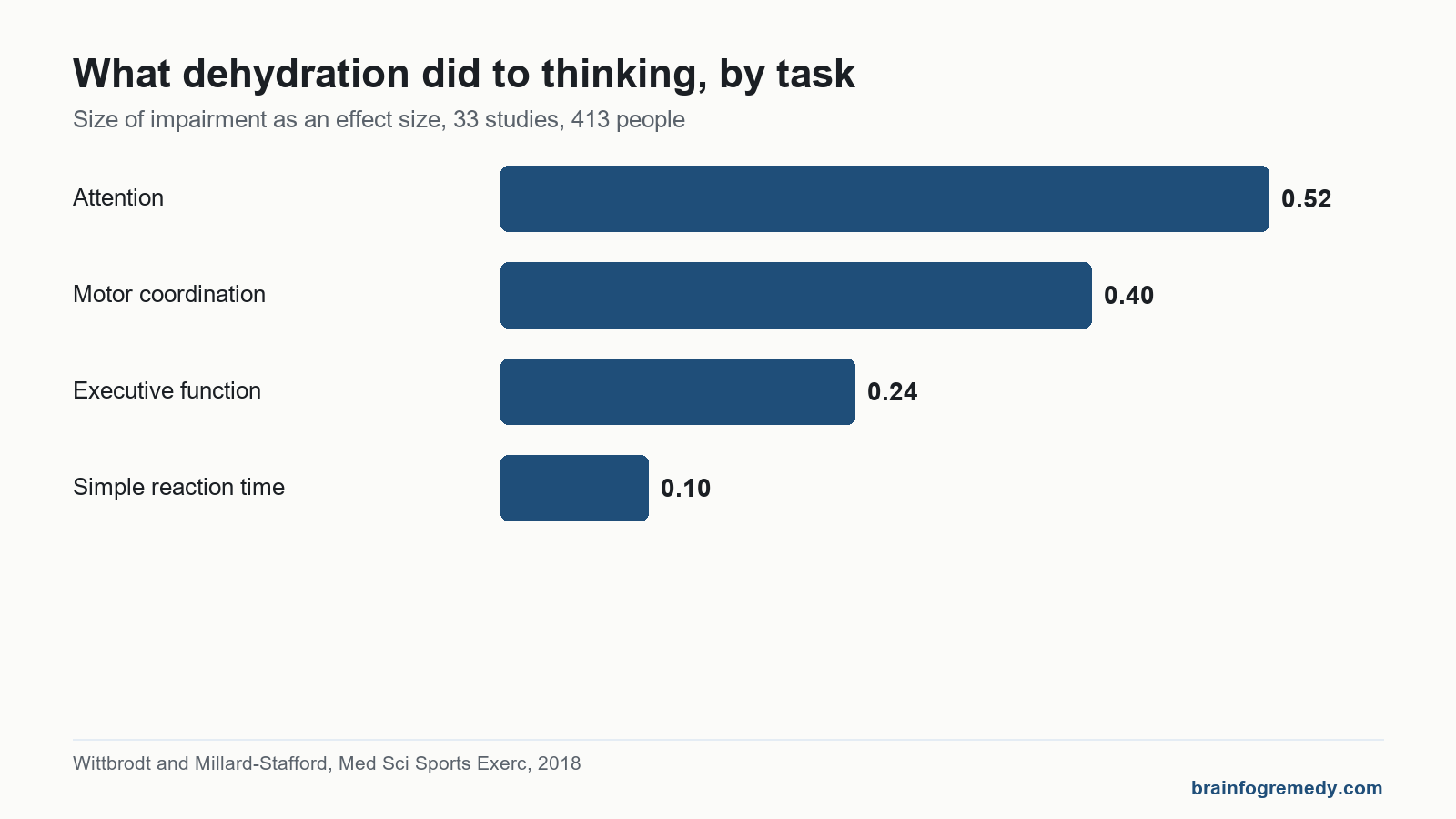
Wittbrodt and Millard-Stafford found attention, coordination and executive function impaired, while reaction time was not significantly affected. Read the section
-
2. What did the 2012 meta-analysis of 79 studies find about a single bout of exercise?
Chang and colleagues in Brain Research reported a small positive effect at all three timings, which is why the page calls it a lift rather than a cure. Read the section
-
3. How long before bed did the 2023 review in Sleep Medicine Reviews say a standard 107 mg coffee should be finished?
The review of 24 studies put it at 8.8 hours for coffee and 13.2 hours for a 217.5 mg pre workout serving. Read the section
-
4. In the meta-analysis of 22 crossover trials in 956 adults, roughly how much did caffeine cut total sleep time?
The meta-analysis, using overnight recordings, found about 35 minutes less sleep and less slow wave sleep, the deep stage. Read the section
-
5. In the sleep pattern table on this page, what is waking repeatedly and unrefreshed worth trying first?
The table flags it as a possible breathing problem, and the page on brain fog from poor sleep explains why unrefreshing sleep is worth raising. Read the section
Unglamorous is not the same as optional. Cleveland Clinic says brain fog has no single official definition or medical diagnosis: it is a cluster of symptoms that can follow an illness, come with a medication or point to an underlying condition. So the cheap, common causes go first, because ruling them out quickly is what tells you whether there is something else to find.
Start with the four day reset
Four days is long enough to feel a difference and short enough to actually do. The point is not that these are cures. The point is that doing all four at once removes the common causes in one go, so whatever is left is the real problem. None of it is instant either, whatever the search results promise, and what can and cannot change inside an hour is a separate question worth being precise about.
- Sleep at a fixed wake time. Not a fixed bedtime, a fixed wake time. It is the anchor the rest of the rhythm hangs off, and it is the one you can control.
- Drink water before coffee. A 2018 meta-analysis of 33 studies in Medicine and Science in Sports and Exercise found dehydration impaired attention, coordination and executive function, with a larger effect once water loss passed 2% of body mass. Simple reaction time barely moved, which is why it is so easy to miss.
- Eat protein at breakfast. The amount is commonly quoted at twenty to thirty grams, a figure from general nutrition advice rather than from any brain fog trial. A breakfast that is mostly refined carbohydrate is a reliable way to feel foggy two hours later.
- Get daylight within an hour of waking, and move for twenty minutes. Outdoor light in the morning does more for sleep quality that night than anything you do in the evening.
If four days of that makes a clear difference, you have found your cause and the fix is to keep doing it. If it makes no difference at all, that is genuinely useful information, and it points toward the list in what actually causes brain fog.

What helps beyond the basics
| What | How long before you notice | Worth it? |
|---|---|---|
| Fixed wake time | 3 to 5 days | Yes, the single highest return change |
| Morning daylight | 3 to 7 days | Yes, and it is free |
| Protein at breakfast | Same day | Yes, if your fog is worst mid morning |
| Twenty minute walk | Within the hour | Yes, most reliable short term lift |
| Cutting afternoon caffeine | 5 to 7 days | Yes, if you sleep badly |
| Correcting a proven deficiency | 4 to 12 weeks | Yes, once a test shows one |
| Supplements with no deficiency | Usually nothing | No |
| Nootropic stacks | Varies, poorly evidenced | No, not as a first move |
The walk is the quickest of these, and the evidence behind it is real but modest. A 2012 meta-analysis of 79 studies with 1,034 people in Brain Research found a small positive effect of a single bout of exercise on thinking, during the exercise, straight after it and after a delay. Small is the honest word. It is a lift, not a cure, which is still more than most things sold for focus can show.
If the fog is worst in the afternoon
This is the commonest pattern by a distance, and it has two usual explanations that are easy to tell apart.
If it lifts noticeably within half an hour of eating, it is food. The fix is protein and fibre earlier in the day rather than a bigger lunch, because the crash you feel at three usually starts with what you ate at eight.
If eating makes no difference, it is sleep pressure, and the fix is upstream. Afternoon fog on a background of six broken hours is not a lunchtime problem. Moving your last caffeine to before noon and holding a fixed wake time for a week will tell you which one you are dealing with. Fog that is worst in the first hour after waking is a separate pattern again, and the sleep inertia research on morning brain fog shows how long that normally takes to lift.
What good sleep actually means here
Sleep advice usually arrives as a list of twenty things, which is why nobody does any of it. Three of them carry most of the effect.
- A fixed wake time, seven days a week. Weekend lie ins feel restorative and cost you the following Monday and Tuesday.
- Daylight within an hour of waking. Ten minutes outdoors beats any amount of indoor lighting, and it sets the timer that decides how sleepy you are that night.
- Last caffeine by early afternoon. It has a long tail, and the cup you had at four is still measurably present at bedtime even if you fell asleep without trouble.
Nothing there is novel. All three are free, and doing all three for one week is a real experiment rather than a gesture.
Caffeine, properly
Most advice here is either drink less or drink none, and both miss what actually helps, which is timing.
Caffeine has a long tail. The European Food Safety Authority puts its half life in healthy adults at about four hours, ranging from roughly two to eight from one person to the next, so a meaningful fraction of an afternoon cup remains at bedtime. That residue does not necessarily stop you falling asleep, which is why people conclude it does not affect them. It costs you deep sleep instead, and you feel that the following afternoon rather than that night. A meta-analysis of 22 crossover trials in 956 adults, with a literature search running to March 2025 and every night measured by overnight recording rather than by asking people how they slept, found caffeine cut total sleep time by about 35 minutes, reduced sleep efficiency, and reduced the proportion of slow wave sleep, which is the deep stage. Its effect on REM sleep was not significant. An older and much quoted experiment made the same point at the extreme: 400 mg, roughly two to three cups, taken six hours before bed cut measured total sleep time by more than an hour in 12 healthy sleepers.
So the classic pattern is self sustaining: poor sleep, more caffeine to cope, later caffeine, worse sleep. Breaking it does not require quitting. Where the amount rather than the timing is the problem, what too much caffeine does to concentration, and the withdrawal clock behind it, takes that apart separately.
- Keep the amount, move the timing. A 2023 review of 24 studies in Sleep Medicine Reviews put a figure on early afternoon: at least 8.8 hours before bed for a standard 107 mg coffee, and 13.2 hours for a 217.5 mg pre workout serving. On an eleven o’clock bedtime that is about quarter past two for the coffee, and breakfast time for the pre workout.
- Do not have any within an hour of waking. Delaying the first one slightly tends to reduce the mid morning crash.
- Give it a full week. The first two or three days of a later cutoff are worse, not better, which is why people abandon it early.
- Count everything, including tea, energy drinks and anything taken for headaches, which frequently contains it.
- If you genuinely cannot function without an afternoon cup, that is information about your sleep rather than about your caffeine tolerance.
The week where you move your last caffeine earlier is the single most informative week available to you. If afternoon fog improves, you have found a large part of your answer for free.
When you cannot sleep
The advice to sleep more is useless to people who are lying awake, and that deserves better than being skipped.
Two different problems get treated as one. Not being able to fall asleep is usually about the body clock or about arousal. Waking in the night and not getting back is usually about something else entirely, and the distinction changes what helps.
| Pattern | Usually points to | Worth trying first |
|---|---|---|
| Cannot fall asleep | Body clock, or a busy mind | Fixed wake time, morning daylight, earlier caffeine |
| Wake at 3am, mind racing | Stress or anxiety | Getting up rather than lying there, and addressing the daytime cause |
| Wake repeatedly, unrefreshed | Possible breathing problem | Worth a doctor rather than self help |
| Sleep fine, still exhausted | Sleep quality rather than quantity | Worth a doctor |
| Sleep well at weekends only | Body clock misalignment | Fixed wake time, seven days |
The one rule that helps across all of them: do not lie in bed awake for long stretches. Getting up, sitting somewhere dim and doing something undemanding until you feel sleepy is better than an hour of frustration, because the frustration teaches your brain that bed is where you feel anxious.
If unrefreshing sleep persists despite adequate hours, that is worth raising rather than working around, and brain fog from poor sleep covers why.

The first week, concretely
The reset described above is simple and people still stall on it, usually by trying to change everything at once.
- Days one and two. Fixed wake time and morning daylight only. Nothing else changes. Expect to feel worse, because you are short on sleep and not yet compensating.
- Days three and four. Add protein at breakfast. This is where most people notice the mid morning difference first.
- Day five. Move the last caffeine earlier. Expect one bad afternoon.
- Days six and seven. Add a twenty minute walk, ideally outdoors and earlier in the day.
- End of week one. Judge nothing yet. One week is enough to feel a difference and not enough to conclude anything.
If a fortnight of all four produces no change whatsoever, that is genuinely useful, because it removes the largest and most common cause from the list.
Reset week diary
A plain record of the first week, so you can see what actually changed and show it to a GP if the fog stays. It does not score, interpret or diagnose anything.
Entries stay on this device and are not sent anywhere. Only a clinician can assess what is behind persistent brain fog.
The things that are not worth your money yet
Most of the supplement market for brain fog is aimed at people who have not tested for anything. If you are low in B12 or iron or vitamin D, correcting it helps and is worth doing properly. If you are not, you are buying an expensive placebo. I have written about vitamins and brain fog in more detail, including which ones have a real case behind them.
Nootropic blends are the same problem with more marketing. The individual ingredients are usually present at doses well below anything that was ever studied, and the blend as a whole has not been tested at all.
What to try when the basics are not enough
Once sleep, food and movement are genuinely in place and the fog is still there, the question stops being lifestyle and starts being medical. That means bloods, and the list in what actually causes brain fog is the one to take to the appointment.
There is also a middle category that helps some people considerably and does nothing for others: attention training. The guide to meditation for brain fog covers what the practices actually involve, which kinds have evidence behind them, and how long you would need to give it before deciding.
A reasonable rule: give any free change one week, any tested deficiency correction eight weeks, and anything you are paying for a hard deadline before you decide whether it earned its place.
If nothing works
Fog that survives a genuine month of good sleep, adequate food, daylight and normal bloods is worth pushing on rather than accepting. Ask specifically what has been ruled out and what has not. Persistent unexplained fog with fatigue is a recognised pattern that deserves a proper look rather than a shrug.
What to take to the appointment
If a month of the basics has not shifted it, these make a GP appointment more useful. Tick them off as you gather them.
This list helps you describe what is happening. It is not a test and it does not point to a cause.
What has changed since this was first published?
This page went up in August 2026 and was rechecked on 20 September 2026. The advice has not changed. What changed is that two of the numbers holding it up now carry the sources they should have carried from the start.
- Early afternoon now has a figure behind it. The 2023 review of 24 studies in Sleep Medicine Reviews calculates the cut off directly: at least 8.8 hours before bed for a standard 107 mg coffee, 13.2 hours for a 217.5 mg pre workout serving. On an eleven o’clock bedtime that is about quarter past two. The advice on this page has not changed, it has just stopped being a feeling.
- The claim that caffeine costs you deep sleep is now sourced. A meta-analysis of 22 crossover trials in 956 adults, literature searched to March 2025, with sleep measured overnight rather than self reported, found reduced total sleep time, reduced sleep efficiency and a reduced proportion of slow wave sleep. That is the deep stage, and it is what this page hangs the following afternoon on.
- Four more claims gained sources on 9 October 2026. They are the half life of caffeine from the European Food Safety Authority, the effect of dehydration on attention from a 2018 meta-analysis, the size of the lift from a single walk from a 2012 meta-analysis, and the definition of brain fog from Cleveland Clinic. The protein figure is now labelled as general nutrition advice, because no brain fog trial tested it.
- Nothing else on this page moved. The four day reset, the timings in the comparison table and the sleep pattern table were rechecked on 20 September 2026 and left exactly as they were. Rewriting advice that still works, so that a page looks busy, is the worse of the two available mistakes.
Frequently asked questions
How fast can brain fog clear?
If the cause is sleep, dehydration or a skipped meal, you can feel different the same day and clearly better within three or four days. If the cause is thyroid, iron or a medication, nothing changes until that is addressed, however well you sleep.
Does caffeine help or make brain fog worse?
Both, at different times. It genuinely sharpens attention for a few hours. It also delays sleep for far longer than most people assume, which feeds the fog the next day. The usual compromise is keeping it and moving it earlier rather than quitting.
Do brain fog supplements work?
If you are deficient in something, correcting that deficiency helps a great deal. If you are not deficient, most supplements do very little. That is why testing before buying makes more sense than the reverse.
Why is my brain fog worse in the afternoon?
The two usual explanations are sleep pressure and blood sugar. If it lifts after you eat, look at what you had for breakfast. If it does not, look at your sleep.
Can exercise make brain fog worse?
Ordinary exercise usually helps within the hour. Hard exercise while already exhausted can make it worse for the rest of the day. If effort reliably makes you worse rather than better, that is worth mentioning to a doctor rather than pushing through.
How long before I should expect to feel different?
Three to five days for anything driven by sleep, food timing or dehydration. Four to twelve weeks for a corrected deficiency, because rebuilding stores is slow. If a fortnight of consistent basics changes nothing at all, that is genuinely useful information and points toward a physical cause worth testing.
Finished the page? The same five questions from the top, to see what stuck.
This article is general information, not medical advice, and is not a substitute for care from a qualified healthcare professional. Speak to your doctor about your own situation.
Leave a Reply