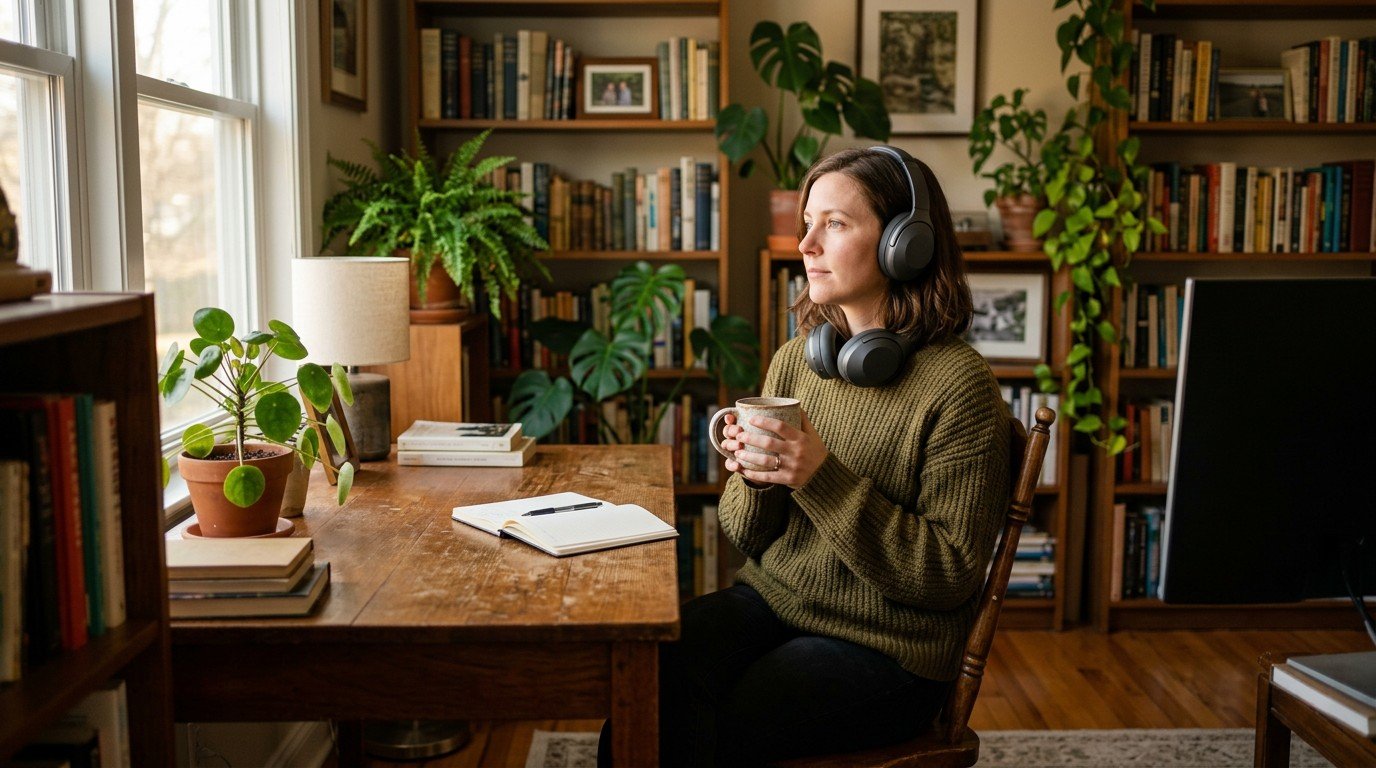
Binaural beats concentration claims rest on two meta-analyses that found a medium average effect on attention and memory, g = 0.45 across 22 studies and g = 0.40 across 15. But single studies keep contradicting each other, samples are small, and no trial this page found tested people with brain fog.
Listen to this article, about 12 minutes. A synthetic voice reads the article and announces each section title as it begins; tables are read row by row and the questions at the end are left out.
Recorded 16 October 2026 from the article as published that day. Press a chapter to jump there; the highlighted line is what is playing. A play button sits beside every section heading, and once you scroll past this player a bar at the bottom of the screen keeps the controls in reach. Tap or click any sentence to hear the reading start from there.
On this page: the pooled effect sizes from three binaural beats meta-analyses drawn as a chart, a table of four single studies that point the other way, a dated check of what focus tracks promise, and what about 40 listeners reported.
Think you already know this? Five questions, one minute.
Every answer is on this page. Answer from what you know now; the page fills in the rest.
-
1. In the 2023 PLOS ONE review of 14 brainwave studies, how many contradicted the entrainment idea?
The 2023 systematic review found 5 studies in line with entrainment, 8 contradicting it and 1 mixed. Read the section
-
2. What overall effect size did the 2019 Garcia-Argibay meta-analysis report across 22 studies?
The 2019 meta-analysis pooled 35 effect sizes from 22 studies on memory, attention, anxiety and pain and reported g = 0.45. Read the section
-
3. What did Robison and colleagues conclude about 16 Hz beats and sustained attention?
Across their experiments, Robison and colleagues found no consistent evidence that beta beats augment sustained attention. Read the section
-
4. Why can the 2024 long COVID pilot not show what the binaural beats did?
The pilot study combined biofeedback, vibration, video and music with beats; 13 of 15 finished, 9 treated and 4 controls. Read the section
-
5. In the 2021 Global Drug Survey, what share of respondents had used binaural beats to alter their state of mind?
According to the RMIT summary of the survey, 1,635 of 30,896 respondents, 5.3 per cent, reported this in the previous year. Read the section
Somewhere right now a video promises that 40 minutes of humming will make you a genius by Friday. The research is more interesting than that, and more awkward. This page sets out what the pooled studies found, the single studies that point the other way, what the most searched focus tracks claim, and what people who listen to them actually report. It does not tell you to use them or to avoid them.
What are binaural beats, and why would they affect concentration?
Play one tone in the left ear and a slightly different one in the right, say 200 Hz and 210 Hz, and the brain hears a third, wobbling beat at the difference, here 10 Hz. That beat does not exist in the air. It is made inside the head, which is why the effect needs headphones and vanishes on a speaker.
The theory is called brainwave entrainment: listen to a 10 Hz beat and your brain activity drifts towards 10 Hz too. Faster beta and gamma beats are marketed for focus, slower theta and delta beats for calm and sleep. The trouble is that the theory itself is unsettled. A 2023 systematic review in PLOS ONE looked at 14 studies that actually recorded brainwaves during listening and found 5 that fitted the idea, 8 that contradicted it, and 1 mixed. So even where a study finds better scores, nobody can say with confidence why.
What do the meta-analyses say about attention and memory?
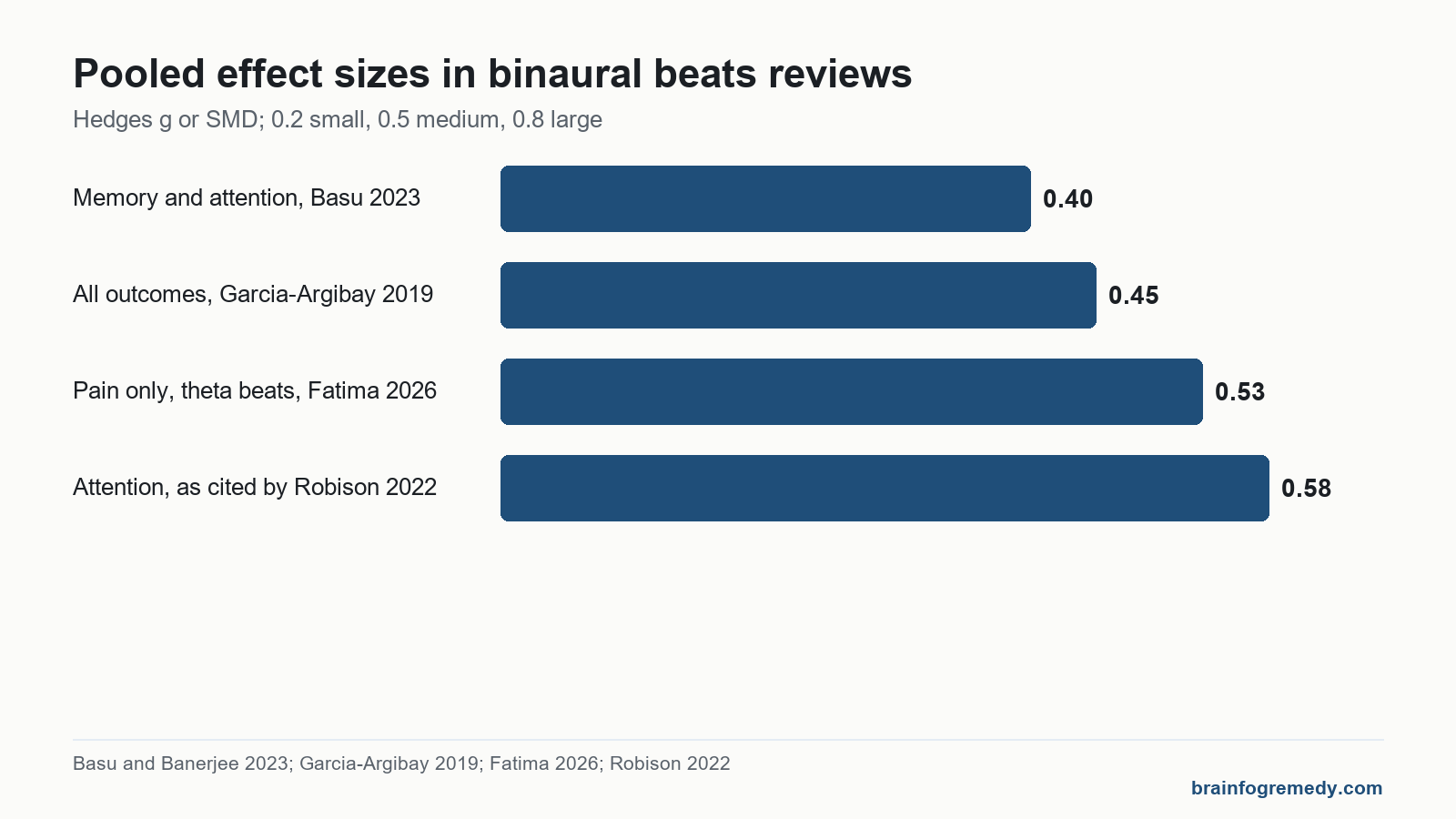
Two pooled analyses carry most of the weight, and both are more positive than you might expect. The 2019 meta-analysis by Garcia-Argibay and colleagues combined 22 studies and 35 effect sizes and reported an overall medium effect of g = 0.45 across memory, attention, anxiety and pain. A later paper by Robison and colleagues cites that work as giving an average effect of about 0.58 for attention alone. The 2023 review by Basu and Banerjee, limited to memory and attention, found g = 0.40 across 15 studies and 31 effect sizes.
| Review | What it pooled | Headline number | What it admits |
|---|---|---|---|
| Garcia-Argibay and colleagues, Psychological Research, 2019 | 22 studies, 35 effect sizes, on memory, attention, anxiety and pain together | g = 0.45, a medium effect | The size of the effect depended on the frequency, how long people listened and when |
| Basu and Banerjee, Psychological Research, 2023 | 15 studies, 31 effect sizes, on memory and attention only | g = 0.40, called near moderate | Conflicting results for theta and beta beats on memory and attention tasks |
| Ingendoh and colleagues, PLOS ONE, 2023 | 14 studies of brainwave recordings during binaural beats | 5 studies fitted the entrainment idea, 8 contradicted it, 1 was mixed | The studies were very different in how they played the beats |
| Fatima and colleagues, Explore, 2026 | 13 randomised trials of theta beats, 630 people | Pain fell by SMD 0.53 on 4 trials, low certainty | Cognition results were too varied to pool at all |
Two cautions sit under those numbers. First, the separate memory and attention figures inside the Basu paper could not be accessed for this page, so the 0.40 is the combined figure. Second, the 2019 review found the effect depended on the frequency, the listening time and whether people listened before the task or during it, which is a polite way of saying the average hides a lot of results near zero and a few large ones.
Why do single studies keep contradicting the pooled numbers?
Because they are small, and because they test very different things. Here are four, chosen because each tested attention, memory or tiredness directly.
| Study | Who and how many | What it tested | What it found |
|---|---|---|---|
| Colzato and colleagues, 2017 | Healthy adults | 40 Hz beats for 3 minutes before and during an attention task | A narrower focus of attention; no change in ignoring distractions |
| Robison and colleagues, 2022 | Three experiments | 16 Hz beats during a long, dull vigilance task | Combined data gave rather strong evidence against any boost to sustained attention |
| Wang and colleagues, 2022 | Four listening groups | 15 Hz or 40 Hz beats, relaxing music or a plain tone during a 20 minute tiring task | No difference between the groups on fatigue scales or a reaction time test |
| Borges and colleagues, 2023 | 30 people | 40 Hz beats against a control sound during memory tasks | No significant change in memory scores or brainwaves |
The Colzato study is the one focus channels love: 40 Hz beats narrowed the spotlight of attention on a lab task. The Robison experiments are the ones they skip: beta beats did not help people stay alert on a dull task, and the authors called the combined evidence rather strong against it. The Wang study of mental fatigue found no difference between groups on fatigue scales or reaction times, then described 15 Hz beats in its conclusion as a proven intervention for mental fatigue, based on brain network measures. Read the results, not the last paragraph.
There is also the comfort problem. A 2021 conference paper from the Australian National University reported that the beats themselves can cause discomfort and so get in the way of focus, which matches what some listeners say below.
Has anyone tested binaural beats on brain fog itself?
Not on its own, as far as this page could find. The nearest is a 2024 long COVID pilot study in Explore of a therapy system that combined biofeedback, vibration, video and music containing binaural beats. Fifteen people enrolled and 13 finished, 9 in the treatment group and 4 in the control group, and recruitment stopped early. The treatment group reported less difficulty concentrating, but with four parts to the therapy and four people in the comparison, nobody can say what the beats did. The authors themselves call for a full trial.
That gap matters. Studies of healthy volunteers on a lab task tell you little about the slow, foggy thinking that long COVID, ADHD or cognitive fatigue can bring.
What do the focus tracks promise?
On 16 October 2026 a web search for binaural beats focus music returned video titles promising to activate deep concentration, to deliver super focus and a flow state, and music that improves concentration. None of the three pages cited a study. Two of the three named 40 Hz, the frequency in the Colzato and Borges studies, which found a narrower focus on one task and no memory change on another.
Binaural beats also have a stranger fan base. In the 2021 Global Drug Survey, 5.3 per cent of 30,896 respondents said they had used them to alter their state of mind in the past year, mostly to relax or sleep, and about 12 per cent of those users were chasing something like a psychedelic effect. One set of tones sold both as a focus aid and as a digital drug is a good reason to read the label sceptically.
What do people who use binaural beats for focus report?
These are reports, not findings. On 16 October 2026 this page read about 40 posts and comments from the past year across r/Biohackers, r/covidlonghaulers, r/Meditation, r/Vent and r/Nootropics. They ran from near devotion to irritation, with a large middle who could not tell whether anything had happened.
In October 2026 the author of a widely upvoted r/Biohackers thread wrote that focus tracks helped them get back to work after cancer treatment left their thinking badly affected, and that they returned to the same playlist a decade later. In the same thread a teacher said they had used a beats app for about 15 years when marking papers, while another reply said the tracks made them angry and kept them awake. Several commenters warned that many uploads are ordinary ambient music with a frequency in the title.
In September 2026 a reply in r/Meditation opened with “Nobody knows” and put the benefit down partly to belief. In r/Vent the same month, someone trying them for the first time said they could not tell if anything was happening, though reading might have been a little easier. And in January 2026 a long COVID patient in r/covidlonghaulers objected to beats being presented as a cure, arguing that recovery stories like that make the illness look psychological.
Where the accounts agree with the research: people report more benefit for relaxing and settling into a task than for memory, and the headphones point is correct. Where they part company: many listeners describe years of reliable help, while the controlled studies are short and mixed. A ritual that signals “work starts now” may help some people focus whatever the frequency, and only a placebo controlled trial can separate the two.
Listening diary
One line per session. It records what you played and what you were doing, nothing more. It does not score or judge anything.
This diary interprets nothing. Sleep, caffeine, the task and the time of day all change with each session, so a pattern is not a cause. Saved on this device only.
Are binaural beats safe, and when is brain fog a reason to see a doctor?
None of the papers on this page reported harm from the tones, and the 2026 theta review called them safe, though small, short trials are poor at spotting rare problems. The clearer risk is volume over long sessions. The WHO and ITU safe listening standard sets a reference of 80 decibels for 40 hours a week for adults, so long focus sessions at high volume through headphones use that allowance quickly. The reviews here did not study people with epilepsy or other seizure conditions; anyone with one should ask their doctor first.
Brain fog that is new, getting worse, or affecting work, driving or safety needs a doctor, not a playlist. Sudden confusion, trouble speaking or weakness on one side needs emergency help. A GP can look at the causes that can be tested for, set out in our guide to what causes brain fog, and poor sleep is often one of them, as our page on sleep and brain fog explains. If you are weighing up other quiet ways to settle the mind, the meditation page sets out what those studies measured, and our look at brain supplements covers the pill version of the same promise.
Frequently asked questions
Do binaural beats work without headphones?
No. The beat is created inside the head from two slightly different tones, one in each ear. A speaker mixes the two tones in the air, so the binaural effect is lost.
Which frequency is used for concentration?
Focus tracks usually use beta beats, around 14 to 30 Hz, or gamma beats at 40 Hz. The studies on this page tested 16 Hz, 15 Hz and 40 Hz and got mixed results; no single frequency has been shown to work reliably.
How long did people listen in the studies?
Most lab studies used short sessions, from a few minutes before a task to about 20 minutes during it. The 2019 meta-analysis found longer listening and listening before the task were linked with bigger effects.
Are isochronic tones the same as binaural beats?
No. Isochronic tones are a single tone switched on and off, so they work through speakers. The reviews on this page studied binaural beats, not isochronic tones.
Can binaural beats replace ADHD treatment?
No study on this page tested them as a replacement for any treatment. Anyone considering changes to ADHD care should talk to their prescriber or GP.
Is it a problem to listen every day?
No review here reported harm from daily listening. The main thing to watch is volume: the WHO and ITU safe listening reference is 80 decibels for 40 hours a week for adults.
Finished the page? The same five questions from the top, to see what stuck.
This article is general information, not medical advice, and is not a substitute for care from a qualified healthcare professional. Speak to your doctor about your own situation.
Leave a Reply