
Morning brain fog is usually what sleep researchers call sleep inertia: slow, groggy thinking right after waking. In the studies it is worst in the first few minutes, mostly clears within 30 minutes, and can take two to four hours to lift fully. Fog that lasts all morning, every morning, is worth a doctor.
Listen to this article, about 11 minutes. A synthetic voice reads the article and announces each section title as it begins; tables are read row by row and the questions at the end are left out.
Recorded 13 October 2026 from the article as published that day. Press a chapter to jump there; the highlighted line is what is playing. A play button sits beside every section heading, and once you scroll past this player a bar at the bottom of the screen keeps the controls in reach. Tap or click any sentence to hear the reading start from there.
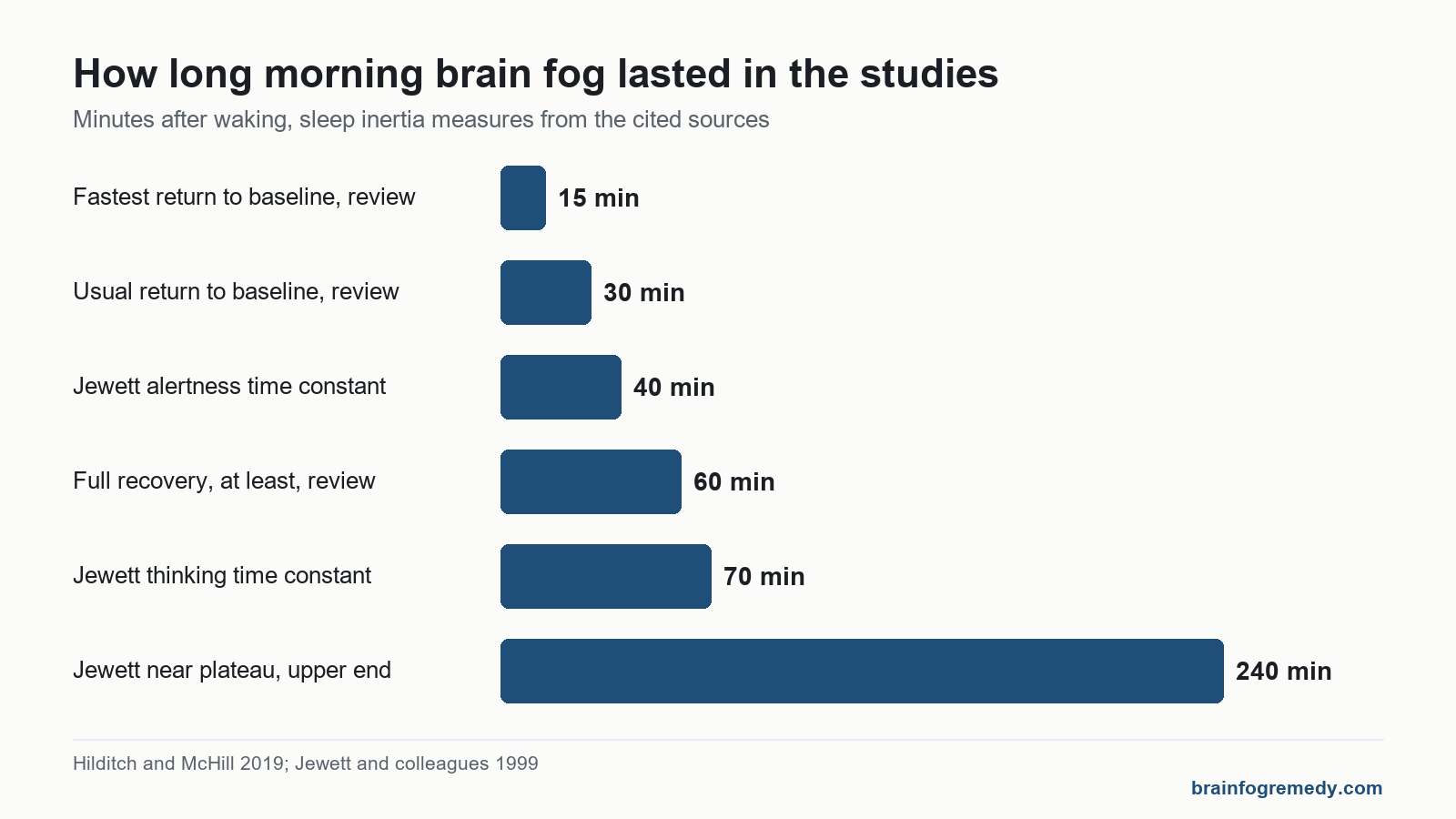
On this page: a cited table of how long sleep inertia lasted in three sources, the measured recovery times drawn as a chart, why waking after eight hours tested worse than a night awake, and what 47 forum answers said was behind their foggy mornings.
Think you already know this? Five questions, one minute.
Every answer is on this page. Answer from what you know now; the page fills in the rest.
-
1. What does the 2020 Continuum review call a markedly prolonged and more severe form of sleep inertia?
Trotti’s 2020 review says that when sleep inertia is markedly prolonged and more severe it is classically referred to as sleep drunkenness. Read the section
-
2. In the 1999 Jewett study, how long did thinking speed take to near its plateau after a full night of sleep?
Jewett and colleagues reported that sleep inertia took 2 to 4 hours to near the asymptote, with time constants of 0.67 hours for alertness and 1.17 hours for thinking speed. Read the section
-
3. According to the University of Colorado release on the 2006 JAMA study, when was impairment after waking most severe?
The University of Colorado release says the most severe impairments from sleep inertia came within the first three minutes after waking. Read the section
-
4. What did the 2019 Hilditch and McHill review conclude about light as a fix for grogginess?
The 2019 review reports that neither light study it covered found a significant improvement on objective performance, describing light as of limited effectiveness. Read the section
-
5. Which of these is among the features of possible sleep apnoea listed in the NICE guideline NG202?
NICE NG202 lists snoring, witnessed apnoeas, unrefreshing sleep, waking headaches, excessive sleepiness, fatigue, nocturia, choking during sleep and sleep fragmentation or insomnia. Read the section
The big health sites cover this in a paragraph and a list of tips. What they skip is the stopwatch. This page sets out how long the grogginess lasted in three sources, what made it heavier in the lab, and what 47 people answering one forum question said was behind their foggy mornings. It will not tell anyone why their own mornings feel like wading through mud. That is a conversation for a doctor, and the list of causes a GP usually checks first shows why it can take a while.
What is morning brain fog, in research terms?
There is no clinical diagnosis called morning brain fog. The nearest research term is sleep inertia, and a review by the sleep neurologist Lynn Marie Trotti in Continuum, 2020 defines it plainly: after waking, “the period of sleepiness, desire to return to sleep, and cognitive dysfunction is known as sleep inertia.” Everyone has it. It is the brain finishing the job of switching on, and in most people it is over before the kettle has properly argued with the toast.
The same review describes a rarer, heavier version, in which “the period of sleep inertia is markedly prolonged and more severe, classically referred to as sleep drunkenness.” The difference is largely how long it lasts, which is why the timings below matter. For fog that hangs around all day rather than just the first hour, our page on brain fog after poor sleep covers what short and broken nights do to thinking.
How long does sleep inertia last in the studies?
Minutes for most of it, hours for the tail. Here is what each source measured, and the answer it got.
| Source | What was measured | How long the grogginess lasted |
|---|---|---|
| Wertz and colleagues, JAMA, 2006 | Healthy adults woken after eight hours of sleep and given a simple addition test | Worst in the first three minutes after waking, and at that point worse than after more than 24 hours awake |
| Hilditch and McHill review, 2019 | Summary of the laboratory studies to date | Most measures back to pre sleep levels within 30 minutes, sometimes 15; full recovery not complete until at least an hour after waking |
| Jewett and colleagues, Journal of Sleep Research, 1999 | Alertness and addition speed tracked for four hours after a full eight hour night, three days running | Took 2 to 4 hours to near its plateau; time constants of 0.67 hours for alertness and 1.17 hours for thinking speed |
The short numbers and the long numbers are not really arguing. The 2019 review by Hilditch and McHill says most measures return to pre sleep levels “within 30 mins of awakening”, sometimes “as soon as 15 mins”, but that “full recovery does not appear to be complete until at least an hour after awakening.” The 1999 study by Jewett and colleagues woke people from a full night and kept testing them, and found that thinking speed took two to four hours to near its asymptote, in other words to stop improving.
One detail from the Jewett study is worth noticing. Subjective alertness recovered faster than measured thinking speed, with time constants of 0.67 hours against 1.17 hours. People felt awake before their thinking had fully caught up, which is a good argument for not booking the hardest task of the day for 7.05 am.

Why can eight good hours leave you foggier than a night awake?
This is the finding that made the news. Wertz and colleagues, reporting in JAMA in January 2006, woke healthy adults after eight hours of sleep and gave them a simple addition test. The University of Colorado release on the study says people “who awaken after eight hours of sound sleep have more impaired thinking and memory skills than they do after being deprived of sleep for more than 24 hours”, and that the most severe impairment came within the first three minutes after waking.
It sounds alarming and is mostly reassuring. The effect is steep but short; the 2019 review calls it a “striking demonstration” of sleep inertia, not evidence that sleep is bad for thinking. It does explain why an email answered three minutes after the alarm can look odd an hour later.
What makes the morning fog heavier or longer?
Three things stand out in the research, and one popular fix does not.
Prior sleep loss. The Hilditch and McHill review reports that “performance upon waking was significantly worse after the partial sleep deprivation night”, and that the impairment is exaggerated by sleep loss in general. A short night leaves less sleep and a rougher waking. Alcohol the night before and caffeine late in the day both cut into sleep.
Time of day. The same review says sleep inertia “effects are greatest during the biological night”, when the body clock still expects sleep. A pre dawn shift or a late running body clock puts waking closer to that point.
The stage of sleep at waking, possibly. Being woken from deep sleep is widely blamed, but the review says the evidence is mixed and that “it is difficult to synthesize a clear conclusion as to the role of SWS”, slow wave sleep, in sleep inertia. Jewett and colleagues found no effect of sleep stage at all.
Now the popular fix. Light alarms, cold showers and leaping out of bed are sold as grogginess cures. In the Jewett study, thinking and alertness were “significantly impaired upon awakening” whether people got up and moved about in ordinary room light or stayed in bed in very dim light, and the review describes light as of “limited effectiveness” on objective performance. That does not make a bright morning pointless, since daylight affects the body clock, but the sunrise lamp promising a sharp brain by 7.10 is promising more than the studies found.
What do people who wake up foggy actually report?
In August 2026 someone on r/Biohackers asked people who sleep about eight hours and still wake foggy what turned out to be the problem. We read the 47 readable top level answers among the 206 comments the thread had loaded on 13 October 2026. These are what people report, not findings, and none of them says anything about why any other person wakes up foggy.
The striking thing was the range: more than fifteen different answers. The most common were breathing during sleep, named by seven, some of whom said a sleep study or a breathing device was where things changed; iron, ferritin or anaemia, named by six; bedroom air and carbon dioxide in a closed bedroom, four; caffeine, meal or exercise timing, four; and hormones, including thyroid and perimenopause, four. Several of those are things only a test can find. The most upvoted answer described years of mornings that felt like waking up poisoned, a hangover with shivers, before an allergy test gave them an answer. Another said treatment for a breathing problem left them better but not cured, and called it “a deep rabbit hole”.
A July 2026 post on r/sleephackers cuts against the tidy version. A 22 year old described two years of grogginess, slow thinking and a drunk feeling that lasted most of the day and lifted only a few hours before bed. A sleep apnoea test, repeated blood panels and a long list of schedule changes had found nothing, and the earliest fuller sleep study they could get was about a year away. In the same thread another person reported waking exhausted after eight hours begun after 2 am and fine after the same hours begun before midnight, which echoes the lab finding on the body clock without proving anything.
Where the accounts agree with the research: timing, short nights and broken breathing come up again and again. Where they go beyond it: fog lasting most of the day is well outside the 30 minutes to four hours the studies measured, and no laboratory study above describes it. That gap is the point of the next section.
When is morning brain fog worth taking to a doctor?
When it does not fit the timings. Grogginess that clears within the first hour or so is ordinary sleep inertia. Fog that lasts all morning, most mornings, or that comes with the features below, is worth raising with a GP rather than with another app.

The NICE guideline on obstructive sleep apnoea, NG202 lists the features of possible OSAHS as snoring, witnessed apnoeas, unrefreshing sleep, waking headaches, unexplained excessive sleepiness, tiredness or fatigue, nocturia, choking during sleep, and sleep fragmentation or insomnia. The NHS page on sleep apnoea says to see a GP if your breathing stops and starts while you sleep, if you make gasping, snorting or choking noises while you sleep, or if you always feel very tired during the day. A bed partner who has heard the snoring is worth bringing.
Waking that is very hard, with confusion or repeatedly falling back to sleep, is also worth describing to a doctor in those words. The 2020 Continuum review says that in some people with idiopathic hypersomnia “the sleep drunkenness is the most problematic symptom, even overshadowing the daytime sleepiness itself.” Only a sleep specialist can say whether that applies to anyone.
If fog in the morning comes with low mood that does not lift, new memory problems, or anything that worries you, see a doctor. Writing down a fortnight of wake times and when the fog lifted makes that appointment far more useful, and the diary on this page exists for that. How long brain fog lasts by documented cause and what has evidence for clearing brain fog cover the wider picture.
Wake time and morning fog diary
A plain record of when you woke and when the fog lifted, to show a GP if mornings stay foggy. It does not score, interpret or diagnose anything.
Entries stay on this device and are not sent anywhere. Only a clinician can assess what is behind persistent morning fog.
Frequently asked questions
Is morning brain fog the same as sleep inertia?
Sleep inertia is the research term for the grogginess and slowed thinking straight after waking. Morning brain fog is not a clinical term, and fog that lasts well beyond the first hour or two is longer than the sleep inertia measured in studies.
Why do I feel worse after a long lie in?
This page cannot say why any one person feels that way. The research it cites found sleep inertia is heavier when waking falls during the body clock’s biological night, and a lie in followed by an early alarm the next day shifts that timing.
Does coffee straight after waking clear sleep inertia?
The 2019 Hilditch and McHill review reports that caffeine taken after waking leaves the first and most severe period of sleep inertia unaffected, because it takes time to act. It does not recommend caffeine as a treatment.
Do sunrise alarm clocks help with morning grogginess?
The studies in the 2019 review found light had limited effect on measured thinking straight after waking. People may still prefer them, and daylight matters for the body clock, but the measured effect on grogginess was small.
Is it normal to need an hour to think clearly in the morning?
The 2019 review says full recovery from sleep inertia is not complete until at least an hour after waking, and one 1999 study measured thinking speed still improving two to four hours after waking. Fog lasting much longer is worth raising with a GP.
Can sleep apnoea cause foggy mornings?
NICE lists unrefreshing sleep, waking headaches and tiredness among the features of possible sleep apnoea. Only an assessment can say whether someone has it, so snoring, gasping at night or constant daytime tiredness are worth taking to a GP.
Finished the page? The same five questions from the top, to see what stuck.
This article is general information, not medical advice, and is not a substitute for care from a qualified healthcare professional. Speak to your doctor about your own situation.
Leave a Reply