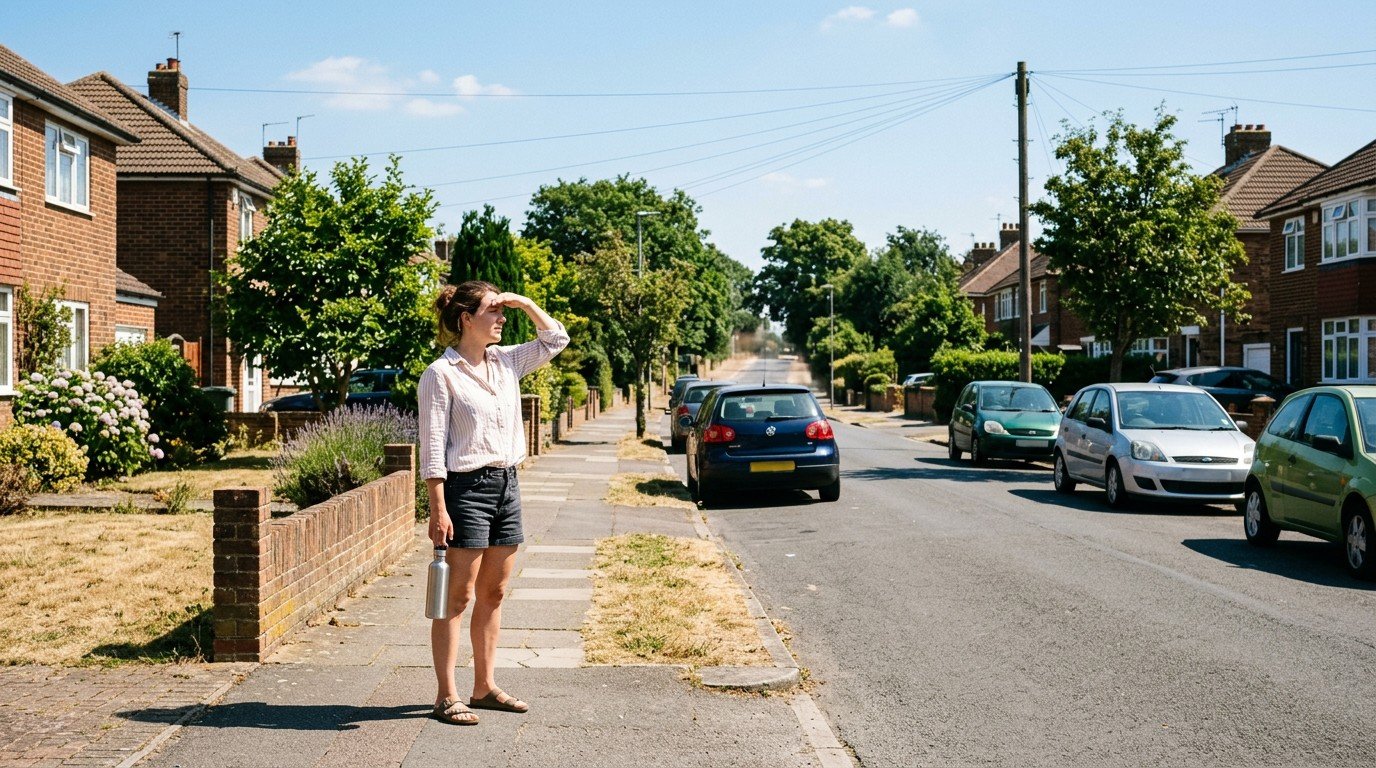
Can dehydration cause brain fog? Yes, but the effect is smaller and harder to reach than the hydration industry implies. In controlled trials, losing about 1.4 to 1.6 percent of body mass left mood, effort and concentration worse while most objective test scores held steady. Reaching that level without exercise took a day of drinking almost nothing.
Listen to this article, about 14 minutes. A synthetic voice reads the article and announces each section title as it begins; tables are read row by row and the questions at the end are left out.
Recorded 3 October 2026 from the article as published that day. Press a chapter to jump there; the highlighted line is what is playing. A play button sits beside every section heading, and once you scroll past this player a bar at the bottom of the screen keeps the controls in reach. Tap or click any sentence to hear the reading start from there.
How much fluid do you have to lose before thinking changes?
It comes mainly from two trials run by the same laboratory at the University of Connecticut, one in men and one in women, published a year apart. Here is what each actually did and found, alongside the meta analysis that later pooled the wider literature and a 2025 trial that shows what it takes to get there without exercise.
| Study | Who took part | How the fluid was lost | Mean body mass lost | What got worse | What did not change |
|---|---|---|---|---|---|
| Ganio and colleagues, British Journal of Nutrition, 2011 | 26 men, average age 20 | Walking in heat, with 40 mg of the diuretic furosemide in one of the two trials | 1.59 percent, SD 0.42, against 0.01 percent in the control | More errors on a visual vigilance task, slower visual working memory responses, more fatigue and more tension or anxiety | Psychomotor vigilance, four choice reaction time, repeated acquisition and grammatical reasoning. The paper records no detectable change in reported headache or trouble concentrating |
| Armstrong and colleagues, Journal of Nutrition, 2012 | 25 women, average age 23 | The same design, exercise with and without 40 mg of furosemide | 1.36 percent, SD 0.16 | Vigour, fatigue, total mood disturbance, perceived task difficulty, concentration and headache | In the authors’ own words, most aspects of cognitive performance were not affected |
| Juett and colleagues, European Journal of Applied Physiology, 2025 | 15 men, average age 27 | 100 mL of water across 24 hours at seated rest, no exercise at all | 1.52 percent, SD 0.34, against 0.24 percent in the control | A urinary marker of proximal kidney tubule injury rose at 12 and 24 hours | This trial measured kidneys, not thinking, so it says nothing either way about fog |
| Wittbrodt and Millard-Stafford, Medicine and Science in Sports and Exercise, 2018 | A meta analysis: 33 studies, 413 people, losses of 1 to 6 percent | Pooled from heat, exercise and fluid restriction studies | Varied by study | Attention, executive function and motor coordination, by a small but statistically significant margin | Reaction time tasks barely moved, and impairment was clearly greater above 2 percent than at or below it |
Two things in that table rarely survive the trip into a blog post. The men and the women did not react the same way: at a slightly larger fluid loss, the men reported no noticeable change in headache or mental clouding, which is the very symptom this question is about, while the women reported both. And the pooled evidence puts the clearer threshold above 2 percent, not at 1 percent.
One more figure deserves flagging. A claim that 1 percent dehydration produces a 5 percent drop in cognitive function circulates widely on hydration pages. It is commonly quoted at exactly that, and we could not trace it to any published study. Treat it as folklore with a decimal point attached.
The companion claim, that dehydration shrinks the brain, has a source, and it is smaller than the headline suggests. A pilot self control trial in Frontiers in Nutrition, 2022 scanned 12 young men after 36 hours with no water at all and reported changes in regional brain density that rehydration reversed. Twelve people, total deprivation, and the study measured no thinking of any kind.
What did the trials measure, and what stayed the same?
This is the part that matters most to anyone who actually feels foggy. In both trials, the measures that moved were mostly subjective: how tired people felt, how tense, how hard the task seemed, how well they judged their own concentration. The measures that mostly held steady were the objective scores. The women’s paper says so outright, concluding that most aspects of cognitive performance were not affected.
So mild dehydration did not reliably make people worse at thinking. It made thinking feel worse. Which, if you are trying to explain the experience of brain fog rather than score it, is arguably the more interesting result, and it is the one that gets flattened into the phrase “dehydration impairs cognition”.
It is also worth knowing how the fluid was removed. In both trials people walked in the heat, and in one arm of each they were also given a prescription diuretic. That is a long way from leaving your glass untouched at a desk. Our overview of what brain fog actually is covers why the gap between a laboratory measure and a lived symptom comes up so often in this field.
Could you get that dehydrated sitting at a desk?

Only with real commitment. The cleanest test of this was published in 2025: Juett and colleagues gave 15 healthy men 100 ml of water across a whole 24 hours, kept them at seated rest on a dry food diet with no exercise, and measured how far they fell. The answer was 1.52 percent of body mass. One small glass of water for an entire day, sitting still, to reach roughly the point the mood trials reached with a heat walk and a diuretic.
Put into weight, the scale of it becomes clearer.
| If you weigh | 1.4 percent of that is | 1.6 percent is | 2 percent is |
|---|---|---|---|
| 55 kg | 0.77 kg, roughly 770 mL | 0.88 kg | 1.1 kg |
| 70 kg | 0.98 kg, roughly 980 mL | 1.12 kg | 1.4 kg |
| 85 kg | 1.19 kg | 1.36 kg | 1.7 kg |
| 100 kg | 1.4 kg | 1.6 kg | 2 kg |
For a 70 kg adult, the trial threshold works out close to a litre of net fluid loss. That is reachable in heat, in illness with vomiting or diarrhoea, on a long flight, during hard exercise, or across a day of drinking essentially nothing. It is less likely on an ordinary indoor day that included tea at breakfast, water with lunch and a coffee in the afternoon.
One finding from that same 2025 trial belongs here and is written plainly: a urinary marker of kidney tubule injury rose after a single day of severe restriction. Going without fluid is not a neutral experiment, which is why nothing in this article suggests testing yourself by trying it.
What do people who tried drinking more water for brain fog report?
What follows is testimony, not evidence, and it is here because none of the pages ranking for this question carry any. It comes from four public threads across three subreddits, about 40 posts and replies in all, read on 17 September 2026. Nobody below is a finding, no cause a poster gives for their own fog applies to anyone else, and a reported improvement is not proof of anything.
- In a June 2026 r/BrainFog thread, someone six months into heavy fog listed drinking more water among the obvious things they had already tried, alongside less sugar and earlier nights, and said none of it made a dent. Of the replies, not one named hydration as the thing that helped.
- A July 2026 r/BrainFog post ran the same way. The poster had changed their sleep, eaten better and drunk more water, and the fog kept coming back. Across the replies people named therapy, stress removal, quitting caffeine, ketogenic diets and gluten. Water appeared only in the list of things already attempted.
- Cutting against that pattern, an April 2026 r/longtermTRE post flagged as an experience report said drinking enough made a large difference to the writer’s fog, lethargy and headaches during demanding stretches, while stating plainly that it was not a cure. A reply reported feeling clear headed after 500 to 750 mL first thing in the morning.
- In a July 2026 r/POTS thread, someone described episodes of sudden fog with flushing, a feeling of being about to faint and an urgent need for fluid, and said the first mouthful of cool water settled it. The replies pointed mostly at sensory overload and vestibular migraine rather than at hydration.
Across those threads the pattern was consistent enough to state: in communities about brain fog, water is what people have already tried, rarely what they credit afterwards. The two accounts that did credit it came from different situations, one describing physically demanding work and one a diagnosed circulatory condition where fluid shifts symptoms within minutes.
That sits reasonably well beside the research. An effect on mood and perceived effort at around 1.4 percent is real and small, and small effects are exactly the kind nobody notices against six months of heavy fog. Where the accounts and the official advice part company is tone. Guidance treats hydration as the first easy thing to check. People who have been foggy for months treat it as the thing they checked ages ago.
One honest warning about reading those threads. Two of the four carried comments promoting a branded supplement, one of them tucked inside an edit to the original post in a way that read like advertising. A thread titled “what actually helped” is a magnet for people whose answer happens to come in a capsule.
Is thirst a reliable guide?

For most healthy adults under about 65, reasonably so. Thirst is a regulated signal rather than a decorative one, and the trials above had to work fairly hard to push people past it. The NHS offers a simpler check than counting glasses: drink enough during the day that your urine stays a pale colour.
There are groups for whom thirst is a poor guide, and that is where the caution genuinely belongs. A narrative review of low intake dehydration in older adults describes a blunted thirst response with age, from reduced sensitivity in the receptors that trigger it, combined with lower total body water. The NHS also lists babies, young children, people with diabetes, anyone ill with vomiting or diarrhoea, people out in strong sun and people taking diuretics as being at higher risk.
As for how much: the European Food Safety Authority sets adequate total water intake at 2.0 litres a day for women and 2.5 litres for men in moderate conditions, and that total includes water from food and from drinks of every kind, not eight separate glasses on top of everything else. The eight glasses rule has been taken apart before. It was the first item in a 2007 BMJ paper on medical myths that doctors themselves believe, whose authors searched the literature and found nothing supporting it.
When is feeling foggy and thirsty a reason to get medical help?
Brain fog and confusion are not the same thing, and the difference matters here. The NHS lists confusion and unusual sleepiness among the signs of shock that warrant calling 999 or going to A and E, alongside cold skin, skin or lips that look blue, grey, pale or blotchy, fast breathing and a fast heartbeat. Sudden confusion is an emergency, not a hydration question.
The NHS advises contacting 111 or a GP urgently for unusual tiredness, dizziness on standing, dark urine or passing much less urine than normal, particularly in an older person or in anyone who has been vomiting or has diarrhoea and cannot keep fluids down.
For fog itself, the advice does not change because water is part of the question. Fog that has lasted more than a few weeks, is getting worse, or arrives with unexplained weight change, numbness, weakness or vision changes is worth a GP appointment. Our guide to what causes brain fog sets out what a doctor usually checks first, and the caffeine question covers another everyday suspect that turns out to cut both ways.
None of this is a reason to delay seeing someone. Drinking normally for a week is a cheap variable to remove, but it is not a test, it rules nothing out, and a fog that persists deserves a proper look.
Frequently asked questions
How much water should an adult drink each day?
The European Food Safety Authority gives an adequate total water intake of 2.0 litres a day for women and 2.5 litres for men, in moderate temperatures and at moderate activity. That total includes water from food and from all drinks, not water alone, and requirements rise in heat, illness and exercise.
Do tea, coffee and food count towards fluid intake?
Yes. The EFSA reference values cover drinking water, beverages of all kinds and the water held in food. The figure was never meant to describe eight glasses of plain water taken on top of a normal diet.
Is urine colour a reliable way to check hydration?
The NHS uses it as its practical guide, advising that you drink enough during the day for your urine to stay a pale colour. It is a rough indicator rather than a measurement, and some vitamins, medicines and foods change the colour on their own.
Does dehydration really shrink the brain?
That claim traces back to small imaging studies, and the one usually meant is linked in the article above. It scanned 12 young men after 36 hours with no water at all and reported changes in regional brain density that rehydration reversed. Twelve people, total deprivation, and it measured no thinking of any kind.
Are older adults more at risk of this than younger people?
Reviews of low intake dehydration in older adults describe a blunted thirst response with age and lower total body water, and the NHS lists older people among those at higher risk. That is a reason for households to keep an eye on fluid, and a reason to raise new confusion or drowsiness urgently rather than waiting it out.
If I drink normally for a week and the fog does not lift, what does that mean?
It means one common variable is less likely to be the main driver, and nothing more. Brain fog has a long list of possible contributors, from sleep and iron to thyroid function, medicines, menopause and viral illness. A fog that has outlasted a few weeks is worth taking to a doctor rather than to another intervention.
This article is general information, not medical advice, and is not a substitute for care from a qualified healthcare professional. Speak to your doctor about your own situation.
Leave a Reply