
Can brain fog be caused by anxiety? Research suggests it can: a 2016 meta analysis covering 22,061 people linked higher anxiety to lower working memory scores, a small to moderate effect, and experiments that induce anxiety show similar dips. Forum accounts describe fog sometimes outlasting the anxiety, and fog that persists deserves a doctor’s view.
Listen to this article, about 10 minutes. A synthetic voice reads the article and announces each section title as it begins; tables are read row by row and the questions at the end are left out.
Recorded 10 October 2026 from the article as published that day. Press a chapter to jump there; the highlighted line is what is playing. A play button sits beside every section heading, and once you scroll past this player a bar at the bottom of the screen keeps the controls in reach. Tap or click any sentence to hear the reading start from there.
On this page: a comparison table of cognitive studies, a checklist for doctor visits, and key figures from a major meta analysis on anxiety and working memory.
Think you already know this? Five questions, one minute.
Every answer is on this page. Answer from what you know now; the page fills in the rest.
-
1. According to the 2016 meta analysis by Moran, what was the overall pooled effect size (g) linking anxiety to poorer working memory?
The pooled effect size across 177 samples was g = 0.334, as detailed in Moran’s 2016 meta analysis in Psychological Bulletin. Read the section
-
2. What does attentional control theory suggest about how anxiety affects cognitive performance?
According to attentional control theory, set out by Eysenck and colleagues in the journal Emotion in 2007, worry pulls attention away, meaning people must exert more effort to maintain their test scores. Read the section
-
3. In the 2020 cohort study of young people, what happened as anxiety scores fell?
As tracked in a 2020 cohort study in BJPsych Open, each point anxiety fell was linked to an 11 to 13 percent higher rate of reporting clearer thinking. Read the section
-
4. What did a forum poster in a July 2026 thread report about their recovery?
In a July 2026 thread, the poster noted that although their anxiety had improved over a year, their fog and afternoon exhaustion persisted. Read the section
-
5. Which symptom does the NHS list alongside difficulty concentrating for generalised anxiety disorder?
The NHS overview of generalised anxiety disorder lists finding it difficult to concentrate alongside restlessness, tiredness, and difficulty sleeping. Read the section
The pages ranking for this question mostly say yes, mention cortisol, and stop, while the lower half of the results is clinics with a treatment to sell. Nobody puts a number on it. This article does, along with what the number cannot tell you. The wider shortlist of things that commonly sit behind foggy thinking is in the eight causes of brain fog worth checking first.
How much does anxiety actually affect thinking?
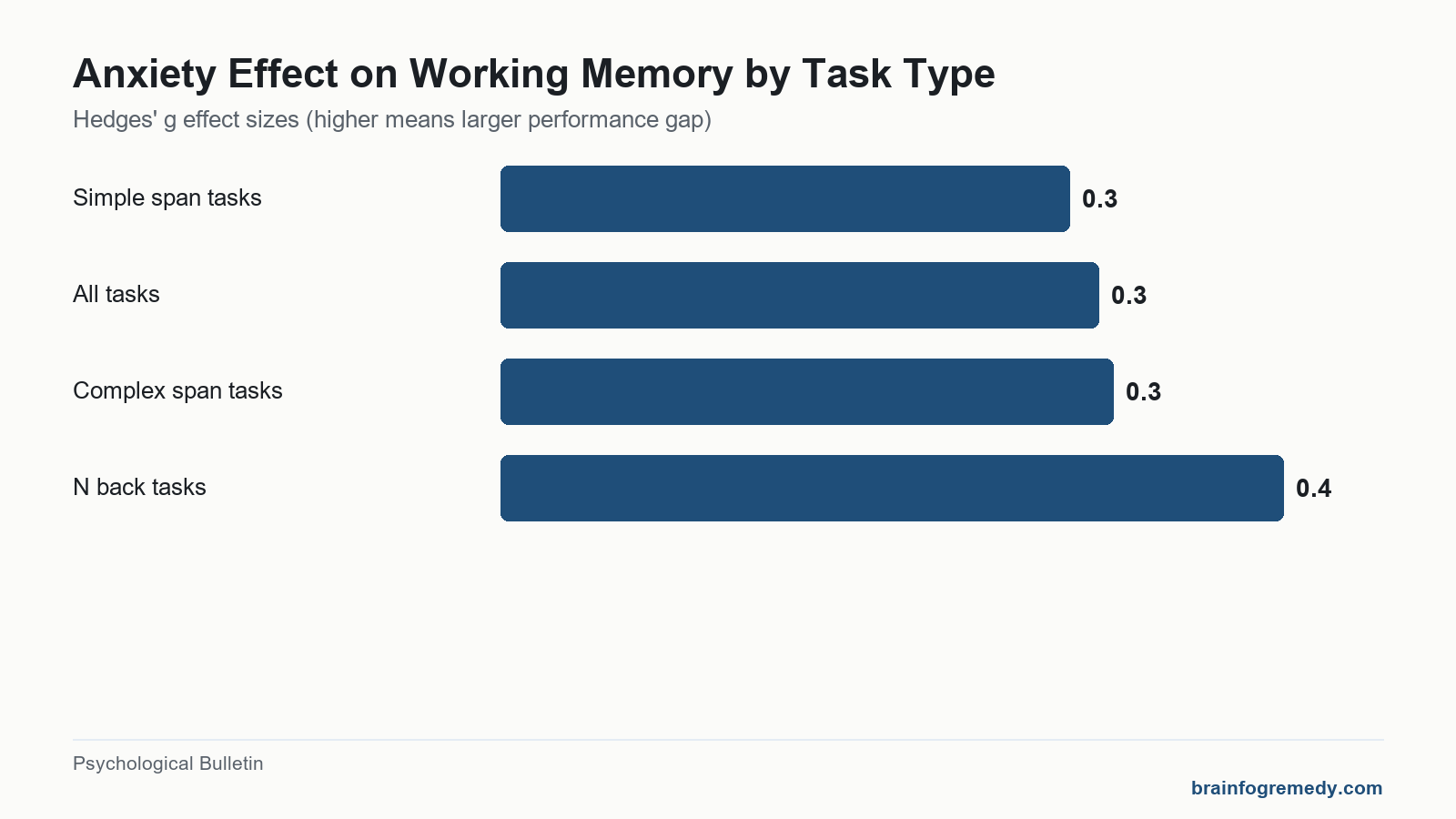
The best single answer comes from Moran’s 2016 meta analysis in Psychological Bulletin. It pooled 177 samples and 22,061 people and found that higher self reported anxiety was reliably linked to poorer performance on working memory tests, with a pooled effect of g = 0.334. Working memory is the mental scratchpad that holds a phone number while you dial it.
The finding held across very different tests, and the same review found that anxiety induced in the lab also went with poorer performance.
| Study and source | Who was measured | What was compared | What it found |
|---|---|---|---|
| Moran 2016, all tasks | 177 samples, 22,061 people | Self reported anxiety against working memory tests | Lower scores with more anxiety, g = 0.334 |
| Moran 2016, complex span tasks | 30 samples, 3,196 people | Holding items in mind while doing a second task | Lower, g = 0.342 |
| Moran 2016, simple span tasks | 127 samples, 17,547 people | Repeating back lists, such as digit span | Lower, g = 0.318 |
| Moran 2016, n back tasks | 20 samples, 1,318 people | Constantly updating what you hold in mind | Lower, g = 0.437, the largest gap |
| Lukasik and colleagues 2019 | 503 non depressed US adults, tested online | Momentary anxiety and everyday stress against ten working memory tasks | Only a trend for anxiety (p = 0.06), none for stress |
| Mascherek and colleagues 2020 | 877 German adults aged 35 to 65 | Worry and low mood against how people rated their own memory and attention | Each unit of worry: 6% more memory complaints, 11% more attention complaints |
| Allott and colleagues 2020 | 656 young people aged 12 to 25 in Australian mental health services | Change in anxiety score over three months against self rated thinking | Each point anxiety fell: 11 to 13% higher rates of reporting clearer thinking |
What g = 0.334 means, worked through: take that pooled effect and assume scores follow a bell curve. The average person in a more anxious group then sits 0.334 standard deviations below the middle of a calmer group, at about its 37th percentile, so roughly 63% of the calmer group outscore them rather than 50%. The same inputs give about 87% overlap between the two groups. Real and consistent, then, and most anxious people still score in the normal range.
Why does the fog feel worse than the test scores suggest?
A modest dip on a test does not sound like wading through soup. The leading explanation is attentional control theory, set out by Eysenck and colleagues in the journal Emotion in 2007. It separates how well you perform from how much effort that performance costs, and holds that anxiety hurts the second more than the first. Worry pulls attention away, people compensate by trying harder, and the score survives while the effort bill rises.
That fits the self report studies. In a 2020 German study, also in Frontiers in Psychology, covering 877 adults, each extra unit of worry went with 6% more memory complaints and 11% more attention complaints, while diet, exercise, sleep quality and weight added nothing once mood was accounted for.
The evidence does not all point one way. a 2019 study in Frontiers in Psychology tested 503 non depressed adults on ten working memory tasks and found only a trend for anxiety that fell short of significance, and nothing for everyday stress. The authors concluded working memory looks fairly robust against normal ups and downs in anxiety. One likely reconciliation is that passing nerves and sustained anxiety are different loads, but neither study tested that.

Does brain fog cause anxiety, or does anxiety cause brain fog?
Probably some of each. Moran’s pooled figure is a correlation, and while lab studies suggest anxiety can push thinking down, nobody has run the reverse experiment of making people foggy and watching their worry climb.
The clearest evidence that they travel as a pair comes from a 2020 cohort study in BJPsych Open of 656 young people using Australian mental health services. Over three months, each point their anxiety score fell went with 11 to 13% higher rates of reporting clearer thinking, and about a third of the group said their thinking had improved. The authors flag the limits themselves: thinking was self rated, recalled after the fact, and never tested objectively.
The loop is easy to picture: fog at work is unnerving, the unease takes up more of the scratchpad, and the fog thickens. It is also part of why meditation for brain fog helps some people and unsettles others.
What do people on anxiety forums actually report?
To see what the studies cannot, we read four recent threads in the r/Anxiety community on Reddit, and about 35 replies beneath them, on 14 September 2026. These are what people report, not findings, and none of it says anything about any individual reader.
In a January 2026 thread, one poster described close to a year of fog, poor memory and broken sleep, and suspected unaddressed stress and anxiety. One reply named a problem the studies never touch: they could not tell whether their fog came from anxiety or from the medication they took for it. Several replies urged seeing a professional.
A July 2026 thread cut against the tidy story. The poster said their anxiety had improved a lot over a year, yet the fog at work and the afternoon exhaustion had stayed. Replies raised other explanations, and one person said a doctor’s blood test had found deficiencies that took about six months to correct.
In another July 2026 thread, someone about ten days into feeling better from an anxiety spell described severe fog that crept in an hour or two after waking. Their blood tests came back normal, and a later reply said they were doing significantly better though not fully back.
And in a September 2026 thread asking whether constant fog ever lifts, one reply described being about half recovered two years after a collapse in April 2024, with stressful work days still setting them back, and another said it had lifted gradually. One of the most detailed replies ended with a disclosure that its author worked for a company selling earbuds for brain fog, a reminder that even a support thread can have a gift shop.
Where the accounts agree with the research: fog and anxiety were described as arriving together, and several people linked easing anxiety with easing fog, much as the Australian cohort found. Where they go beyond it: two threads describe fog outlasting the anxiety by weeks or months, which snapshot studies are not built to capture, and one describes a physical explanation turning up on a blood test. The range ran from largely recovered to still stuck.
When is foggy thinking with anxiety worth seeing a doctor about?
The NHS overview of generalised anxiety disorder lists finding it difficult to concentrate among the symptoms of generalised anxiety disorder, alongside restlessness, tiredness and difficulty sleeping. It advises seeing a GP if you think you might have it, or if treatment you already have is not helping.

Beyond that, fog that has not lifted when an anxious period has passed, fog that comes with low mood, and fog that is getting worse rather than better are all reasons to book an appointment. So is memory trouble that other people have started to notice. Anxiety being present does not rule out something else, and a doctor can look for other explanations, such as thyroid function, iron or B12, that anxiety would never show up on. If you are in crisis or thinking about harming yourself, contact emergency services or an urgent mental health line now.
Sleep tangles with both, since anxiety disturbs it and poor sleep produces fog on its own, as covered in what lack of sleep does to thinking. For what the word fog covers, see what brain fog actually is. Why that combination leaves people so drained, and how strongly anxiety and broken sleep predict each other over time, is set out in our look at the studies behind anxiety fatigue.
Clinical Evaluation Checklist for Persistent Fog
This checklist outlines key indicators and diagnostic steps discussed in the article for evaluating cognitive fog that occurs alongside anxiety.
Ticks are saved on this device only.
Frequently asked questions
Can anxiety make you forget things?
Studies link higher anxiety to lower scores on working memory tests, the kind of short term holding that lets you remember why you walked into a room. A 2016 meta analysis of 22,061 people put the effect at small to moderate. Forgetfulness that is new, worsening or noticed by others is worth raising with a doctor.
Is brain fog from anxiety permanent?
The research here does not follow people for long enough to answer that. In one three month study, about a third of young people reported clearer thinking as anxiety eased. Forum accounts range from full recovery to fog lasting months. Fog that persists should be assessed rather than waited out.
Can an online quiz tell me if anxiety is causing my brain fog?
No. A handful of questions cannot separate anxiety from sleep problems, thyroid issues, low iron, medication effects or the tail of an infection, and many quizzes exist to sell the thing on the results page. A doctor can check for other explanations properly.
Does worrying about brain fog make it worse?
It plausibly can. Attentional control theory proposes that worry uses attention the task needs, so thinking takes more effort. That is a theory with supporting lab evidence, not a measured rule for any one person.
Can you have foggy thinking from anxiety without feeling anxious?
The studies measured anxiety people could report or anxiety induced in a lab, so they cannot answer this. Fog without an obvious reason is a good reason to see a doctor rather than to assume a cause.
Will a blood test show whether my fog comes from anxiety?
No blood test detects anxiety. Doctors use blood tests to look for other explanations for fog, such as thyroid function, iron or B12, which is why testing is useful even when anxiety seems the obvious answer.
Finished the page? The same five questions from the top, to see what stuck.
This article is general information, not medical advice, and is not a substitute for care from a qualified healthcare professional. Speak to your doctor about your own situation.
Leave a Reply