
When my head feels heavy and foggy, the likeliest explanations are ordinary ones: tension type headache, blocked sinuses, a run of short nights, or painkillers taken too often. Heaviness is rarely the alarming part. A short list of published features does change that, and those need a doctor the same day.
Listen to this article, about 12 minutes. A synthetic voice reads the article and announces each section title as it begins; tables are read row by row and the questions at the end are left out.
Recorded 14 October 2026 from the article as published that day. Press a chapter to jump there; the highlighted line is what is playing. A play button sits beside every section heading, and once you scroll past this player a bar at the bottom of the screen keeps the controls in reach. Tap or click any sentence to hear the reading start from there.
On this page: a checklist for appointment preparation, a table of common causes, and a breakdown of the SNNOOP10 screening list.
Think you already know this? Five questions, one minute.
Every answer is on this page. Answer from what you know now; the page fills in the rest.
-
1. In the analysis of 141 accounts, how many people described a feeling of fuzziness, grogginess, or pressure in the head?
A study published in the Journal of Neurology, Neurosurgery and Psychiatry found that only 10 out of 141 first person descriptions of brain fog mentioned fuzziness, grogginess, or pressure. Read the section
-
2. According to a 2025 study across 17 countries, what percentage of adults experienced a tension type headache in the past year?
A study of 41,614 adults, 17 countries, 2025 reported that 33.2% of adults aged 18 to 65 experienced a tension type headache in the past year. Read the section
-
3. Which screening list did headache specialists publish in 2019 to help clinicians spot headaches with serious underlying causes?
The SNNOOP10 screening list was published in 2019 to replace the older SNOOP4 list. Read the section
-
4. What did researchers find regarding the sensitivity of the SNNOOP10 list when testing it in Madrid?
A study testing the list reported that its sensitivity was 100%, meaning it missed no cases, though it also flagged many people who turned out to be fine. Read the section
-
5. What did a forum user report in the longest running online thread from March 2026?
In the longest running thread, a user described experiencing constant head pressure for 13 years with a CT scan that found nothing. Read the section
Why does a heavy head so often arrive with fog?
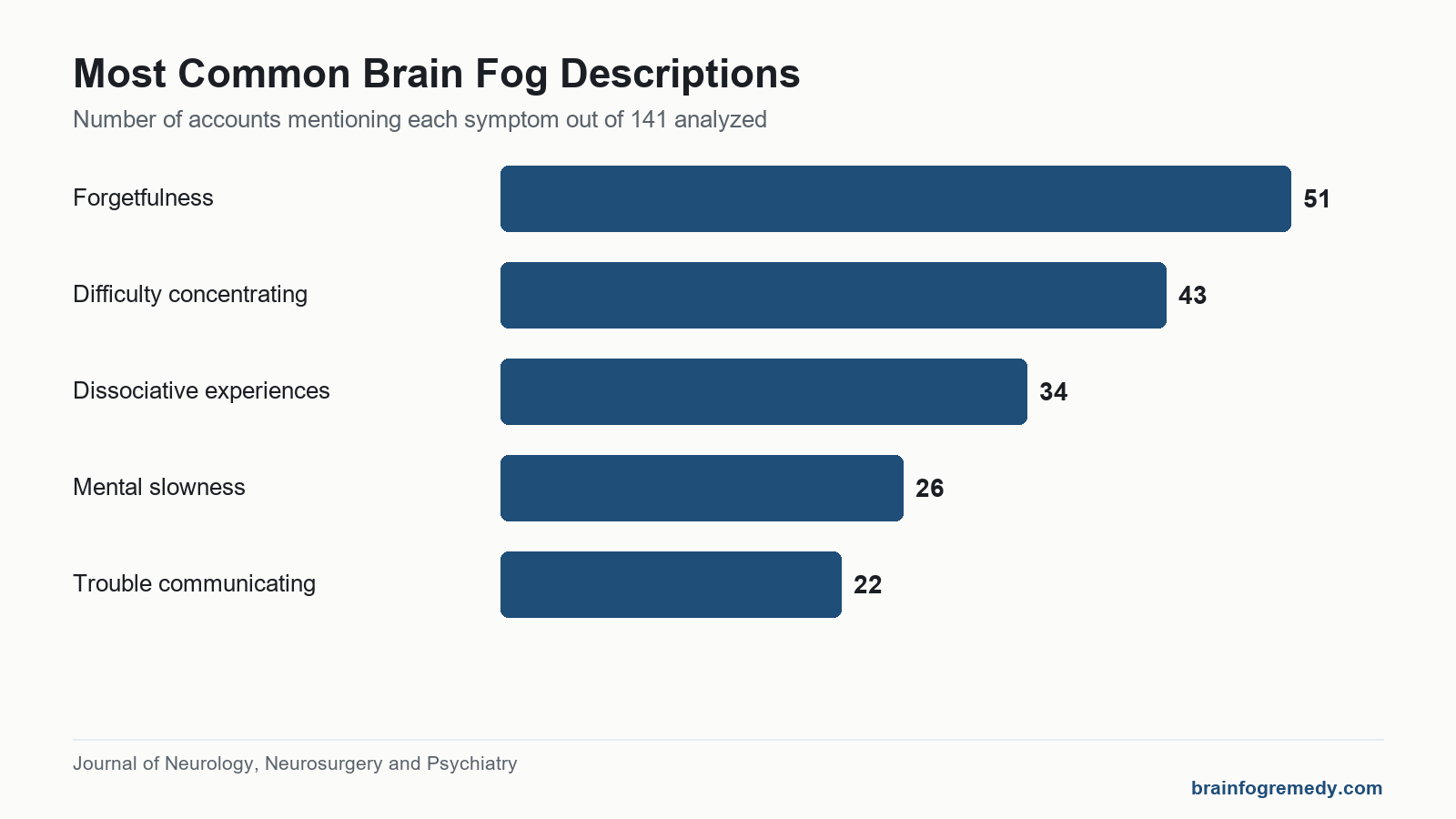
Because the vocabulary for this is thin. Researchers at the University of Edinburgh analysed 141 first person descriptions of brain fog and published the breakdown in the Journal of Neurology, Neurosurgery and Psychiatry: forgetfulness (51 accounts), difficulty concentrating (43), dissociative experiences (34), mental slowness (26), trouble communicating (22), fatigue (9), and a feeling of fuzziness, grogginess or pressure in the head, which came up just 10 times. That thin vocabulary matters most where people already struggle to speak up, and our page on why a foggy head in depression can outlast the low mood looks at how often that symptom goes unmentioned.
Ten out of 141. That is why a general brain fog page leaves you unsatisfied: the heaviness is a minority report. The same study quotes two descriptions that could have come from your search bar, one person writing that their head felt foggy and full of pressure, another that theirs felt full of pudding. Our piece on the fuzzy head feeling covers why the words themselves are part of the problem.
Brain fog is not a diagnosis, and the Edinburgh authors say so: the term covers a mixed range of experiences attached to a wide range of illnesses, drugs and behaviours. Any quiz that names your condition in six questions is selling you something that does not exist.

What is usually behind a heavy, foggy head?
No web page can tell you which of these, if any, applies to you, and this one is not going to try. What it can do is lay out what the heavy, pressured feeling is most commonly associated with, and how common each one is.
| Commonly associated with | How it is usually described | How common |
|---|---|---|
| Tension type headache | Pain on both sides of the head, face or neck, like something pressing on your head or tightening around it (NHS) | 33.2% of adults aged 18 to 65 in the past year, 95% CI 32.7 to 33.6 (41,614 adults, 17 countries, 2025) |
| Sinusitis | Pain, swelling and tenderness around the cheeks, eyes or forehead, with a blocked nose and reduced sense of smell (NHS) | Usually clears on its own within 4 weeks |
| Short or broken sleep | Still tired on waking, irritable, and finding it difficult to concentrate during the day (NHS) | Adults are advised to aim for 7 to 9 hours on average |
| Painkillers taken too often | Everyday headache that the tablets stop touching; overuse can itself trigger rebound headaches (NHS) | Headache on 15 or more days a month with medication overuse: 4.1% of adults, 95% CI 3.9 to 4.3 |
| The neck | Pain starting in the neck or the back of the head, with tenderness in the neck muscles | Disputed. Older reviews put it at 15 to 20% of chronic headaches; a 2025 systematic review and meta-analysis concludes it is rare even in headache clinics |
That last row is a real disagreement in the literature, not a rounding error, and it matters because the neck is the explanation the internet reaches for first. One body of work treats neck driven headache as a sizeable slice of chronic headache; the 2025 meta-analysis pools population and clinic studies and lands on one year prevalence figures between 0.17% and 2.2%. Same skulls, no agreement yet.
Which signs mean a heavy, foggy head needs a doctor today?
This is the part worth reading twice. In 2019 a group of headache specialists published a screening list in the journal Neurology, known as SNNOOP10, to help clinicians spot the headaches that have a serious cause sitting behind them. It replaced the older and shorter SNOOP4 list. Below is the published list translated into plain language. It is a prompt to get assessed, not a way to work out what you have, and a single item on it is a reason to be seen rather than a verdict.
| Published flag | What that means in ordinary words |
|---|---|
| Systemic symptoms including fever | The heavy head comes with a temperature, chills, night sweats or weight loss |
| Neoplasm in history | You have had cancer at any point |
| Neurologic deficit or dysfunction | Weakness, numbness, slurred speech, changed vision, unsteadiness, or reduced consciousness |
| Sudden or abrupt onset | It arrived in seconds rather than building over hours |
| Older age at onset | A new headache pattern starting after about 65 |
| Pattern change or recent onset | Your usual head feeling has changed character, or this is new to you |
| Positional headache | It clearly changes when you stand up, lie down or bend forward |
| Precipitated by sneezing, coughing or exercise | Straining reliably sets it off |
| Papilloedema | Swelling at the back of the eye, which only an eye examination finds |
| Progressive headache and atypical presentations | It is steadily getting worse rather than coming and going |
| Pregnancy or puerperium | You are pregnant or recently gave birth |
| Painful eye with autonomic features | One eye is painful and red, or watering, with a drooping lid |
| Posttraumatic onset | It started after a blow to the head, however minor it seemed |
| Pathology of the immune system such as HIV | Your immune system is suppressed by illness or medication |
| Painkiller overuse or a new drug at onset | You have been taking painkillers most days, or a new medicine started around the same time |
Separately, the NHS says to call 999 or go to A and E for a headache that comes on suddenly and is extremely painful, or one that comes with sudden problems speaking or remembering, loss of vision, drowsiness or confusion, a very high temperature with meningitis symptoms, or a red and painful eye. If your heavy head sits alongside changes in what you can see, our guide to brain fog and blurred vision goes through that combination in more detail.
How good is that red flag list, actually?
Blunt, is the honest answer, and it is better to hear that here than to be frightened by it later. Spanish and Danish researchers tested SNNOOP10 against 100 high risk emergency patients in Madrid and reported in Cephalalgia in 2022 that its sensitivity was 100%, 95% confidence interval 90.2 to 100. It missed nothing. But the area under the curve was 0.66, which is the statistical way of saying it also lights up for a great many people who turn out to be fine. The most sensitive single items were neurological deficit at 75.5%, a change in pattern at 64.4% and onset after 50 at 64.4%.
The other half of that picture is a 2025 report from the HEAD study, which followed 3,951 emergency department patients who arrived with headache and a normal neurological examination. A serious secondary cause turned up in 191 of them, 4.8%, confidence interval 4.2 to 5.5. These were people sick enough to attend an emergency department, so that is the high end, and it still means the frightening explanation was the wrong one about 19 times out of 20.
What do people with a heavy, foggy head actually report?
We read 25 first person accounts across three public threads in the r/BrainFog forum, posted between March and August 2026. None of this is evidence of anything. It is what people report, and it is worth reading precisely because it is the part the clinical pages leave out.
- Normal results are the most consistent thread. In the longest running thread, from March 2026, the person who started it described 13 years of constant head pressure and a CT scan a month earlier that found nothing. In the June 2026 thread the writer lists a clear MRI, a clear CT and a run of normal laboratory tests.
- Position comes up again and again. A commenter in the March thread wrote that bending their head down made the pressure much worse; another reported it vanishing when their head was supported. In an August 2026 thread the poster described it easing at a computer and returning at the dinner table. Positional change is one of the published flags above, which is why it belongs in front of a clinician rather than a search engine.
- Being told it is stress is close to universal. The August poster reported normal bloods, normal blood pressure and a doctor concluding it was probably stress and anxiety.
- Strangers hand out diagnoses with enormous confidence and contradict each other doing it. Across the three threads, commenters proposed Lyme disease, raised intracranial pressure, jaw joint problems, mast cell activation, vagus nerve inflammation, B12 deficiency, sleep apnoea and trapped nerves at the back of the head. Same symptom, eight verdicts, no examination between them.
- Two accounts cut against the pattern, and they matter. One person in the June thread reported a sleep study coming back positive after everything else was clear. Another reported long standing head pain and fog improving after surgery on nerves at the back of the head. A clear scan is not the same as nothing to find, which is an argument for persisting with a doctor rather than giving up on one.
Set against the official guidance, the accounts agree on the important thing: most of these people did not have a dangerous cause, and the scans said so. They disagree on tone. The guidance treats a normal result as the end of the question. The accounts treat it as the middle. For that middle, the usual next step is the ordinary list of sleep, iron, thyroid and medication, which our piece on what causes brain fog and what to note before an appointment walks through one by one.

What is worth writing down before an appointment?
Not a theory. Detail. This combination is hard to describe under the pressure of a ten minute consultation, and arriving with a suspected condition tends to narrow the conversation rather than open it. Worth writing down: where the heaviness sits, whether it changes when you bend forward, lie down or stand up, how it compares on waking and in the evening, how many days last month you took any painkiller, what the fog specifically stops you doing, and when the pattern changed. We have a longer piece on describing brain fog so a doctor takes you seriously, and one on why a run of short nights lingers into the next day.
If any of the published flags above apply to you, that is not a research project. That is an appointment, today.
Appointment Preparation Checklist
Write down these details before your appointment to help your doctor understand your symptoms.
Ticks are saved on this device only.
Frequently asked questions
Is a heavy head the same thing as brain fog?
Not quite. In the Edinburgh analysis of 141 first person descriptions, fuzziness, grogginess or pressure in the head appeared in only 10, while forgetfulness appeared in 51. People often have both at once, but heaviness is a physical sensation and fog is a cognitive one. Describing them separately to a doctor is more useful than merging them.
Why would my scans come back normal when my head feels this heavy?
Because normal is the usual result. Among 3,951 emergency department patients who arrived with headache and a normal neurological examination, a serious secondary cause was found in 4.8%. A clear scan rules out what the scan looks for. It does not mean the sensation is imaginary, and it does not mean the conversation is finished.
Does it mean something if the heaviness changes when I bend forward?
It means it is worth mentioning. A headache that clearly changes with position is one of the 15 published items on the SNNOOP10 screening list, which is a prompt for assessment rather than a diagnosis. Note when it happens and which position triggers it, then take that to a doctor instead of interpreting it yourself.
How long should I put up with it before seeing someone?
The NHS suggests seeing a GP if you get headaches several times a week, if they are severe, if painkillers are not helping, or if they come with nausea, vomiting and sensitivity to light and noise. For sleep, it suggests a GP visit once trouble sleeping has lasted months. Anything on the red flag list is same day.
Can taking painkillers make a heavy head worse?
The NHS notes that overusing painkillers can trigger rebound headaches, and painkiller overuse is one of the published SNNOOP10 flags. Across 41,614 adults in 17 countries, 4.1% had headache on 15 or more days a month alongside medication overuse. Do not change a prescription on the strength of a web page: take the count of days to your doctor or pharmacist.
Is brain fog an actual medical diagnosis?
No. The Edinburgh study concluded that the term covers a heterogeneous range of experiences linked to many different illnesses, drugs and behaviours, rather than one condition with one mechanism. That is no reason to stop using the phrase, which communicates something real. It is a reason to distrust anything that claims to treat brain fog as a single thing.
Finished the page? The same five questions from the top, to see what stuck.
This article is general information, not medical advice, and is not a substitute for care from a qualified healthcare professional. Speak to your doctor about your own situation.
Leave a Reply