
A foggy head is one of the most common parts of depression and one of the least discussed. In a three year study of 267 patients, thinking problems were present most of the time during depressive episodes and still around four in ten days in remission. Clearing the low mood does not always clear the fog.
Listen to this article, about 12 minutes. A synthetic voice reads the article and announces each section title as it begins; tables are read row by row and the questions at the end are left out.
Recorded 5 October 2026 from the article as published that day. Press a chapter to jump there; the highlighted line is what is playing. A play button sits beside every section heading, and once you scroll past this player a bar at the bottom of the screen keeps the controls in reach. Tap or click any sentence to hear the reading start from there.
On this page: five studies of depression and thinking problems side by side with their denominators, what clinicians say makes the fog hard to screen for, and what people interviewed by Oxford researchers describe.
Think you already know this? Five questions, one minute.
Every answer is on this page. Answer from what you know now; the page fills in the rest.
-
1. Which thinking problem does the NICE depression guideline list among the features of depression?
The NICE guideline NG222 includes reduced ability to concentrate and sustain attention, or marked indecisiveness, in its description of depression. Read the section
-
2. In the three year Dutch study of 267 patients, how much of the time were cognitive problems, low energy and sleep problems present during remission?
Conradi and colleagues found those three symptoms present 85 to 94 percent of the time in episodes and 39 to 44 percent in remission. Read the section
-
3. In the RADAR-MDD analysis of 508 adults, how did objective test results compare with what people reported themselves?
The Matcham and colleagues analysis found only small to moderate agreement between objective and self reported measures. Read the section
-
4. In the US survey of 123,452 adults, what share of people aged 75 and over with depression and worsening memory had discussed it with a health professional?
The Rose and colleagues study found only a minority discussed it, from 44.5 percent at 18 to 29 down to 23.0 percent at 75 and over. Read the section
-
5. How does the NICE guideline describe choosing a first treatment for less severe depression?
The NICE guideline lists a menu of first options for less severe depression and says choices are made with the person. Read the section
Most pages on this subject list “difficulty in focusing” as one item among a dozen and move on. That undersells it. For many people the fog is what makes depression hard to work through, and it is often the last part to leave. This page sets out what the cohort studies counted, with their denominators, why the symptom so rarely comes up in an appointment, and what people interviewed about depression say it is like. It cannot tell you why your own head feels foggy. Depression is one possibility among many, and our overview of the causes a doctor usually checks first covers the rest.
Is a foggy head a recognised symptom of depression?
Yes, and officially so. The NICE depression guideline lists a reduced ability to concentrate and sustain attention, or marked indecisiveness, among the features of depression. The NHS symptoms page puts it in simpler words: people who are depressed may find it hard to concentrate, remember things or make decisions. Neither uses the phrase brain fog, but the description is the same thing people mean when they search for it.
What the lists cannot show is the weight of it. A symptom listed beside appetite changes looks minor. The studies below suggest it is closer to the centre of the illness than that.
How often does the fog show up during depression and after it?
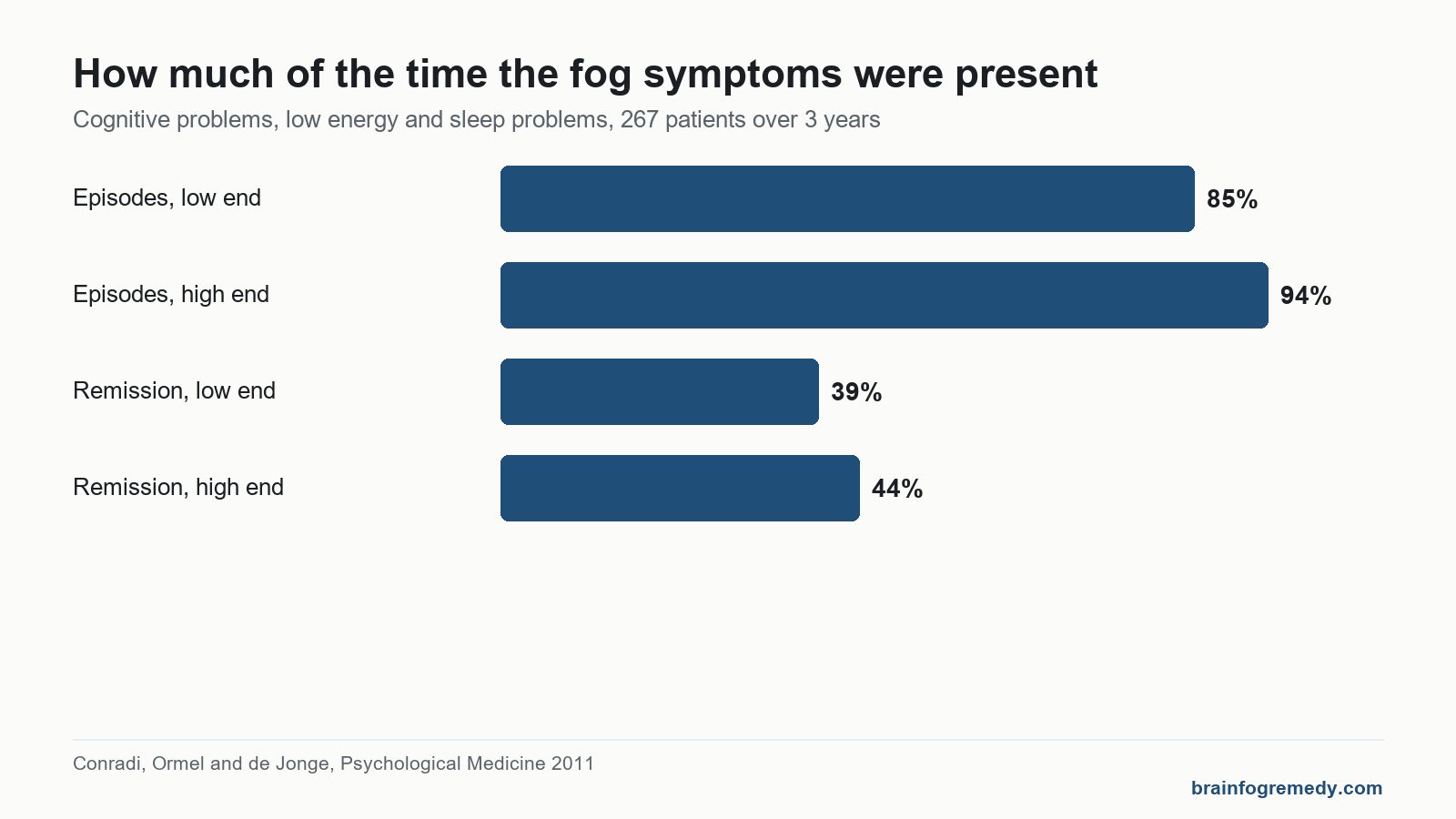
The clearest count comes from a Dutch study published in Psychological Medicine. Researchers followed 267 people who were depressed when they first saw their GP and interviewed them 12 times at three monthly intervals over three years. Three symptoms dominated the whole course: cognitive problems, lack of energy and sleeping problems. Each was present 85 to 94 percent of the time during depressive episodes and 39 to 44 percent of the time during remission. Put simply, for roughly four days in ten after the depression had officially lifted, the fog was still there.
Other groups have counted it different ways and landed in the same place. Here are five of them side by side, with the number of people behind each figure.
| Study | Who and how many | What was counted | The figure |
|---|---|---|---|
| Conradi, Ormel and de Jonge, Psychological Medicine, 2011 | 267 primary care patients, assessed 12 times over 3 years | How much of the time each depressive symptom was present, in episodes and in remission | Cognitive problems, low energy and sleep problems: present 85 to 94 percent of the time in episodes, 39 to 44 percent in remission |
| Rock, Roiser, Riedel and Blackwell, Psychological Medicine, 2014 | A meta-analysis of studies using the same computerised test battery | Test scores against people without depression | Moderate deficits in executive function and attention that persisted after mood recovered (effect sizes 0.52 to 0.61) |
| Matcham and colleagues, Psychological Medicine, 2022 | 508 adults with recurrent depression, tracked repeatedly | Who had thinking difficulties at more than 75 percent of check points | About 40 percent on objective tests; about 20 percent by their own report |
| Rose and colleagues, Journal of Psychiatric Research, 2021 | 123,452 US adults in a national health survey | Confusion or memory loss happening more often or getting worse in the past year | 25.7 percent of people with a depression history, against 6.3 percent without |
| Journal of Participatory Medicine, 2019 | 17,166 patient records, plus a survey of 2,525 people | How patients rated their own symptoms and priorities | 28 percent rated difficulty concentrating as severe; 23 percent (118 of 508 asked) named thinking symptoms a treatment priority |

Two cautions apply. The Dutch abstract gives one range for the three symptoms rather than a separate figure for each, so thinking problems sit somewhere inside it rather than at an exact point. And the survey figure of 25.7 percent counts people with any history of depression, not people who are depressed now. Neither weakens the pattern; both are reasons not to quote a single number as if it were exact.
Does depression fog show up on memory and attention tests?
Often, though not always in the way people expect. The 2014 meta-analysis by Rock and colleagues pooled studies that used the same computerised test battery and found moderate deficits in executive function, memory and attention in people with depression. In people whose mood had recovered, the deficits in executive function and attention were still there, which led the authors to conclude that the thinking problems are partly separate from the low mood itself.
The more recent RADAR-MDD analysis adds an awkward twist. Of 508 adults with recurrent depression, about 40 percent had objective thinking difficulties at more than three quarters of their check points, but only about 20 percent reported high difficulty that often themselves. The two measures agreed only weakly. Some people feel foggy and test normally; others test below par and do not notice. Neither is a sign of exaggeration or denial. It is a reason a short memory test in a clinic can miss what a person is living with.
Why does nobody seem to ask about the fog?
Partly because it is easy to file under “it will lift when the mood does”. In the US survey of 123,452 adults, only a minority of people with depression and worsening memory or confusion had discussed it with a health professional, from 44.5 percent of those aged 18 to 29 down to 23.0 percent of those 75 and over. In a 2019 patient survey, fewer than a quarter of those asked named thinking symptoms as a treatment priority, even though more than a quarter rated their concentration problems as severe.
The clinicians’ side of it was explored in a UK qualitative study of 12 health and social care professionals, including GPs, psychiatrists and mental health nurses. They described difficulty screening for it, partly because the tools to hand were built for dementia and may not pick up the subtler deficits of depression. That is not a failure of any one doctor. It is a gap between the symptom and the tools, and it means the fog often has to be raised by the person living with it. Our guide on how to describe brain fog so it is taken seriously was written for exactly that conversation.
It is also worth knowing what will not help with that conversation: the six question online quiz that diagnoses you before the kettle boils, or the nootropic stack promising focus by Friday. Neither has been tested on depression fog, and neither can replace an appointment.
What do people with depression say the fog is like?
The University of Oxford’s Health Experiences Research Group publishes filmed and recorded interviews with people about their illness. We read two of its depression pages and one 2025 interview study. These are what people report, paraphrased, not findings, and they say nothing about anyone else’s cause.
On the adult depression page (last reviewed September 2017), a 33 year old man described realising he needed help when he could no longer hold enough concentration to read a storybook aloud to his young daughter. A 39 year old woman described her mind racing while everything also seemed to run in slow motion, which made decisions hard. A 50 year old man described feeling confused and not functioning, and losing about an hour in a supermarket with no memory of it.
On the young people’s depression page (last reviewed July 2025), a 26 year old woman described constantly forgetting where things were and losing track of what she was saying mid sentence. In a 2025 study of 12 British South Asian adults aged 45 to 60 with recurrent depression, participants said trouble with attention left them feeling not present with the people around them, and that learning new things had become hard enough to affect their work.
Not everyone on those pages described slowness. Several younger interviewees described the opposite kind of trouble: a mind that would not stop, running through worst cases and turning good things bad. So the accounts agree with the guideline that thinking changes in depression, but they show it can feel like too little traffic or far too much. A single phrase like brain fog hides that range. If the racing kind sounds more familiar, our page on what the studies measured about anxiety and brain fog may fit better.

What does the NICE guideline say about getting help?
The NICE guideline sets out a range of first options for less severe depression, including guided self help, talking therapies, group exercise and medication, chosen with the person rather than for them. None of them is specific to the fog, and this page is not a guide to choosing among them. What it does mean is that the fog is part of a condition with recognised, evidence based routes to help, which is more than any brain detox can say.
Low mood with a foggy head that has lasted more than a couple of weeks is worth taking to a GP. Mention the thinking problems by name, because, as the surveys above show, they often go unmentioned. If the fog has stayed after your mood improved, say that too. If you are having thoughts of harming yourself, this is urgent, and the table below shows where to go.
| Situation | Where the NHS and crisis services point you |
|---|---|
| Low mood or a foggy head that has lasted more than a couple of weeks | Your GP, or an NHS talking therapies service in England |
| You need urgent help for your mental health but no one is in immediate danger | NHS 111, choosing the mental health option, or an urgent GP appointment |
| Someone’s life is at risk, or you do not feel you can keep yourself safe | Call 999 or go to A&E now |
| You want to talk to someone, any time, in the UK or Ireland | Samaritans on 116 123, free |
| You are in the United States | Call or text 988, the 988 Suicide and Crisis Lifeline |
For the wider picture, our pages on emotional exhaustion and the fog that comes with it and on a head that feels heavy and foggy cover overlapping ground. Nothing here can tell you what is behind your own symptoms; a clinician who can ask about them can.
Before a GP appointment: points to mention
Built from what the surveys on this page found often goes unsaid. It helps you prepare what to say; it does not score, assess or explain anything.
Ticks stay on this device. If you are having thoughts of harming yourself, call 999, NHS 111 with the mental health option, Samaritans on 116 123, or 988 in the US.
Frequently asked questions
Can depression make you feel like you are losing your memory?
Many people with depression report forgetting things and losing track mid sentence, and studies find measurable memory and attention deficits. Memory problems have many possible causes, so they are worth raising with a GP rather than assuming the cause.
Does brain fog from depression go away?
For many people it eases as mood improves, but not for everyone. A three year Dutch study found thinking problems, low energy and sleep problems together still present 39 to 44 percent of the time in remission.
Is depression brain fog the same as dementia?
They are different conditions. UK professionals interviewed in a recent study noted that dementia screening tools may not be sensitive to the thinking problems of depression. Only a clinician can assess which, if either, applies.
Why do I feel foggy even though my mood is better?
Research shows some thinking deficits can persist after low mood lifts. This page cannot say why that is happening to you; it is worth telling your GP, because residual symptoms are discussed in depression care.
Do antidepressants cause brain fog?
Some people report thinking changes on medication, and telling medicine side effects apart from depression symptoms can be hard. Do not stop or change a medicine without speaking to the prescriber.
Will a brain supplement fix depression fog?
No supplement is recommended for it in the NICE depression guideline, and none of the studies on this page tested one. The guideline’s options are talking therapies, exercise, self help and medication.
Finished the page? The same five questions from the top, to see what stuck.
This article is general information, not medical advice, and is not a substitute for care from a qualified healthcare professional. Speak to your doctor about your own situation.
Leave a Reply