
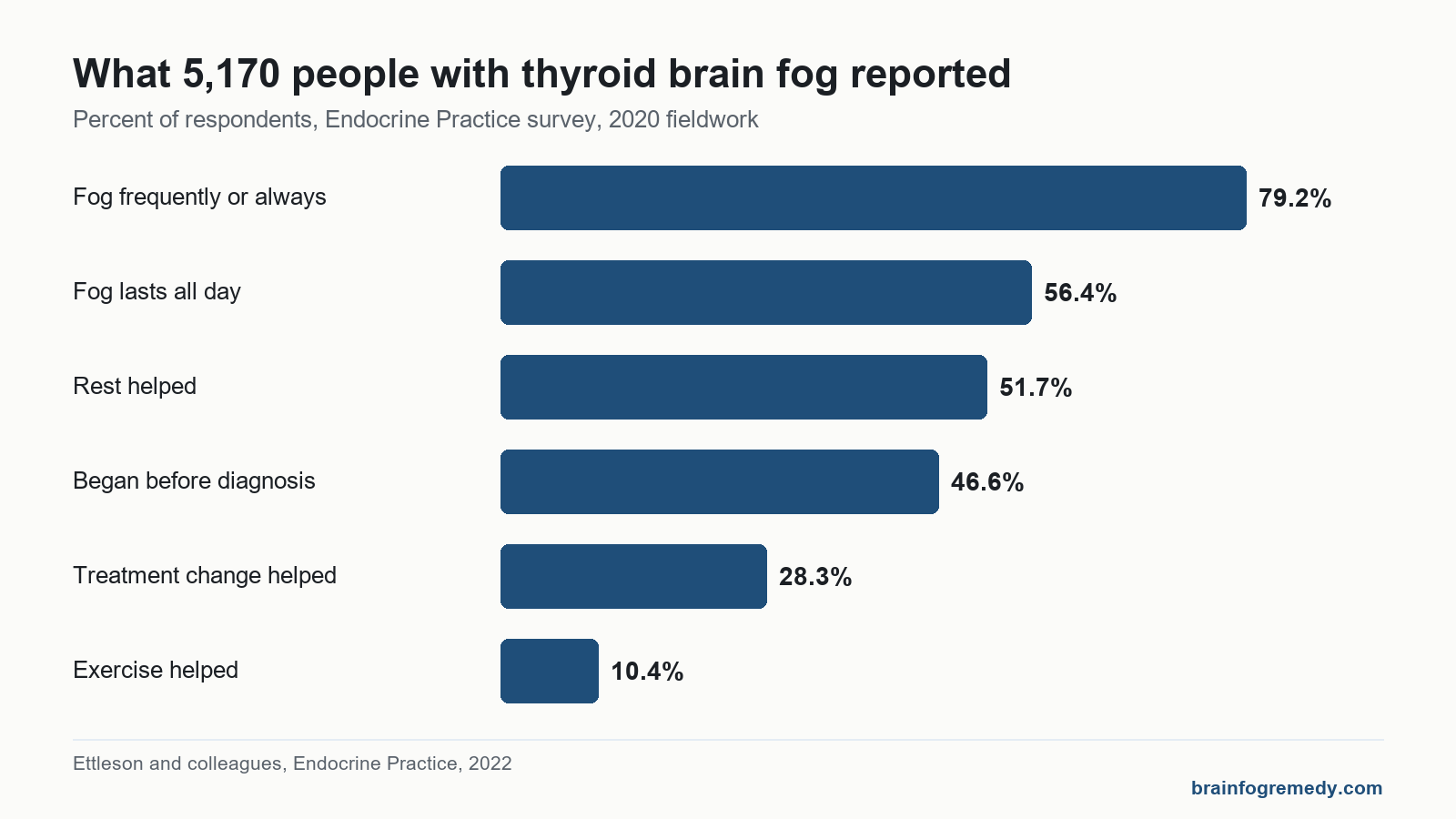
Thyroid brain fog is real enough to have its own survey: of 5,170 people treated for hypothyroidism who reported it, 79.2 percent had it frequently and 46.6 percent said it began before diagnosis. A thyroid blood test can show whether the gland is involved, but a normal result does not always end the fog.
Listen to this article, about 12 minutes. A synthetic voice reads the article and announces each section title as it begins; tables are read row by row and the questions at the end are left out.
Recorded 10 October 2026 from the article as published that day. Press a chapter to jump there; the highlighted line is what is playing. A play button sits beside every section heading, and once you scroll past this player a bar at the bottom of the screen keeps the controls in reach. Tap or click any sentence to hear the reading start from there.
On this page: the published figures from the 5,170 person thyroid brain fog survey, eight NICE NG145 testing recommendations quoted by number, the four explanations for fog that outlasts a normal result, and five patient accounts from the British Thyroid Foundation.
Think you already know this? Five questions, one minute.
Every answer is on this page. Answer from what you know now; the page fills in the rest.
-
1. In the 2025 meta-analysis of 85 studies, roughly what share of people with hypothyroidism scored in the impaired range on the common screening test?
The Pankowski meta-analysis gave a pooled prevalence of 0.29, with the authors warning of large differences in how studies reported results. Read the section
-
2. What did respondents in the Endocrine Practice survey most often say improved their brain fog?
In the Ettleson survey, more rest was the most common answer, given by 51.7 percent, ahead of treatment adjustment and exercise. Read the section
-
3. According to the Clinical Endocrinology review, how has the most researched explanation, low tissue T3, performed so far?
Perros and colleagues write that decades of work on this hypothesis have failed to yield results that translate to patient benefits. Read the section
-
4. What does the Brain, Behavior, and Immunity review say about thyroid peroxidase antibodies and thinking problems?
The Leyhe and Mussig review reports an association with antibody levels but says the antibodies may only mark an autoimmune process. Read the section
-
5. Why does NICE NG145 recommendation 1.2.11 ask about biotin?
NICE NG145 says high biotin consumption from supplements may lead to falsely high or low test results. Read the section
Most pages on this subject list “brain fog” between dry skin and constipation and move on. This one stays with it: what the largest survey of thyroid patients with brain fog actually counted, what the UK guideline says about testing, quoted by recommendation number, why the fog sometimes outlasts a normal result, and what people living with a thyroid condition have written about it. It cannot tell you whether your own fog is thyroid related. Thyroid is one cause on a fairly short list, and our overview of the causes a doctor usually checks first covers the others.
Can an underactive thyroid really cause brain fog?
Yes, and the NHS says so in plain words. Its underactive thyroid symptoms page lists difficulty concentrating or thinking clearly alongside tiredness, feeling cold, weight gain and low mood, and notes that symptoms usually develop slowly. That slowness is the trap. Thinking that dims over a year does not announce itself; people tend to blame age, work or a toddler.
The measured version comes from a 2025 meta-analysis in Alzheimer’s and Dementia that pooled 85 studies. Across the studies that used the same screening test, about 29 percent of people with hypothyroidism scored in the impaired range, with memory and working memory hit hardest, and higher TSH went with lower scores. The authors flag large differences in how studies reported results and some publication bias, so treat the figure as a rough size, not a precise rate. Lupus research has the same reporting problem, and our page on how the lupus brain fog studies were measured lines the disagreeing estimates up side by side.
An overactive thyroid can disturb thinking too, but differently. The NHS overactive thyroid page lists nervousness, irritability, difficulty sleeping and feeling tired all the time. People describe that kind as wired and scattered rather than slowed.
What did 5,170 thyroid patients say their brain fog feels like?
The largest study of the question is Ettleson and colleagues, published in Endocrine Practice in 2022. Between 15 September and 26 October 2020, people with hypothyroidism were invited through the American Thyroid Association’s patient database, support websites and social media. The 5,170 who reported brain fog while on treatment were analysed: 95.9 percent were women, the average age was 50.6, and 45.3 percent had Hashimoto’s disease as the cause.
More than 95 percent linked their fog with low energy, forgetfulness, feeling sleepy and difficulty focusing. For 56.4 percent it lasted all day. Asked what helped, 51.7 percent named more rest, 28.3 percent an adjustment to thyroid hormone treatment and 10.4 percent more exercise, according to the journal’s accompanying commentary. Respondents also kept returning to how they were diagnosed and how their doctor listened, things that standard thyroid questionnaires barely ask about.
Two cautions. The sample was self selected, mostly from support groups, so it says what fog is like for people who have it, not how common it is. And an earlier conference version of the same survey, reported by Healio in May 2021, gave 5,282 respondents and different subgroup figures; the published paper’s numbers are the ones used here.
Why can the fog linger when thyroid tests look normal?
Nobody knows for certain, which is more honest than most pages on this admit. A 2018 online survey of 12,146 hypothyroid patients posted on the American Thyroid Association website found a median treatment satisfaction of 5 out of 10, and memory was among the problems respondents reported. Endocrinologists writing in Clinical Endocrinology describe a significant minority who keep symptoms despite normal blood results, and set out four possible explanations.
| Explanation | The idea in one line | Where the evidence stands |
|---|---|---|
| Low tissue T3 | Standard replacement may leave some tissues, the brain among them, short of active hormone | The most researched of the four, and the review says it has not yet produced results that help patients |
| Autoimmune effects on the brain | Inflammation from thyroid autoimmunity, the commonest cause, may affect the brain directly | A proposed mechanism; not settled |
| Other conditions alongside | Physical and psychosocial problems that cluster with hypothyroidism may drive the symptoms | Plausible and, the authors argue, under studied |
| Somatic symptom disorders | A separate condition that coexists with treated hypothyroidism in some people | Raised as a possibility; not a verdict on anyone’s symptoms |

Two practical facts from the guideline sit underneath this. NICE notes that TSH can take up to 6 months to settle after a very high starting level, and that symptoms may lag behind treatment changes by weeks to months. Fog in the first months after diagnosis may simply be early. Fog that persists is something NICE expects to be raised, and changes to treatment are a decision for the prescriber, not for a web page.
Does Hashimoto’s cause brain fog even with normal thyroid levels?
Possibly, and the evidence is thinner than the confident blog posts suggest. A review in Brain, Behavior, and Immunity gathered studies reporting thinking and mood problems in people with Hashimoto’s whose thyroid levels were normal, with some linking the problems to thyroid peroxidase antibody levels. The same review is careful to say the antibodies may only be a marker of something else going on rather than the cause. These are mostly small studies, and none of them can tell an individual reader what is behind their own fog.
A rare and serious condition called Hashimoto’s encephalopathy also exists, with confusion that is far beyond ordinary fog. Sudden confusion, new difficulty speaking or a rapid change in behaviour is a reason to get urgent medical help, whatever the thyroid history.
What does NICE say about testing thyroid function?
The UK guideline is NICE NG145. It does not mention brain fog by name, but several of its recommendations decide whether and how a foggy, tired adult gets tested. Here they are by number.
| NG145 number | What it says, in brief | Why it matters for brain fog |
|---|---|---|
| 1.2.1 | Consider thyroid tests when there is clinical suspicion of thyroid disease, bearing in mind that one symptom alone may not point to it | Fog on its own is a weak signal; fog with the company listed below is a stronger one |
| 1.2.3 | Consider tests for adults with depression or unexplained anxiety | Low mood and anxiety travel with brain fog often enough that NICE names them |
| 1.2.5 | Be aware that in menopausal women, symptoms of thyroid dysfunction may be mistaken for menopause | Midlife fog has two common suspects, and they overlap |
| 1.2.6 | Do not test during an acute illness unless the illness is suspected to be thyroid related | A result taken while you are unwell may mislead |
| 1.2.8 | For most adults, consider TSH alone first, adding free T4 (and free T3 if TSH is low) in the same sample | Explains why many people see only one number on their result |
| 1.2.10 | Consider repeating tests if symptoms worsen or new ones develop, but no sooner than 6 weeks after the last test | A normal result is not a permanent answer |
| 1.2.11 | Ask about biotin intake, because high doses from supplements can make results falsely high or low | A hair and nail supplement can quietly distort the test |
| 1.4.4 | Consider measuring free T4 as well as TSH in adults who still have symptoms after starting levothyroxine | Persistent symptoms on treatment are expected to be raised and looked at |
Two of these surprise people. Recommendation 1.2.11 was added in 2023 because high dose biotin, common in hair and nail products, can push results either way; NICE asks clinicians to ask about it, so mention it. And 1.2.5 is the reason perimenopause brain fog and thyroid fog get confused: they turn up at the same age with nearly the same symptoms.
Questions drawn from NICE NG145 to take to a thyroid appointment
Each item comes from a numbered NICE recommendation. Ticking them interprets nothing; it only helps you remember what to ask.
This list is a memory aid built from the guideline, not a diagnosis or a treatment plan. What applies to you is for your clinician to decide.
What do people living with a thyroid condition actually report?
The British Thyroid Foundation publishes patient stories written by people with thyroid disease. We read five that describe hypothyroidism; four mention brain fog or foggy thinking and one does not. Dates are each page’s last update in the charity’s sitemap. These are personal accounts, not findings.

In a story last updated in June 2024, a man diagnosed five years earlier names brain fog as the hardest part. He says it improved a great deal after diagnosis but that on some Monday mornings he still cannot recall what he did the day before. In an account updated in November 2025, a woman with Hashimoto’s since childhood describes being constantly tired and mentally foggy, made worse by low iron from heavy periods, and says the fog and fatigue improved once her levels were stable.
Another woman, in a story updated in June 2024, put her poor memory and fog down to lack of sleep during years of shifting thyroid results, then a menopause diagnosis; she says the sleep and the fog are still a problem. A fourth, in an account updated in September 2025, listed brain fog among symptoms she only recognised once treatment began, and later attributed new fog to the menopause rather than her thyroid. The fifth, a runner in his sixties, describes tiredness and aching muscles he blamed on age, and no fog at all.
Where these agree with the survey: the fog came on slowly and was blamed on something else first, and treatment helped some but not all of it. Where they add something: two of the five could not separate thyroid fog from menopause, which is exactly the overlap NICE warns about.
If your thinking has slowed along with other changes, the page on extreme fatigue and brain fog and our look at how long brain fog can last may help you describe it to a GP. Nothing here can say what is behind your own symptoms; a clinician who can examine you and order the test can.
Frequently asked questions
Does levothyroxine get rid of brain fog?
For many people symptoms improve on treatment, but in the 2022 survey all 5,170 respondents were already on treatment and still reported fog. Any change to treatment is a decision for your prescriber.
Which blood test checks the thyroid?
NICE suggests most adults start with TSH, with free T4 added if TSH is high and free T3 as well if TSH is low, measured in the same sample. Your doctor decides what is appropriate for you.
Can thyroid brain fog come before the diagnosis?
Yes. In the Endocrine Practice survey, 46.6 percent of respondents said their fog began before they were diagnosed with hypothyroidism.
Is thyroid brain fog the same as dementia?
They are different. Thinking problems linked to thyroid disease are often improved with treatment, while dementia is progressive. Worsening memory of any kind is worth raising with a GP.
Can biotin affect a thyroid test?
Yes. NICE recommendation 1.2.11 notes that high biotin intake from supplements may lead to falsely high or low results, so tell whoever orders the test if you take it.
Does an overactive thyroid cause brain fog too?
It can affect thinking differently. The NHS lists nervousness, irritability, difficulty sleeping and tiredness among its symptoms, which people tend to describe as scattered rather than slowed.
Finished the page? The same five questions from the top, to see what stuck.
This article is general information, not medical advice, and is not a substitute for care from a qualified healthcare professional. Speak to your doctor about your own situation.
Leave a Reply