
Emotionally exhausted symptoms are usually described as feeling drained, flat and detached, waking already tired, and snapping at people you actually like. The part most articles skip is the cognitive one: word finding, losing the thread, rereading the same paragraph. Measured studies find real drops in memory and attention alongside the exhaustion.
Listen to this article, about 11 minutes. A synthetic voice reads the article and announces each section title as it begins; tables are read row by row and the questions at the end are left out.
Recorded 25 September 2026 from the article as published that day. Press a chapter to jump there; the highlighted line is what is playing. A play button sits beside every section heading, and once you scroll past this player a bar at the bottom of the screen keeps the controls in reach. Tap or click any sentence to hear the reading start from there.
On this page: the measured drops in word finding, attention and memory in people with clinical burnout, the ICD-11 line that restricts burnout to work, the r = .80 overlap with depression, and what three long Mumsnet threads told people to do first.
Think you already know this? Five questions, one minute.
Every answer is on this page. Answer from what you know now; the page fills in the rest.
-
1. In the pooled analysis of 17 studies covering 730 people with clinical burnout, which ability showed no measurable difference from healthy controls?
Fluency was 0.53 standard deviations lower and working memory 0.36 lower, while crystallised knowledge and visuospatial ability did not differ, per Gavelin and colleagues in Work and Stress, 2022. Read the section
-
2. How does the eleventh revision of the International Classification of Diseases describe burn-out?
The WHO’s ICD-11 note defines it by energy depletion, mental distance and reduced efficacy, and says it should not be applied outside the occupational context. Read the section
-
3. Across 14 samples and 12,417 people, how strongly did exhaustion correlate with depressive symptoms?
That is the figure from Bianchi and colleagues in Clinical Psychological Science, 2021; other researchers still treat the two as related but distinct, and the disagreement is unresolved. Read the section
-
4. What did repliers in the three Mumsnet threads most often suggest first?
In the April 2021 thread and the two others, tests came first, though repliers also named specific causes from a paragraph of text, which nobody can do. Read the section
-
5. According to NHS guidance, when should tiredness take you to a GP?
The NHS page on tiredness and fatigue also names weight loss, changes in mood, and gasping or choking noises in sleep as reasons to go sooner. Read the section
What do emotionally exhausted symptoms actually feel like?
The descriptions that repeat are less about sadness than about flatness. People report an emotional blank where a reaction used to be, dread in front of ordinary small tasks, irritability aimed at people they are fond of, and sleep that does not seem to repay anything. The tank is not low. The gauge has stopped working.
What almost every guide buries in a single bullet is the thinking part. Losing the thread halfway through your own sentence. Reading a page and arriving at the bottom with nothing. Reaching for a word you have used ten thousand times and finding the shelf empty. If that is the symptom that finally made you search, you are not the only one, and it belongs in the list rather than in a footnote. We have written separately about what brain fog actually feels like from the inside and about the mental fog feeling people describe when the words stop arriving on time.
One caution before the rest of the page. No six question quiz can tell you what is happening to you, however confidently it prints a score, and neither can this article. What follows is what people report and what has been measured.
Do emotionally exhausted symptoms include measurable thinking problems?
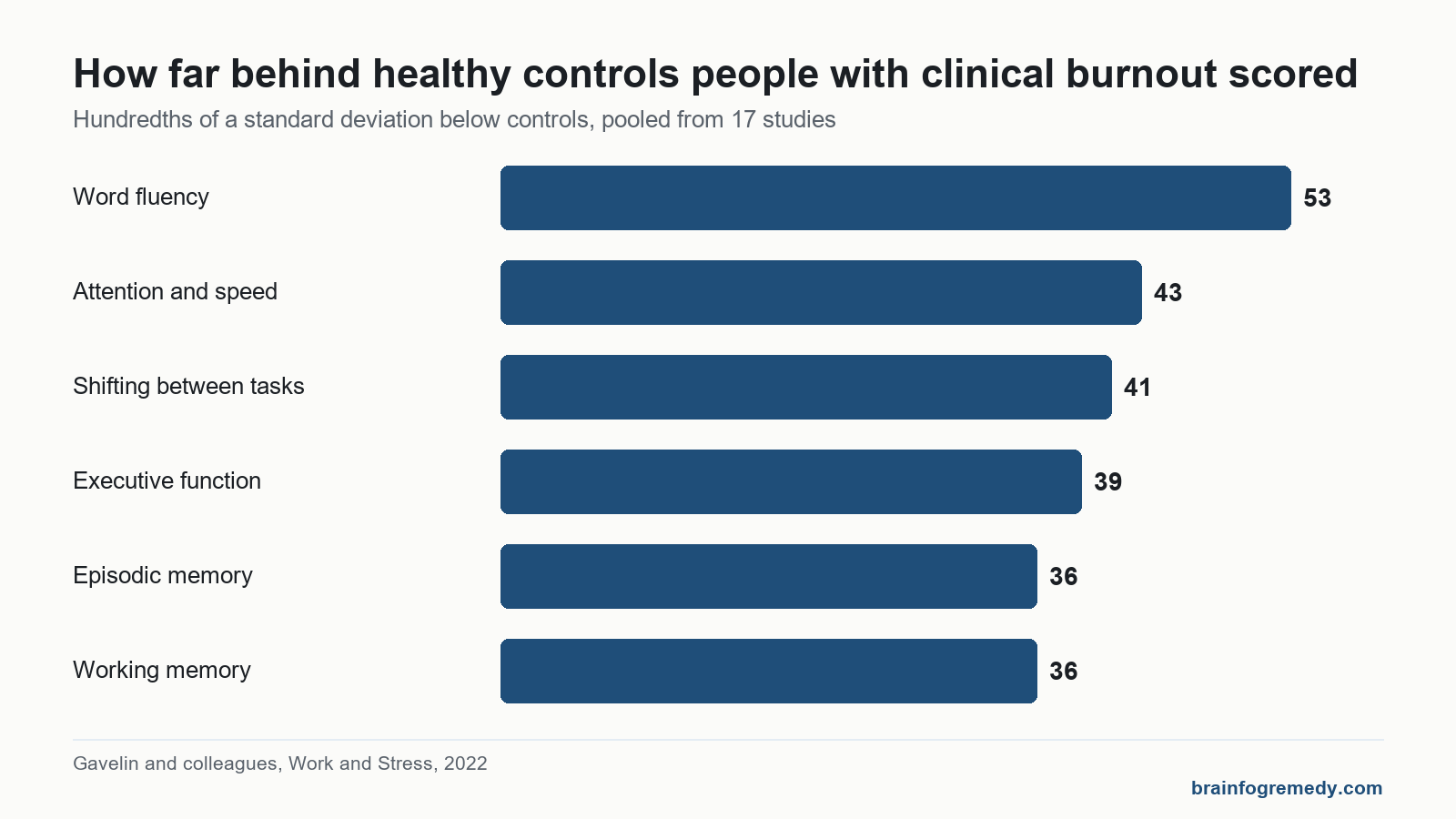
Yes, at least in people exhausted enough to reach a clinic. A systematic review and meta analysis of 17 studies, covering 730 patients with clinical burnout and 649 healthy controls, published in the journal Work and Stress by Gavelin and colleagues, 2022, found consistent deficits across several cognitive domains. The effects are small to moderate rather than dramatic, which is worth saying plainly, because a small average effect can still be the difference between following a meeting and not.
| What was measured | How clinical burnout patients compared with controls | Source |
|---|---|---|
| Fluency, finding words on demand | 0.53 standard deviations lower | Gavelin and colleagues, 2022 |
| Attention and processing speed | 0.43 standard deviations lower | Gavelin and colleagues, 2022 |
| Executive function overall | 0.39 standard deviations lower | Gavelin and colleagues, 2022 |
| Episodic memory, recalling events | 0.36 standard deviations lower | Gavelin and colleagues, 2022 |
| Short term and working memory | 0.36 standard deviations lower | Gavelin and colleagues, 2022 |
| Mental shifting between tasks | 0.41 standard deviations lower | Gavelin and colleagues, 2022 |
| Crystallised knowledge, what you already know | No measurable difference | Gavelin and colleagues, 2022 |
| Visuospatial ability | No measurable difference | Gavelin and colleagues, 2022 |
The shape of that table is the interesting bit. Things you already know stayed intact. The machinery for handling new material, holding it, switching between it and retrieving the right word did not. That matches what people describe when they say they can still do their job but cannot learn anything new this month.

Outside clinic populations the picture is thinner. A longitudinal study of 100 apparently healthy teachers, Feuerhahn and colleagues in Stress and Health, 2013, found emotional exhaustion related to worse mental performance on self ratings, on ratings by colleagues and on a learning and memory test, all at conventional significance. When the same authors looked across time rather than at a single moment, the effects only reached trend level. So the association is well documented; the direction it runs in over months is not settled, and anyone telling you which causes which is ahead of the evidence.
Is emotional exhaustion the same thing as burnout?
Not quite, and the gap matters more than it sounds. Emotional exhaustion is one component of burnout rather than the whole of it. Burn-out itself sits in the eleventh revision of the International Classification of Diseases as an occupational phenomenon, explicitly not classified as a medical condition, defined by energy depletion, mental distance or cynicism about your job, and reduced professional efficacy.
Here is where this site parts company with most of the pages ranking for this search. They apply burnout to parenthood, caregiving, relationships and grief. The classification text says the opposite in one sentence: burn-out refers specifically to phenomena in the occupational context, and should not be applied to describe experiences in other areas of life. You can think that rule is too narrow. Plenty of clinicians do. But an article that calls your exhausted parenting burnout, without mentioning that the classification it is borrowing from forbids exactly that use, has quietly handed you a label that no doctor can write down. Sweden went the other way and wrote a stress diagnosis that counts home as well as work, and our guide to what nervous exhaustion means today, with the Swedish exhaustion disorder criteria sets it beside the WHO wording.
| Question | Emotional exhaustion | Depression |
|---|---|---|
| Is it a diagnosis? | No, it is a measured component of burnout | Yes, a clinical diagnosis |
| Where does it apply? | Defined for the occupational context in ICD-11 | Any area of life |
| Core reported feeling | Depleted, flat, nothing left to give | Low mood, loss of pleasure, often hopelessness |
| How separate are they? | Contested, see below | Contested, see below |
| Who can tell them apart? | A qualified professional, not a website | A qualified professional, not a website |
Could this be depression rather than exhaustion?
It is a fair question and the research does not resolve it neatly. A meta analytic and bifactor study across 14 samples and 12,417 people, Bianchi and colleagues in Clinical Psychological Science, 2021, reported that exhaustion, the core of burnout, correlated with depressive symptoms at 0.80 on a scale where 1.0 would mean identical, and that controlling for fatigue did not reduce the overlap. Their reading is that burnout overlaps with depression to a degree that makes the separation hard to defend.
Other researchers treat them as related but distinct. The disagreement is real and unresolved. What follows from it is practical: the two things that most need telling apart here are the two the field itself finds hardest to separate, so this is not a label to apply to yourself from a webpage. If your mood has changed as well as your energy, that is a conversation to have with a doctor.

What do people describing these symptoms online actually report?
We read three long public threads on Mumsnet, carrying roughly twenty replies between them, of which about ten described the writer’s own experience. These are accounts, not evidence, and nobody’s blood results generalise to yours. What they show is a pattern in how people respond, and it is not the pattern the wellness articles predict.
In an April 2021 thread, a poster in her mid thirties described losing the thread in meetings, managing only a few minutes of reading, groping for words and feeling, in her phrase, dull and slow. She put it down to lockdown and a job change. Two repliers said the same picture had turned out to be B12 deficiency for them and resolved with injections. Others raised early perimenopause and undiagnosed ADHD. One reply cut the other way and attributed hers to stress, phone use and no exercise, reporting that it improved with changes to all three.
A February 2023 thread ran the same way. A poster in her early forties described a month of not retaining anything, repeating tasks without realising, and waking at four in the morning, following a dying grandmother, a work reorganisation and a bout of COVID. Replies named pernicious anaemia in a relative with the identical picture, severe B12 deficiency where the fog began lifting after loading doses, a long standing medication, ADHD and perimenopause. One reply reported post COVID fog that simply cleared within weeks.
An October 2020 thread came from a lawyer with three years of episodic fatigue and fog, needing two naps a day, whose tests had shown low vitamin D and a thyroid stimulating hormone reading of 6.2. Almost every reply pushed thyroid function and pernicious anaemia, several from people describing their own results and how they felt after treatment.
The pattern across all three is that when someone says they are exhausted and cannot think, the crowd’s first instinct is blood tests, not bath salts. That agrees with official guidance, which also treats unexplained persistent tiredness as something to investigate. Where they part company is confidence: repliers name a specific cause from a paragraph of text, which nobody can do, and the dramatic explanations draw more replies than the two accounts that resolved without any diagnosis at all.
When do emotionally exhausted symptoms need a doctor?
The NHS guidance on tiredness and fatigue says to see a GP if you have felt tired for a few weeks and do not know why, or if the tiredness is stopping you managing everyday activities. It names weight loss, changes in mood, and gasping, snorting or choking noises during sleep as reasons to go sooner. The conditions it lists as worth ruling out include sleep apnoea, iron deficiency anaemia, diabetes, an overactive thyroid, and myalgic encephalomyelitis or chronic fatigue syndrome, which involves extreme fatigue lasting at least three months.
None of that means your exhaustion is one of those things. It means the list is checkable, which is more than any article can offer. It helps to arrive with specifics, and our piece on how to describe mental fogginess to a doctor covers what to write down beforehand. Where fatigue and fog arrive together, what that combination usually prompts a clinician to check may also be useful.
If the exhaustion comes with thoughts of harming yourself, or you cannot keep yourself safe, contact your doctor or emergency services now rather than reading further.
What to write down before an appointment about exhaustion and fog
The NHS list of reasons to see a GP and the forum threads on this page point at the same thing: arrive with specifics. Tick each item once it is on paper.
A list of what to bring, not a way of working out what is causing it. Ticks are saved on this device only.
Frequently asked questions
How long do emotionally exhausted symptoms usually last?
There is no reliable published figure, because emotional exhaustion is not a diagnosis with a defined course. Reported experiences range from weeks to years, and the research on recovery is thin. Persistent exhaustion with no obvious explanation is a reason to see a doctor rather than to wait it out.
Is emotional exhaustion an official medical diagnosis?
No. Emotional exhaustion is a measured component of burnout, and burnout itself is listed in ICD-11 as an occupational phenomenon rather than a medical condition. That is why a doctor will look for something else that is diagnosable and treatable before settling on it as a description.
Can emotional exhaustion cause memory loss?
Research on people with clinical burnout finds small to moderate reductions in episodic, short term and working memory compared with healthy controls. That is a measured group difference, not a cause established in any individual, and memory changes that worry you should be assessed rather than attributed.
Will a blood test show emotional exhaustion?
No test detects it. Blood tests are used to look for other explanations for exhaustion and fog, such as thyroid function, iron levels and B12, which is why forum threads on this topic fill up with people telling each other to get bloods done. What gets tested is a decision for a doctor.
Can you be emotionally exhausted without a demanding job?
People certainly describe it, and caregiving, illness and bereavement come up constantly in public threads. The ICD-11 definition of burnout is restricted to the occupational context, so the label does not formally travel outside work, even though the reported experience clearly does.
Does emotional exhaustion get better on its own?
Some public accounts describe it lifting after a change in circumstances, and others describe years without much change. There is no published recovery rate to quote, and the honest answer is that nobody can tell you which of those you are in from a description.
Finished the page? The same five questions from the top, to see what stuck.
This article is general information, not medical advice, and is not a substitute for care from a qualified healthcare professional. Speak to your doctor about your own situation.
Leave a Reply