
A brain fog headache usually has an ordinary driver, such as poor sleep, a missed coffee, dehydration, a migraine or a virus. The combination still matters: NICE lists new thinking problems alongside a headache as a reason for a clinician to assess, and the NHS says a sudden severe headache with confusion needs 999.
Listen to this article, about 12 minutes. A synthetic voice reads the article and announces each section title as it begins; tables are read row by row and the questions at the end are left out.
Recorded 3 October 2026 from the article as published that day. Press a chapter to jump there; the highlighted line is what is playing. A play button sits beside every section heading, and once you scroll past this player a bar at the bottom of the screen keeps the controls in reach. Tap or click any sentence to hear the reading start from there.
On this page: the red flag wording from the NICE headache guideline and the NHS quoted and dated in one table, set beside what three ranking pages lead with, plus what people in the Oxford long covid interviews described.
Think you already know this? Five questions, one minute.
Every answer is on this page. Answer from what you know now; the page fills in the rest.
-
1. Which of these appears word for word in the NICE CG150 list of headache features that call for evaluation?
NICE CG150 lists new-onset cognitive dysfunction and change in personality among thirteen features that call for evaluation and consideration of further tests or referral. Read the section
-
2. Of the three ranking pages checked on 28 September 2026, how many put urgent warning signs in front of the reader?
The Cleveland Clinic, Ubie and Global Healthy Living Foundation pages open with what brain fog is or what might cause it, and none carries an urgent care threshold. Read the section
-
3. In the 2004 review of caffeine withdrawal, how long did symptoms typically last?
The review in Psychopharmacology found symptoms typically began 12 to 24 hours after the last dose, peaked in the first day or two and lasted 2 to 9 days. Read the section
-
4. For paracetamol, aspirin or an anti inflammatory, how often does NICE say use becomes a medication overuse concern, over three months or more?
NICE CG150 gives 15 or more days a month for these, and 10 or more days a month for triptans, opioids, ergots or combination painkillers. Read the section
-
5. For how long does NICE suggest a headache diary is kept, when one is used?
NICE CG150 asks for at least 8 weeks, recording frequency, duration and severity, associated symptoms, all medicines taken, possible triggers and any link to periods. Read the section
Which brain fog and headache combinations need help today?
This is the part most pages leave until last, so it goes first here. The NICE headache guideline, CG150, which tells UK clinicians which headaches to investigate, lists thirteen features that call for evaluation and consideration of further tests or referral. Two of them are about thinking: “new-onset cognitive dysfunction” and “change in personality”. A third, “impaired level of consciousness”, covers someone who is drowsy or hard to rouse.
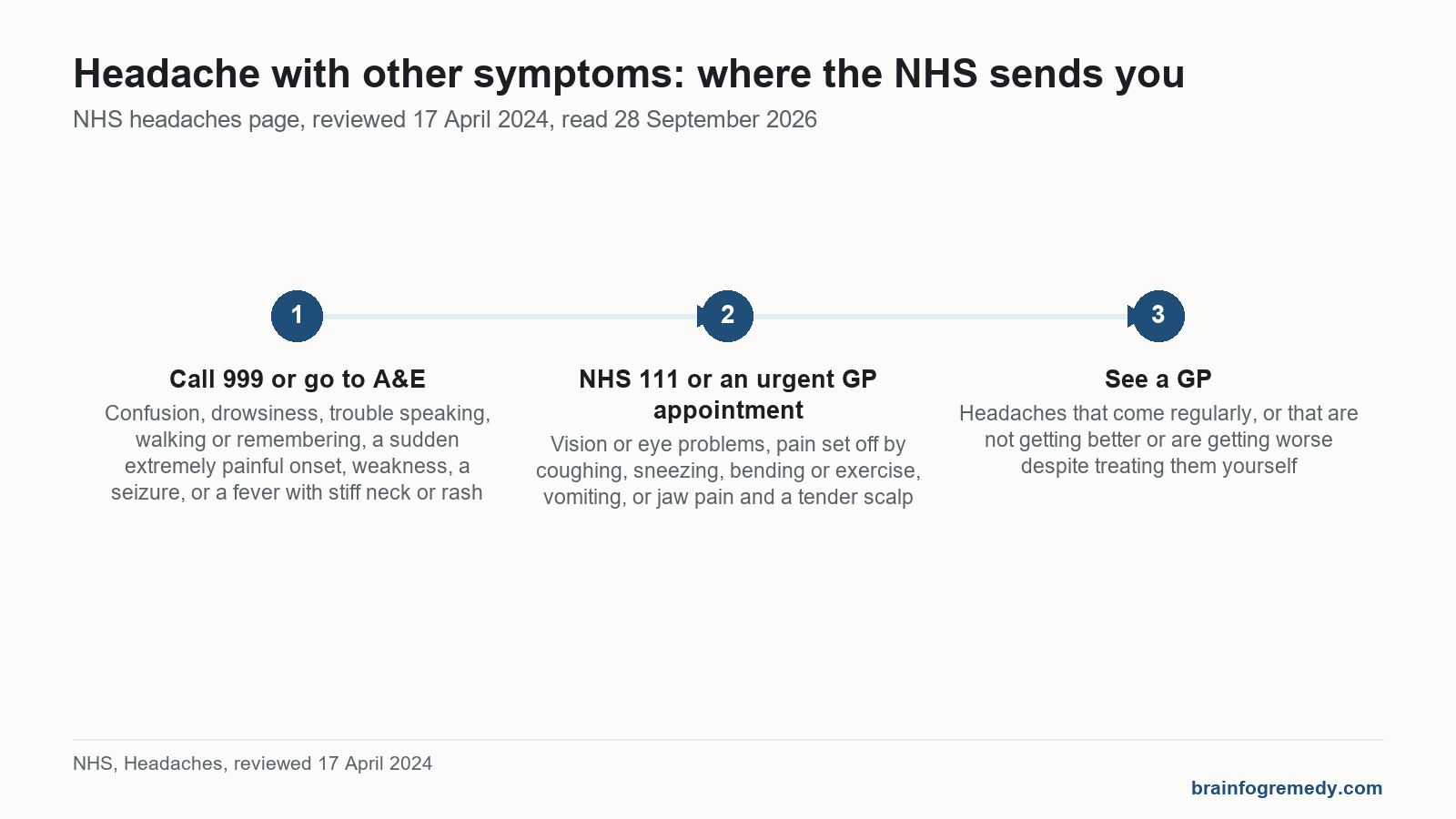
The NHS headaches page turns this into plain instructions. Call 999 or go to A&E for a headache with difficulty speaking, walking or remembering, drowsiness or confusion, a sudden and extremely painful onset, numbness or weakness, a seizure, loss of vision, a rash that does not fade under a glass, or a very high temperature with a stiff neck. The same confusion, memory loss and trouble finding words appear on the NHS stroke symptoms list. In the US the number is 911.
| Feature alongside a headache | Exact wording in the source | What the source says to do |
|---|---|---|
| Thinking problems that are new | NICE CG150: “new-onset cognitive dysfunction” | A clinician should evaluate and consider investigations or referral |
| A change in who someone seems to be | NICE CG150: “change in personality” | A clinician should evaluate and consider investigations or referral |
| Drowsy, confused or hard to rouse | NICE CG150: “impaired level of consciousness”; NHS: drowsiness, confusion | Call 999 or go to A&E |
| Trouble speaking, walking or remembering | NHS headaches page | Call 999 or go to A&E |
| Pain that peaks almost at once | NICE CG150: “sudden-onset headache reaching maximum intensity within 5 minutes” | NHS: call 999 or go to A&E for a sudden, extremely painful headache |
| Fever, stiff neck, light hurting, a rash that does not fade | NICE CG150: “worsening headache with fever”; NHS lists the rest | Call 999 or go to A&E |
| A knock to the head in recent months | NICE CG150: “recent (typically within the past 3 months) head trauma” | NHS: 999 or A&E for a head injury within the last 3 months with a headache |
| Pain set off by coughing, sneezing, bending or exercise | NICE CG150 and NHS | NHS 111 or an urgent GP appointment |
| Vision or eye problems, jaw pain when eating, a tender scalp | NHS headaches page | NHS 111 or an urgent GP appointment |
| Better outdoors, worse in one building | NHS carbon monoxide page | 111 if suspected; 999 for sudden confusion or breathing trouble |
The row most people would not guess is the last one. The NHS carbon monoxide page lists headache, tiredness and confusion among the symptoms and notes they may get worse in an affected room or building and better when you leave or go outside. A headache and fog that lift every time you leave the house is a pattern worth mentioning to 111, and the page gives the gas emergency number, 0800 111 999.
The same day checklist, in the guidance’s own words
Each line is taken from the NHS headaches page or the NICE headache guideline. Nothing here scores or diagnoses anything. If any line is true with a headache, the NHS says call 999 or go to A&E; in the US, call 911.
One tick is enough to act on. This list is not a way to rule anything out: if you are worried and nothing here is ticked, NHS 111 or a GP is still the route.
What do the top pages lead with instead?
Search this phrase and the answer arrives as a list of possible causes: thyroid, anxiety, lupus, a brain injury, an infection, sometimes all of them before the first scroll. A list of ten causes is impossible to argue with and almost impossible to use at eleven at night. What the person typing it actually needs first is the line between wait and see and get seen today, and on the three ranking pages checked for this article that line is missing.
| Page ranking for this search | What it opens with | What it says about urgent signs |
|---|---|---|
| Cleveland Clinic: brain fog | What brain fog is and what it feels like | Headache is not mentioned; the doctor section is near the end and covers routine care only |
| Ubie: foggy head and headache | A short answer naming cluster headaches, thyroid problems, brain injury or infection | No section on urgent or emergency signs |
| Global Healthy Living Foundation: migraine and brain fog | How brain fog feels during migraine | No mention of when to seek urgent care |
None of this makes those pages wrong. It makes them the second thing to read, after the table above.
Why do headaches and brain fog so often arrive together?
Because a lot of ordinary things cause both, and the unglamorous ones are the most common. The NHS lists colds and flu, stress, drinking too much alcohol, poor posture, eyesight problems, skipped meals, dehydration, painkiller overuse, periods and menopause as common headache causes. Several of those turn up on any list of fog causes too, which is why sleep and dehydration are worth ruling out before anything exotic.
Caffeine is the neatest example. A 2004 review of caffeine withdrawal in Psychopharmacology found ten symptoms that met its validity criteria, including headache, fatigue, difficulty concentrating and, in so many words, feeling foggy and not clearheaded. Symptoms typically began 12 to 24 hours after the last dose, peaked in the first day or two and lasted between 2 and 9 days. Anyone who has tried to quit coffee on a Monday will recognise the week. Our piece on whether too much caffeine causes brain fog covers the other direction.
Migraine is another. The NHS describes a headache phase, but the attack does not end when the pain does. In a three month electronic diary study in Neurology of 120 people with migraine, 81% reported at least one symptom after the pain had gone, with tiredness and difficulty concentrating the most common, and in 93% of attacks people were back to normal within 24 hours.
Long covid lists both. The NHS long covid page names problems with memory and concentration, which it calls brain fog, among the most common symptoms, and headaches among the others. After a head injury, the NHS says symptoms can last up to two weeks and to see a GP if they go on longer. Which of these, if any, applies to a particular person is a question for a clinician, not for a list, and not for the six question quiz on a supplement site that somehow always ends in a product.
Could painkillers be keeping both going?
It is one of the more checkable possibilities and one of the least discussed. NICE tells clinicians to be alert to medication overuse headache in people whose headache developed or worsened while taking triptans, opioids, ergots or combination painkillers on 10 or more days a month, or paracetamol, aspirin or an anti inflammatory on 15 or more days a month, for three months or more. The NHS lists overuse of painkillers among common headache causes.

Whether any of this applies is a conversation for a pharmacist or GP, who can look at everything being taken, including tablets bought off the shelf. Do not stop or cut a prescribed medicine on your own because of this.
What do people with long covid headaches and brain fog report?
This section is testimony, not evidence. The research tools used for this article could not reach Reddit, where most first hand accounts of this pairing sit, so it draws on the University of Oxford health experiences archive, which publishes dated interviews, plus one public Q and A thread, all read on 28 September 2026. The Oxford interviews date from 2021, which is worth bearing in mind: they describe the first wave, not what long covid care looks like now. No reported cause or outcome below applies to anyone else.
- Anthony, 66 when interviewed for the University of Oxford health experiences archive in November 2021, described two kinds of headache after an infection in March 2020: early ones with flashing lights in a horseshoe shape, and later sudden, severe ones that sent him to a dark, quiet room and were worse lying down. He said he could no longer concentrate well enough to read, and that a lack of concentration was one of the first signs his energy was running out.
- Adele, 37 when interviewed for the same archive in May 2021, described headaches that came on when she stood up, migraines and flashing lights. At her worst she could not read, follow a recipe or work out the washing machine, and struggled to find words. Fourteen months after infection she said her thinking had definitely improved, though conversations still tired her.
- On the archive’s long Covid symptoms page, a man of 60 compared the feeling to a mild hangover that people call brain fog, alongside dizzy spells and ringing in the ears, and a woman of 59 described nerve pain in her head striking up to three times a minute.
- In a Quora thread asking why someone had mild headaches and brain fog every day, the answers from strangers ranged across sleep, caffeine, dehydration, allergies and thyroid problems, which is roughly what happens when a symptom pair meets the internet.
The range ran from Adele, who reported her thinking had clearly improved within fourteen months, to Anthony, still unable to read for long at around twenty months. What the Oxford accounts share is detail: which position made the headache worse, what the fog stopped them doing, how the two moved together. That agrees with the guidance, which asks for exactly those details. The caution the accounts need beside them concerns the sudden, severe kind Anthony described: a sudden, extremely painful headache is on the NHS 999 list whatever else is going on, and a history of long covid is not a reason to wait it out.
What should you tell a GP about a headache with brain fog?

Specifics beat adjectives. NICE suggests clinicians consider a headache diary kept for at least 8 weeks, recording how often headaches come, how long they last and how bad they are, any symptoms that come with them, every medicine taken for them including ones bought over the counter, possible triggers, and any link to periods. Adding a line on the fog, such as losing words, losing the thread of a conversation, or reading the same paragraph three times, gives a GP something to work with. Our guide to describing brain fog so a doctor takes it seriously goes further on the wording.
If the headache comes with vision changes, our piece on brain fog and blurred vision sets out the eye side, and a head that feels heavy and foggy covers the pressure sensation many people describe. For fog that followed an infection, covid brain fog covers what the studies found.
If low mood, hopelessness or thoughts of self harm are part of what is happening, that needs medical attention now, not after the diary.
Frequently asked questions
Can a tension headache make it hard to think?
Tension headaches are commonly reported as making concentration harder, much as any steady pain pulls attention. The NHS lists stress and poor posture among common causes. A headache that keeps getting worse, or that is not helped by the usual measures, is a reason to see a GP.
Is a headache with brain fog a sign of a brain tumour?
It is far more often something common, but no article can rule anything out for an individual. NICE tells clinicians to evaluate headache with new thinking problems or a change in personality, so that combination is worth a GP appointment rather than a search engine.
Can sinus problems cause head pressure and fog?
Colds and flu are on the NHS list of common headache causes, and feeling blocked and foggy with a cold is commonly reported. If pain comes with a very high temperature, a stiff neck or a rash, the NHS says to call 999.
How long does the fog after a migraine last?
In a Neurology diary study of 120 people with migraine, 93% of attacks were back to normal within 24 hours of the pain ending. Fog that lasts much longer than that, or keeps coming back, is worth recording and discussing with a GP.
Can dehydration give you a headache and brain fog at the same time?
The NHS lists dehydration and skipped meals among common headache causes, and both are commonly reported alongside poor concentration. If drinking and eating normally do not settle things within a day, a GP or pharmacist is the next step.
Should I go to A&E for a headache and confusion?
The NHS says to call 999 or go to A&E for a headache with confusion, drowsiness, or difficulty speaking, walking or remembering, and for a sudden, extremely painful headache. In the US the number is 911.
Finished the page? The same five questions from the top, to see what stuck.
This article is general information, not medical advice, and is not a substitute for care from a qualified healthcare professional. Speak to your doctor about your own situation.
Leave a Reply