
Brain fog period symptoms, thinking slower or losing words in the days before bleeding, are reported by most menstruating people, yet the largest cognition studies measuring memory, attention and executive function find no reliable effect once cycle phase is confirmed by hormone testing rather than counting days on a calendar.
Listen to this article, about 9 minutes. A synthetic voice reads the article and announces each section title as it begins; tables are read row by row and the questions at the end are left out.
Recorded 30 September 2026 from the article as published that day. Press a chapter to jump there; the highlighted line is what is playing. A play button sits beside every section heading, and once you scroll past this player a bar at the bottom of the screen keeps the controls in reach. Tap or click any sentence to hear the reading start from there.
On this page: a table setting the largest cognition meta-analysis beside two smaller studies that measured hormones directly, and why one of them still found an effect the others did not.
Think you already know this? Five questions, one minute.
Every answer is on this page. Answer from what you know now; the page fills in the rest.
-
1. In the 2025 Cureus study of 227 students, what share reported at least mild difficulty concentrating before their period?
The study in Cureus found 41 percent reporting mild difficulty and 22.5 percent moderate difficulty, adding up to close to two in three respondents. Read the section
-
2. What did the 2025 meta-analysis of 102 studies find once cycle phase was confirmed by a hormone test rather than a calendar guess?
Jang, Zhang and Elfenbein’s meta-analysis in PLOS ONE found that once studies were restricted to those using a hormone assay, no cognitive domain showed a significant cycle effect. Read the section
-
3. In the 2026 study of 105 women, when did the PMS or PMDD group show longer stop signal reaction times?
Gnaiger and colleagues found the PMS or PMDD group had longer stop signal reaction times in the mid follicular, mid luteal and late luteal phases alike, describing the effect as trait like rather than phase linked. Read the section
-
4. According to NHS guidance, how is PMDD actually diagnosed?
NHS guidance on PMDD?locale=en&term=A) describes diagnosis through tracking symptoms daily across cycles, not a lab test, so a pattern tied to the cycle can be confirmed. Read the section
-
5. What does NHS guidance say severe mood symptoms such as hopelessness or anger that disrupt daily life, alongside cycle related symptoms, are a reason to do?
NHS guidance on PMDD?locale=en&term=A) names hopelessness, anger and disrupted daily functioning as PMDD features that a doctor should assess, including checking for thoughts of self harm. Read the section
The top ranking pages treat this as settled: oestrogen falls, cognition dips, done. That confidence outruns the evidence underneath it. This site already covers the two hormonal bookends of a reproductive life, perimenopause brain fog when tests come back normal and why menopause brain fog happens and when it lifts, but nothing about the fortnight that repeats every month for anyone still cycling, which is a larger and considerably younger audience. The research on it turns out to be a genuine disagreement, not a settled mechanism, and saying so does not dismiss what anyone feels.
Is brain fog before your period actually common?
Judged by what people say about themselves, yes. In a 2025 study in Cureus of 227 female students in Jodhpur, India, using the Premenstrual Symptoms Screening Tool, a structured self-administered questionnaire, 41 percent reported mild difficulty concentrating before their period and another 22.5 percent reported moderate difficulty, putting the combined total at close to two in three respondents. That is one country’s student population answering a screening tool, not a global measurement, and it is self-report rather than a timed test. It is still a large and consistent number.
What almost no wellness article mentions is that this is exactly where the agreement stops. Self-reported symptoms are strong and consistent; what happens when the same claim is tested with an actual cognitive task is a different story, and it is the one worth reading before buying a supplement that promises to fix it by Friday.
What do the cognition studies actually find?
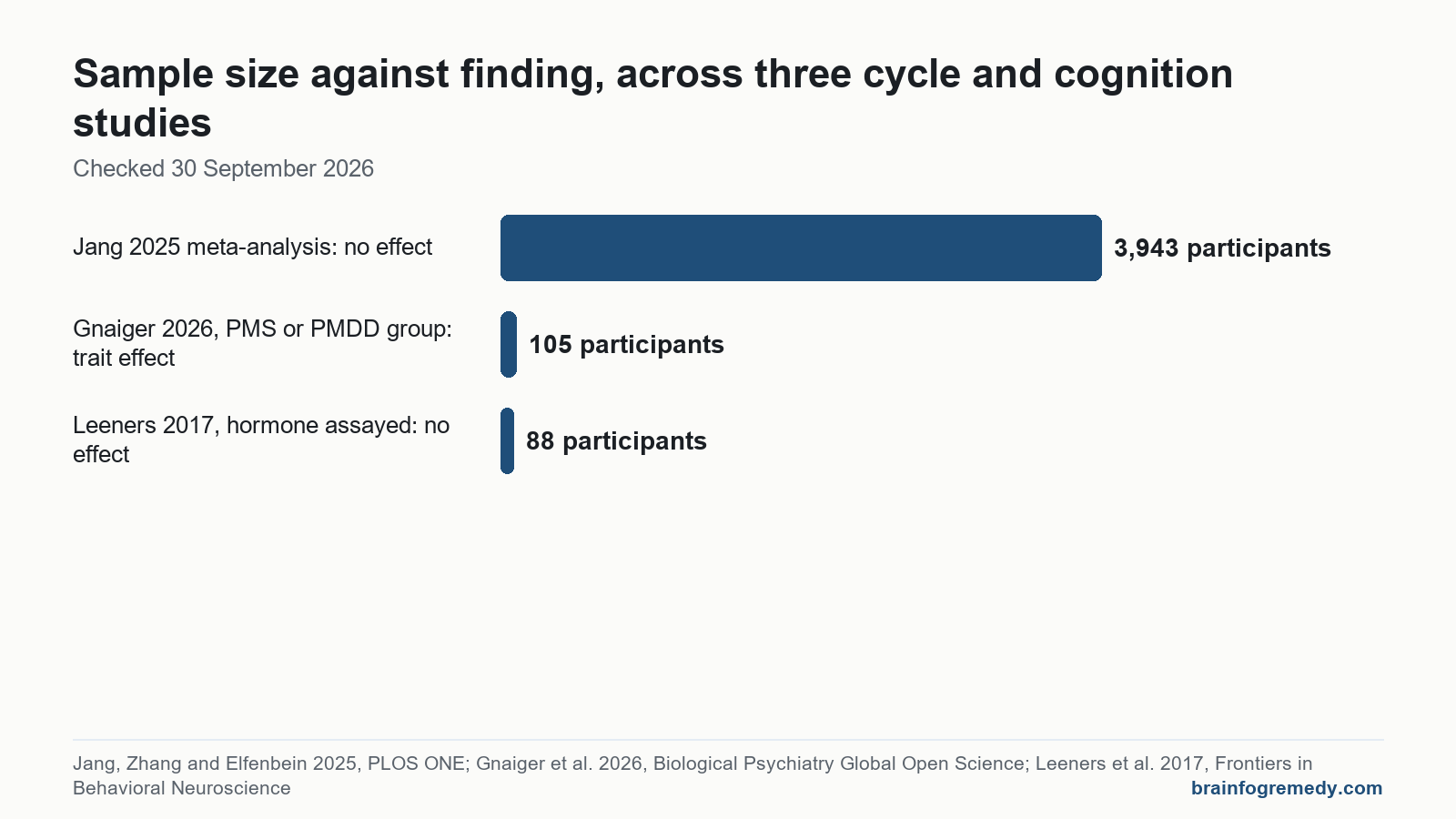
The most complete answer is a meta-analysis by Jang, Zhang and Elfenbein, published in PLOS ONE in March 2025. It pooled 102 studies, 3,943 participants and 730 comparisons across five standardised phases: menstrual, follicular, periovulatory, luteal and premenstrual. Attention, creativity, executive function, intelligence and motor function showed no reliable difference across any phase. Memory, spatial ability and verbal ability produced a handful of differences in the raw pooled data, but none of them survived correction for multiple comparisons, and the spatial ability differences turned up only in studies that estimated cycle phase by counting days on a calendar rather than confirming it with a hormone test.

That last detail is the one that matters most. When the authors isolated only the studies that used a hormone assay, the higher quality subset, no significant effect remained in any cognitive domain. The individual studies feeding the pool averaged about 39 participants each, small enough that a handful of outliers can manufacture a headline finding. The authors’ own conclusion is direct: the body of research does not support the idea that cognitive ability changes across the menstrual cycle, though they are careful to note that absence of proof is not proof of absence, just that any real effect would have to be very small to have gone undetected in a sample this size.
| Study | Sample size | How phase was set | What was tested | What it found |
|---|---|---|---|---|
| Jang et al., 2025, PLOS ONE | 3,943 pooled across 102 studies | 5 standard phases; hormone assay in the highest quality subset | Attention, memory, executive function, spatial and verbal ability | No effect survived correction; hormone confirmed studies showed none at all |
| Gnaiger et al., 2026, Biological Psychiatry Global Open Science | 105 (54 with PMS or PMDD, 51 controls) | 3 phases: mid follicular, mid luteal, late luteal | Working memory (n-back task), inhibitory control (stop signal task) | PMS or PMDD group impaired across all three phases, not just before bleeding |
| Leeners et al., 2017, Frontiers in Behavioral Neuroscience | 88 (68 followed through a second cycle) | Direct hormone assay across two consecutive cycles | Visuospatial working memory, divided attention, cognitive bias | No association between hormone levels and performance |
Why did one study find an effect when the meta-analysis did not?
Because it asked a different question. Gnaiger and colleagues, publishing in Biological Psychiatry Global Open Science on 6 April 2026, tested 105 regularly cycling women, 54 with diagnosed PMS or PMDD and 51 controls, across three phases using the n-back task for working memory and the stop signal task for inhibitory control. The PMS or PMDD group had significantly longer stop signal reaction times, and those reaction times correlated with symptom severity, but the effect showed up in mid follicular, mid luteal and late luteal phases alike. The authors describe the deficit as trait like, meaning it travels with the person rather than the calendar.
Put the two studies side by side and the disagreement mostly dissolves. The Jang meta-analysis asked whether cycle phase changes cognition for people in general, and found essentially nothing once phase was confirmed properly. The Gnaiger study asked whether a specific, diagnosed group performs differently, and found that some of them do, consistently, regardless of where they are in the cycle. Neither result contradicts the other; they answer different questions, and a lot of the confusion in this space comes from treating them as if they answered the same one.
That still leaves the gap from the first section unexplained: if the average cycling person shows no measurable change on a cognitive task, why do so many report noticing one. Part of the answer is that concentration is not purely a cognitive measurement, it is also an experience shaped by mood, pain, poor sleep and simple distraction, none of which the n-back task or the stop signal task were built to capture. Cramping, tender breasts or a low mood in the days before bleeding can all make thinking feel harder without a single test score moving. A felt difficulty is not invented just because a laboratory measure cannot find it, and a null result in a lab is not proof that nothing is happening, only that whatever is happening was not the kind of thing that task could see.
Could this be PMDD instead of ordinary PMS?
Premenstrual dysphoric disorder is a recognised, more severe condition, and it is written about here straight, without the joke. NHS guidance on PMDD describes symptoms similar to PMS but markedly more intense, including mood swings, hopelessness and anger that meaningfully disrupt daily life, and notes that some people with PMDD also experience suicidal thoughts. It is not diagnosed from a single conversation or a blood test. The standard route is a daily symptom diary kept across at least two menstrual cycles, so a doctor can see whether the pattern actually tracks the cycle rather than running continuously.
NHS guidance on PMS more broadly lists the combined contraceptive pill, cognitive behavioural therapy and antidepressants among the options a doctor may discuss, alongside general measures like regular exercise and sleep. None of that is a protocol to follow on your own initiative, and nothing here recommends starting or stopping any of it; it is what the guidance says exists, for a conversation with a clinician who knows the rest of your history.
Cycle day and thinking, a two column log
A plain log to bring to an appointment if a pattern is worth showing someone. It does not score, interpret or diagnose anything.
Entries stay on this device and are not sent anywhere. This cannot diagnose PMDD, PMS or anything else; only a clinician reviewing a diary across cycles can do that.
When is it worth seeing a doctor about it?
See a doctor if concentration problems are severe, last well beyond the usual premenstrual window, or arrive alongside low mood, hopelessness or anger that is disrupting work, relationships or daily functioning. See a doctor sooner if any of that includes thoughts of harming yourself. A symptom diary kept for two or three cycles, noting the day, what was hard to do, and how it felt, is genuinely useful to bring to that appointment, because it is the same evidence a PMDD diagnosis relies on. This page cannot tell you what is causing your particular symptoms, and it is not trying to; that is a conversation for someone who can examine you and see your history.

For the wider picture of what else slows thinking day to day, unrelated to cycle timing, the eight most common causes of brain fog worth checking first is a reasonable next stop.
Frequently asked questions
Does everyone with a period get brain fog before it?
No. Self report studies find it very common, a 2025 study of 227 students found close to two in three noticed some concentration difficulty, but that still leaves a meaningful share who notice little or nothing, and severity varies widely from person to person.
Does a hormone blood test level predict how foggy someone feels?
Not reliably. In a 2017 study that tracked 88 women’s hormone levels directly across two menstrual cycles, oestrogen, progesterone and testosterone levels did not correlate with performance on working memory, divided attention or cognitive bias tasks.
Is premenstrual brain fog the same thing as PMDD?
No. Ordinary premenstrual brain fog is a felt symptom with no diagnosis attached to it. PMDD is a distinct, more severe condition involving mood symptoms such as hopelessness and anger that meaningfully disrupt daily life, confirmed with a tracked symptom diary rather than how foggy thinking feels alone.
Does premenstrual brain fog get worse over time or stay the same?
NHS guidance describes both PMS and PMDD as a hormone related pattern that recurs every month, not a steadily worsening condition, though how strongly anyone experiences it can change over the years, including around large hormonal shifts such as pregnancy or the approach of perimenopause.
Can a symptom tracking app diagnose PMDD on its own?
No. A tracking app can help show a pattern worth bringing to an appointment, but PMDD is diagnosed by a clinician reviewing a daily symptom diary kept across at least two cycles, not by an app’s own scoring.
Is there a blood test a doctor can order to confirm cycle related brain fog?
No standard test exists for this. The hormone assays described in the research above were run to confirm cycle phase for research purposes, not as a diagnostic tool a doctor would order to investigate someone’s cognitive symptoms.
Finished the page? The same five questions from the top, to see what stuck.
This article is general information, not medical advice, and is not a substitute for care from a qualified healthcare professional. Speak to your doctor about your own situation.
Leave a Reply