
Perimenopause brain fog often starts while periods still look regular, and a normal hormone blood test does not rule it out, because follicle stimulating hormone rises and falls unpredictably at this stage. NICE advises identifying perimenopause at 45 or over without lab tests, yet its own symptom list leaves out brain fog entirely.
Listen to this article, about 12 minutes. A synthetic voice reads the article and announces each section title as it begins; tables are read row by row and the questions at the end are left out.
Recorded 14 October 2026 from the article as published that day. Press a chapter to jump there; the highlighted line is what is playing. A play button sits beside every section heading, and once you scroll past this player a bar at the bottom of the screen keeps the controls in reach. Tap or click any sentence to hear the reading start from there.
On this page: why the hormones move before the calendar does, what NICE actually says about blood tests at each age and what it leaves out, the documented gap between the guideline and the NHS symptom page, what sixty forum posts from women told they were too young reveal, and what to gather over two or three cycles before an appointment.
Think you already know this? Five questions, one minute.
Every answer is on this page. Answer from what you know now; the page fills in the rest.
-
1. Under the STRAW+10 staging criteria, what happens to follicle stimulating hormone in the stage just before the transition?
The staging criteria mark the formal early transition later, by consecutive cycles differing in length by seven days or more, and even then describe FSH as elevated but variable rather than simply high. The hormones move before the calendar does. Read the section
-
2. What does NICE guideline NG23 recommendation 1.3.1 say for otherwise healthy people aged 45 or over with menopause associated symptoms?
The guideline reserves FSH, in recommendation 1.3.6, for confirming menopause only, at 40 to 45 with a change in the cycle or under 40 when menopause is suspected. Nothing in it turns a normal FSH at 42 into proof that perimenopause is not happening. Read the section
-
3. Which symptoms does recommendation 1.2.2 list, and what is missing?
So the patient information and the clinical guideline, both from the same health system, describe the stage differently. Someone with fog, poor sleep and a cycle that has not visibly changed sits outside the wording of 1.3.1, which asks about hot flush symptoms together with a change in the cycle. Read the section
-
4. In the 2025 British Journal of General Practice study of 18 women and 11 GPs, what did one GP say was far easier to work with?
The study also recorded GPs describing variable approaches to asking about perimenopause and acknowledging gaps in their training. Clinicians notice the gap in the guideline too. Read the section
-
5. Which features did the National Institute on Aging conference summary name as calling for closer assessment?
The summary, published in Menopause, noted that dementia is rare in midlife while forgetfulness is common, and that depression, stress, sleep disorders and medication effects can all affect memory. Low mood, hopelessness or thoughts of self harm mean speaking to a GP promptly, or in the UK calling 111, or 999 in an emergency. Read the section
That last clause is the part nobody mentions. A woman whose main complaint is losing words can walk into an appointment holding the right guideline and find it does not quite describe her. This piece covers the perimenopausal window only; why the fog happens across the whole transition and when it tends to lift, and what the largest studies found about memory recovering afterwards, have their own articles, and what the cognition studies actually measure about brain fog before a period covers the cycling years before this stage begins.
Why does the fog start while periods are still regular?
Because the hormones move before the calendar does. Under the STRAW+10 staging criteria, published in the Journal of Clinical Endocrinology and Metabolism, the stage just before the transition is when early cycle FSH “increases and becomes more variable” while the only change in the cycle is mild, usually slightly shorter cycles. The formal early transition is marked later, by consecutive cycles differing in length by seven days or more, and even then FSH is described as elevated but variable rather than simply high.
The NHS symptoms page, reviewed in May 2026, lists poor memory and brain fog and notes they can feel worse with poor sleep and tiredness, so night waking belongs in the picture too; there is more on what broken sleep does to daytime thinking.
Can a blood test show whether the fog is hormonal?
Not reliably, and the reason is in the word variable. A single FSH result is one reading of a changing number, rather like judging a month of weather from one photograph of the sky. The Menopause Charity says hormone blood tests are not usually necessary because levels can vary by the hour, while noting that tests still help rule out other things such as an underactive thyroid.
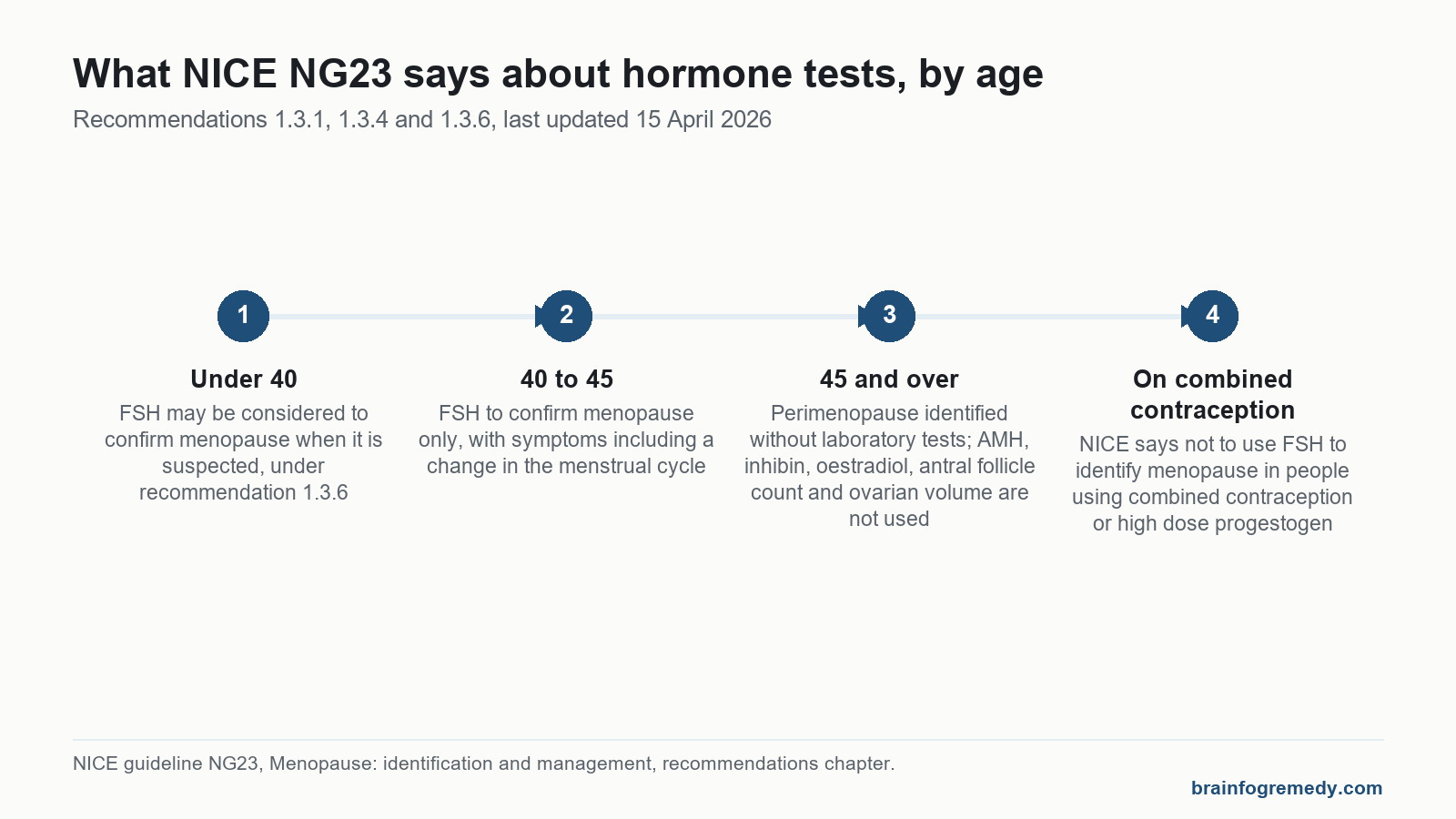
Here is what NICE guideline NG23, last updated on 15 April 2026, actually says. Recommendation 1.3.1 is to identify perimenopause “without laboratory tests” in otherwise healthy people aged 45 or over with menopause associated symptoms. Recommendation 1.3.4 lists tests not to use for that at 45 or over, naming anti Mullerian hormone, inhibin A and B, oestradiol, antral follicle count and ovarian volume. Recommendation 1.3.6 says to consider FSH “to confirm menopause only” in people aged 40 to 45 with symptoms including a change in their cycle, or under 40 when menopause is suspected.
Two things follow from that wording, and both are routinely flattened. First, FSH is not named in the 1.3.4 list; it is reserved by 1.3.6 for other age groups, so the guideline leaves no role for it at 45 or over rather than banning it in a sentence. Second, the under 45 use is about confirming menopause, not perimenopause. Nothing in the guideline turns a normal FSH at 42 into proof that perimenopause is not happening.

Where does brain fog fit in the guideline?
This is the documented disagreement. Recommendation 1.2.2 of the same NICE guideline lists what menopause associated symptoms may include besides cycle changes: vasomotor symptoms, genitourinary symptoms, effects on mood, musculoskeletal symptoms and sexual difficulties. Memory, concentration and brain fog are not on it. The NHS page for the public names brain fog outright. So the patient information and the clinical guideline, both from the same health system, describe the stage differently.
It matters because recommendation 1.3.1 does not say perimenopause is identified on any symptoms. It says on hot flash symptoms that have recently started together with any change in the menstrual cycle. Someone with fog, poor sleep and a cycle that has not visibly changed sits outside that wording. The guideline is not wrong to be specific, but the popular shorthand, symptoms alone from 45, promises more than the text delivers.
Clinicians notice this too. In a 2025 qualitative study in the British Journal of General Practice, which interviewed 18 women aged 45 to 55 and 11 GPs in south west England, GPs described variable approaches to asking about perimenopause and acknowledged gaps in their training. One GP said a presentation of hot flushes, night sweats and brain fog together was far easier to work with than mood or cognitive symptoms arriving alone.
| Source, checked 22 September 2026 | What it says about hormone blood tests | Where brain fog appears |
|---|---|---|
| NICE NG23, last updated 15 April 2026 | At 45 or over, perimenopause is identified without laboratory tests. FSH is reserved for confirming menopause at 40 to 45 with a cycle change, or under 40 | Not in its list of symptoms. The list names vasomotor, genitourinary, mood, musculoskeletal and sexual symptoms |
| NHS symptoms page, reviewed 19 May 2026 | Not discussed on the symptoms page | Named directly, under mood changes, poor memory and brain fog |
| STRAW+10 staging criteria | FSH rises and becomes more variable before cycles clearly change, then stays elevated but variable in the early transition | Not addressed; it is a staging system, not a symptom guide |
| The Menopause Charity | Usually unnecessary, because levels can vary by the hour; tests may still be used to rule out thyroid problems | The whole page is about it |
| BJGP qualitative study, 2025 | Not its subject | A GP interviewed found fog easier to place when it arrived with hot flushes and night sweats than on its own |
What do women who were told they were too young actually report?
To see how this plays out, we read about 60 posts on 22 September 2026: the first page of two long Mumsnet threads and the whole of a short one, all from March 2024 onwards. These are what people report, not findings, and they come from a self selected forum audience that skews towards those having a hard time.
In a June 2026 thread, a poster about to turn 43 described new dry skin, shorter and much heavier periods, and anxiety. She said her GP called her “far too young” for perimenopause, suggested polycystic ovary syndrome instead, and that she had to ask several times before blood tests were booked. Several replies said a blood test would not necessarily settle it; one insisted it would and was contradicted. One pushed back on the pile on, saying heavy periods have other causes worth excluding and some doctors blame perimenopause for everything. Another asked whether thyroid function had been checked.
In a March 2024 thread, a 49 year old with fairly regular periods and no hot flushes described using the wrong word and only realising hours later, and small mistakes at work that her manager raised with her. She wrote that some days she felt completely normal and on others found it hard to string a sentence together. Most replies suggested supplements bought online; one poster said hers did nothing. A thread of strangers is not evidence either way.
In another March 2024 thread asking what perimenopause feels like mentally, with 67 replies, the range was wide. People described rage, anxiety, flatness and lost motivation. One called the menopause “The List Syndrome” and described ticking off chores on a chalkboard to remember to feed the animals. At least two said they had noticed no mental change at all, which is worth keeping: the fog is common, not universal.
Where the accounts agree with the guidance: most who mentioned testing understood that one hormone result can mislead, which matches STRAW+10 and NICE. Where they part company: the forum repeatedly treats symptoms as the whole test, while the guideline asks specifically about flushes and cycle changes. The 49 year old with regular periods and no flushes is exactly the case the guideline wording does not reach.
When is fog a reason to see a doctor sooner?
Midlife fog is common and usually not a sign of anything serious, but some patterns need a proper assessment rather than an assumption. a National Institute on Aging conference summary published in Menopause noted that dementia is rare in midlife while forgetfulness is common, and named features that call for closer assessment: losing the ability to manage everyday tasks, a parent or sibling with dementia before 60, or an abnormal finding on neurological examination. Depression, stress, sleep disorders and medication effects can all affect memory too.
If low mood, hopelessness or thoughts of self harm are part of what is happening, speak to a GP promptly, or in the UK call 111, or 999 in an emergency. Thyroid problems and low iron, which heavier periods can quietly produce are ordinary things to check at this age and are settled by a test rather than a guess, which is one place where a blood test is genuinely useful. The other ordinary candidates, from broken sleep to a new prescription, are set out side by side in our guide to the common brain fog causes a GP can check.
What is worth bringing to the appointment?
Given the wording of 1.3.1, the most useful preparation is information the guideline actually asks about, gathered over two or three cycles. This is a checklist, not a diagnosis, and it does not point towards any particular treatment, which is a conversation for a clinician.

- Cycle dates and lengths, including cycles only a few days shorter than they used to be
- Any flushes or sweats, day or night, and roughly when they started
- The days the fog is bad and the days it is not, since fluctuation is itself informative
- Sleep: how often you woke, not just how tired you felt
- Your age, and any hormonal contraception, since NICE says not to use FSH to identify menopause in people using combined contraception or high dose progestogen
- Anything else new: mood, heavier bleeding, joint pain
There is more on how to describe the fog so a doctor can work with it. If an appointment ends with “too young” and nothing else, asking what the guideline says for your age, and what else might explain the symptoms, is a reasonable next question. Nobody walks out with an answer from a six question online quiz, whatever the quiz claims.
What to gather over two or three cycles
The guideline asks about specific things. This is the page’s list, to tick as you collect them. It is a checklist, not a diagnosis, and it points at no treatment.
Ticks are saved on this device only. If an appointment ends with too young and nothing else, asking what the guideline says for your age, and what else might explain the symptoms, is a reasonable next question.
Frequently asked questions
Can you have perimenopause brain fog with regular periods?
Many people report exactly that, and STRAW+10 describes hormone changes starting while cycle changes are still subtle. Whether a given person is perimenopausal is a question for a clinician, and the NICE route to identifying it without tests expects some change in the cycle.
Is 40 too young for perimenopause?
No age is ruled out by the guidance. NICE’s pathway without lab tests applies from 45, it describes FSH use from 40 to 45 to confirm menopause, and it separately covers people under 40. Being under 45 changes which route is used, not whether symptoms are taken seriously.
Should I ask for an FSH test?
That depends on age and circumstances, which is why it is a conversation with a clinician. NICE reserves FSH for confirming menopause at 40 to 45 or under 40, and says not to use it to identify menopause in people using combined hormonal contraception or high dose progestogen.
Why did my hormone test come back normal if I feel foggy?
FSH in this stage is described as variable, so one normal reading is a snapshot rather than a verdict. A normal result also does not explain the fog in either direction, which is why other causes are still worth checking.
Does brain fog appear in NICE’s list of menopause symptoms?
Not as of 22 September 2026. Recommendation 1.2.2 of NG23 lists vasomotor, genitourinary, mood, musculoskeletal and sexual symptoms, while the NHS public symptoms page does name brain fog.
Can a supplement fix perimenopause brain fog?
This site does not recommend supplements, and no forum thread counts as evidence that one works. Products sold for focus or hormone balance are not a substitute for an assessment.
Finished the page? The same five questions from the top, to see what stuck.
This article is general information, not medical advice, and is not a substitute for care from a qualified healthcare professional. Speak to your doctor about your own situation.
Leave a Reply