
Celiac disease and brain fog are reported together often enough that patient surveys put fog near the top of the symptom list, though the trial evidence behind it is thin. The practical point is blunter: cutting gluten out before you are tested makes both the blood test and the biopsy unreliable, so the testing conversation comes first.
Listen to this article, about 11 minutes. A synthetic voice reads the article and announces each section title as it begins; tables are read row by row and the questions at the end are left out.
Recorded 10 October 2026 from the article as published that day. Press a chapter to jump there; the highlighted line is what is playing. A play button sits beside every section heading, and once you scroll past this player a bar at the bottom of the screen keeps the controls in reach. Tap or click any sentence to hear the reading start from there.
On this page: a comparison table of clinical gluten challenge guidelines, patient forum accounts, and a checklist of diagnostic steps.
Think you already know this? Five questions, one minute.
Every answer is on this page. Answer from what you know now; the page fills in the rest.
-
1. According to a 2021 survey of 1,396 people, what percentage of respondents with celiac disease reported experiencing brain fog?
In the survey indexed on PubMed, roughly 89 percent of the celiac group and 95 percent of the gluten sensitivity group reported experiencing brain fog. Read the section
-
2. Why does cutting out gluten before medical testing make the results of blood tests and biopsies unreliable?
Testing depends on the immune system’s reaction to gluten. As explained in a 2024 BJGP review, stopping gluten before testing leads to falling antibody levels and intestinal healing, resulting in a potentially false normal reading. Read the section
-
3. According to the UK guidelines from Coeliac UK, how much gluten should a person eat daily before testing?
According to Coeliac UK, the daily requirement is at least 3 g, preferably 6 g of gluten every day for at least six weeks. Read the section
-
4. In a 20-year retrospective study of 158 adults who had already cut out gluten, what percentage had celiac disease confirmed after a gluten challenge?
A retrospective cohort study reported in 2025 followed 158 adults who were already gluten free, confirming celiac disease in 47 of them, which is about 29.7 percent. Read the section
-
5. How is non celiac gluten sensitivity diagnosed?
Non celiac gluten sensitivity has no specific blood test or biopsy, so it is identified by ruling out celiac disease and wheat allergy first. Read the section
What does brain fog in celiac disease actually look like?
Brain fog is not a diagnosis and never has been. It is shorthand for a cluster of slowness, forgetfulness and word finding trouble, and celiac disease is one of the conditions it gets attached to.
The largest picture comes from a survey of 1,396 people, 1,143 with celiac disease and 253 with non celiac gluten sensitivity, published in the Journal of Clinical Gastroenterology in 2021 and indexed on PubMed. Around nine in ten reported brain fog: roughly 89 percent of the celiac group and 95 percent of the gluten sensitivity group. The commonest descriptions were trouble concentrating, forgetfulness and tiredness, and respondents put onset and peak at one to two days after gluten, with some still affected three to five days later.
Read that with the authors’ own caveat attached. People who answer a survey about brain fog are people who have brain fog. It describes the symptom, not how common it is.
How strong is the evidence that gluten affects thinking?
The evidence linking gluten to “brain fog” is much weaker than the internet makes you think. When you actually look at the scientific studies everyone points to, the number of people tested is incredibly small.
For example, a famous 2014 study followed newly diagnosed coeliac patients in Melbourne. By the end, only eleven people actually finished it. While their brain function did show some improvement on a gluten-free diet, you just can’t make definitive medical claims based on eleven people.
Other studies don’t clear things up much either. A 2026 study compared people with coeliac disease to healthy controls. While the coeliac patients did report more brain fog and worse sleep, the study couldn’t prove whether gluten was the actual cause, or if something else was at play. Another study from 2020 tried using brain scans, but their pilot test only looked at five people and didn’t even use a placebo to double-check the results.
Ultimately, while thousands of people genuinely complain about feeling foggy after eating gluten, the actual scientific proof we have right now rests on a handful of tiny studies. When the fog follows every meal rather than gluten in particular, what the meal studies show about brain fog after eating covers the more ordinary explanations worth ruling out first.

Why does going gluten free before the test wreck it?
Because the tests do not look for gluten. They look for your immune system’s reaction to it, and that reaction fades once the gluten stops. Antibody levels fall and the lining of the small intestine begins to repair, so blood test and biopsy can both read normal in someone who genuinely has the condition.
A 2024 review of coeliac diagnosis in primary care, published in the British Journal of General Practice, puts the background plainly: the condition affects approximately 1 percent of the population worldwide, two thirds of UK cases remain undiagnosed, and the work up depends on serology followed by endoscopic biopsy while the person is still eating gluten. Someone who has already stopped lands, in the review’s words, in an indeterminate diagnostic space.
This matters more than a tidy label. A confirmed diagnosis changes what gets monitored: iron, bone density, family screening. Iron deficiency is one of the commonest ways the condition gets picked up at all, and low iron has its own documented effect on concentration. A negative test that was never valid closes none of those doors.
How much gluten do the guidelines actually require before testing?
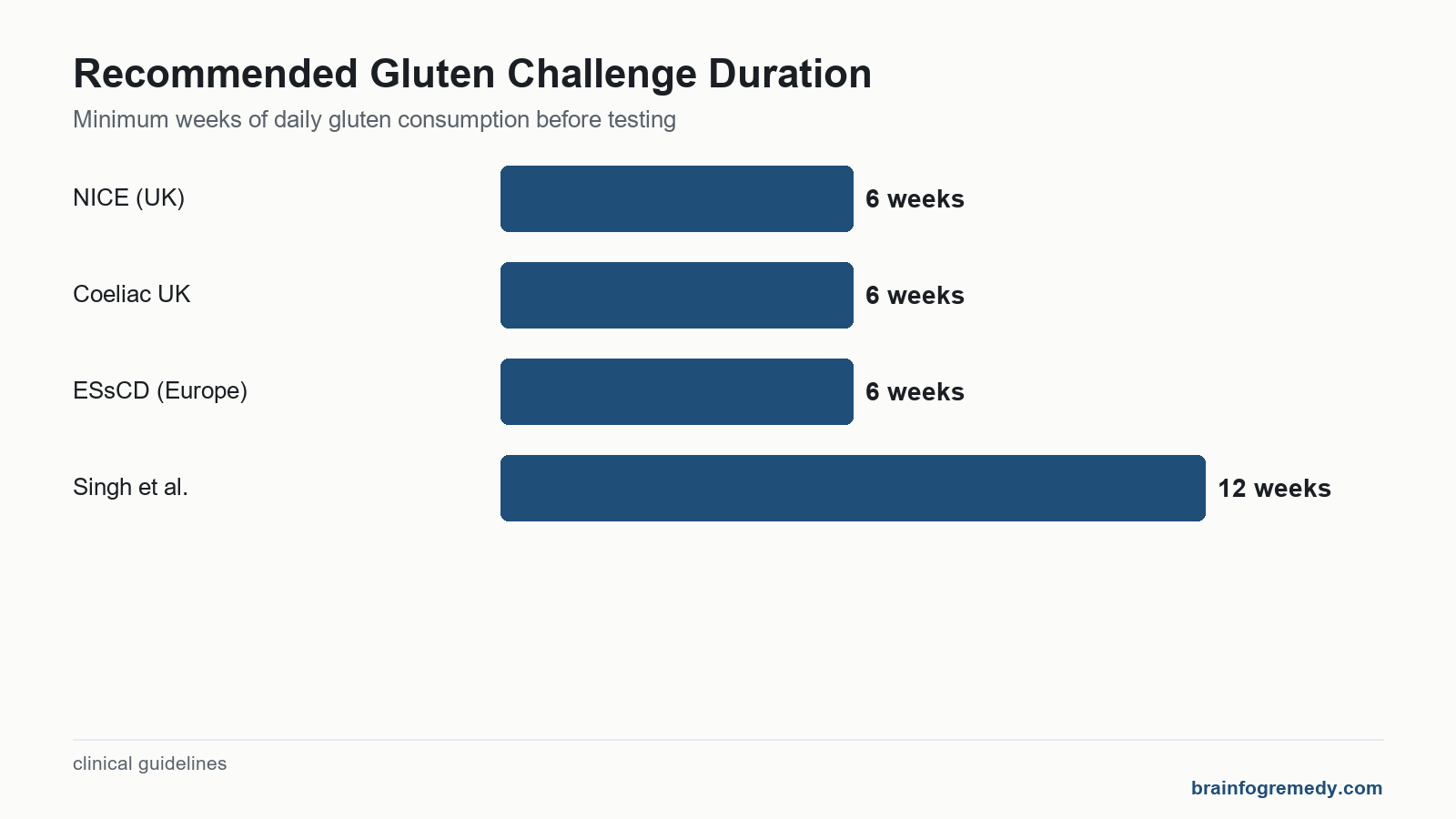
Here is where the ranking pages go quiet, because the bodies writing the guidance do not agree with each other. All of them say keep eating gluten. The amount and the duration vary by a factor of two, and no head to head trial settles it.
| Source | Date | How much gluten | For how long |
|---|---|---|---|
| NICE guideline NG20, UK | wording as quoted in the 2024 BJGP review | some gluten in more than one meal every day | at least six weeks before testing |
| Coeliac UK | page checked 18 September 2026 | at least 3 g, preferably 6 g of gluten every day | at least six weeks, and throughout the diagnosis process |
| ESsCD European guidelines | 2025 | a minimum of 3 g a day | six weeks, to balance accuracy against discomfort |
| American Gastroenterological Association | clinical guidance | three slices of wheat bread daily | preferably one to three months before repeating the tTG-IgA test |
| Singh and colleagues, clinician’s guide, Journal of Pediatric Gastroenterology and Nutrition | 2023 | a minimum of 3 to 6 grams of gluten per day | 12 weeks, with a formal check in at four to six weeks |
Six weeks against twelve is not a rounding difference. It is the gap between a bad autumn and most of a season, and it is the reason two clinicians can give two honest and incompatible answers to the same question. Read the table as what the guidance says, not as a plan: a gluten challenge is arranged and supervised by a doctor, and the dose, the timing and whether to do one at all are decisions for that conversation.
What do people who went through a gluten challenge actually report?
Guidance describes the protocol. It does not describe what six weeks of deliberately eating something that makes you ill is like, and for that, public forum threads are the only record there is. Label them accurately: this is testimony, not evidence, and nothing in it is a finding. Across four public threads on the Patient community forum, dated between August 2015 and February 2020, we read 18 accounts from people preparing for or going through coeliac testing. They are five years and more behind us, though the six week figure they quote has not changed.
- In a January 2020 thread from January 2020, the poster said their doctor had set a four week challenge while everything they had read said six. They aimed at two slices of bread a day, reported nausea within days and alternating constipation and diarrhoea by early February, and cut back to two slices of toast rather than stopping.
- A replier there said they had been given six weeks, managed about two slices of toast and four biscuits across one of them, and got an inconclusive result anyway. A third had three weeks before the endoscopy and called the outcome indicative but not conclusive.
- In an April 2018 thread, a poster reported being told by a nurse to start a gluten free diet before the endoscopy. Other members told them not to, because it can produce a false negative. Another in that thread said they had gone gluten free before testing once before, got a negative result, and needed a second endoscopy later to settle it.
- At day 12 of a challenge after about a year without it, a poster listed fatigue, a fuzzy head and difficulty finding words alongside the digestive symptoms. Another member of that thread had refused a challenge outright and was assessed a different way.
- In a November 2017 thread, someone who had eaten at least two slices of bread a day for four weeks still got a negative blood test, and a replier pointed out that four weeks was short of the six they had been given.
Where the accounts and the guidance agree: the six week figure is common knowledge in these threads, quoted back and forth by members long before a clinician confirms it. Where they part company: what people reported being asked for ran shorter, three and four weeks, and what people managed to eat ran well under any published dose. One account cuts against the pattern entirely, reporting a positive biopsy despite having stopped gluten four weeks earlier. None of this is data. It is a reminder that the protocol on the page and the protocol in a real week are different objects.

What if you have already cut gluten out?
Then you are in the situation the guidance quietly assumes you are not, and in a great deal of company. It is not a dead end, and the next move is a conversation, not a decision made alone at a kitchen table.
A 20 year retrospective cohort in Digestive and Liver Disease, reported in 2025, followed 158 adults who were already gluten free and went through a challenge to settle the question. Coeliac disease was confirmed in 47 of them, about 29.7 percent, and enteropathy was ruled out in 108. Read that in both directions: about three in ten got an answer that changed their medical care, and about seven in ten ate gluten for weeks to be told the thing they suspected was not it. Neither result is wasted, but only one is the one people picture when they start.
Two things are shifting. The 2025 European guidelines allow, under specific conditions, a diagnosis in adults on serology alone when the initial IgA anti-tTG is at least ten times the upper limit of normal and a second sample is positive. And a whole blood assay measuring interleukin 2, published in Gastroenterology in June 2025, detected celiac disease in people already on a gluten free diet with 90 percent sensitivity and 95 percent specificity in the HLA-DQ2.5 positive group, falling to 56 percent sensitivity in the HLA-DQ8 group. It is a research test, not something waiting at your surgery.
Pre-Testing Doctor Discussion Checklist
Before you change your diet or start a gluten challenge, use this checklist to guide your conversation with your healthcare provider.
Ticks are saved on this device only.
Is this celiac disease or non celiac gluten sensitivity?
Both groups report fog at similar rates, which is exactly why you cannot sort yourself into one of them by how you feel. Celiac disease is an autoimmune condition with a confirmable test. Non celiac gluten sensitivity has no blood test and no biopsy that confirms it: it is identified by ruling out celiac disease and wheat allergy first, which puts the celiac test at the front of the queue either way.
It is also the polite answer to the intolerance testing industry and its six question quizzes that return a verdict before the kettle boils. None of them diagnose celiac disease. Brain fog has a long list of possible contributors, and gluten is one candidate among many, which is the sort of sentence a quiz will never sell you.
If the fog is severe, persistent, or coming with weight loss, exhaustion that sleep does not touch, anaemia or a change in memory that worries the people around you, that is a reason to see a doctor promptly and to say so plainly when you book. Do not change your diet first in the hope of arriving with a tidier story.
Frequently asked questions
Does brain fog on its own mean I have celiac disease?
No. Brain fog is a common symptom with many possible contributors and it is not specific to any one condition. Surveys of people already diagnosed with celiac disease find it reported often, but that says nothing about how likely it is in any individual. Only testing arranged by a doctor can answer the question.
How soon after eating gluten do people report brain fog starting?
In the 2021 Journal of Clinical Gastroenterology survey of 1,396 people, respondents put onset and peak at one to two days after gluten, with a proportion still reporting symptoms three to five days later. In a smaller 2020 survey of people with non celiac gluten sensitivity, the median reported onset of neurological symptoms was 90 minutes. These are self reports, not measurements.
Can a home intolerance test diagnose celiac disease?
No. Celiac disease is confirmed through specific antibody blood tests, usually IgA tissue transglutaminase with a total IgA, and in most cases an endoscopic biopsy, all while the person is still eating gluten. Commercial food intolerance panels do not measure those antibodies and cannot rule the condition in or out.
Is gluten free bread enough to keep a test valid?
No. Gluten free products are made to contain as little gluten as possible, which is the opposite of what the pre test guidance describes. Every source in the table above specifies ordinary gluten containing food, and the whole point is to provoke a measurable immune response. What counts as enough is a question for the doctor arranging the test.
Does a positive blood test still need a biopsy?
Usually, though this is changing. Endoscopic biopsy while eating gluten remains the standard confirmation in adults. The 2025 European guidelines allow diagnosis on serology alone in specific circumstances, when the initial IgA anti-tTG is at least ten times the upper limit of normal and a second blood sample is also positive. Which route applies to a given person is a clinical decision.
Does brain fog improve after a celiac diagnosis and a gluten free diet?
The only trial that followed this specifically, Lichtwark and colleagues in 2014, tracked 11 newly diagnosed patients over 52 weeks and found four of eight cognitive tests improved significantly. That is a very small study without a control group, so the honest answer is that it is reported to improve and that the evidence remains preliminary.
Finished the page? The same five questions from the top, to see what stuck.
This article is general information, not medical advice, and is not a substitute for care from a qualified healthcare professional. Speak to your doctor about your own situation.
Leave a Reply