
Nervous exhaustion is the everyday name for neurasthenia, a diagnosis coined in 1869 for tiredness, poor concentration and aches blamed on overworked nerves. It has mostly left the medical books. Today the same picture is usually described as burnout, which WHO counts as a work phenomenon, or in Sweden as exhaustion disorder, which has formal criteria.
Listen to this article, about 12 minutes. A synthetic voice reads the article and announces each section title as it begins; tables are read row by row and the questions at the end are left out.
Recorded 2 October 2026 from the article as published that day. Press a chapter to jump there; the highlighted line is what is playing. A play button sits beside every section heading, and once you scroll past this player a bar at the bottom of the screen keeps the controls in reach. Tap or click any sentence to hear the reading start from there.
On this page: the 1869 term traced to today, the Swedish exhaustion disorder criteria and the WHO burnout definition set side by side in one table, and what 58 Swedish patients said about their thinking years later.
Think you already know this? Five questions, one minute.
Every answer is on this page. Answer from what you know now; the page fills in the rest.
-
1. In the 1982 Hunan study, how many of 100 patients diagnosed with neurasthenia also met the criteria for major depression?
Arthur Kleinman’s study in Culture, Medicine and Psychiatry found 87 of the 100 could be rediagnosed with major depression. Read the section
-
2. Under the Swedish criteria, how long must the identifiable stressors have been present?
The criteria summarised in the BJPsych Open scoping review require stressors for at least 6 months and exhaustion symptoms for at least 2 weeks. Read the section
-
3. How does WHO classify burn-out in ICD-11?
WHO lists it as an occupational phenomenon in the chapter on factors influencing health status, and says it applies only to the work context. Read the section
-
4. What did the scoping review find when formal cognitive tests were compared with what patients reported?
The scoping review found at most mild impairment on tests, against large and consistent effects in self reported attention and memory problems. Read the section
-
5. In the Umea interview study of 38 people, how many rated themselves fully recovered?
In the BMC Psychiatry study, 7 of 38 rated themselves fully recovered, none not recovered, and 30 somewhere in between. Read the section
Where does the term nervous exhaustion come from?
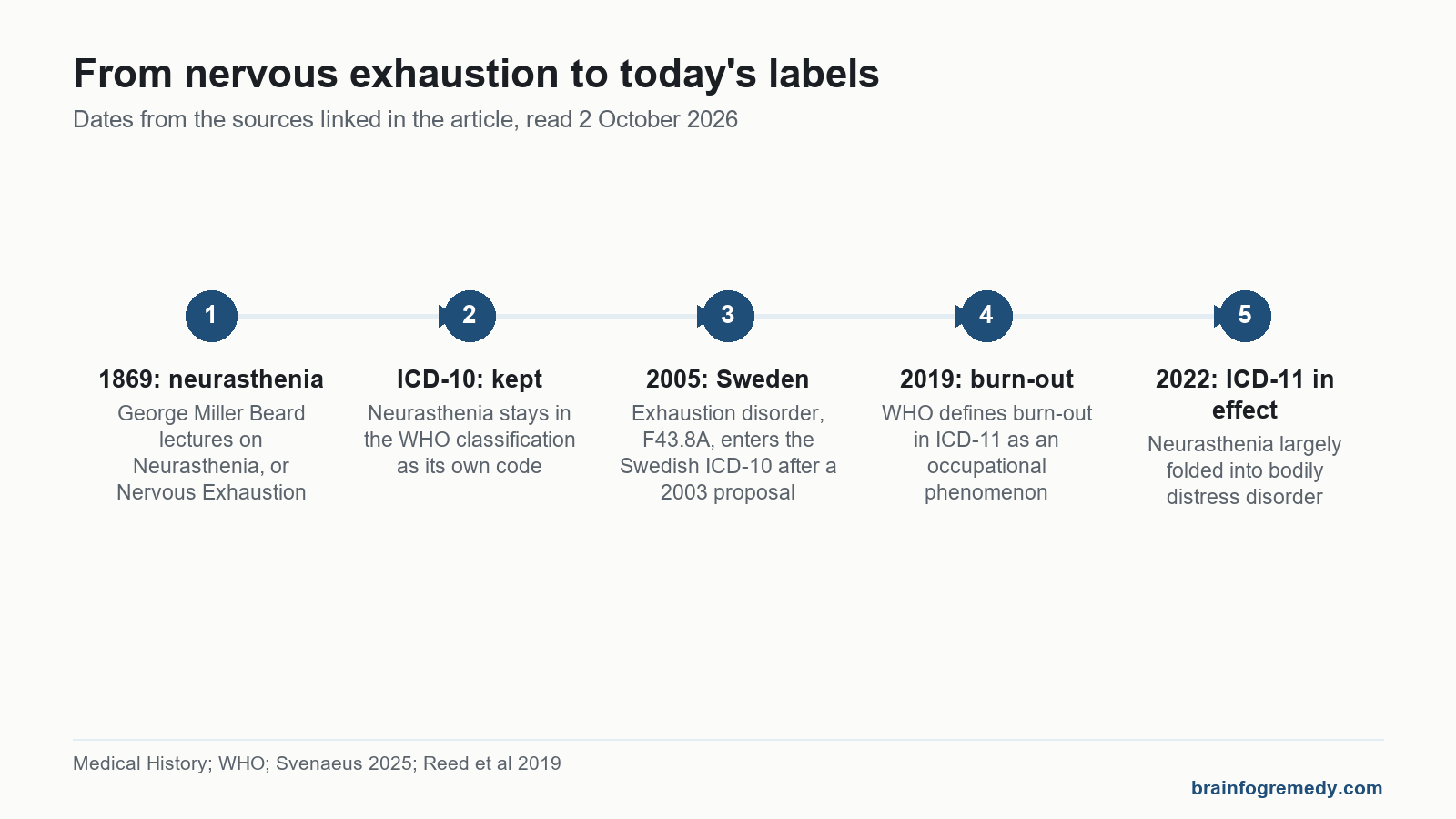
From an American physician called George Miller Beard, who in 1869 gave a lecture titled “Neurasthenia, or Nervous Exhaustion”. As a history in Medical History describes it, the word literally meant a want of strength in the nerve, and Beard thought a shortage of “nervous force” could produce almost anything: tiredness, headaches, palpitations, anxiety, low mood and sexual impotence. It is a broad church for one diagnosis, and that breadth was both its success and its undoing. For half a century it was fashionable, especially among the busy and well off, and it came with a shelf of nerve tonics that promised the force back by the bottle.
The word did not vanish everywhere at once. It stayed in the World Health Organization’s ICD-10 classification as neurasthenia, and in China, as shenjing shuairuo, it remained a common clinic label. In a 1982 study in Hunan, the anthropologist and psychiatrist Arthur Kleinman found that 87 of 100 patients diagnosed with neurasthenia also met the American criteria for major depression, which says something about how much a name can hide. When ICD-11 came into effect in January 2022, neurasthenia was largely folded into a new category called bodily distress disorder rather than kept as a diagnosis of its own.
What is exhaustion disorder, the Swedish diagnosis?
It is the closest modern descendant of nervous exhaustion with actual written criteria. In 2003 a Swedish expert group proposed it to the National Board of Health and Welfare, and in 2005 it was added to the Swedish version of ICD-10 as code F43.8A, according to a 2025 history by the philosopher Fredrik Svenaeus. No other country has an equivalent code. Elsewhere, people with the same picture are diagnosed with burnout, depression, an adjustment disorder or nothing in particular.
| Criterion | Requirement |
|---|---|
| A | Physical and mental symptoms of exhaustion for at least 2 weeks, developed in response to one or more identifiable stressors present for at least 6 months |
| B | A marked lack of mental energy: reduced initiative, poor endurance, or a longer time to recover after mental effort |
| C | At least four of six, most of the day, nearly every day in the same 2 weeks: complaints of impaired memory and concentration; a much reduced capacity to handle demands or time pressure; emotional instability or irritability; sleeping too little or too much; physical fatigue and poor endurance; physical symptoms such as muscle pain, chest pain, palpitations, stomach problems, dizziness or sensitivity to sound |
| D | Clinically significant distress or impaired functioning at work, socially or elsewhere |
| E | Not explained by a substance or by another medical condition |
| F | Not better described as major depression, persistent low mood or generalised anxiety disorder |
Two details stand out. The stress does not have to come from work; family, illness and money all count. And memory and concentration complaints are the first item on the symptom list, which makes this the only one of the three labels in this article that names brain fog outright.

It is also a large diagnosis in Sweden. The scoping review says it accounts for more long term sick leave payments than any other single diagnosis there, and the Swedish Social Insurance Agency, Försäkringskassan, counted 43,500 ongoing stress related sick leave cases in spring 2024, up from 34,700 in spring 2019. That figure covers all stress related diagnoses, not exhaustion disorder alone.
Not everyone is convinced. Svenaeus argues the diagnosis has spread in Sweden “despite no evidence of validity”, and ties its growth to how it opens the door to sick pay. The scoping review, which looked at 89 studies, is gentler but agrees the boundary with burnout and depression is still unclear. Both views are worth holding at once: the symptoms are real, and the label is contested.
How is burnout different from nervous exhaustion?
Burnout is narrower, and WHO is strict about it. Since 2019 ICD-11 has listed burn-out as an occupational phenomenon, in the chapter on factors that influence health, and says plainly it is not classified as a medical condition. Its definition is a syndrome “resulting from chronic workplace stress that has not been successfully managed”, with three dimensions: energy depletion or exhaustion; mental distance, negativism or cynicism about the job; and reduced professional efficacy. WHO adds that the term should not be used for experiences in other areas of life.
That last line is the real difference. Nervous exhaustion, as people use the phrase, covers the carer, the new parent and the person who has had three bereavements in a year. Burnout, as WHO defines it, does not. We cover the emotional side of that wider picture in what emotional exhaustion feels like and the fog that comes with it.
| Term | Who uses it today | Core idea | Time rule | Where thinking problems sit |
|---|---|---|---|---|
| Neurasthenia, or nervous exhaustion | Retained in ICD-10; folded largely into bodily distress disorder in ICD-11 | Nerves running out of “force” (Beard, 1869) | None in the original idea | One symptom among many in Beard’s list |
| Exhaustion disorder (F43.8A) | Sweden only, in its own ICD-10 version since 2005 | Exhaustion after long stress from any part of life | Stressors for 6 months, symptoms for 2 weeks | Named first in criterion C |
| Burn-out (QD85) | WHO ICD-11, as an occupational phenomenon, not a medical condition | Unmanaged chronic workplace stress | None stated | Not named; “reduced professional efficacy” is the closest dimension |
Where does brain fog fit into all three?
Unevenly. Beard listed poor concentration among dozens of symptoms. WHO’s burnout definition does not mention thinking at all, although reduced efficacy at work is where most people would feel it. The Swedish criteria put “impaired memory and concentration” first. If brain fog is the part that worries you most, exhaustion disorder is the framework that takes it most seriously, which is one reason Swedish researchers have studied it so closely.
What they found is a puzzle worth knowing about. The scoping review reports that on formal tests, people with exhaustion disorder show at most mild cognitive impairment, and not consistently in the same domains. Yet their own reports of attention and memory problems show large, consistent effects. That gap does not mean people are imagining it. Tests run for an hour in a quiet room; life asks for sustained attention all day, with interruptions, and that is where people say it breaks down. Our page on what being mentally tired actually means looks at the same mismatch from another angle.

Recovery is slower than most people expect. Follow up studies summarised in the review found that after 7 to 10 years, nearly half still reported fatigue, 73% reported reduced tolerance of stress and about a third were still judged clinically exhausted, even though 87% were back off sick leave. Low mood often improves earlier than the fatigue and the thinking problems do.
What do people who had exhaustion disorder report years later?
The best first hand accounts here are not on forums but in two Swedish interview studies, which recorded patients in their own words years after diagnosis. Between them they hold 58 people: 38 interviewed in Umeå in 2019 and 2020, six to ten years after rehabilitation, and 20 interviewed in Gothenburg in 2017, seven to twelve years after onset. These are reports of what people experienced, not findings about what causes anything, and the studies are older than the usual window for accounts on this site because long term recovery takes that long to describe.
- Reading was the clearest example. One participant in the Umeå interview study published in BMC Psychiatry in 2025, interviewed in 2019 or 2020, said they could read three pages three times “and still not remember that I’ve read it”.
- Another described losing the thread mid sentence, asking themselves where on earth they were going with it, and a third said that thinking a complex sentence through to the end still felt “too tough”.
- Interruptions were a recurring theme: one person cooking a meal said a single comment from someone walking in left them unsure whether they had already added the milk.
- In the Gothenburg study published in Frontiers in Psychology in 2021, interviewed in 2017, some described sensitivity to sound and a lost ability to multitask, and one said bluntly that the illness had brought “just losses”. Others in the same group said they were grateful it had happened, because it forced a change they needed.
The range matters as much as the pattern. In the Umeå group, 7 of the 38 rated themselves fully recovered, none rated themselves not recovered at all, and the other 30 sat in between. About a third still met the self rated criteria or scored as severely burnt out. Most said thinking was markedly better than at its worst, and what lingered was keeping concentration going over time. The accounts agree with the official picture on that point, and add something the criteria leave out: people said their thinking got worse again with stress, and that how they treated their own lapses, with worry or with patience, changed how bad they felt.
What will a doctor want to know about exhaustion like this?
The NHS says to see a GP if you have felt tired for a few weeks and do not know why, or if the tiredness is affecting daily life. Long stress exhaustion can look a lot like anaemia, a thyroid problem, diabetes, sleep apnoea or depression, and blood tests are the usual way those are checked. Notice that the Swedish criteria themselves require other medical causes to be ruled out first. That is the job of a clinician, not of a list of symptoms on a website.
It helps to arrive with specifics. How long the strain has gone on and where it comes from; how long the exhaustion has been there; what has changed in memory, concentration and sleep; and what has had to stop. The checklist on this page gathers those questions from the criteria so they are not forgotten in a ten minute appointment. For the physical side, our guide to extreme fatigue that comes with brain fog covers what a GP is likely to test.
If low mood, hopelessness or thoughts of self harm are part of this, speak to a doctor now, or call 999 or Samaritans on 116 123 in the UK, rather than waiting for an appointment.
Questions a clinician may ask about long exhaustion
Drawn from the areas the Swedish criteria and the NHS tiredness page cover. Tick the ones you have thought through before an appointment. It scores nothing and says nothing about what is going on.
General information only. Only a clinician can assess what is causing exhaustion, and other medical causes are checked first.
Frequently asked questions
Is nervous exhaustion the same as a nervous breakdown?
Neither is a current medical diagnosis. Nervous breakdown is an everyday phrase for a point where someone can no longer cope, while nervous exhaustion comes from the old diagnosis neurasthenia and describes a longer state of depleted energy. A doctor will use other terms for what is actually happening.
Can you get exhaustion disorder diagnosed outside Sweden?
No. The code F43.8A exists only in the Swedish version of ICD-10. Doctors elsewhere may describe the same symptoms as burnout, depression, an adjustment disorder or a stress reaction, depending on what they find.
Is burnout a medical diagnosis?
WHO says not. ICD-11 lists burn-out as an occupational phenomenon in its chapter on factors influencing health, and says it is not classified as a medical condition. It also limits the term to work.
How long does it take to recover from exhaustion like this?
Longer than most people expect. Swedish follow up studies found about a third of patients were still judged clinically exhausted 7 to 10 years later, while most had returned to work. Individual recovery varies widely, and a doctor is the person to discuss it with.
Is neurasthenia still used as a diagnosis?
It remained in ICD-10, which some countries still use, but ICD-11, in effect since January 2022, largely folded it into a broader category called bodily distress disorder.
Why does nervous exhaustion affect memory and concentration?
The cause is not settled. Swedish studies find people report large problems with memory and attention, while formal tests show at most mild impairment, which suggests sustained daily attention suffers more than short test performance. Research is ongoing.
Finished the page? The same five questions from the top, to see what stuck.
This article is general information, not medical advice, and is not a substitute for care from a qualified healthcare professional. Speak to your doctor about your own situation.
Leave a Reply