
Brain fog is not one symptom. It is a cluster: losing your thread mid sentence, rereading a paragraph that will not land, a pause between being asked something and being able to answer, and words that are plainly there but will not arrive. It fluctuates, it worsens with load, and the list itself cannot tell you the cause.
Listen to this article, about 12 minutes. A synthetic voice reads the article and announces each section title as it begins; tables are read row by row and the questions at the end are left out.
Recorded 11 October 2026 from the article as published that day. Press a chapter to jump there; the highlighted line is what is playing. A play button sits beside every section heading, and once you scroll past this player a bar at the bottom of the screen keeps the controls in reach. Tap or click any sentence to hear the reading start from there.
On this page: what the fog feels like from the inside rather than from a clinic letter, which complaints actually cluster in a study of 25,796 people, why the wall arrives in the afternoon and sometimes two days late, why a symptom list cannot name a cause, and what two weeks of notes should contain.
Think you already know this? Five questions, one minute.
Every answer is on this page. Answer from what you know now; the page fills in the rest.
-
1. What does this page say is the most consistent description of brain fog from the inside?
The unifying thread across the small failures is working memory and attention, the short term workspace used to hold information while doing something with it. A second feature is a loss of the sense of being sharp: you can often still do the task, but the checking costs more than the task did. Read the section
-
2. In the 2024 study that asked 25,796 people about brain fog, which complaint was reported by 94.3 percent of the brain fog group?
The study ranked the complaints rather than listing them, and irritability at 88.9 percent and difficulty relaxing at 79.2 sat above the memory complaints. The cohort volunteered, so the 28 percent prevalence says more about who answers cognition surveys than about how common brain fog is. Read the section
-
3. In the delayed pattern documented in ME and chronic fatigue syndrome and reported in long COVID, when does the crash arrive?
The trigger does not have to be physical, because concentration counts as exertion. If Wednesday is always bad and you cannot work out why, look at Monday, and record the day before as well as the day itself, or a delayed pattern will look random when it is not. Read the section
-
4. What did the 2025 European Psychiatry review by Denno and Hampshire conclude about the term?
The reviewers went as far as recommending more precise terms where they exist. Two people can give word for word identical descriptions and have entirely different things going on, and anyone who names a cause from your list, particularly with a product attached, has skipped the step where evidence would go. Read the section
-
5. What does the NHS advise when someone becomes confused suddenly?
The NHS page on sudden confusion is unambiguous. Brain fog moves up and down; something that only gets worse week on week with no better days is a different pattern, and if the people around you are worried and you are not, that combination deserves an appointment. Read the section
Most symptom lists on this subject are accurate and written from the outside, in the vocabulary of a clinic letter, which is why people read them and still are not sure whether what they have counts. This one goes the other way: what it is like from the inside, which symptoms actually cluster, how the pattern moves through a day, and the part nobody says out loud, which is that a symptom list is not a diagnostic tool.
What does brain fog actually feel like from the inside?
The most consistent description is not forgetting. It is effort. Thinking that used to happen on its own now has to be pushed, and the push is tiring out of all proportion to the task. In practice that shows up as small failures that are individually trivial and cumulatively demoralising.
- You are three quarters of the way through a sentence and the end of it has gone. You know the shape of what you meant. The words have vacated.
- You read a paragraph, reach the bottom, and realise nothing was retained. You go back. It happens again.
- Somebody asks you a straightforward question and there is a beat of silence before you can produce an answer, and you are aware of the beat while it is happening.
- You go upstairs for something and arrive with no idea what. Everybody does this occasionally. Now it is several times a day.
- A word you use constantly is simply unavailable. Not forgotten, blocked, sitting just out of reach.
- Holding two things in mind at once, a phone number and a pen, a recipe step and a timer, stops being automatic.
- Noise that never used to matter now makes thinking impossible. Open plan offices become unworkable.
The unifying thread across all of that is working memory and attention, the short term workspace you use to hold information while doing something with it. That is why the descriptions are so similar between people whose underlying situations have nothing in common. Different roads, same bottleneck.
There is a second feature people mention less because it sounds vague: a loss of the sense of being sharp. You can often still do the task. You no longer trust that you did it right, so you check, and the checking costs more than the task did.

Which brain fog symptoms come up most often?
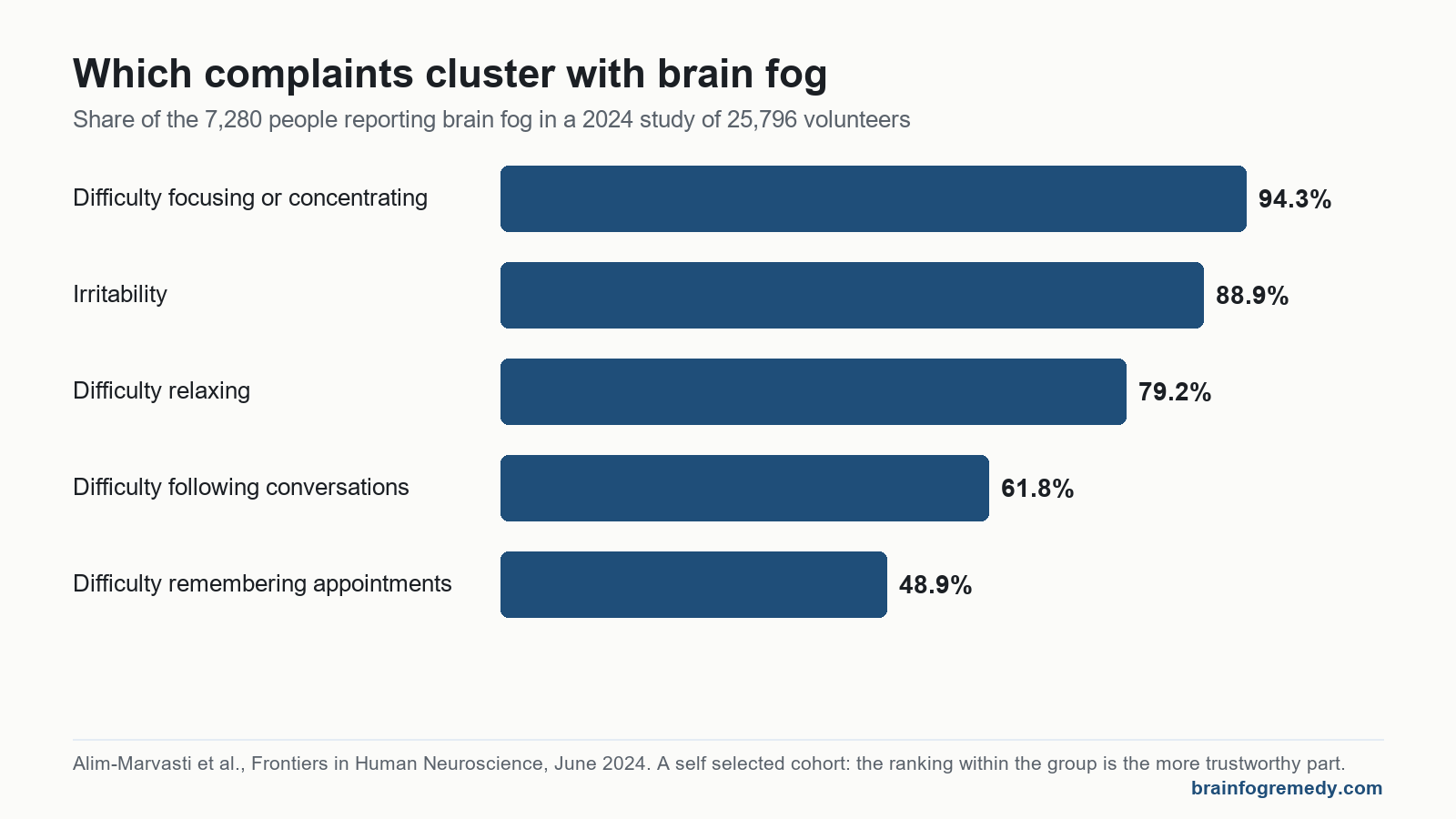
One of the larger attempts to characterise this asked 25,796 people about it and found 7,280 of them, roughly 28 percent, reported brain fog. Published in Frontiers in Human Neuroscience in 2024, it is useful because it ranks the complaints rather than just listing them.
| What people reported | Share of the brain fog group |
|---|---|
| Difficulty focusing or concentrating | 94.3 percent |
| Irritability | 88.9 percent |
| Difficulty relaxing | 79.2 percent |
| Difficulty following conversations | 61.8 percent |
| Difficulty remembering appointments | 48.9 percent |
Two things stand out. Concentration is nearly universal, which matches how people describe it. And the second and third entries are not cognitive at all: irritability and an inability to settle sit higher than the memory complaints, which is worth knowing if you had assumed the mood side was a separate problem. That overlap is the reason we looked separately at what emotional exhaustion is reported to feel like alongside the fog.
Read the numbers with caution. That cohort volunteered, so the 28 percent figure says more about who answers cognition surveys than about how common brain fog is generally. The ranking within the group is the more trustworthy part.
Why does it get worse as the day goes on?
Because it is load dependent, and this is the most recognisable feature of the pattern. Most people describe a reasonable morning, a wall somewhere in the early afternoon, and an evening in which reading a menu is genuinely difficult. The triggers are cumulative rather than dramatic: a long meeting, a supermarket, a phone call that took concentration, a day of screens. None of those is demanding alone. Stacked, they are.
There is also a delayed version, documented in ME and chronic fatigue syndrome and reported by a large share of people with long COVID, where the crash does not arrive on the day. Symptoms worsen twelve to forty eight hours later and can last days, and the trigger does not have to be physical, because concentration counts as exertion. If Wednesday is always bad and you cannot work out why, look at Monday.
If you are tracking this, record the day before as well as the day itself. A single day diary will make a delayed pattern look random when it is not.
That timing question overlaps heavily with fatigue and brain fog together, and it is one of the more useful things to bring to an appointment because it is specific and it is not something you can get from a symptom list.

Can a symptom list tell you what is causing your brain fog?
No, and this is the honest centre of the whole topic. A 2025 review in European Psychiatry by Denno and Hampshire went through brain fog across conditions and reached an uncomfortable conclusion: the term has no standardised definition, and the same reported experience turns up in post COVID syndrome, menopause, an underactive thyroid, head injury, chronic fatigue syndrome, fibromyalgia and lupus, among others.
How one of those conditions reads from the inside, in the words of 5,170 patients, is in what thyroid brain fog feels like. In a companion review published in February 2025, the same authors went as far as recommending that researchers stop using the phrase where a more precise term exists, which tells you how little the label narrows anything down.
The practical consequence: two people can give word for word identical descriptions and have entirely different things going on. Your symptoms establish that something is happening. They do not identify what. Anyone who reads your list back to you and names a cause, particularly if a product follows, has skipped the step where evidence would go. We have covered the eight causes worth checking first, and the framing there is the same: candidates to investigate, not answers.
Why do cognitive tests often come back normal?
Research comparing what people report against how they score on cognitive tests finds the relationship inconsistent. Some studies show mild deficits in attention and memory. Others find none. Where deficits do appear, they are frequently mediated by fatigue and by mood rather than standing alone. The menopause literature is the sharpest illustration of that inconsistency, which is why we compared the biggest cohorts directly on what the evidence shows about memory loss during menopause.
A normal result does not mean nothing is wrong. It means a short battery, in a quiet room, on a single morning, did not capture it. A fluctuating load dependent symptom is close to the hardest thing to catch that way, and that is a limitation of the instrument rather than a verdict on you.
There is also a recognised pattern called functional cognitive disorder, where a marked gap between reported difficulty and measured performance is itself the defining feature, and where increased self monitoring appears to make the experience worse. It is a real clinical entity rather than a polite way of saying nothing is wrong. Whether it applies to any individual is a question for a clinician who has assessed them, and not something a website can tell you.
What is not brain fog?
Being precise matters more than being reassuring here, because a few things share the general territory and are handled completely differently.
| How it tends to look | What it usually calls for | |
|---|---|---|
| Brain fog | Fluctuates, worse with load and tiredness, you are the one who notices | A GP conversation with a written record of the pattern |
| Sudden confusion | Comes on over hours or days, not knowing where or when you are | The NHS advises A and E or 999, treated as an emergency |
| Progressive memory change | Steady rather than fluctuating, others often notice first | A GP appointment, not left to see whether it settles |
| Long standing attention difficulty | Present since school rather than a recent change | A different conversation entirely, since it is not a change to explain |
The distinction that matters most is direction of travel. Brain fog moves up and down. Something that only gets worse, week on week, with no better days, is a different pattern and worth raising sooner rather than later. Equally, if the people around you are worried and you are not, that combination deserves an appointment. On sudden confusion the NHS position is unambiguous and has no wait and see version: anyone who becomes confused suddenly needs urgent assessment. If a physical heaviness or pressure sits underneath your fog, the screening list clinicians use for a heavy, foggy head names the features that mean the same day rather than next month.
What should you write down before an appointment?
Turning up and saying you have brain fog gives a doctor very little, through no fault of yours: the word covers too much ground. Two weeks of notes converts a vague complaint into a pattern that can be investigated.
- When it started, and whether you can attach it to anything: an illness, a new prescription, a bereavement, a change in sleep.
- Whether it fluctuates through the day, and roughly when the wall arrives.
- What reliably makes it worse, including the day before, not just the day itself.
- Whether anything makes it better, and for how long.
- What you can no longer do that you could do a year ago, stated concretely.
- Every medication and dose, including things you would not think to mention.
Sleep in particular changes everything downstream of it, which is why brain fog after a bad night is its own topic, and for anyone in their forties or fifties the timing question also intersects with brain fog in menopause.
If the terminology is what is tripping you up, what the phrase brain fog actually means covers what doctors tend to write instead, which is occasionally the difference between being heard and being filed under stress.
A two column diary: today, and the day before
Two weeks of one line entries turn a vague complaint into a pattern a doctor can investigate. The column for the day before is the one that makes a delayed crash visible.
Kept on this device only. A diary describes a pattern; it does not identify a cause, and nothing here interprets your entries. Bring it to the appointment.
What has changed since this was first published?
A symptom list ages slowly and its sources age faster, so this page is rechecked on the weekly refresh and the entries below say what was looked at and when.
- 11 October 2026: the Denno and Hampshire review was confirmed as published online in European Psychiatry on 26 August 2025 (DOI 10.1192/j.eurpsy.2025.1226) and its open access copy is live. Its abstract describes brain fog as poorly defined and as mainly attention, memory and language difficulties overlapping with fatigue, anxiety, depression and dissociation, which is what this page says. The recommendation to replace the phrase with a more precise term where one exists comes from the same authors’ February 2025 feature review in Trends in Neurosciences, and this page now says so.
- 11 October 2026: the 2024 Frontiers in Human Neuroscience figures, 25,796 people and 7,280 reporting brain fog, are unchanged, and the NHS confusion page link is live. No figure on this page has changed.
Frequently asked questions
What are the most common brain fog symptoms?
Difficulty focusing is close to universal, reported by 94.3 percent of the brain fog group in a 2024 study of 25,796 people, linked in the article above. Difficulty following conversations came next at 61.8 percent, then difficulty remembering appointments at 48.9 percent. Irritability and trouble relaxing both ranked higher than the memory complaints.
Does brain fog feel like forgetting things?
Most people describe effort rather than forgetting. Thinking that used to be automatic now has to be pushed, and the push is tiring. Words are blocked rather than lost, and information does not stick while you are trying to use it. Failing to retain that a conversation happened at all is a different symptom and worth raising with a doctor.
Why is my brain fog worse in the afternoon?
It is load dependent for most people, so it accumulates through the day. Meetings, screens, noise and concentration all add to the total. There is also a delayed pattern, documented in ME and chronic fatigue syndrome and reported in long COVID, where symptoms worsen twelve to forty eight hours after the effort rather than on the day.
Can my symptoms tell me what is causing my brain fog?
No. A 2025 European Psychiatry review found the term has no standardised definition and that the same reported experience appears across post COVID syndrome, menopause, thyroid problems, head injury, chronic fatigue syndrome, fibromyalgia and lupus. Identical descriptions can have entirely different explanations, which is why the list is a starting point for investigation rather than an answer.
Why did my cognitive tests come back normal?
Studies comparing reported brain fog against test performance find an inconsistent relationship, with some showing mild attention and memory deficits and others showing none. Where deficits appear they are often mediated by fatigue and mood. A short battery in a quiet room on one morning is poorly suited to catching a symptom that fluctuates with load.
When are these symptoms an emergency?
Sudden confusion is. The NHS advises going to A and E or calling 999 if someone suddenly becomes confused, and there is no wait and see version of that advice. Gradual forgetfulness or confusion is not an emergency but the NHS still advises seeing a GP rather than leaving it.
Finished the page? The same five questions from the top, to see what stuck.
This article is general information, not medical advice, and is not a substitute for care from a qualified healthcare professional. Speak to your doctor about your own situation.
Leave a Reply