
No food has been shown in a trial to clear brain fog. The best test so far of foods that help with brain fog, a 2023 trial of the MIND diet in 604 older adults, found no meaningful difference in thinking after three years against a control diet. The confident food lists rest mostly on observational studies.
Listen to this article, about 12 minutes. A synthetic voice reads the article and announces each section title as it begins; tables are read row by row and the questions at the end are left out.
Recorded 8 October 2026 from the article as published that day. Press a chapter to jump there; the highlighted line is what is playing. A play button sits beside every section heading, and once you scroll past this player a bar at the bottom of the screen keeps the controls in reach. Tap or click any sentence to hear the reading start from there.
On this page: the 2023 MIND diet trial result the food lists leave out, a table of seven diet studies with the source on every row, the one survey that measured brain fog itself, and what people with long covid told Oxford researchers about cooking.
Think you already know this? Five questions, one minute.
Every answer is on this page. Answer from what you know now; the page fills in the rest.
-
1. In the 2025 survey by Altinsoy and Dikmen, how did MIND diet adherence relate to Brain Fog Scale scores?
Altinsoy and Dikmen found no correlation between MIND diet adherence and brain fog scores; gut symptoms and mood were linked instead. Read the section
-
2. After three years in the 2023 NEJM trial, what was the difference in global cognition between the MIND diet and control groups?
Barnes and colleagues reported rises of 0.205 and 0.170 units, a difference of 0.035 that was not significant. Read the section
-
3. What kind of study produced the widely quoted 53 percent lower Alzheimer’s risk for the MIND diet?
The 2015 Morris study scored the existing diets of 923 older adults, so it shows association rather than cause. Read the section
-
4. At what caffeine dose did the European Food Safety Authority panel call it well established that caffeine increases attention?
The EFSA black tea opinion says caffeine increases attention in healthy adults at doses of at least 75 mg. Read the section
-
5. In the Oxford Health Experience Insights interviews on home life, what did several people describe?
The Oxford archive carries accounts of fog making meal preparation too much, with family members cooking instead. Read the section
The top search results, from a wellness shop, a snack bar maker, a menopause app and a supplement seller, agree on a list: blueberries, walnuts, oily fish, leafy greens, dark chocolate. Good foods, mostly. The problem is the promise stapled to them, that a better plate will lift the fog, ideally by Friday.
Which foods actually help with brain fog, according to the studies?
The honest answer is that nobody has tested food against brain fog directly and published a result. What exists is research on diet and cognitive decline over years in older adults. That is a different question from the slow, cloudy thinking of brain fog, though the food lists borrow freely from it.
The one study that did ask about brain fog and diet found nothing. In a 2025 cross sectional study in Medicina, Altinsoy and Dikmen found that adherence to the MIND diet showed no correlation with Brain Fog Scale scores. Brain fog scores did rise with gastrointestinal symptoms and with mood, and they were higher in people who had had COVID. A survey taken at one moment cannot show cause in either direction, but it is a long way from “eat these ten foods”.
There is a trial on the way. A published protocol from Turkey describes a randomised trial of the MIND diet in 62 adults with relapsing multiple sclerosis, with the Brain Fog Scale as its primary outcome. As far as we could find on 8 October 2026, it has not reported.
| Study | Design | Who | What it found | Source |
|---|---|---|---|---|
| MIND diet and Alzheimer’s, 2015 | Observational: people reported what they already ate | 923 older adults in Chicago | Closest followers had up to 53 percent lower Alzheimer’s risk; moderate followers about 35 percent | Morris and colleagues |
| Ultra processed food, 2023 | Observational, about 8 years | 10,775 Brazilian adults | Eating above the lowest quarter went with a 28 percent faster rate of global cognitive decline | Gomes Gonçalves and colleagues |
| PREDIMED cognition, 2015 | Randomised, unblinded | 447 older Spanish adults at high heart risk | Olive oil group held steady while the low fat advice group declined | Valls Pedret and colleagues |
| MIND diet trial, 2023 | Randomised, 3 years | 604 older adults | Both groups improved; the difference, 0.035 units, was not significant | Barnes and colleagues |
| Brain fog survey, 2025 | Cross sectional survey | Adults in Turkey | MIND diet adherence showed no correlation with Brain Fog Scale scores | Altinsoy and Dikmen |
| ReDIRECT, 2025 | Randomised, long covid | 234 adults with excess weight | Small benefit on each person’s main symptom; only 5 percent chose cognition | ReDIRECT trial |
| MIND diet in MS | Randomised, registered protocol | 62 adults with relapsing MS planned | Brain Fog Scale is the primary outcome; no results yet | published protocol |
What did the MIND diet trial in the NEJM find?
The MIND diet blends the Mediterranean diet with the blood pressure focused DASH diet, leaning on leafy greens, berries, nuts, beans, whole grains, fish and olive oil. It looked very promising on paper. In a 2015 observational study of 923 older adults, Martha Clare Morris and colleagues found the people who followed it most closely had up to 53 percent lower risk of Alzheimer’s disease. The catch: researchers scored what people already ate, and people who eat well differ in many other ways.
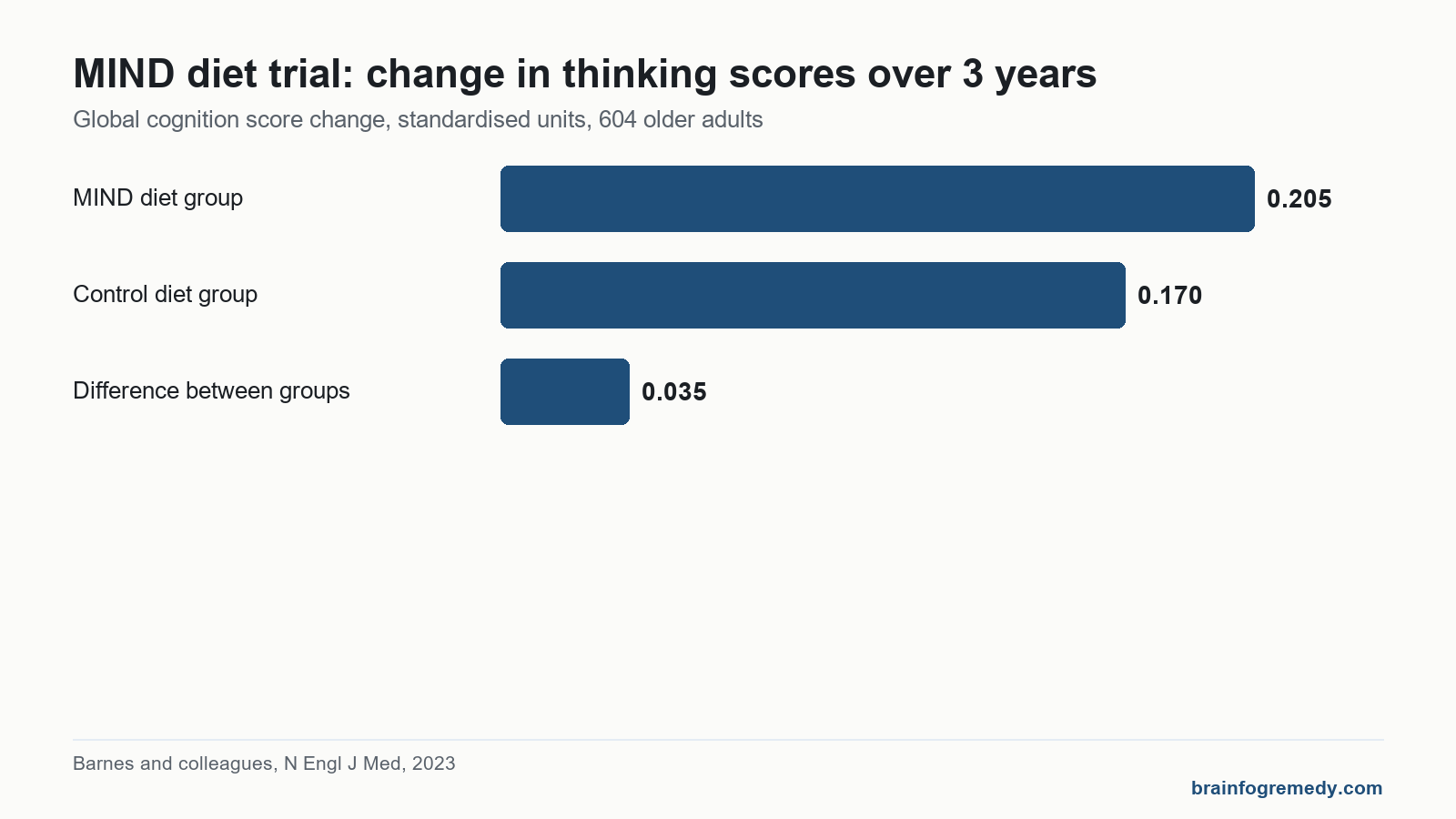
So the team ran a proper trial. Barnes and colleagues, writing in the New England Journal of Medicine in 2023, randomly assigned 604 adults aged 65 and over, all overweight, with a family history of dementia and a less than ideal diet, to the MIND diet or to a control diet. Both groups were asked to cut calories slightly and both got counselling. After three years, global cognition scores rose by 0.205 units in the MIND group and 0.170 in the control group. The difference, 0.035, was not statistically significant. The full paper also found no meaningful difference in brain scans.
Both groups lost weight and both improved, which suggests that eating a bit less and getting regular support did something, though the trial was not designed to say what. What it did show is that the specific foods on the MIND list added no measurable benefit over that. This is the study the food lists leave out, and it was built by the very researchers who had championed the diet. That deserves more credit than it gets.
Why do the food lists sound so confident?
Because observational studies produce big, quotable numbers, and a 53 percent drop sells more berries than “no significant difference”. The same pattern runs through the evidence on ultra processed food. In a 2023 study in JAMA Neurology, Gomes Gonçalves and colleagues followed 10,775 Brazilian adults for a median of eight years and found that eating more ultra processed food than the lowest quarter went with a 28 percent faster rate of global cognitive decline. A real association, but not proof that a packet of crisps clouds anyone’s thinking next Tuesday.
Trials that did find a benefit tend to be smaller and harder to read. In the PREDIMED cognition study in JAMA Internal Medicine, 447 older Spanish adults at high cardiovascular risk were given a Mediterranean diet with extra olive oil, one with extra nuts, or advice to eat low fat. Over about four years the olive oil group held steady while the control group declined. Participants knew which diet they were on and none of it involved brain fog. The brain detox smoothie, meanwhile, has been tested in precisely zero published trials.
None of this means diet is irrelevant. It means the evidence that particular foods lift brain fog is not there yet. Pills have their own murkier record, covered in our look at which vitamins have any evidence for brain fog.
Does what you drink matter as much as what you eat?
Possibly more, at least in the short term, because drinks have been tested over hours rather than years. In a 2018 meta analysis in Medicine and Science in Sports and Exercise, Wittbrodt and Millard Stafford pooled 33 studies and found that attention, executive function and coordination suffered more once fluid loss passed 2 percent of body weight. The effects were small and other analyses have disagreed, so treat this as a sensible likelihood rather than a law. The NHS cites the Eatwell Guide figure of 6 to 8 cups or glasses of fluid a day, and says tea and coffee count. Our page on how much dehydration it takes to cause brain fog goes further.

Caffeine is the one dietary ingredient with an official verdict on attention. In a 2018 opinion on black tea, the European Food Safety Authority panel said it is well established that caffeine increases attention in healthy adults at doses of at least 75 mg. That is about alertness in the hour after a cup, not a cure for fog, and caffeine has a habit of sending the bill later. The withdrawal side of caffeine and brain fog is its own story. Alcohol works the other way, and the next morning is covered in what clears fast and what lingers after drinking.
What do people with long covid say about food and fog?
Something the food lists never mention: when the fog is bad, cooking itself can become the problem. The Health Experience Insights archive at the University of Oxford publishes interviews with adults who had COVID between March 2020 and February 2022. Its page on home and family life, read on 8 October 2026, carries about ten accounts touching on meals and the kitchen. These are what people report, not findings about food.
Helen, 38, said that fog and fatigue made preparing a meal feel like too much, and the family now keeps food in the freezer so there is always something to eat. Ada, 34, described being unable to cook a proper meal for her extended family, with her mother in law now cooking their weekly meal. Golda, 53, stopped cooking altogether for a time, with food bought or brought in. Sonal said her sons took over, mostly with toasties, beans on toast, frozen food and takeaways. Amanda described leaving pans on and burning things, and worrying constantly about safety.
Not one of the accounts we read said cooking was untouched, though Helen’s family said they now had it largely sorted. Our attempts to read food diary accounts on two patient forums were blocked, so this rests on the Oxford archive alone. A list of ingredients assumes the energy to shop for, chop and cook them, and the trial diets above came with counselling and support. Anyone struggling to eat enough is better served by a GP or a dietitian than by a list.
Fog after a specific meal is a slightly different question, with its own studies, covered in what the meal studies show about brain fog after eating.
When is brain fog a reason to see a doctor rather than change your diet?
When it lasts, worsens or comes with other changes. See a GP if brain fog has gone on for weeks without an obvious reason, if memory problems are new or getting worse, or if it comes with unexplained weight loss, ongoing gut symptoms, low mood that will not lift, or extreme tiredness. Some causes of fog, such as low iron, low B12, thyroid problems and coeliac disease, are found with blood tests, and changing your diet first can hide the answer. Cutting gluten before a coeliac test is the classic example.
Sudden confusion, slurred speech, weakness on one side or a severe headache needs emergency care straight away, not a food diary.
A plain record of food, drink and how your thinking felt can take an appointment further than “I just feel foggy”. Our guide to describing brain fog so a doctor takes you seriously covers the words, and the causes a doctor usually checks first puts food in its place on the wider list.
Two week food and fog diary
A plain record for fourteen days of what you ate and drank and how your thinking felt, to take to an appointment if you want to. It records only. It does not score, interpret or diagnose anything.
Entries stay on this device and are not sent anywhere. A diary cannot show whether any food is involved in brain fog; only a clinician can work out causes, and some tests need a food to still be eaten.
Frequently asked questions
Is the MIND diet bad for brain health, given the trial result?
No. In the 2023 trial both the MIND group and the control group improved slightly. The trial found that the MIND foods added no significant benefit over a mildly calorie reduced control diet.
Are blueberries good for brain fog?
No published trial has tested blueberries against brain fog. They appear on food lists largely because of observational research on diet and long term cognitive decline.
Does sugar cause brain fog?
There is no trial showing that sugar causes brain fog. Ultra processed food intake has been linked with faster cognitive decline over years in an observational study, which is a different question.
Is there a brain fog diet for long covid?
No diet has been shown to treat long covid brain fog. The ReDIRECT trial tested a weight management programme in long covid, and only 5 percent of participants chose cognition as their main symptom.
How long would a diet take to affect thinking?
The MIND trial ran for three years and PREDIMED for about four. Short term effects of particular foods on thinking have not been tested against brain fog.
Should I keep a food diary for brain fog?
A diary can be useful to show a doctor, but it cannot show what is causing anything. If a food seems involved, speak to a GP before cutting it out, as some tests need the food to be eaten.
Finished the page? The same five questions from the top, to see what stuck.
This article is general information, not medical advice, and is not a substitute for care from a qualified healthcare professional. Speak to your doctor about your own situation.
Leave a Reply