Brain fog after eating has a measured basis: in a 1997 sleep lab study, a solid meal made volunteers fall asleep faster than water did, whatever the meal contained. Doctors call it reactive hypoglycaemia only when blood sugar is measured low during the symptoms and the symptoms clear as it rises.
Listen to this article, about 10 minutes. A synthetic voice reads the article and announces each section title as it begins; tables are read row by row and the questions at the end are left out.
Recorded 7 October 2026 from the article as published that day. Press a chapter to jump there; the highlighted line is what is playing. A play button sits beside every section heading, and once you scroll past this player a bar at the bottom of the screen keeps the controls in reach. Tap or click any sentence to hear the reading start from there.
On this page: what a 1997 sleep lab study measured after a meal, the glucose peaks 24 healthy volunteers actually reached, how the Endocrine Society says reactive hypoglycaemia is confirmed, and a table of six explanations with the source on every row.
Think you already know this? Five questions, one minute.
Every answer is on this page. Answer from what you know now; the page fills in the rest.
-
1. In the 1997 Orr study, what happened to volunteers after a solid meal compared with an equal volume of water?
Orr and colleagues found the solid meal significantly shortened sleep latency at the 5.30, 6 and 8pm naps. Read the section
-
2. According to the 2005 review of the post lunch dip, can the dip happen without any lunch?
Monk’s review says the dip can occur even with no lunch, and that a high carbohydrate lunch makes it worse. Read the section
-
3. In the 2007 continuous monitoring study of healthy volunteers, how long did glucose take on average to reach its peak after a meal?
Freckmann and colleagues reported a mean time to peak of between 46 and 50 minutes. Read the section
-
4. What does the Endocrine Society guideline require before hypoglycaemia is evaluated?
The Endocrine Society guideline recommends evaluation only when Whipple’s triad is documented. Read the section
-
5. What does NICE NG20 say about eating gluten before a coeliac blood test?
NICE NG20 says testing is only accurate while a gluten containing diet is being eaten. Read the section
Search for this and you will mostly find two kinds of page: a company selling a low carb loaf, and a company selling a glucose test. Both have a stake in the answer being blood sugar. This page goes back to what the sleep studies, the glucose studies and the guidelines actually measured, and says plainly where the evidence runs out, which is sooner than the bread suggests. It cannot tell you why your own head goes cloudy after lunch. It can tell you which explanations have data behind them.
Why do some people get brain fog after eating?
Because eating a meal makes almost everyone a bit sleepier, and sleepy thinking feels like fog. The cleanest test of this is old but well designed. In a 1997 study in Physiology and Behavior, Orr and colleagues had ten healthy men nap at 4pm, eat at 5pm, then nap again at 5.30, 6, 7 and 8pm while polysomnography timed how fast they fell asleep. After a solid meal they dropped off significantly faster than after an equal volume of water at the 5.30, 6 and 8pm naps.
This is not a quirk of human willpower. In a 2016 study in eLife, fruit flies slept more after bigger meals too, for roughly 20 to 40 minutes. If an animal with a brain smaller than a poppy seed needs a lie down after dinner, the rest of us can stop treating the 2pm slump as a character flaw.
Sleep matters as much as the meal. A short night makes the after lunch dip deeper, which is covered in our piece on why one bad night of sleep lingers.
Does what you eat change the post meal slump?
Less than the internet says. The same 1997 study tested a high fat meal, a high carbohydrate meal and a mixed one, and found no significant difference in how fast people fell asleep. The authors’ conclusion was blunt: meal constituents had no effect on postprandial sleepiness. Ten men is a small sample, and how sleepy people felt was not the measure, so this is not the last word. But it is the measured word.
Timing may matter more than the plate. In a 2005 review on the post lunch dip, Timothy Monk describes a mid afternoon drop in performance that can happen even when people have had no lunch and do not know the time of day. It is rooted in the body clock. A high carbohydrate lunch makes it worse, he writes, but it does not create it. So the sandwich gets blamed for a slump that was booked in advance.

What does blood sugar actually do after a meal?
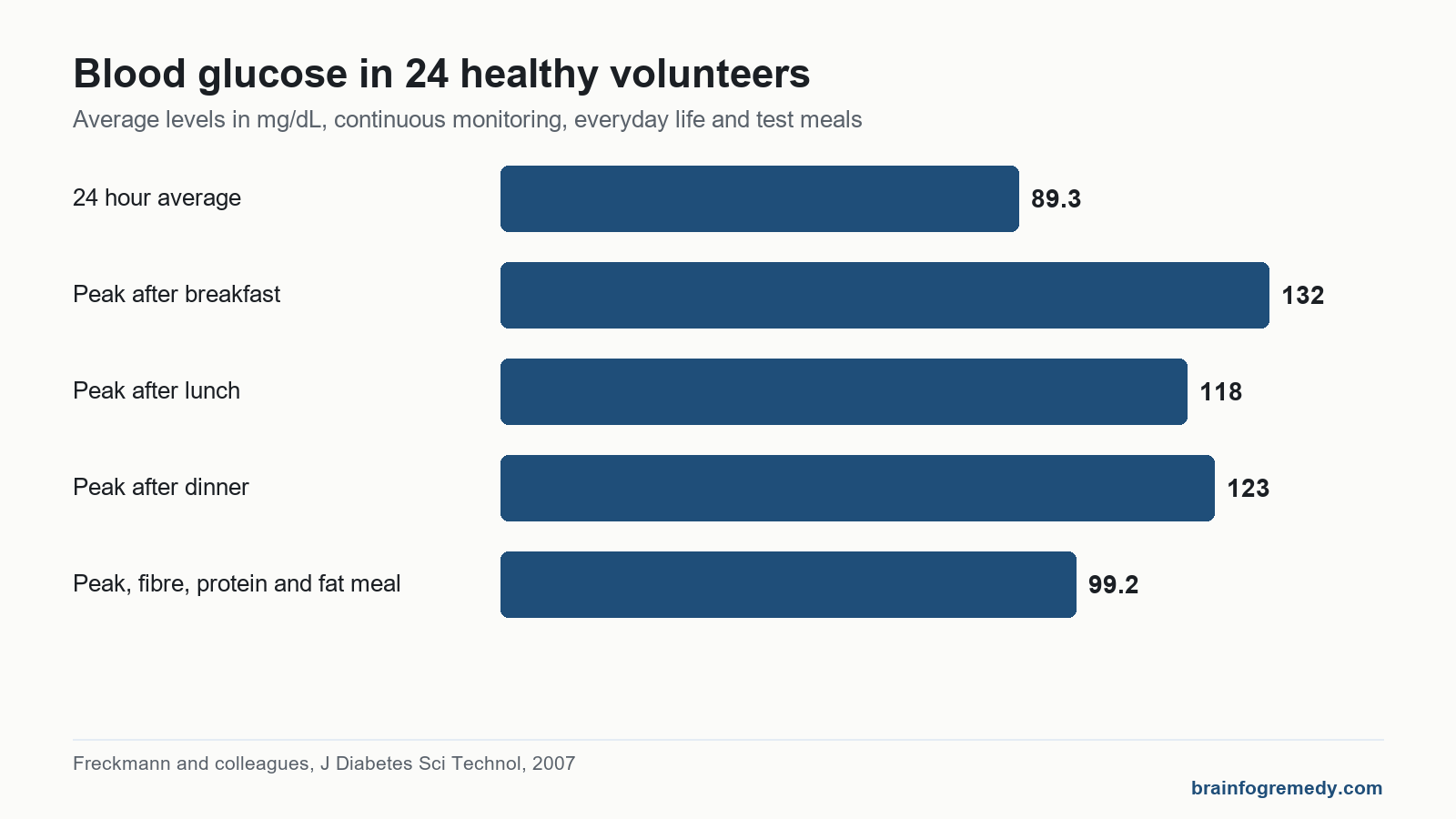
It rises, peaks within the hour, and comes back down, even in people with no diabetes at all. In a continuous monitoring study of 24 healthy volunteers published in the Journal of Diabetes Science and Technology in 2007, Freckmann and colleagues found an average 24 hour level of 89.3 mg/dL (about 5.0 mmol/L). The highest peaks came after breakfast, at 132.3 mg/dL on average, with lunch at 118.2 and dinner at 123.0. Glucose took 46 to 50 minutes on average to reach its peak.
Meals with more fibre, protein and fat produced a smaller and slower rise, with one peaking at 99.2 mg/dL. That is the finding the bread sellers quote, and it is real. What it does not show is that those peaks cause fog; the study measured glucose, not thinking.
A larger picture came from Stanford. In a 2018 study in PLOS Biology, Hall and colleagues found that even people classed as normal by standard tests spent 15 percent of their monitored time in the prediabetic range and 2 percent in the diabetic range, and that people responded very differently to identical meals. That cuts both ways. A spike on a wearable monitor is common in healthy people, so seeing one is not a diagnosis, and a curve from someone else’s app says little about yours.
What is reactive hypoglycaemia, and how is it confirmed?
Reactive hypoglycaemia means blood sugar falling too low some hours after a meal, and it is much less common than the number of pages about it would suggest. The Endocrine Society’s 2009 clinical practice guideline sets the bar. It recommends evaluating hypoglycaemia only when Whipple’s triad is documented: symptoms that fit, a low plasma glucose measured at the time, and the symptoms resolving once glucose is raised. The level commonly used for that low reading in people without diabetes is under 55 mg/dL (3.0 mmol/L).
Feeling foggy at 3pm and guessing it was sugar does not meet that bar, and neither does a finger prick taken an hour after the fog has passed. For symptoms after meals, the guideline describes a mixed meal test, eating a meal like the one that seems to set things off while blood is taken over several hours, rather than the old sugary drink test. A recognised cause is stomach surgery, including bariatric surgery, which speeds food into the gut. Whether testing is worthwhile is a decision for a doctor who knows the history.
| Explanation | When it tends to show up | What the evidence actually says | Source |
|---|---|---|---|
| Ordinary post meal sleepiness | Within about an hour | A solid meal shortened the time to fall asleep compared with the same volume of water; fat versus carbohydrate made no difference | Orr and colleagues, 1997 |
| The afternoon dip | Early to mid afternoon | Can happen with no lunch at all; a high carbohydrate lunch makes it worse | Monk, 2005 |
| Reactive hypoglycaemia | Hours after the meal | Only counts when glucose is measured low during symptoms and the symptoms clear when it rises | Endocrine Society guideline, 2009 |
| Coeliac disease | Not tied to one meal | NICE lists prolonged fatigue and persistent gut symptoms among reasons to offer a blood test, taken while still eating gluten | NICE NG20 |
| Gut bacteria and D lactate | With gas and bloating | One clinic series of 30 patients; contested in published letters and not replicated in a trial | Rao and colleagues, 2018 |
| A fall in blood pressure after meals | Within about two hours, mostly in older adults | Found in 8 of 16 older patients with unexplained fainting in one small study | Jansen and colleagues, 1995 |
Could gluten or the gut be involved?
Sometimes, and here a blood test beats guessing. The NICE coeliac disease guideline, NG20 says testing should be offered to adults with persistent unexplained gut symptoms, prolonged fatigue, unexpected weight loss or unexplained iron, B12 or folate deficiency, among others. It also says the test is only accurate while gluten is still being eaten. Cutting bread first and testing later is the most common way to spoil the answer, which is why our page on coeliac disease and brain fog is subtitled the way it is.
The gut more broadly has some interesting and shaky evidence. In a 2018 series in Clinical and Translational Gastroenterology, Rao and colleagues described 30 patients with brain fog, gas and bloating; small intestinal bacterial overgrowth was found in 68 percent of them against 28 percent of 8 patients without fog, and all 30 had been taking probiotics. The journal printed four comments on it within five months. It is a hypothesis from one clinic, not an established cause.
A 2025 survey from Turkey points the same way, loosely. In a cross sectional study in Medicina, Altinsoy and Dikmen found brain fog scores rose with gastrointestinal symptom scores and with mood, while sleep quality dropped out once other factors were accounted for, and adherence to the MIND diet showed no relationship at all. It is a survey taken at one moment, so it can show things travelling together but not which one drives the other.
When does brain fog after a meal need a doctor?
When it comes with any of the following, which should be checked by a doctor rather than managed at home: fainting or nearly fainting after meals; shaking, sweating or confusion that eases when you eat; weight loss you cannot explain; ongoing diarrhoea, bloating or pain; new or worsening memory problems; or fog after meals following stomach or weight loss surgery.

One cause is easily missed in older adults. A 1995 study in Archives of Internal Medicine found that 8 of 16 older patients with unexplained fainting had postprandial hypotension, a fall in blood pressure after eating, with mean arterial pressure dropping by 17 mmHg on average after a meal. The authors advised that blood pressure be measured around meals when fainting is investigated in older people. Feeling lightheaded or foggy after meals in later life is worth mentioning for that reason.
If none of that applies and the fog is the familiar post lunch heaviness, the evidence above suggests it is a normal response many people share. A record of what you ate, when, and how your thinking felt afterwards is more useful at an appointment than a memory of bad afternoons. Our guide to describing brain fog so a doctor takes it seriously covers how to put it into words, and the causes a doctor usually checks first sets the meal question in the wider list.
Meal and thinking diary
A plain record to take to an appointment if you want to show a pattern to someone. It does not score, interpret or diagnose anything.
Entries stay on this device and are not sent anywhere. A diary cannot show whether blood sugar, the gut or anything else is involved; only a clinician can work that out.
Frequently asked questions
Is it normal to feel sleepy after every meal?
Some sleepiness after a solid meal is common. In a 1997 sleep lab study, healthy volunteers fell asleep faster after a meal than after water. Sleepiness strong enough to disrupt daily life is worth raising with a GP.
Does a high carbohydrate meal cause more brain fog than a high fat one?
In the 1997 Orr study, fat, carbohydrate and mixed meals made no difference to how fast people fell asleep. A 2005 review found a high carbohydrate lunch can deepen the afternoon dip.
Can a continuous glucose monitor show whether I have reactive hypoglycaemia?
It can show glucose trends, but healthy people also show spikes. The Endocrine Society guideline relies on a low plasma glucose measured during symptoms, with symptoms clearing as glucose rises.
How soon after eating does reactive hypoglycaemia happen?
It is described as occurring some hours after a meal rather than straight away, which is why a mixed meal test samples blood over several hours.
Should I stop eating gluten to see if the fog lifts?
NICE advises that coeliac tests are only accurate while gluten is still being eaten. Speak to a GP about testing before changing your diet.
Why do I feel foggy in the afternoon even when I skip lunch?
A review of the post lunch dip describes a drop in alertness in the early afternoon that can happen without any lunch, linked to the body clock.
Finished the page? The same five questions from the top, to see what stuck.
This article is general information, not medical advice, and is not a substitute for care from a qualified healthcare professional. Speak to your doctor about your own situation.
Leave a Reply