
How long can brain fog last? No guideline gives a figure, because brain fog is a description, not a diagnosis. The timelines that exist belong to whatever sits behind it: usually days after a concussion, weeks after a run of bad sleep, months around an infection or perimenopause, and years for a small minority after COVID.
Listen to this article, about 11 minutes. A synthetic voice reads the article and announces each section title as it begins; tables are read row by row and the questions at the end are left out.
Recorded 10 October 2026 from the article as published that day. Press a chapter to jump there; the highlighted line is what is playing. A play button sits beside every section heading, and once you scroll past this player a bar at the bottom of the screen keeps the controls in reach. Tap or click any sentence to hear the reading start from there.
On this page: a comprehensive table of documented timelines by trigger, a checklist for doctor preparation, and key statistics on recovery rates.
Think you already know this? Five questions, one minute.
Every answer is on this page. Answer from what you know now; the page fills in the rest.
-
1. Why is there no official diagnostic duration for brain fog?
Brain fog is a description rather than a diagnosis, meaning there are no official diagnostic criteria to measure duration. For example, the National Cancer Institute lists how long memory problems might last as a question to ask your own care team rather than giving a set number. Read the section
-
2. In the LONG COVID EXP study of hospitalised survivors, what percentage of people reported brain fog at all three checkpoints?
According to the LONG COVID EXP study, only 2.23 percent of survivors reported brain fog at all three checks (8, 13, and 18 months), showing that for most people the symptom came and went. Read the section
-
3. What did researchers find when sleep-deprived adults had a single recovery night of up to ten hours?
In a 2010 study in Sleep, some attention deficits were still measurable even after a ten-hour recovery night following five nights of restricted sleep. Read the section
-
4. What did the SWAN study observe regarding cognitive performance during perimenopause?
The SWAN study found that learning gains stalled during perimenopause but returned to premenopausal levels after the transition. Read the section
-
5. How long should concussion symptoms last before warranting a clinical assessment?
According to the 2023 Amsterdam consensus, concussion symptoms that last more than four weeks are considered persisting and warrant clinical assessment. Read the section
Less satisfying than a number, which is exactly what every brain detox promising clarity by Friday is counting on. Here are the numbers that do exist, trigger by trigger, with a source on every row.
Why will nobody give a straight answer on duration?
Because there is nothing to measure against. A 2025 transdiagnostic review in European Psychiatry by Denno and Hampshire calls the term poorly defined and suggests researchers stop using it in favour of clearly defined ones. It describes brain fog as “chronic but often transient or variable”, which is an honest summary and also a sentence that contradicts itself in five words.
No diagnostic criteria means no official duration. Even the National Cancer Institute page on memory problems during cancer treatment, checked on 21 September 2026, gives no figure. It lists how long they might last as a question to ask your own care team.
So the table below takes the documented triggers one at a time. It is not a way of working out which one is yours: they overlap, and the list of possible causes is longer than any table.
What do the documented timelines actually say?
| Documented trigger | What the source actually measured | Time course it reports | Source |
|---|---|---|---|
| Concussion | International consensus on sport related concussion, all ages | Symptoms commonly resolve within days. Anything past four weeks counts as persisting, at every age | Amsterdam consensus, BJSM 2023 |
| A run of short nights | 159 adults, five nights of 4 hours in bed, then one recovery night of up to 10 hours | Some attention deficits were still there after the longest recovery night | Banks and colleagues, Sleep 2010 |
| Iron deficiency | NHS treatment guidance, and a 1996 trial in 81 teenage girls with low iron but no anaemia | Treatment usually runs about six months. The trial saw better verbal learning scores at eight weeks | NHS, Bruner and colleagues, Lancet 1996 |
| Other infections | 253 people followed for a year after glandular fever, Q fever or Ross River virus | About 11 percent met criteria for chronic fatigue syndrome, which includes cognitive difficulty, at six months | Hickie and colleagues, BMJ 2006 |
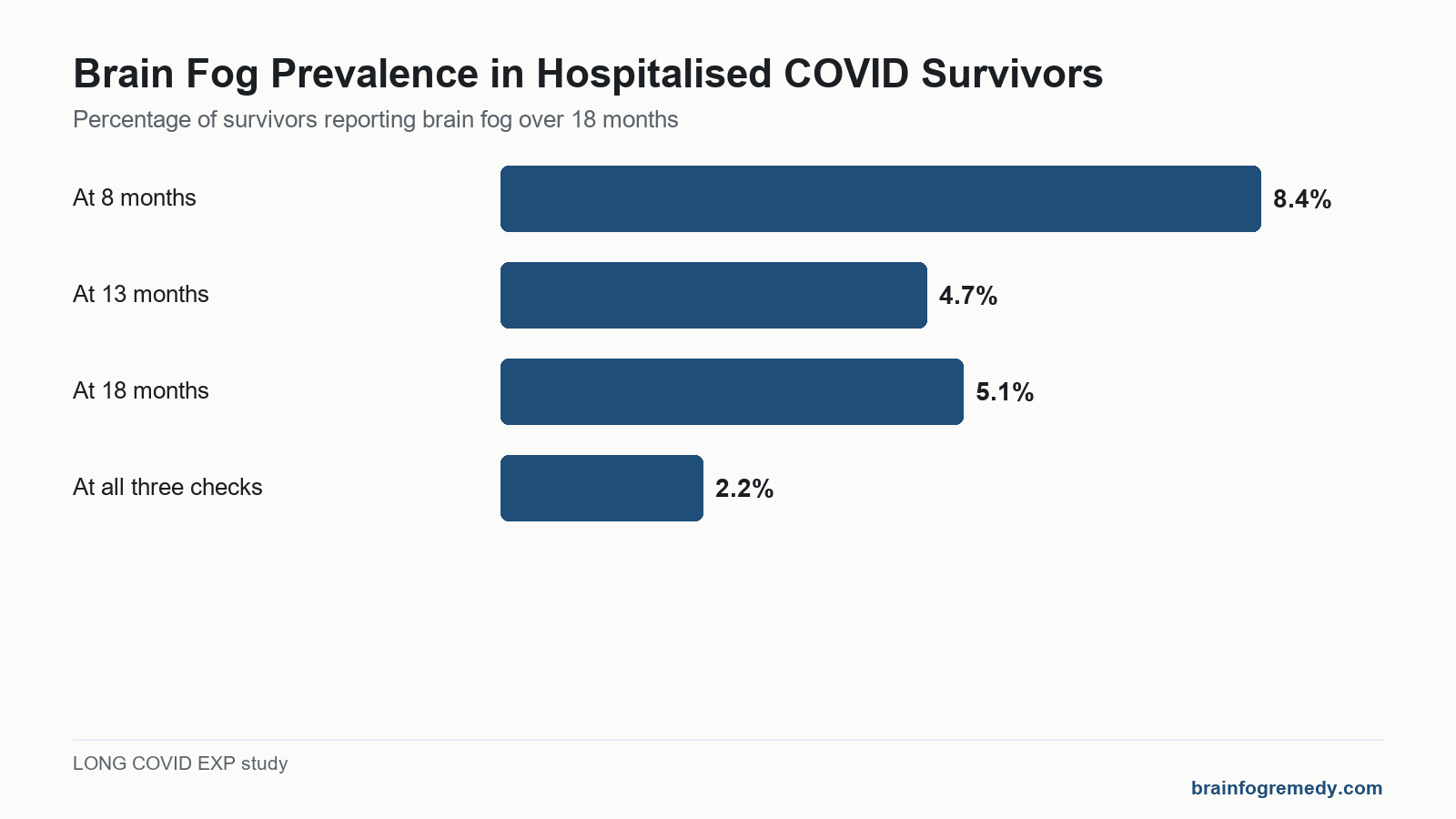
| COVID, hospitalised | 1,266 survivors checked at 8, 13 and 18 months after discharge | Brain fog fell from 8.37 to 4.70 percent, then sat at 5.10 percent. Only 2.23 percent had it at every check | LONG COVID EXP, Frontiers 2023 |
| COVID, population records | Health records of 1,284,437 people after infection, compared with other respiratory infections | Raised risk of a recorded cognitive deficit was still present at the end of two years | Taquet and colleagues, Lancet Psychiatry 2022 |
| Perimenopause | 2,362 midlife women tested repeatedly over four years | Learning gains stalled during perimenopause and returned to premenopausal levels after it | Greendale and colleagues, Neurology 2009 |
| Cancer treatment | The US National Cancer Institute patient page, updated January 2023 | No figure given. It lists how long the problems might last as a question to ask your care team | National Cancer Institute |
Read down the time column and a shape appears. Triggers with a clear end point, a knock to the head, a bad week of sleep, a measurable deficiency, tend to run in days to months. Illness the body is still working through runs longer, and for a minority much longer. Two caveats: almost none of these studies measured “brain fog” by name, and every figure describes a group, not any one person in it.
Why do the COVID numbers disagree so much?
Because each study counted different people. The LONG COVID EXP study followed 1,266 people who had been in hospital: brain fog in 8.37 percent at eight months, 4.70 at thirteen and 5.10 at eighteen. Only 2.23 percent reported it at all three checks, so for most people it came and went, or cleared, rather than running as one continuous stretch.
A 2024 follow up in The Lancet Psychiatry of 475 people two to three years after a hospital stay found 52.1 percent reporting at least mild cognitive decline, and the best predictor was how people were doing at six months, not how ill they had been.
The largest dataset, health records of over 1.28 million people analysed by Taquet and colleagues, found the extra risk of depression and anxiety after COVID faded within two years, while the extra risk of a recorded cognitive deficit was still there when follow up ended. NICE guideline NG188 calls symptoms beyond 12 weeks post COVID syndrome. There is more in the site’s article on COVID brain fog.
Does sleep debt clear as soon as you catch up?
Not in one night. In a 2010 study in Sleep, 159 adults spent five nights with four hours in bed, then one recovery night of up to ten hours. More recovery sleep helped, but some deficits were still measurable after the full ten. Anyone who has tried to repay a fortnight of short nights with one heroic Saturday lie in has run this experiment already, with a worse control group. More in brain fog from lack of sleep.

What about perimenopause, iron and concussion?
The SWAN study is the best news in the table. Across 2,362 women over four years, the usual improvement from repeating the same tests stalled during perimenopause and came back after it, which the authors read as a sign the difficulty may be time limited. The catch is that the transition can run for years, as the article on menopause brain fog explains.
For iron, the NHS says treatment for iron deficiency anaemia usually runs about six months. The trial in the table found better verbal learning after eight weeks of iron given by the researchers than on placebo. That is a time course, not a suggestion: iron is something to be tested for, not taken on a hunch, because too much of it causes harm. See what the evidence on low iron and brain fog shows.
For concussion, the 2023 Amsterdam consensus says symptoms commonly resolve within days, and now treats anything past four weeks as persisting at every age, where an earlier version used two weeks for adults. Anyone still symptomatic past four weeks should be assessed by a clinician with concussion experience.

What do people living with it report about how long it lasted?
To see what individuals describe, we read five Mumsnet threads on 21 September 2026, about 90 replies in all, and kept only accounts that said something concrete about time. These are reports, not findings, and none of them is evidence that anything works.
In a thread started in October 2023, the opening poster described fog for more than twenty years, with GP blood tests for iron, hormones, thyroid and diabetes all normal; updating in December 2024, it had not resolved. One reply described fog from their twenties to late thirties easing a few months after changing fitness, diet and a supplement all at once, so nobody can say which mattered. Another said decades of fog were better, but not gone.
A poster in July 2023 had been foggy at work for six months and described a task that used to take two and a half hours taking five. And in an October 2025 perimenopause thread asking how people got rid of it, 37 replies arrived in three days. Not one said how long the fog had lasted. Every answer named something different the person credited, and two replies reported opposite results from the same product.
Where the accounts agree with the research: the time course is long, it varies enormously, and normal blood results are common. Where they part company: every cohort in the table starts from a known trigger, while several of these accounts run for years with none ever identified, a group almost no study follows. People also measure fog by what they tried rather than by the calendar.
When has brain fog gone on long enough to see a doctor?
There is no waiting period you have to sit out first. Fog that is getting worse rather than better, memory problems that other people have started to notice, difficulty with work, money or driving, or fog that arrived alongside low mood or a new medicine are all reasons to book an appointment now rather than later.
Sudden confusion, weakness or numbness on one side, slurred speech, a severe headache, or fog after a head injury that is getting worse needs urgent medical help the same day. After a concussion, symptoms lasting more than four weeks warrant assessment, as the consensus above says.
Notes on when it started, whether it comes and goes and what else changed around then make the appointment more useful. The site has a guide to describing brain fog so a doctor can work with it.
Brain Fog Doctor’s Visit Checklist
Prepare for your appointment by noting down these important medical indicators and history details.
Ticks are saved on this device only.
Frequently asked questions
Can brain fog be permanent?
For most documented triggers it improves, and in the perimenopause research it returned to earlier levels after the transition. A minority of people after COVID still show cognitive difficulty at two to three years, and some people describe fog lasting decades with no cause found. Nobody can say in advance which group a particular person is in.
Is fog that comes and goes different from fog that never lets up?
In the hospital follow up study in the table, only 2.23 percent of people had brain fog at every one of three checks across eighteen months, while more had it at one check and not another. Fluctuating fog appears to be common. The pattern is still worth describing to a doctor, because it helps narrow down what might be driving it.
How long does brain fog usually last after flu?
Most people recover from flu itself within about two weeks, and fog after the infection often eases on a similar timescale. Accounts of recovery taking a month or more after a bad flu are not unusual. The site covers this in its article on brain fog after flu.
Is there a test that predicts how long mine will last?
No. Tests can look for things that cause fog and can be treated, such as low iron or an underactive thyroid, and cognitive screening can measure performance on the day. None of them give an end date.
If my blood tests are normal, will it go away on its own?
Not necessarily. A normal result rules out some common explanations, which is useful, but it does not predict how long the fog will last. People with normal results and ongoing fog are worth following up rather than discharged with a shrug.
Why do websites give such different timelines?
Because they are usually quoting different triggers, or different groups of people. A figure from hospitalised COVID patients, one from healthy volunteers kept short of sleep and one from concussed athletes will never agree, and none of them describes brain fog in general.
Finished the page? The same five questions from the top, to see what stuck.
This article is general information, not medical advice, and is not a substitute for care from a qualified healthcare professional. Speak to your doctor about your own situation.
Leave a Reply