Creatine has been tested for memory and attention in adults, not for brain fog. Pooled trials report a small memory effect, and in 2026 the statistics behind it were formally challenged. The largest single trial, 123 people over six weeks, missed significance on both of its main outcomes. This is an evidence summary, not a recommendation.
Listen to this article, about 14 minutes. A synthetic voice reads the article and announces each section title as it begins; tables are read row by row and the questions at the end are left out.
Recorded 25 September 2026 from the article as published that day. Press a chapter to jump there; the highlighted line is what is playing. A play button sits beside every section heading, and once you scroll past this player a bar at the bottom of the screen keeps the controls in reach. Tap or click any sentence to hear the reading start from there.
On this page: what the creatine trials measured instead of brain fog, the 123 person trial that missed on both of its main outcomes, two pooled analyses that contradict each other on who benefits, and the 2026 challenge to the statistics behind the memory effect.
Think you already know this? Five questions, one minute.
Every answer is on this page. Answer from what you know now; the page fills in the rest.
-
1. What outcome have the published creatine trials actually measured?
Brain fog has no agreed definition and no validated scale, so it is not a scored outcome anywhere in that literature; the trials pooled by Frontiers in Nutrition in 2024 measured memory, attention and executive function scores. Read the section
-
2. In the largest single trial, 123 people taking 5 g a day for six weeks, what happened to the two main outcomes?
Backward digit span came out at p equals 0.064 and Raven’s matrices at p equals 0.327, per the BMC Medicine trial, whose authors asked for larger studies. Read the section
-
3. The 2023 pooled analysis found the memory effect sat almost entirely with which group?
The effect size was 0.88 in the older group and 0.03 in the younger one, per Nutrition Reviews, 2023, while the 2024 analysis found the opposite pattern, so both age claims are unsettled. Read the section
-
4. What dose did the 15 person sleep deprivation study give?
One large single dose in fifteen people kept awake for 21 hours, per Scientific Reports, 2024: a mechanism study, not a result anyone can lean on. Read the section
-
5. What did the 2026 commentary argue the 2024 pooled analysis got wrong?
The 2026 commentary in Frontiers in Nutrition calls it a unit of analysis error that inflates the apparent sample size and precision, and a 2023 letter raised the same objection to the 2023 analysis. Read the section
What were the creatine trials actually measuring?
Almost nothing published on creatine was designed to answer the question people are asking when they search for it. The trials measure scores on cognitive tests in volunteers, usually healthy students or healthy older adults. Brain fog as a lived complaint is not a scored outcome anywhere in that literature. It has no agreed definition and no validated scale, which is a running problem across this whole subject and one we go into when explaining what brain fog actually means.
So the honest framing is this. A real body of evidence about creatine and cognitive test performance is being borrowed to sell a powder for a symptom it was never measured against. The trials are worth reading. They just do not say what the packaging implies. That gap between what was tested and what is being sold is the same one sitting behind every promise to clear brain fog instantly. It is not unique to creatine either, as the trials behind the wider brain supplement shelf measured memory decline in older adults rather than fog.
Reading a creatine and brain fog claim
Six questions to put to any page, label or video that says creatine clears brain fog. The page you are on answers each of them for the published trials.
A reading aid for evidence claims. It does not recommend, dose or rule anything in or out, and this site does not endorse any supplement.
Does creatine improve memory, or only certain memory tests?
Two pooled analyses have looked, and both landed on a modest answer for memory and a shrug for everything else.
| Study | Design and size | Dose and length | What it found |
|---|---|---|---|
| Frontiers in Nutrition, 2024, pooled analysis | 16 randomised trials, 492 people, ages 21 to 76 | 0.3 g per kg up to 20 g a day, 7 days to 18 months | Memory improved by a small margin. Overall cognition, executive function and attention scores did not. |
| Nutrition Reviews, 2023, pooled analysis | 8 randomised trials, 225 people | 2.2 to 20 g a day, 5 days to 24 weeks | Memory improved by a similar small margin, with wide variation between the studies. |
| BMC Medicine, 2023, single trial | 123 people, double blind, everyone took both | 5 g a day for 6 weeks per arm | Neither main outcome reached statistical significance. One came close. |
| Scientific Reports, 2024, single trial | 15 people, kept awake 21 hours | One dose of 0.35 g per kg | Working memory and processing speed held up better than on placebo. |
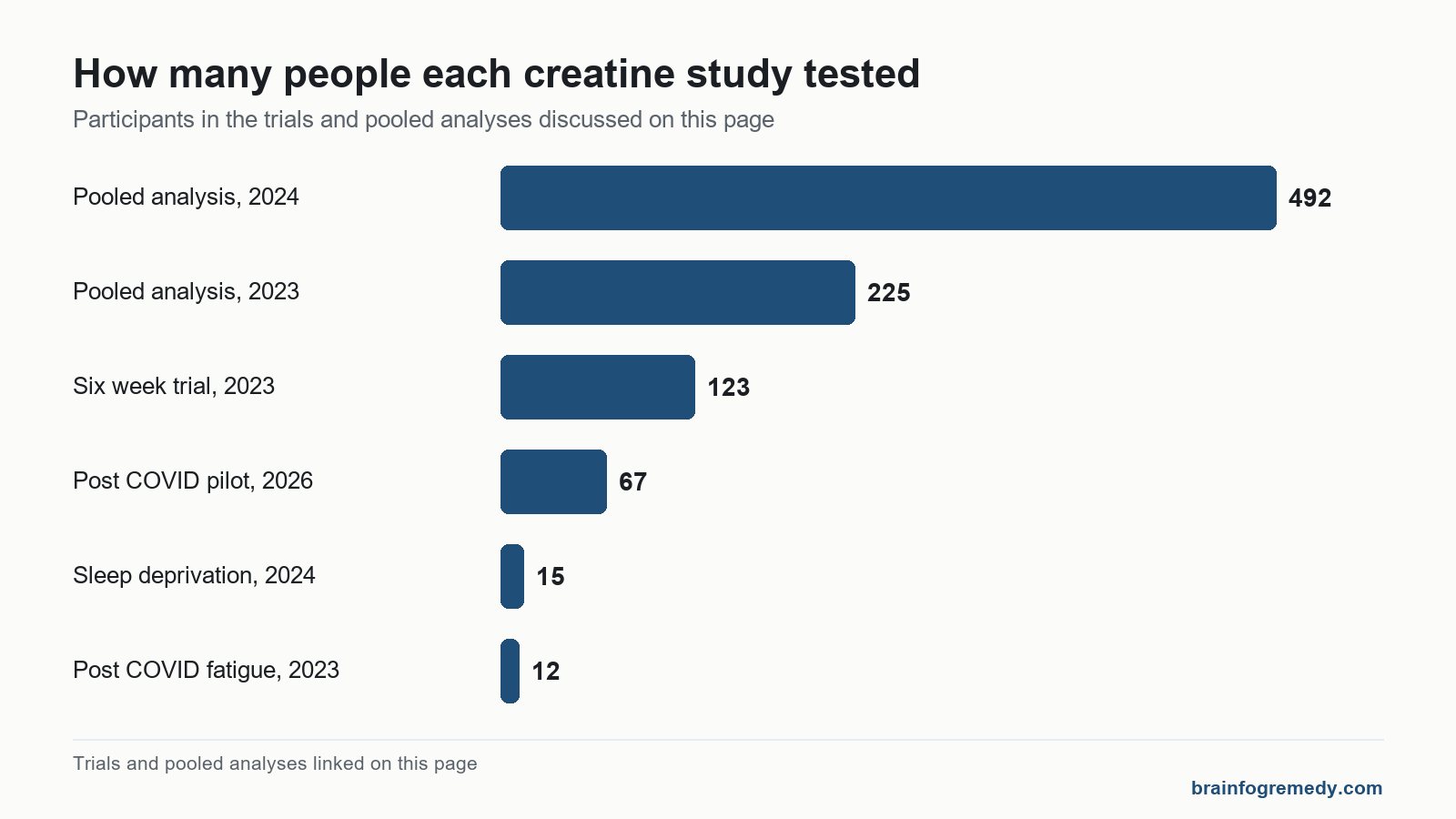
The 2024 analysis in Frontiers in Nutrition pooled 16 randomised trials covering 492 people. Memory improved with a standardised effect of 0.31, meaning the average creatine group sat about a third of a standard deviation above placebo. That is small. Attention time and processing speed time also shifted slightly. Overall cognitive function, executive function and attention scores did not move. The authors rated their own certainty as moderate for memory and low for everything else, and reported no conflicts of interest.
The single most informative study is neither pooled analysis. It is the 2023 trial in BMC Medicine, larger than most of the studies inside them. 123 people took 5 g a day for six weeks and placebo for six weeks, without knowing which was which. Backward digit span, a working memory test, came out at p equals 0.064, just short of the usual threshold, with an effect size of 0.17. Raven’s matrices, a reasoning test, came out at p equals 0.327. The authors concluded that creatine might have a small beneficial effect and that larger studies are needed to confirm or rule it out. That is a fair reading and it is a long way from what is printed on a tub.

Why do the two pooled analyses disagree about who benefits?
This is the part that rarely survives the trip into a product page. The 2023 analysis in Nutrition Reviews broke its results down by age and found the memory effect sat almost entirely with older adults aged 66 to 76, where the effect size was 0.88. In participants aged 11 to 31 it was 0.03, which is nothing. The 2024 analysis broke its results down by age too and found the opposite, with stronger effects in the 18 to 60 group than in the over sixties.
Both cannot be right. The age brackets overlap, the studies overlap, and the two teams reached contradictory conclusions from largely the same small pool of trials. Variation between studies was high in both, reaching 83 percent in the older adult subgroup. Subgroup findings from a handful of small trials are the least reliable thing a pooled analysis produces, and the sensible response is to treat both age claims as unsettled.
Worth noting alongside that. The 2023 analysis received no external funding, but two of its authors declared connections with creatine manufacturers. That does not make the numbers wrong. It is the kind of thing a reader is entitled to know.
A 2024 systematic review in Behavioural Brain Research reached a blunter verdict. Creatine does raise creatine content in the brain, so the mechanism is real. The cognitive results built on top of it were called equivocal, with the review faulting how the supplementation regimens were designed.
Does it matter whether you eat meat?
The theory is neat. Creatine comes largely from meat and fish, so vegetarians start lower and have more room to gain. A 2010 study in the British Journal of Nutrition appeared to show exactly that after 20 g a day for five days.
It has not held up well. That study ran a large number of cognitive tasks, which raises the chance of a false positive somewhere in the set, and it is now generally treated as exploratory. The 2023 BMC Medicine trial deliberately recruited roughly half vegetarians and half omnivores and found no indication that the vegetarians benefited more. On current evidence the diet story is a plausible idea that the better designed test did not confirm.
What about the sleep deprivation study everyone quotes?
The 2024 study in Scientific Reports is genuinely interesting and it is also the most over quoted thing in this field. Fifteen people, average age 23, were kept awake for 21 hours and given either creatine or placebo. On the creatine nights, phosphocreatine and ATP levels in the brain held steadier, and working memory and processing speed held up better than on placebo.
Two details usually go missing. The dose was 0.35 g per kilogram in a single hit, which is roughly 25 g at once for a 70 kg adult, not the 3 to 5 g a day sold as a maintenance dose. And fifteen people is a mechanism study, not a result anyone can lean on. What it plausibly shows is that creatine can buffer a short energy crisis in the brain under one specific stress. Fog that has been present for months is a different situation from one missed night, which is why we treat brain fog and lack of sleep as its own question.

Has anyone tested creatine against brain fog itself?
Twice, and both times the answer is smaller than it sounds. A 2023 trial in Food Science and Nutrition gave 4 g a day for six months to people with post COVID fatigue syndrome and reported improvement in difficulty concentrating, with scans confirming that tissue creatine levels had been replenished. The trial had 12 participants, which cannot settle anything, though it is a reasonable signal to follow up.
A larger pilot published in Frontiers in Nutrition on 25 March 2026 tried. 67 adults with post COVID fatigue took 6 g a day, 18 g a day, or placebo for four weeks. Fatigue scores fell in the 6 g group and did not move at all in the 18 g group, which is not how a dose response behaves and which a pilot this size cannot explain. It was single blind. Most importantly here, it measured no cognitive outcome at all. If your interest is long COVID brain fog, that trial adds something about fatigue and nothing about concentration.
Is creatine safe?
Safety and benefit are separate questions, and creatine scores much better on the first. In healthy adults, loading of 20 g a day for five days and maintenance under 3 g a day have been examined repeatedly without evidence of kidney harm, including use lasting up to five years in athletes. A pooled analysis found no significant change in serum creatinine or plasma urea. Stomach upset does happen, more often at higher doses. The 2023 BMC Medicine trial is more specific than that: its participants reported side effects significantly more often on creatine than on placebo, at p equals 0.002 with a relative risk of 4.25.
The limits are real and worth stating plainly. There is very little long term data beyond about 16 weeks using accurate measures of kidney function. Evidence is lacking rather than reassuring for people with existing kidney disease and during pregnancy, which makes both of those a conversation with a doctor rather than something to settle from an article. Anyone taking regular medication is in the same position.
So what does the whole picture add up to?
A small and possibly real effect on memory tests. Nothing consistent elsewhere. Two pooled analyses that contradict each other on who benefits. One well designed trial that missed significance. Two small post COVID trials, one of which did not measure thinking at all.
That is not a case for a product, and this article is not making one. It is a case for scepticism about anyone claiming the evidence here is settled, in either direction. The same pattern shows up across most of this field, which is why our piece on vitamins and brain fog keeps returning to testing before spending, and why what actually helps brain fog spends more time on sleep, hydration and pacing than on anything you can buy. The same argument for testing before changing something runs through why coeliac testing has to come before cutting gluten. Fog that is new, worsening, or arriving alongside other symptoms is worth taking to a doctor rather than trying to out research.
What has changed since this was first published?
This page went up on 5 September 2026 and was rechecked on 20 September 2026. The trials themselves have not changed. What has changed is how much weight the two pooled analyses can carry, and it is less than this page first gave them.
- The 2024 pooled analysis now has a published methodological challenge against it. A 2026 commentary in the same journal, by Tom Citherlet, argues it made a unit of analysis error: several included trials reported multiple correlated cognitive tests on the same people, and those were counted as independent results, which inflates both the apparent sample size and the apparent precision. It also reports that the European Food Safety Authority reached the same conclusion about pooling non independent cognitive tests, and that no reliable conclusion could be drawn from them.
- The same objection was raised against the 2023 analysis back in 2023, and this page did not mention it. A 2023 letter to the editor in Nutrition Reviews is titled, without much ceremony, "Double-counting due to inadequate statistics leads to false-positive findings". The 2026 commentary reports that on reanalysis the overall memory effect from that 2023 paper was no longer significant, except in older adults. So the opening paragraph here has changed: a small memory effect is now a small memory effect that two separate sets of authors say is partly an artefact of counting the same people twice.
- The side effect finding from the largest trial has been added to the safety section. The 2023 BMC Medicine trial reported side effects significantly more often on creatine than on placebo, p equals 0.002, relative risk 4.25. It belonged here from the start and was missing.
- A correction was issued on the 2024 analysis on 17 February 2025. It is a wording fix rather than a numbers one: the corrigendum changed "attention" to "attention scores" and "processing speed" to "processing speed scores", and states that no scientific conclusion changes. It is noted because this page rests on the difference between attention scores and attention time, and the corrigendum confirms that distinction was in the original.
Frequently asked questions
Does creatine help brain fog?
No trial has measured brain fog as an outcome, so there is no direct answer. Trials measure cognitive test scores instead. There the pooled effect on memory is small, other domains show nothing consistent, and since 2026 the statistics behind the pooled memory effect have been formally challenged.
How much creatine was used in the cognitive studies?
Doses across the pooled trials ranged from about 2.2 g a day to 20 g a day, over periods from five days to 18 months. The largest single trial used 5 g a day for six weeks and did not reach significance on its main outcomes.
Do vegetarians get more benefit from creatine?
It is a reasonable theory that the best test did not confirm. A 2010 study suggested it, but a 2023 trial that deliberately recruited roughly half vegetarians found no difference between them and omnivores.
Why do different reviews of creatine reach different conclusions?
They pool small trials that use different tests, doses and populations, and the subgroup results are fragile. Two reviews reached opposite conclusions about whether older or younger adults benefit more, from an overlapping set of studies.
Is creatine bad for your kidneys?
In healthy adults, repeated studies including use of up to five years have not shown kidney harm, and pooled data found no meaningful change in serum creatinine or urea. Evidence is lacking rather than reassuring for people with existing kidney disease and during pregnancy.
Does this article recommend taking creatine?
No. This site does not recommend supplements. The purpose here is to report what the trials measured, how large the effects were, and where the evidence contradicts itself, so the claims on a product page can be read against the research they cite.
Finished the page? The same five questions from the top, to see what stuck.
This article is general information, not medical advice, and is not a substitute for care from a qualified healthcare professional. Speak to your doctor about your own situation.
Leave a Reply