
Allergies and brain fog are linked in the research, and the research points at both the pollen and the pills. Allergic children made more working memory errors in pollen season, teenagers with hay fever symptoms were more likely to drop an exam grade, and the leaflets for common antihistamines list drowsiness as very common.
Listen to this article, about 13 minutes. A synthetic voice reads the article and announces each section title as it begins; tables are read row by row and the questions at the end are left out.
Recorded 11 October 2026 from the article as published that day. Press a chapter to jump there; the highlighted line is what is playing. A play button sits beside every section heading, and once you scroll past this player a bar at the bottom of the screen keeps the controls in reach. Tap or click any sentence to hear the reading start from there.
On this page: a cited table of what five allergic rhinitis studies actually measured, the antihistamine leaflet wording on drowsiness with the date each was checked, the exam study’s three odds ratios drawn as a chart, and 71 r/Allergies posts on what the fog feels like.
Think you already know this? Five questions, one minute.
Every answer is on this page. Answer from what you know now; the page fills in the rest.
-
1. In the 2020 Pediatric Allergy and Immunology study of 43 grass pollen allergic children, which test showed more errors during pollen season?
The Papapostolou study found more spatial working memory errors in the allergic group during pollen season only, with no difference on the visual memory or attention tests. Read the section
-
2. What was the adjusted odds ratio for having taken a sedating antihistamine among students who dropped a grade?
Walker and colleagues reported an adjusted odds ratio of 1.7 for sedating antihistamines, against 1.4 for symptoms and 1.4 for any rhinitis medicine. Read the section
-
3. How does the Piriton Allergy Tablets leaflet, revised February 2024, classify drowsiness and sedation?
The Piriton leaflet lists drowsiness and sedation as very common, which it defines as may affect more than 1 in 10 people. Read the section
-
4. In the 2006 study of 591 people with allergic rhinitis, which mattered more for sleep?
Léger and colleagues found sleep significantly more impaired in severe than in mild rhinitis, while whether it was intermittent or persistent had no effect. Read the section
-
5. According to the National Center for Health Statistics, what share of US adults had a diagnosed seasonal allergy in 2021?
NCHS Data Brief 460 reported 25.7 percent of adults with a seasonal allergy in 2021; the January 2026 release put the 2024 figure at 25.2 percent. Read the section
The big health sites answer this question in a paragraph and move briskly on to a list of tips. This page does the slower thing. It lines up what the studies actually measured, quotes what the medicine leaflets say about drowsiness with the date each was checked, and reports what people on an allergy forum said the fog feels like. It will not tell you whether your own slow afternoons are the pollen, the tablet, the sleep you lost to a blocked nose, or something unrelated. Nobody can do that from a web page, and the pages that claim to are the ones to be wary of. Our overview of the causes of brain fog a doctor checks first shows how long the list is.
Can allergies and brain fog really be connected?
Yes, in the limited sense that researchers have measured thinking during pollen season and found it worse. The word limited is doing honest work in that sentence. Here is what each study tested and what it found.
| Source | Who was studied | What was actually measured | What it found |
|---|---|---|---|
| Papapostolou and colleagues, Pediatric Allergy and Immunology, 2020 | 43 grass pollen allergic children aged 8 to 17 and 26 non allergic children | Computerised CANTAB tests in and out of pollen season, plus stress and inflammation markers in blood | More spatial working memory errors in pollen season only; visual memory and attention no different; more symptoms went with slower simple reaction time; blood markers no different |
| Clinical and Experimental Allergy, 2017 | 41 unmedicated adults with seasonal allergic rhinitis and 42 healthy controls | A word list learning test and a dual task, in and out of the symptomatic period | Poorer word list learning and a general slowing of processing speed while symptomatic; the specific multitasking costs were not affected |
| Walker and colleagues, Journal of Allergy and Clinical Immunology, 2007 | 1,834 UK students aged 15 to 17 sitting national exams | Whether a grade dropped between winter practice and summer final exams, against symptoms and medicine use on exam days | Adjusted odds ratio 1.4 for symptoms, 1.4 for any rhinitis medicine, 1.7 for a sedating antihistamine |
| Léger and colleagues, Archives of Internal Medicine, 2006 | 591 French patients with allergic rhinitis of at least a year and 502 matched controls | Validated sleep questionnaires and the Epworth Sleepiness Scale | Sleep impaired on every dimension measured; severe rhinitis worse than mild; how long the rhinitis had lasted made no difference |
| German ENT congress abstract, 2005 | Patients with allergic rhinitis and healthy volunteers | Sustained attention, memory, executive function and choice reaction time | Differences on cognitive tests; the authors suggested patients may invest more mental effort for the same result and tire earlier. A conference abstract, not a full paper |
Two things stand out. The children’s study found no difference in stress or inflammation markers in the blood, so whatever slowed the working memory did not show up in the sample. And the adult study found general slowing rather than a specific failure of multitasking. Neither result is dramatic. Both are real. If you wanted a six question quiz that diagnoses your fog as “histamine brain”, the internet will sell you one; the studies above are what the quiz is pretending to be built on.
What did the exam study of 1,834 teenagers actually find?
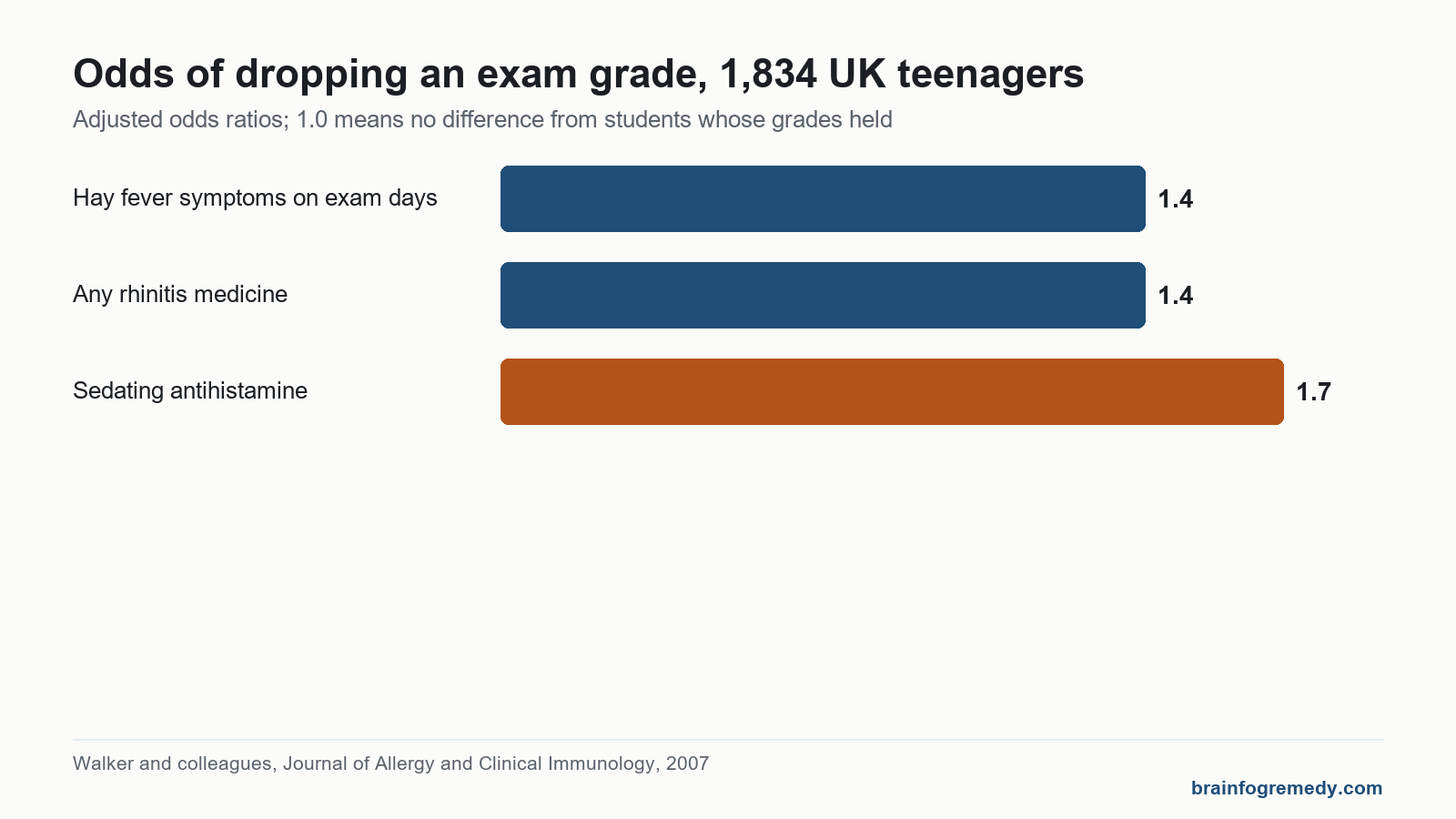
This is the study most pages quote, usually as “hay fever costs students a grade”. The paper itself is more careful. Between 38 and 43 percent of students reported hay fever symptoms on any given exam day. Those who dropped a grade between their winter practice exams and the summer finals were more likely to have had symptoms during the exam period, with an adjusted odds ratio of 1.4, more likely to have taken any rhinitis medicine, also 1.4, and more likely to have taken a sedating antihistamine, 1.7.
An odds ratio of 1.0 would mean no difference, so these are modest effects, not a catastrophe. It was a case control study, which can show association but not cause, and nobody has yet shown that treating the hay fever gives the grade back. The authors concluded that symptomatic rhinitis and its medicines are associated with a significantly increased risk of unexpectedly dropping a grade. That is the whole claim. It is enough to take seriously and not enough to blame your exam results on.

Is it the hay fever or the antihistamine that fogs you?
The exam study could not separate the two, because the students with the worst symptoms were also the ones taking medicine. What can be stated plainly is what the official leaflets say.
| Medicine | What the official wording says about sleepiness | Checked |
|---|---|---|
| Chlorphenamine (Piriton Allergy Tablets) | The patient leaflet lists drowsiness and sedation as very common, “may affect more than 1 in 10 people”, and disturbance in concentrating and fatigue as common, up to 1 in 10. It says: “Do not drive or operate machinery if the tablets make you feel drowsy, dizzy or if you experience blurred vision.” | Leaflet revised February 2024, read 11 October 2026 |
| Cetirizine | The NHS side effects page says: “The most common side effect of cetirizine is feeling sleepy and tired. This happens in more than 1 in 10 people.” Cetirizine is in the NHS non drowsy group. | Page last reviewed 18 February 2025, read 11 October 2026 |
| The two groups | The NHS antihistamines page puts chlorphenamine, cinnarizine, diphenhydramine, hydroxyzine and promethazine in the group that makes you feel sleepy, and acrivastine, cetirizine, fexofenadine and loratadine in the group “less likely to make you feel sleepy”. Less likely, not never. | Page last reviewed 16 May 2023, read 11 October 2026 |
Read that middle row twice. A medicine sold as non drowsy carries an NHS page saying that feeling sleepy and tired is its most common side effect, in more than 1 in 10 people. The label describes a group of medicines, not a guarantee about any one person. Anyone who suspects their tablet is part of their fog can ask a pharmacist, who can look at the whole list of what they take. This page does not recommend any antihistamine, any dose, or any change to one.
Why does a blocked nose make the next day feel slow?
Because you did not sleep properly, and brain fog from lack of sleep does not care what caused the lack. The 2006 French study of 591 people with allergic rhinitis found sleep impaired on every dimension it measured against matched controls: harder to fall asleep, more waking in the night, less restorative sleep. Severity mattered and duration did not; someone with severe rhinitis for one year slept worse than someone with mild rhinitis for ten. Summaries of the paper report that about 44 percent of patients woke feeling fatigued despite a normal night, a figure we could not confirm against the full table and quote as reported.
This is the least glamorous explanation on the page and probably the biggest. A blocked nose at 2am, a sedating tablet at 8am and a working memory test at 10am is a bad night followed by a bad morning, not a mystery of neuroscience.

What do people with allergies say the fog feels like?
None of the studies asked. Two threads on the r/Allergies forum did, so we read both in full: 71 posts and comments between them, from May and June 2026. These are what people report, not findings, and nobody on a forum can know what is causing anyone else’s symptoms.
In a May 2026 thread with 27 comments, the original poster described years of fatigue and fog as their main allergy symptoms, with sneezing and itchy eyes a minor sideshow, and said antihistamines had not touched the fog. One commenter wrote that an early pollen season had them asleep on the sofa for three hours and barely able to think, and that two days back on their usual medicine had them thinking sharply again. Another described a hungover feeling on any day they skipped their cetirizine. A third said their fatigue had run for years, was worst at night, and was now costing them sleep. One Spanish speaking commenter described five months of grass season leaving them foggy and clumsy outdoors on windy days.
In a June 2026 thread with 42 comments, the original poster reported that loratadine, cetirizine and fexofenadine had all given them moderate to severe fog, cetirizine worst. Several replies agreed: one said most antihistamines knock them straight out, another that a morning dose always leaves them wanting a nap even with the non drowsy kind. The pattern was not universal. One commenter had taken cetirizine for over ten years and noticed only occasional dizziness, and in the first thread the medicine was what cleared the fog, not what caused it.
Where the accounts meet the official wording, they agree: the leaflets say sleepiness is very common and the forum says the same in plainer words. Where they part is on what to do about it. The most repeated suggestion in the second thread was to change when the tablet is taken. That is a question for a pharmacist, and this page passes it on as a question, not an answer.
How common is this, and what is still unknown?
Seasonal allergy itself is common. The US National Center for Health Statistics reported that 25.7 percent of adults had a diagnosed seasonal allergy in 2021, and its January 2026 release put the 2024 figure at 25.2 percent. How many of those people have measurable thinking changes in season is not known, because nobody has counted. The studies above are small: 43 children, 41 adults, one exam cohort. There is no agreed definition of brain fog to count against, which is the same problem our plain explanation of what brain fog means runs into, and the same one the thyroid brain fog page found in a different condition.
So the honest summary is this. Pollen season slows some people on some tests. Sedating antihistamines slow some people on most tests. Blocked noses wreck sleep. The three overlap in the same weeks of the year, and no study has pulled them apart. Anyone selling a nootropic stack to fix “allergy brain” is selling a solution to a problem science has not yet finished describing.
When is fog in allergy season a reason to see a doctor?
The Piriton leaflet puts it in one line: you must talk to a doctor if you do not feel better or if you feel worse. The same applies to the fog. Thinking problems that continue outside the pollen season, that get steadily worse, that arrive with a new headache, confusion, or any symptom you have not had before, or that worry someone who knows you well, are reasons to see a GP whatever the pollen count says. A pharmacist can advise on the tablet. A doctor can look at the whole picture, including the long list of other things that cause fog. The diary on this page records what each day was like, including the pollen forecast as it was published, and interprets nothing. Its job is to make a short appointment more useful.
Pollen day and focus diary
One line a day through the season. It records what the day was like and nothing more; a pharmacist or GP can read the pattern with you.
This diary interprets nothing. Pollen, sleep and medicine timing change together in the same weeks, so a pattern is not a cause. Take it to a pharmacist or a GP.
Frequently asked questions
Can hay fever cause brain fog without a runny nose?
Some people on allergy forums report fatigue and fog as their main symptoms with little sneezing, but no study has tested that pattern, and other conditions produce the same picture. A doctor can look at the whole history.
Does the brain fog stop when pollen season ends?
In the children’s study the working memory difference appeared in pollen season and not off season. That is one study of 43 children; fog that continues outside the season is a reason to see a GP.
Are non drowsy antihistamines really non drowsy?
The NHS describes them as less likely to make you feel sleepy, and its cetirizine page says feeling sleepy and tired happens in more than 1 in 10 people. A pharmacist can advise on alternatives.
Is allergy related brain fog the same as long COVID brain fog?
There is no study comparing them. The allergy studies found slowed processing and working memory errors in season; long COVID research describes a different and often longer lasting picture.
Do allergy shots or nasal sprays help the fog?
No study on this page measured thinking before and after any treatment, and the exam study authors noted there is no evidence yet that treating hay fever restores lost grades. Treatment is a decision for a prescriber.
Can a pollen diary show what is causing my fog?
It can show a pattern across days, which is useful to a doctor or pharmacist. It cannot show a cause, because pollen, sleep and medicine timing change together in the same weeks.
Finished the page? The same five questions from the top, to see what stuck.
This article is general information, not medical advice, and is not a substitute for care from a qualified healthcare professional. Speak to your doctor about your own situation.
Leave a Reply