
Brain fog is a description, not a diagnosis. It is the phrase people reach for when thinking has become effortful in a way it did not use to be, and it covers a specific and recognisable cluster of experiences.
Listen to this article, about 11 minutes. A synthetic voice reads the article and announces each section title as it begins; tables are read row by row and the questions at the end are left out.
Recorded 25 September 2026 from the article as published that day. Press a chapter to jump there; the highlighted line is what is playing. A play button sits beside every section heading, and once you scroll past this player a bar at the bottom of the screen keeps the controls in reach. Tap or click any sentence to hear the reading start from there.
On this page: the seven experiences the phrase actually covers, what doctors write in the notes instead and why none of it is more serious, the one distinction from memory loss worth holding on to, where the phrase came from and how it reached a National Academies report, and what researchers measure when they say they are measuring fog.
Think you already know this? Five questions, one minute.
Every answer is on this page. Answer from what you know now; the page fills in the rest.
-
1. What does this page say is the common thread behind the list of experiences?
That is why the experience is so consistent between people with completely different underlying causes. Different roads, same bottleneck. Read the section
-
2. What tends to appear in the notes when you say brain fog?
None of the clinical phrases is more serious than the one you used. They are the vocabulary that connects to tests and treatments, which is the whole point of learning them. Read the section
-
3. Which pattern does this page say is worth raising promptly?
Brain fog is trouble using information in the moment; it fluctuates and you are usually the person most aware of it. Memory loss is information not being stored, tends to be progressive, and others often notice first. Read the section
-
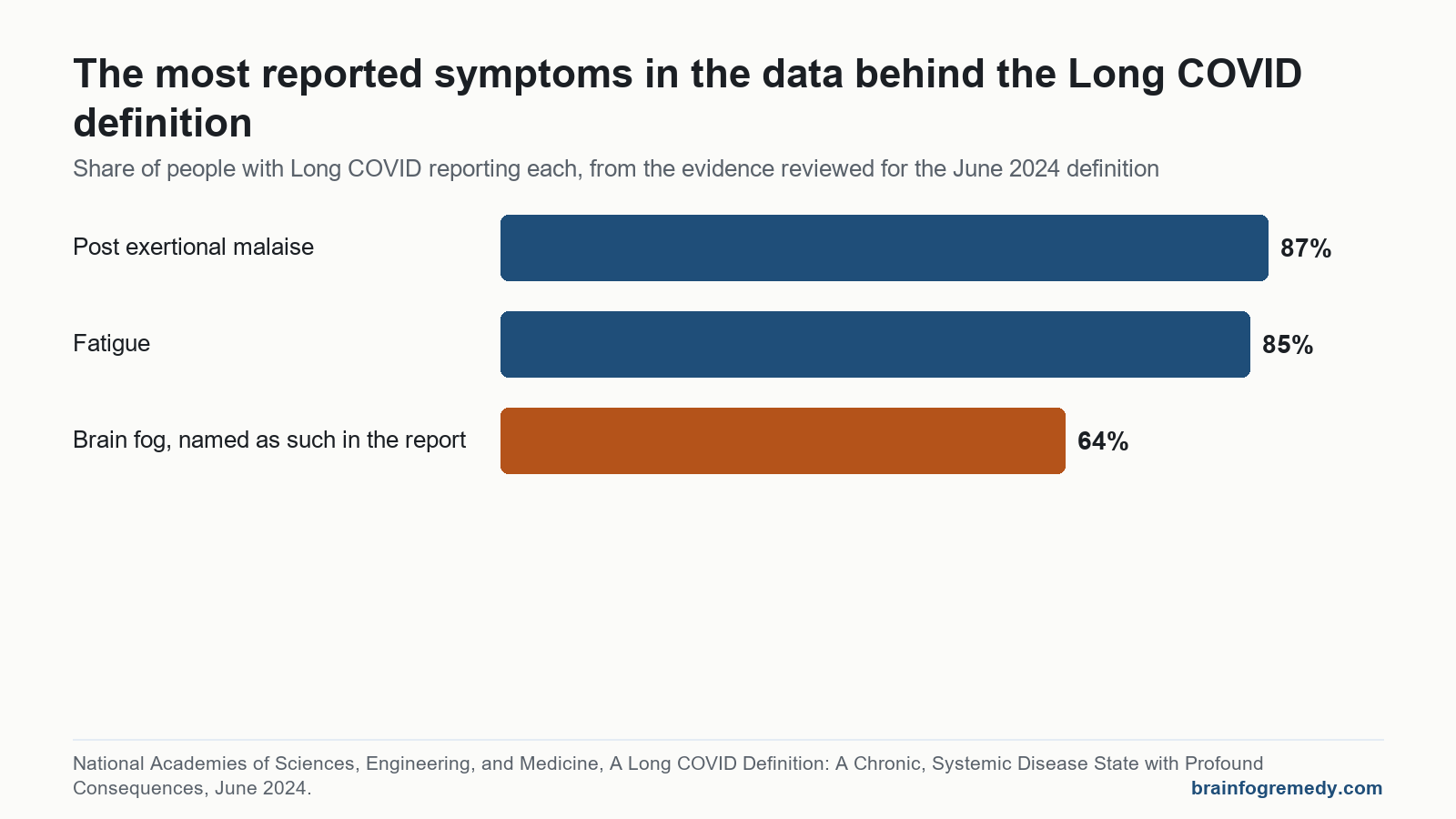
4. In the symptom data reviewed for the 2024 National Academies definition of Long COVID, what share reported brain fog?
The report used the phrase by name rather than translating it into clinical vocabulary first. That does not make brain fog a diagnosis or give it a definition, but the objection that the words are too woolly to say out loud has run out of road. Read the section
-
5. When researchers study brain fog, what do they measure?
Which test gets chosen can move the headline number enormously; estimates of cognitive difficulty in rheumatoid arthritis swing from about a quarter to three quarters of patients depending on the instrument. The experience is not vague at all, even though the word for it is. Read the section
It is worth being precise about what it does and does not mean, because the vagueness is exactly what makes it hard to get taken seriously.
What the phrase actually describes
Ask a hundred people and you get roughly the same list.
- Losing the thread halfway through your own sentence
- Reading the same paragraph three times without it landing
- Walking into a room with no idea why you are there
- A noticeable delay between a question and being able to answer it
- Struggling to hold two pieces of information in mind at once
- Words that are clearly there but will not come
- Feeling like you are thinking through something thick
The common thread is working memory, the short term scratchpad you use to hold information while doing something with it. That is why the experience is so consistent between people with completely different underlying causes.

Is it a real thing?
It is real in the sense that matters: people reliably report it, it interferes with work and daily life, and it correlates with conditions that can be measured. It is not real in the sense of being a diagnosis you can be given. The same split turns up with ADHD, where the phrase is common but the ADHD diagnostic criteria never mention brain fog at all.
That distinction causes a lot of frustration. Turning up and saying you have brain fog can be met with a shrug, because there is nothing to treat under that name. Turning up with two weeks of notes describing when it happens and what makes it worse gives a doctor something to work with.
What doctors write instead
| What you say | What tends to appear in the notes |
|---|---|
| Brain fog | Subjective cognitive complaint |
| Cannot concentrate | Impaired concentration or attention |
| Cannot think straight | Cognitive difficulties |
| Slow to respond | Psychomotor slowing |
| Words will not come | Word finding difficulty |
None of those are more serious than the phrase you used. They are just the vocabulary that connects to tests and treatments.
Brain fog is not memory loss
This is the distinction worth holding on to. Brain fog is trouble using information in the moment. It fluctuates, it is worse when you are tired, and you are usually the person most aware of it.
Memory loss is different. Information does not get stored. It tends to be progressive rather than fluctuating, and other people often notice before the person does. Forgetting a name is ordinary. Forgetting that a conversation took place is a different symptom and worth raising promptly.
A rough test: if you are worried about your memory, that is mildly reassuring. If the people around you are worried and you are not, that combination deserves an appointment.
How it differs from things it gets confused with
| How it tends to present | The distinguishing feature | |
|---|---|---|
| Brain fog | Fluctuates, worse when tired, you notice it most | Tracks something physical, comes and goes |
| ADHD | A lifelong pattern rather than a recent change | Was there in childhood, even if never diagnosed |
| Depression | Low mood or loss of interest alongside the fog | The flatness came first, or arrived with it |
| Anxiety | Racing thoughts, a mind that will not settle | Lifts when the stressor resolves |
| Memory problems | Progressive, and others notice first | Information is not retained at all |
These overlap constantly and one does not rule out another. The distinction matters because the useful next step is completely different for each. Fog from low iron needs a blood test. Fog that has been there since school needs a different conversation entirely.
Does it matter when it started?
It matters more than almost anything else you can report. Fog that arrived on a recognisable date, after an illness, a new prescription, a house move or a bereavement, already has a candidate cause attached. Fog that came on so gradually you cannot say when tends to point at the slow physical causes, thyroid and iron in particular. Where the date is a bout of influenza, our piece on how long brain fog after flu tends to last covers what is actually known and what is only repeated.
If you genuinely cannot remember life without it, that is a different question and worth saying out loud at an appointment, because it changes what is worth investigating.
Where the phrase came from
Brain fog is a patient term, not a clinical one, and it entered general use because there was nothing better available.
People needed a way to describe a specific experience: thinking that is effortful without being absent, and unreliable without being lost. Fog is a good metaphor precisely because it captures that. Things are still there, you simply cannot see far, and it lifts and returns without warning. The vocabulary problem is the whole subject of our piece on the fuzzy head feeling, which goes through the words people actually reach for and why the choice matters at an appointment.
Doctors adopted it because patients kept using it and it communicated something recognisable. That is unusual and it is why the term sits awkwardly in medicine: widely used, universally understood, and attached to no definition of its own.

Has the phrase made it into medicine yet?
Partly, and by a route nobody planned. When the National Academies of Sciences, Engineering and Medicine published its definition of Long COVID in June 2024, the term appeared in the report by name rather than being translated into clinical vocabulary first. In the symptom data the committee reviewed, brain fog was reported by 64 per cent of people with Long COVID, behind post exertional malaise at 87 per cent and fatigue at 85 per cent. A summary written for clinicians works through what the definition changed in practice.
That does not make brain fog a diagnosis, and it does not give it a definition of its own. What it does is settle the older argument about whether the phrase belongs in a clinical conversation at all. It is now printed in a document that clinicians cite. If you have been made to feel the words were too woolly to say out loud, that particular objection has run out of road. One practical consequence of having no definition is that no guideline sets a duration either, which is why the documented timelines for how long brain fog can last belong to the conditions behind it rather than to the fog itself.
What is actually being measured
When brain fog is studied, researchers do not measure fog. They measure specific abilities, which is worth knowing because it explains why the research can feel disconnected from the experience. Which test gets chosen can move the headline number enormously, as the evidence on cognition in rheumatoid arthritis shows, where estimates swing from about a quarter to three quarters of patients depending on the instrument used. The same gap runs through the creatine trials, which measured memory test scores in volunteers rather than fog, as our review of creatine and brain fog sets out trial by trial.
| What is measured | What it looks like in a test | How it feels to you |
|---|---|---|
| Working memory | Holding and manipulating information briefly | Losing the thread mid sentence |
| Processing speed | How quickly you respond correctly | Feeling slow to answer |
| Sustained attention | Staying accurate over a long dull task | Rereading the same paragraph |
| Executive function | Switching, planning, inhibiting | Struggling to juggle two things |
| Word retrieval | Naming things under time pressure | The word is there and will not come |
A useful consequence of that list: the experience you are having is not vague at all, even though the word for it is. Every item on it is a specific, measurable thing, which is part of why the symptom is taken more seriously than it used to be.
What goes in the notes when you say it
Pick the sentence you would use. The tool shows the phrase that tends to appear in the record and the ability a test would measure, from the two tables on this page.
Vocabulary only. None of these phrases is a diagnosis, and matching one says nothing about cause, which is a question for a clinician who has assessed you.
Describing it so people understand
Brain fog is difficult to explain to anyone who has not had it, and being disbelieved makes it worse. Descriptions that tend to land better than the phrase itself: For a fuller account of the experience itself, hour by hour and from the inside, our piece on brain fog symptoms goes through what the cluster actually feels like.
- Like thinking through treacle, where everything still works and takes longer
- Like having twelve browser tabs open and being unable to find the one making noise
- Like reading in a language you are competent in but not fluent
- Like being mildly concussed, or the day after very little sleep, permanently
- Like the moment you walk into a room and forget why, except sustained
For a workplace conversation, the impact framing usually works better than the sensation framing. Needing to reread things to take them in, or finding meetings harder to follow, are specific and credible in a way that feeling foggy is not. The same problem in a consulting room has its own answer, and how to describe brain fog so a doctor takes you seriously works through the wording that survives a ten minute appointment.
If someone responds that everyone is tired, that is not a judgement on the reality of what you are experiencing. It is a limitation of the word, which describes something ordinary sounding and is being used for something that is not.
What causes it
Almost anything that taxes the body shows up as fog, which is why the phrase is so common and so unhelpful on its own. The National Academies report makes the same point from the other end: one word covers symptoms that arise through several different mechanisms. The realistic shortlist is sleep, iron, thyroid, blood sugar, hormones, medication, stress and the aftermath of viral illness. Seasonal allergy touches three of those at once, which is why allergies and brain fog are so hard to pull apart, as the studies on that page show. A second symptom alongside the fog changes the question, as with brain fog with blurred vision, which is usually ordinary and occasionally urgent. The opposite failure is just as common, where a single explanation quietly absorbs everything else, as happens with UTI brain fog and the confusion so readily blamed on a urine test. I have gone through what actually causes brain fog including which ones need a blood test. Where that test is the B12 one, the number itself turns out to be the argument, as the guidelines that disagree about a borderline B12 result show.
What to do with the word
Use it to describe the experience, then get specific fast. When it happens, what makes it better, what makes it worse, and when it started. That is the information that turns a vague complaint into something answerable. Once you have that, how to clear brain fog covers what to change first.
Frequently asked questions
Is brain fog a medical term?
No. It is a patient term that doctors have adopted because it describes something recognisable. In clinical notes you are more likely to see cognitive difficulties, impaired concentration, or subjective cognitive complaint.
What does brain fog feel like?
Most people describe three things: losing the thread mid sentence, having to reread, and a delay between being asked something and being able to answer. It feels like thinking through treacle rather than like forgetting.
Is brain fog the same as memory loss?
No, and the difference matters. Brain fog is trouble holding and using information in the moment. Memory loss is failing to retain it at all. Forgetting a word is common. Forgetting a conversation happened is a different symptom and is worth a doctor.
Can brain fog be a sign of something serious?
Usually it is not, and the common causes are ordinary. It becomes more concerning when it is progressive rather than fluctuating, when other people notice before you do, or when it comes with changes in personality, speech or movement.
Is brain fog permanent?
Rarely. Most brain fog tracks a cause and lifts when the cause is addressed. Fog that has lasted many months without explanation still usually has a cause that has not been found yet.
Is brain fog a symptom of long covid?
Yes, and it is one of the most commonly reported ones. In the symptom data reviewed for the National Academies definition of Long COVID, published in June 2024, brain fog was reported by 64 per cent of people with the condition, behind post exertional malaise and fatigue. Reporting it is not the same as being diagnosed with it, and cognitive symptoms after a viral illness have many other causes worth checking, so it remains a conversation for a doctor rather than a conclusion.
Is brain fog recognised in any official medical document?
The phrase itself now appears in one. The National Academies of Sciences, Engineering and Medicine used it directly in its 2024 report defining Long COVID rather than translating it into clinical terms. That gives the words standing in a clinical conversation. It does not make brain fog a diagnosis, and there is still no definition of the term in its own right.
Finished the page? The same five questions from the top, to see what stuck.
This article is general information, not medical advice, and is not a substitute for care from a qualified healthcare professional. Speak to your doctor about your own situation.
Leave a Reply