
Memory loss during menopause is real, measurable and mostly about words: recalling names, finding the right term, holding the thread of a sentence. In the largest studies the dip is small and concentrated in perimenopause. Most of it recovers afterwards, though the two biggest cohorts disagree about how completely.
Listen to this article, about 11 minutes. A synthetic voice reads the article and announces each section title as it begins; tables are read row by row and the questions at the end are left out.
Recorded 11 October 2026 from the article as published that day. Press a chapter to jump there; the highlighted line is what is playing. A play button sits beside every section heading, and once you scroll past this player a bar at the bottom of the screen keeps the controls in reach. Tap or click any sentence to hear the reading start from there.
On this page: which memory system actually changes and which frightening patterns almost never appear in the data, what the two biggest cohorts found about recovery and why they disagree, what did and did not make it worse in six years of SWAN data, where hormone therapy stands on cognition, and when to see a doctor.
Think you already know this? Five questions, one minute.
Every answer is on this page. Answer from what you know now; the page fills in the rest.
-
1. Which memory system do the studies point at?
The NHS symptom list names memory and concentration problems and notes they feel worse alongside poor sleep and fatigue. What almost never appears in the data is the pattern people fear: getting lost on a familiar route or repeating a question within minutes. Read the section
-
2. What did Greendale and colleagues find in 2,362 US women followed for four years?
The much larger UK Biobank analysis of 15,486 women found postmenopausal scores still below premenopausal ones, with the slowest rate of worsening of the three groups. Both cannot be straightforwardly true, and no popular page says so out loud. Read the section
-
3. In the six year SWAN analysis, what showed no relationship with cognitive performance?
The analysis found women with high depressive symptoms scored about one point lower on processing speed, and women with a history of anxiety learned more slowly across repeated testing. Both effects are small and statistically real. The sleep story did not survive contact with these numbers. Read the section
-
4. What does the 2022 Menopause Society position statement say about hormone therapy and cognition?
The position statement is not a statement about hormone therapy in general, which is prescribed for other symptoms on its own evidence. In the Women’s Health Initiative Memory Study, starting combined therapy after 65 was associated with an additional 23 cases of dementia per 10,000 person years; early postmenopausal starts appear neutral for cognition. Read the section
-
5. What does NHS guidance on memory loss say plainly?
The NHS guidance lists stress, anxiety, depression and insomnia among common causes, alongside conditions that are treatable and better found early. Nothing on this page can tell you whether your own changes relate to menopause, and no page anywhere can. Read the section
What kind of memory actually changes?
Not the kind most people fear. The research points repeatedly at one narrow area, verbal episodic memory, which is the system that files words away and retrieves them later. That is why the complaints are so specific and so oddly similar from one woman to the next. The name of a colleague of eleven years arrives four seconds late. A sentence sets off confidently and loses its footing near the end. The word is not gone. It is simply not answering the phone.
The NHS symptom list for menopause lists memory and concentration problems among menopause symptoms and notes they feel worse alongside poor sleep and fatigue. Subjective complaints are common, commonly quoted at somewhere between 44 and 62 percent of women during the transition, and that wide range tells you something honest: the answer depends heavily on how the question is asked. For the stage when those complaints often begin, while cycles still look regular, see what perimenopause brain fog looks like before periods change. For the broader picture of why it happens and when it lifts, that is covered separately in our piece on menopause brain fog.
What almost never appears in the data is the pattern people are actually frightened of: getting lost on a familiar route, repeating the same question within a few minutes, or being unable to work a washing machine you have owned for a decade. Trouble retrieving a word is a different animal from losing the event the word belonged to.

Does the memory come back after menopause?
This is the question the ranking pages answer in a single cheerful sentence, and it deserves better than that. Cleveland Clinic, currently the most visible page on this search, says menopause related fog tends to stay stable or improve, and names no study to back it. The named studies are more interesting, because they do not entirely agree with each other.
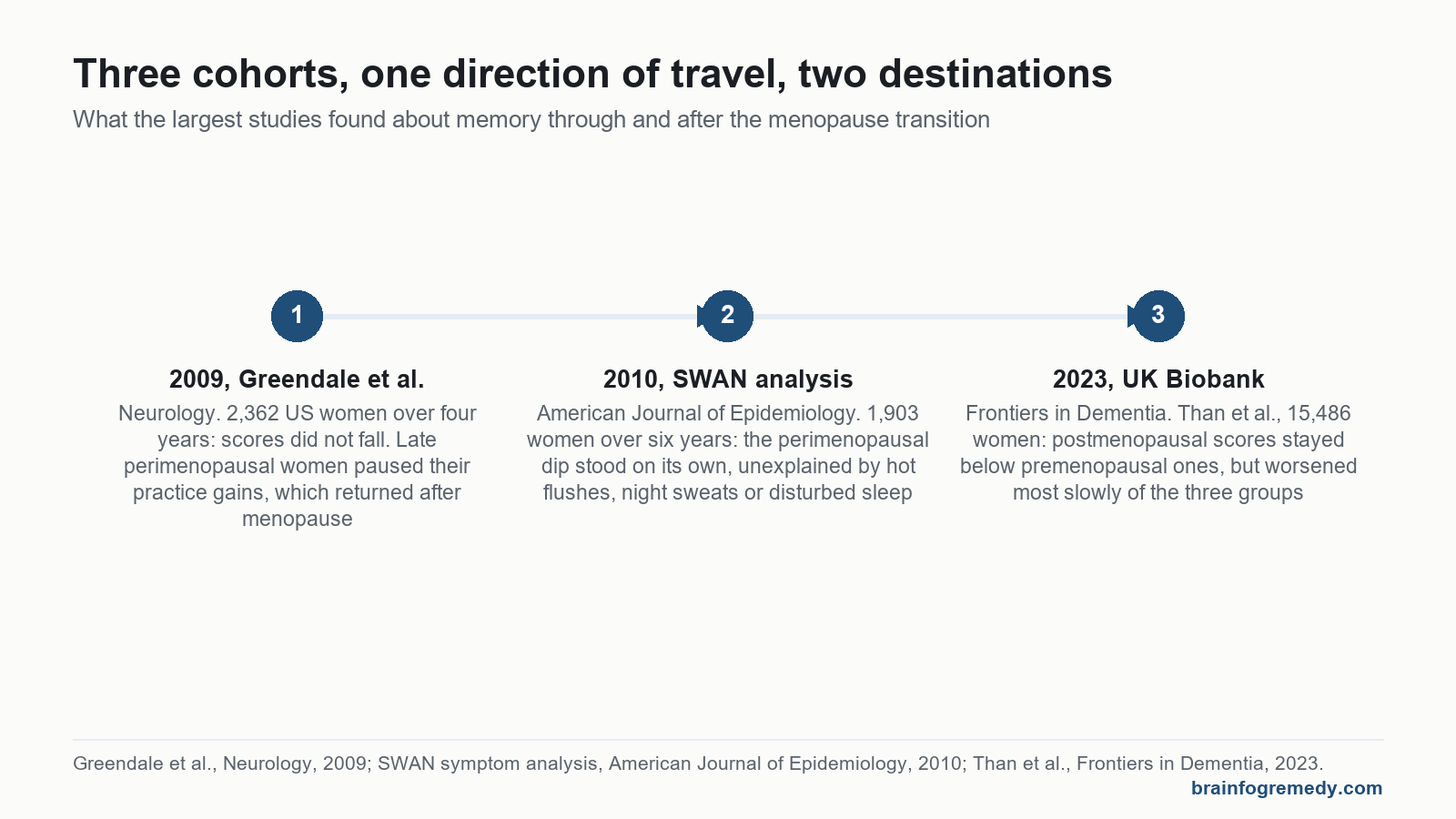
| Study | Who, and how many | What it measured | What it found about recovery |
|---|---|---|---|
| Greendale and colleagues, Neurology, 2009 | 2,362 US women, followed four years | Processing speed, verbal memory, working memory | Scores did not drop. Late perimenopausal women simply stopped showing the practice improvement everyone else showed on repeat testing. The gains reappeared in postmenopause. |
| SWAN symptom analysis, American Journal of Epidemiology, 2010 | 1,903 US women, followed six years | The same three tests, set against menopause symptoms | Menopause symptoms did not account for the perimenopausal dip. It was there on its own. |
| Than and colleagues, Frontiers in Dementia, 2023 | 15,486 women in UK Biobank | Reaction time, verbal and numeric reasoning, visual and prospective memory | Postmenopausal women still scored below premenopausal women across the domains tested, but their rate of worsening was the slowest of the three groups. |
Read the rows side by side and the disagreement is plain. The American cohort found a temporary stall that resolved. The much larger British cohort found stabilisation rather than a full return to premenopausal scores. Both cannot be straightforwardly true, and no popular page on this query says so out loud.
Why do the biggest studies disagree?
Three reasons worth knowing, none of them dramatic. They used different tests, and reaction time and word list recall are not the same skill. They compared different things: one followed the same women through their own transition, the other largely set groups of women at different stages against each other, so age and education and everything else that separates a 46 year old from a 62 year old sits inside the result. And a stall in practice gains, which is what the American data actually shows, is a subtler finding than a fall, and subtlety is the first thing lost on the way to a headline.
The honest summary is that the direction of travel is agreed and the destination is not. Nobody serious is describing a steady slide. The argument is about whether the ground you land on is exactly the ground you left.
What made memory worse in the research, and what did not?
The six year SWAN symptom analysis produced a result that surprises almost everyone, including some of the people who found it. Women with high depressive symptoms scored about one point lower on the processing speed test. Women with a history of anxiety symptoms learned more slowly across repeated testing, by roughly 0.09 of a point per occasion. Both effects are small, and both are statistically real. Why a depressive episode can leave a foggy head behind after the mood itself lifts is in depression foggy head.
What showed no relationship with cognitive performance at all: hot flushes and night sweats. No detrimental effect from disturbed sleep was seen either. That is genuinely awkward, because the explanation everyone repeats is that the fog is downstream of broken nights. It may still hold for individual women, and other work does tie sleep to daytime clarity, which is why there is a whole article here on brain fog and lack of sleep. But in this particular dataset the sleep story did not survive contact with the numbers, and that is worth saying rather than tidying away.
Does hormone therapy bring the memory back?
It is not prescribed for that purpose. The 2022 hormone therapy position statement of The Menopause Society is explicit that hormone therapy is not recommended at any age to prevent or treat a decline in cognitive function or dementia. That is a statement about cognition specifically. It is not a statement about hormone therapy in general, which is prescribed for other symptoms on its own separate evidence.
The caution has a number behind it. In the Women’s Health Initiative Memory Study, starting combined oestrogen and progestin therapy after the age of 65 was associated with an additional 23 cases of dementia per 10,000 person years. Starting in the early postmenopausal years appears to be neutral for cognition rather than harmful. Two dated events since this page was written have not changed that position. On 10 November 2025 the US Food and Drug Administration announced it would remove the boxed warning that cited probable dementia, among other risks, from menopausal hormone therapy labels, and on 12 February 2026 it approved the first six relabelled products. That is a change in how the label presents risk, not new evidence that hormone therapy helps memory, and on 11 October 2026 no newer Menopause Society position statement replacing the 2022 wording could be found. Whether hormone therapy suits any individual is a conversation with a doctor who knows her history, and it turns on her symptoms and her risk factors, not on her memory.

Which study is behind the claim you read?
Pick the sentence you have seen elsewhere. The tool shows which cohort supports it, which contradicts it, and where the evidence actually stops.
Nothing here assesses anyone. If you are frightened, that is a sufficient reason to book the appointment on its own.
How do specialists tell this apart from early dementia?
Not with a six question quiz on a website, which is the format this particular fear is most often monetised in. Formal assessment looks at the shape of the performance rather than the score alone. A learning curve that climbs across repeated attempts, with the difficulty showing up at delayed recall, looks different from a flat curve where the material never went in properly to begin with. Recognition matters too: being reminded of a word and instantly knowing it is a different result from being reminded and drawing a blank.
None of that is something a reader can run at the kitchen table, and this article will not pretend otherwise. It is described here for one reason. The thought that “they will just tell me it is my hormones” keeps people away from appointments. There is an actual examination, it distinguishes between actual things, and in the UK it is free at the point of use.
Scale helps as context, carefully. Alzheimer’s disease beginning before 65 is uncommon, reported at roughly 41 cases per 100,000 people worldwide in a population based analysis of early onset dementia in adults aged 40 to 64. Uncommon is not the same as impossible, and a global statistic is not an assessment of anyone in particular.
When should memory changes be checked by a doctor?
The NHS guidance on memory loss is short and worth following exactly. It says to see a GP if memory problems are affecting your day to day life, and it says plainly: do not try to self diagnose the cause of your memory loss, always see a GP. It also lists stress, anxiety, depression and insomnia among the common causes, alongside conditions that are treatable and better found early.
Nothing on this page can tell you whether your own memory changes are related to menopause, and no page anywhere can. That is a question for someone who can examine you, take a history and order a blood test. If you are frightened, that is a sufficient reason to book the appointment on its own. Being reassured by a clinician who has looked at you is worth considerably more than being reassured by an article, this one included.
If the problem right now is describing what is happening while the words refuse to come, our guide to putting mental fogginess into words and the plain list in brain fog symptoms are both written for exactly that conversation.
What has changed since this was first published?
The cohorts are published and will not move. The guidance and the labels around hormone therapy do, so this page is rechecked on the weekly refresh and the entries below carry a date and a source.
- 10 November 2025: the US Food and Drug Administration announced it would remove the boxed warning citing cardiovascular disease, breast cancer and probable dementia from menopausal hormone therapy labels, and on 12 February 2026 it approved the first six relabelled products. Added to the hormone therapy section on 11 October 2026 as a labelling change, not as evidence on memory.
- 11 October 2026: a search for a Menopause Society hormone therapy position statement newer than 2022 found none, so the 2022 wording that hormone therapy is not recommended to prevent or treat cognitive decline stands as this page’s reference.
- 11 October 2026: the SWAN, Greendale and UK Biobank papers are fixed publications and were not re-read; their links and the NHS and Cleveland Clinic pages were checked and are live. No figure on this page has changed.
Frequently asked questions
Is memory loss during menopause the same thing as brain fog?
They overlap but they are not identical. Brain fog is the broader complaint and takes in concentration, processing speed and a general sense of dullness. The memory element is narrower and shows up mainly as trouble retrieving words and names rather than losing events.
At what age do these memory changes usually start?
They cluster in perimenopause, the years before periods stop, which for most women falls somewhere in the forties or early fifties. The research measures by menopause stage rather than by birthday, because the transition arrives at very different ages.
How long do the memory changes last?
In the American longitudinal data the stall was confined to the perimenopausal window and the practice gains returned afterwards. The larger British dataset found scores stabilising after menopause rather than fully returning. Either way the timescale is years, not weeks.
Can menopause memory changes affect work?
Women report exactly that, particularly in jobs built on recall and quick verbal responses such as teaching, law and medicine. The measured effects in the studies are small, which does not mean they feel small when you are chairing a meeting.
Would a memory test at the GP surgery show anything?
It might, and that is the point of doing one. A brief cognitive screen alongside blood tests can pick up thyroid problems, vitamin deficiencies, anaemia and depression, all of which affect memory and all of which are worth identifying whatever else is going on.
Does going through menopause raise the risk of dementia later?
This is genuinely unsettled, and anyone giving you a confident answer is running ahead of the evidence. What is settled is the practical part: hormone therapy is not recommended for preventing cognitive decline, and any worry about dementia risk belongs in a conversation with a doctor.
Finished the page? The same five questions from the top, to see what stuck.
This article is general information, not medical advice, and is not a substitute for care from a qualified healthcare professional. Speak to your doctor about your own situation.
Leave a Reply