
Green tea brain fog claims rest on trials that dosed far more theanine than a cup of tea contains. Those studies measured attention in healthy or sleep deprived adults within an hour of one dose. None of them measured persistent fog lifting over weeks, which is the thing most people are asking about.
Listen to this article, about 12 minutes. A synthetic voice reads the article and announces each section title as it begins; tables are read row by row and the questions at the end are left out.
Recorded 10 October 2026 from the article as published that day. Press a chapter to jump there; the highlighted line is what is playing. A play button sits beside every section heading, and once you scroll past this player a bar at the bottom of the screen keeps the controls in reach. Tap or click any sentence to hear the reading start from there.
On this page: a comparison table of trial doses, chromatography figures for brewed tea, and a checklist for discussing brain fog symptoms with a doctor.
Think you already know this? Five questions, one minute.
Every answer is on this page. Answer from what you know now; the page fills in the rest.
-
1. What did the 2025 meta-analysis in the Journal of Clinical Medicine find regarding theanine’s effect on cognitive tests?
The meta-analysis in the Journal of Clinical Medicine pooled five trials and found faster visual processing at higher doses, but noted that benefits could not be confirmed by all test methods. Read the section
-
2. What were the testing conditions in the 2025 study published in the British Journal of Nutrition?
As published in the British Journal of Nutrition, researchers evaluated sleep deprived adults 50 minutes after a single dose of theanine and caffeine. Read the section
-
3. According to the 2025 chromatography study, how much theanine is typically found in a 200 mL cup of green tea brewed for 5 minutes at 80C?
The study published in Foods measured about 17 mg of theanine and 23 mg of caffeine in a standard 200 mL cup of green tea. Read the section
-
4. How can caffeine consumption late in the day contribute to brain fog?
A study in the Journal of Clinical Sleep Medicine showed that caffeine taken six hours before bed cut sleep by more than an hour without participants noticing. Read the section
-
5. What restriction did the European Commission place on green tea extracts under Regulation 2022/2340?
Under Commission Regulation (EU) 2022/2340, supplements sold in the EU must contain less than 800 mg of EGCG per daily portion and carry specific warnings. Read the section
Does green tea clear brain fog?
Nobody has shown that it does, because almost nobody has tested it. What has been tested is narrower. A 2025 meta-analysis in the Journal of Clinical Medicine pooled five randomised dummy treatment controlled trials of theanine covering 148 healthy adults at 50 mg to around 500 mg. Every trial was a single dose, with cognitive testing 40 to 70 minutes later. The authors found a dose dependent improvement in rapid visual information processing and in recognition reaction time at the higher doses, around 15 milliseconds faster, and nothing on simple reaction time or the Stroop test. Their own summary is that the benefits “could not be confirmed by all test methods”.
Fifteen milliseconds is real. It is also not the experience of walking into a room and forgetting why. Persistent fog is measured in weeks, not milliseconds, and the second claim has not been answered. Our guide to vitamins for brain fog covers the same gap in the supplement aisle.
What did the caffeine and theanine trials actually measure?
Two studies do most of the work in every article you will read on this subject. The first, published in Nutritional Neuroscience in 2010, gave 44 young adults 97 mg of theanine with 40 mg of caffeine. Accuracy on a task switching test improved, self reported alertness rose and self reported tiredness fell. Visual search, choice reaction time and mental rotation did not move.
The second, published in the British Journal of Nutrition in 2025, kept 37 healthy adults awake overnight and then gave them 200 mg of theanine with 160 mg of caffeine. Fifty minutes later their hit rate on a visual attention task improved and the timing of a brain wave linked to attention shifted by roughly 30 milliseconds. That is one dose, in people who had been kept awake all night, measured within the hour. It says nothing about long term effects on brain fog.
How much theanine does a cup of green tea actually contain?
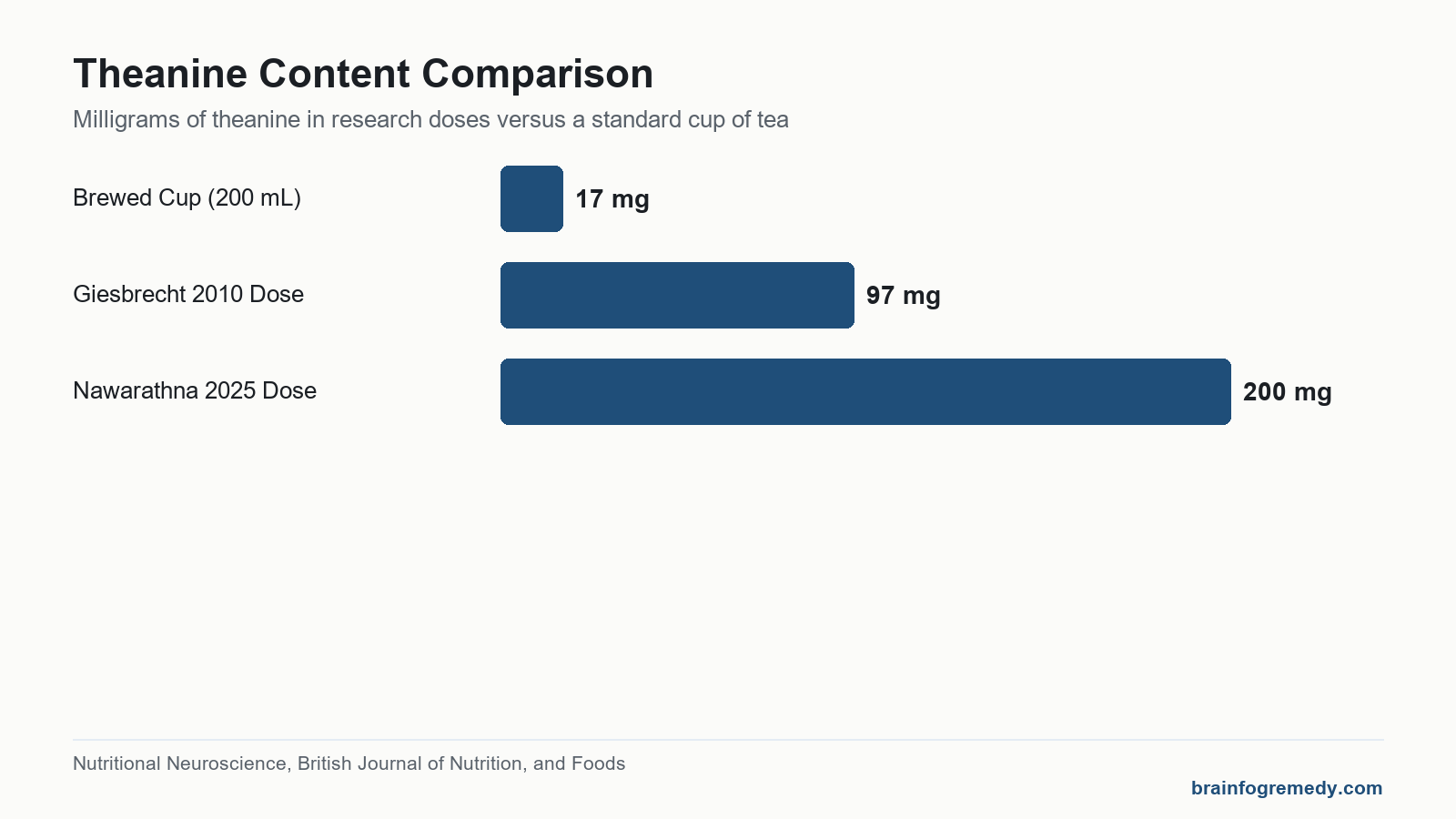
This is the question the commercial pages skip, and it is where the caffeine and theanine story quietly falls apart. In 2025 a team publishing in Foods put twelve green tea samples through chromatography across six brewing conditions. Five minutes at 80C gave about 17 mg of theanine and about 23 mg of caffeine per 200 mL. Brewing longer or hotter moved caffeine more than it moved theanine.
| What was dosed | Theanine | Caffeine | Theanine per unit caffeine | What it measured |
|---|---|---|---|---|
| Giesbrecht 2010, Nutritional Neuroscience | 97 mg | 40 mg | 2.4 | Task switching accuracy and self rated alertness in 44 young adults, one dose |
| Nawarathna 2025, British Journal of Nutrition | 200 mg | 160 mg | 1.25 | Selective attention and brain wave timing in 37 sleep deprived adults, tested 50 minutes after one dose the study evaluated attention and changes in brain activity in 37 adults who were awake whole night and there responses were assessed after 50 minutes after their first dose |
| One cup of green tea, 200 mL, 5 minutes at 80C (Foods, 2025) | 17 mg | 23 mg | 0.74 | Laboratory measurement of the drink itself, not a cognitive test |
| Cups needed to match Giesbrecht | about 5.7 | about 131 mg comes with them | 0.74 | Arithmetic from the row above |
| Cups needed to match Nawarathna | about 11.8 | about 271 mg comes with them | 0.74 | Arithmetic from the row above |
The arithmetic is not subtle. Matching the 97 mg used in 2010 takes roughly six cups carrying about 131 mg of caffeine, more than three times what that trial gave. Matching the 2025 trial takes nearly twelve cups and about 271 mg. The ratio is upside down too. Both trials dosed more theanine than caffeine, while a cup delivers about 0.74 mg of theanine for every milligram of caffeine. Whatever those studies showed, a teapot is not the delivery route for it.

Matcha and gyokuro are teas that contain more theanine than regular green tea. However, even one cup does not contain as much theanine as the amount used in the studies. They also contain more caffeine.
Why does green tea sometimes make brain fog worse?
A fair number of people arrive at this question from the other direction, because green tea seems to leave them foggier rather than sharper. Three mechanisms are documented well enough to name.
The first is timing. In a trial published in the Journal of Clinical Sleep Medicine in 2013, 400 mg of caffeine taken six hours before bed still cut objectively measured sleep by more than an hour, and the participants did not notice it had happened. Six cups of green tea in an afternoon sits inside that range. Sleep debt is one of the best evidenced causes of fog there is, which our piece on brain fog from lack of sleep goes through in detail.
The second reason is iron. Tea can make it harder for your body to absorb iron from food. This is very important if your iron levels are already low, as low iron can also contribute to brain fog.
The third reason is caffeine. Everyone reacts to caffeine differently. For some people, it can help them feel more alert, while for others, it can make them feel restless or even more tired and foggy later. If you regularly drink caffeine and then suddenly stop, you may also experience headaches and trouble concentrating for a few days. This is not something that happens only with green tea, and the other drink people most often blame for fog runs on a different clock, set out in what clears fast and what lingers after alcohol.

What do people who have tried it actually report?
Reported experience is not evidence, and on a health site it never stands in for a study. It is still worth knowing what people say when nobody is selling them anything, so here is what roughly 40 accounts across two public threads looked like, read in September 2026.
- In a February 2026 thread in the Nootropics community on Reddit asking whether theanine had done anything, the single most common reported effect was not clearer thinking but blunted caffeine jitters. Several posters described it as subtle to the point of being hard to distinguish from placebo.
- Doses people reported in that thread ran from 50 mg to 1,000 mg, all of them supplement capsules rather than tea. One poster said they reached it through two or three cups of gyokuro instead, which is the only account in the thread using tea as the route.
- Several reported the opposite of focus. One described 200 mg as sometimes too sedating to work through and 400 mg as reliably too sedating, and said that once the effect became noticeable their functioning dropped.
- Two reported the effect fading with daily use, one taking breaks of two or three days, another saying it “falls off quick”. Several reported nothing at all.
- In a separate June 2026 thread in the Reddit brain fog community, a poster who cut total caffeine below 50 mg a day, partly by switching to low caffeine green teas such as genmaicha and bancha, reported markedly less fog after a week or two. Commenters agreed and also described withdrawal symptoms while getting there.
That lines up with the trials on one point, that the dependable effect of theanine is blunting caffeine rather than lifting fog, and contradicts the marketing on nearly everything else. The same threads also carry claims with nothing behind them, including that caffeine blocks mineral absorption generally and that it drains a life force. Forum threads are like that. Oxford’s health experiences archive found a similar pattern in long Covid interviews collected by September 2022: eight people described trying supplements while, as one put it, in a desperate situation, and most could not tell whether any of it helped.
Is a green tea extract capsule the same thing as a cup of tea?
No, and the regulators treat them as different products. In 2018 the European Food Safety Authority reviewed green tea catechins and concluded that the infusion is safe at normal European consumption levels, while supplements are a separate question. Doses of 800 mg of EGCG a day or more taken as a supplement produced statistically significant rises in liver enzymes in clinical trials. The panel was blunt that it could not identify a supplement dose it was able to call safe. Daily EGCG from drinking the stuff runs around 90 to 300 mg.
The European Commission acted on that opinion. Under Commission Regulation (EU) 2022/2340, a food or supplement sold in the EU that contains green tea extract must hold less than 800 mg of EGCG per daily portion, state its EGCG content per portion, and warn that it should not be consumed by pregnant or breastfeeding women or anyone under 18, or on a day when other green tea products are consumed. Ordinary brewed tea, and water extracts that end up comparable to it, are excluded.
The same regulation placed the extracts under Union scrutiny, which gives the Commission four years from its entry into force in late 2022 to decide whether to ban them outright or keep them restricted. That deadline falls around the end of 2026, and when we checked in October 2026 we found no published decision. A capsule bought from outside the EU is under no obligation to carry any of those warnings, which is worth knowing before trusting the label on one.
So the concentrated version is not the tea with the boring parts removed. It is a different exposure with a different safety profile. Anything you are considering taking is worth raising with a pharmacist or doctor, particularly alongside other medicines.
When is brain fog worth taking to a doctor?
If brain fog lasts for weeks, suddenly gets worse, or starts affecting your daily life, it’s worth talking to a doctor instead of simply trying different products. Common checks may include iron, vitamin B12, vitamin D, and thyroid levels. If you have significant memory problems, very low mood, hopelessness, or thoughts of self-harm, seek medical help promptly.
Green tea itself isn’t a bad drink. It’s just important to remember that the benefits seen in studies may not be the same as what you get from an ordinary cup of tea. Knowing this can help you make a more informed choice.
Evaluating Green Tea Brain Fog Claims
Use these steps to analyze scientific claims and evidence regarding green tea and mental clarity.
Ticks are saved on this device only.
Frequently asked questions
How much green tea would match the doses used in theanine research?
One 200 mL cup contains about 17 mg of theanine. You would need about 6 cups to reach 97 mg and nearly 12 cups to reach 200 mg. However, these amounts would also give you much more caffeine than the studies used.
Does matcha contain more theanine than regular green tea?
Yes. Matcha and gyokuro usually contain more theanine than regular green tea. However, one serving still provides less than the amounts used in the studies, and it also contains more caffeine.
Can green tea interfere with iron levels?
Yes. Tea can reduce the amount of iron your body absorbs from food. This matters most if your iron levels are already low.
Why does green tea make some people feel foggier?
Caffeine taken six hours before bed has been shown to cut measured sleep by over an hour without people noticing.
Is green tea extract safer than drinking the tea?
Not necessarily. Regular green tea is generally considered safe, but high-dose green tea extracts can affect the liver. Supplements containing high amounts of EGCG should therefore be used with caution.
How long would it take to know whether green tea was helping my fog?
There is no clear answer because studies have mainly looked at short-term effects after one dose. If brain fog continues for several weeks, it is better to look for the underlying cause rather than keep experimenting with green tea.
Finished the page? The same five questions from the top, to see what stuck.
This article is general information, not medical advice, and is not a substitute for care from a qualified healthcare professional. Speak to your doctor about your own situation.
Leave a Reply