
Fibromyalgia and brain fog go together often enough that the NHS lists cognitive problems, nicknamed fibro fog, among the condition’s symptoms, and the 2016 diagnostic criteria score trouble thinking or remembering beside fatigue. Across 37 pooled studies, people with fibromyalgia scored lower than controls on every kind of thinking tested, with ignoring distractions the most affected.
Listen to this article, about 15 minutes. A synthetic voice reads the article and announces each section title as it begins; tables are read row by row and the questions at the end are left out.
Recorded 22 October 2026 from the article as published that day. Press a chapter to jump there; the highlighted line is what is playing. A play button sits beside every section heading, and once you scroll past this player a bar at the bottom of the screen keeps the controls in reach. Tap or click any sentence to hear the reading start from there.
On this page: the seven kinds of thinking a 37 study meta-analysis measured with the size of each gap, the two 2018 meta-analyses set side by side, the within-day pain and cognition figures, and what eleven people on r/Fibromyalgia reported between May and September 2026.
Think you already know this? Five questions, one minute.
Every answer is on this page. Answer from what you know now; the page fills in the rest.
-
1. Which three symptoms does the symptom severity scale in the 2016 fibromyalgia criteria rate from 0 to 3 over the past week?
The 2016 revision by Wolfe and colleagues rates fatigue, waking unrefreshed and cognitive symptoms each from 0 to 3, then adds up to 3 more points for headaches, lower abdominal pain and depression. Read the section
-
2. In the 2018 meta-analysis of 37 studies by Bell and colleagues, which kind of thinking showed the largest gap between people with fibromyalgia and controls?
Bell and colleagues found the largest difference in inhibitory control at g 0.61, the smallest in set shifting at 0.30, with processing speed at 0.46 in between. Read the section
-
3. In the eight days of home phone testing by Kratz and colleagues, on which task did the fibromyalgia group not differ from controls?
Kratz and colleagues found the fibromyalgia group reported worse thinking and scored worse on working memory at home, but the groups did not differ on the processing speed task. Read the section
-
4. When Whibley and colleagues looked at which came first within a day, what did they find in the fibromyalgia group?
In Whibley and colleagues, 2022, a worse working memory score predicted higher pain at the next assessment, and there was no evidence that pain preceded worse thinking. The authors call the findings tentative. Read the section
-
5. Across the eleven r/Fibromyalgia accounts read for this page, which complaint came up most often?
Seven of the eleven mentioned words, speech or following a conversation, starting with the June 2026 thread; the accounts split on reading. These are accounts, not findings. Read the section
Most health websites explain fibro fog by listing its causes and sharing tips to manage it. But they often miss what research has actually found, how much it affects people, why medical tests can still appear normal, and what it feels like in everyday life. This article looks at all four in simple terms, one by one.
Is brain fog a recognised symptom of fibromyalgia?
Yes, by the people who write the criteria, not just by the people who have it. The NHS fibromyalgia symptoms page, last reviewed 12 October 2022, lists cognitive problems under the name fibro-fog and says you may have trouble remembering and learning new things, problems with attention and concentration, and slowed or confused speech. The 2016 revision of the diagnostic criteria by Wolfe and colleagues goes further: its symptom severity scale rates three things over the past week, fatigue, waking unrefreshed, and trouble thinking or remembering, each from 0 to 3. Thinking is a third of that score. A condition whose diagnosis partly rests on how foggy you are is not a condition where the fog is imaginary.
How many people that covers is less tidy. An archived CDC page put fibromyalgia at about 4 million US adults, around 2 percent; the current CDC page says only millions, and an analysis of the 2012 National Health Interview Survey estimated 1.75 percent of adults, or 3.94 million people. Within that population the fog sits near the top of the complaint list: in a 2007 internet survey of 2,569 people with fibromyalgia, forgetfulness and poor concentration were each rated 5.9 out of 10 for severity, behind only morning stiffness, fatigue, unrefreshing sleep and pain.
Which kinds of thinking does fibromyalgia affect most?
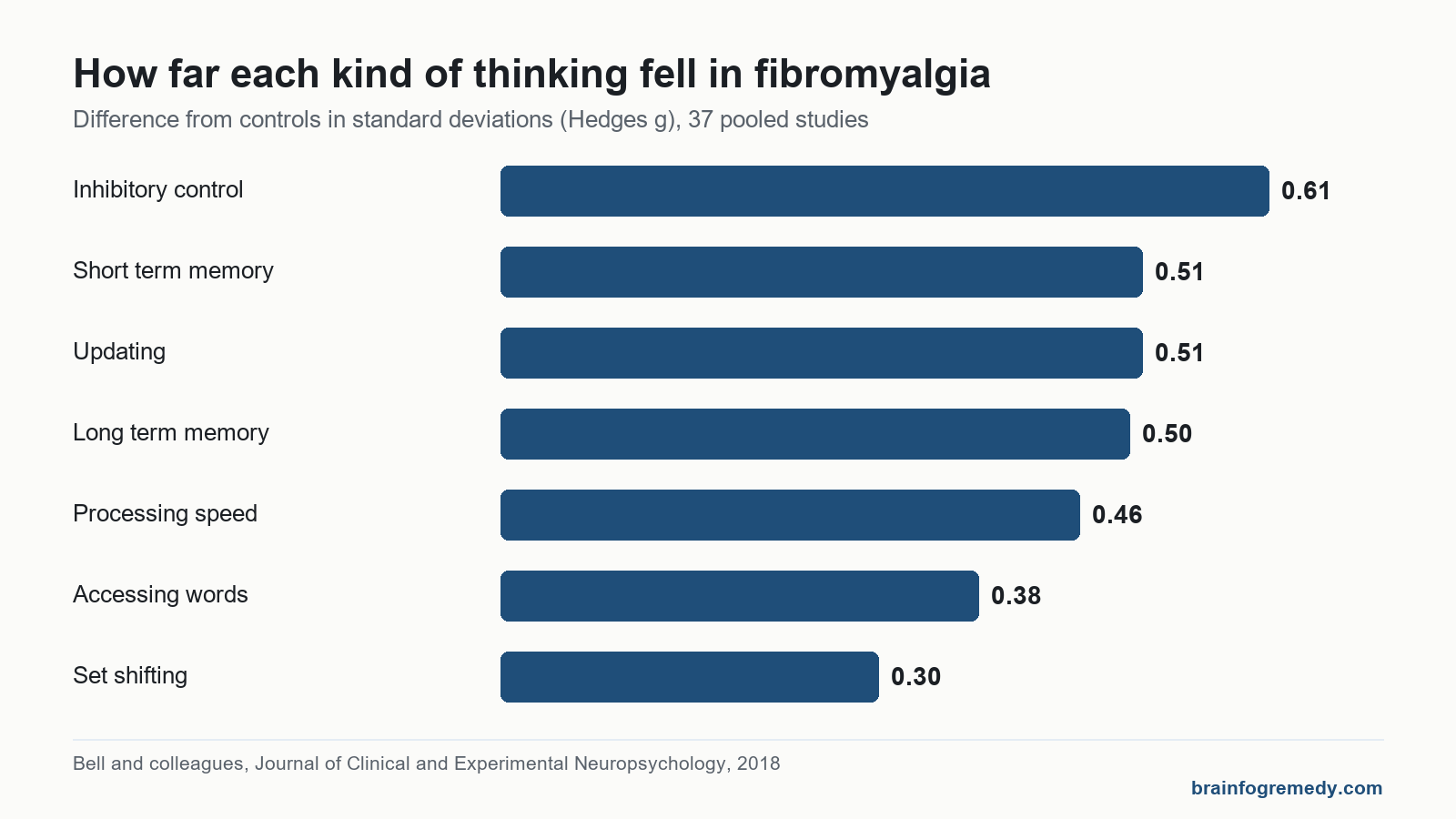
This is the question the ranking pages answer with a shrug and a stock photo. The studies are more specific. The largest meta-analysis, Bell and colleagues, 2018, pooled 37 studies and sorted every test into seven kinds of thinking. The fibromyalgia group scored lower on all seven. The gap is given as Hedges g, which is the difference between the two groups measured in standard deviations: 0.2 is usually called small, 0.5 medium, 0.8 large.
| Kind of thinking | What the tests ask | Difference, Hedges g | 95 percent interval | Studies |
|---|---|---|---|---|
| Inhibitory control | Ignore a distraction, stop a habit | 0.61 | 0.38 to 0.83 | 18 |
| Short term memory | Hold a list for a few seconds | 0.51 | 0.29 to 0.74 | 12 |
| Updating | Keep a running tally in mind | 0.51 | 0.33 to 0.69 | 17 |
| Long term memory | Recall it later | 0.50 | 0.28 to 0.72 | 11 |
| Processing speed | Do a simple task quickly | 0.46 | 0.25 to 0.67 | 10 |
| Accessing | Fetch words, as in naming as many animals as you can | 0.38 | 0.03 to 0.73 | 6 |
| Set shifting | Switch between two rules | 0.30 | 0.11 to 0.49 | 7 |
The biggest gap was in inhibitory control, the ability to shut out a distraction or stop an automatic response. Memory in its three forms sat around 0.5, processing speed a little behind, and the two smallest gaps were in fetching words and switching rules. The authors lean on an older argument from Eccleston and Crombez, that pain demands attention and competes with everything else for it, which would explain why the attention heavy domains come off worst.
A second meta-analysis the same year, Wu and colleagues, 2018, found bigger gaps from a smaller pool: an overall difference of 0.87, with attention and psychomotor speed at 1.22 and learning and memory at 0.94. The two papers agree on the direction and disagree on the size, so the honest summary is a real difference, moderate to large on average, varying a lot from study to study. No detox tea was harmed in the making of either.
| Bell and colleagues, 2018 | Wu and colleagues, 2018 | |
|---|---|---|
| Journal | Journal of Clinical and Experimental Neuropsychology | Psychosomatic Medicine |
| Studies pooled | 37 | 23 |
| People | 964 with fibromyalgia, 1,025 controls | 2,096 in total |
| Overall difference | Not pooled into one number | g 0.87, interval 0.60 to 1.15 |
| Largest gap | Inhibitory control, g 0.61 | Attention and psychomotor speed, g 1.22 |
| Smallest gap | Set shifting, g 0.30 | Executive function, g 0.72 |
| Memory | g 0.50 to 0.51 | Learning and memory, g 0.94 |
| What moved the numbers | Older samples showed smaller memory gaps | Depression and anxiety scores tracked the size of the gap |

Why can a cognitive test come back normal when the fog is obvious?
Because a group difference is not a personal verdict. A gap of 0.5 standard deviations means the average person with fibromyalgia scores below about 69 percent of controls, which is a real shift. It also means about 31 percent of healthy controls score below that average patient. The two curves overlap heavily, so a person whose thinking has dropped from the top of the range to the middle will test as normal, and unless somebody tested them before, nobody can see the drop. That arithmetic is this page’s, worked from the effect sizes above; it is simply what a g of 0.5 means.
The daily life studies back this up from another angle. Kratz and colleagues, 2020 gave 50 people with fibromyalgia and 50 matched controls a clinic test, then eight days of five a day phone tests at home. In the clinic the fibromyalgia group did worse on three measures. At home they reported worse thinking and did worse on a working memory task, but not on a processing speed task. The link between how people felt their thinking was going and how they actually scored was about the same in both groups, which the authors read as evidence that people with fibromyalgia are not overstating the problem. The fog is measurable. It is just not always measurable on the test you happened to be given, on the day you happened to be given it.
Does pain make the fog worse in the moment?
Slightly, and the direction of travel is not what you might expect. Whibley and colleagues, 2022, in the journal Pain, re-analysed the same hundred people over seven days, matching each pain rating to the thinking test taken at the same moment. For every one point rise in pain on a 0 to 10 scale, self rated cognitive trouble rose 0.27 points in the fibromyalgia group against 0.17 in the controls, and response times on the speed test slowed by 1.73 milliseconds, while the controls actually got faster. The working memory test did not move with pain at all in the fibromyalgia group.
Those are small numbers, and the authors call them tentative. The more interesting result was the order of events: a worse working memory score predicted higher pain at the next check in, and there was no evidence that pain predicted worse thinking at the next one. Fog and pain seem to rise and fall together rather than one pushing the other, which is a more honest picture than the “pain causes fog” line most pages carry, and it fits what the rheumatoid arthritis studies and the lupus studies keep finding: the fog tracks the whole condition, not one dial on it.
What do people with fibromyalgia say fibro fog feels like?
Three threads on r/Fibromyalgia were read for this page, posted between May and September 2026 and carrying 31 comments between them, in which eleven people described their own thinking. These are accounts, not findings, and nothing in them says what is happening to any reader.
The thread with the most detail, from June 2026, was started by someone three years into a diagnosis and finishing a science doctorate. Their word recall had got markedly worse, to the point that a lost word in conversation is now left lost; arithmetic and spelling had gone the same way; writing was the hardest task of all. Reading was untouched, even in a flare, so it had become their bad day default. A reply from someone tested repeatedly reported being told they were “within normal parameters” with no earlier baseline to compare; they talk around missing words with the vocabulary they still have and cannot follow a television series without a recap. A third person found the fog worsened in the premenstrual week and the period week, giving two usable weeks in four. A fourth, still at school, found reading comprehension was precisely the part that failed, the opposite of the first account.
In a thread from September 2026 the original poster described walking into a table while carrying dishes and being unable to account for it, losing the thread of conversations they knew they had had, and two hours of sleep behind it all. One reply described mixing up words and being unable to pronounce familiar ones, like wading through something thick, with concentration gone; another forgets what a partner said and loses words mid sentence. And in a thread from May 2026, filed under Funny, people traded the comic end of the range: frozen peas poured into a water bottle and not noticed until drinking, a phone found ringing in the fridge next to the gap where the cheese had been, cat food spooned into steeping tea.

The pattern across the eleven: seven mentioned words, speech or following a conversation, more than any other thing. Recent memory came next. Flares, bad sleep and the menstrual cycle were the named triggers, and the accounts split on reading. Where they agree with the studies: attention and recent memory are the heavy losses, and bad sleep makes everything worse, which is why brain fog from lack of sleep is worth reading alongside this. Where they do not: word fetching had one of the smallest gaps in the Bell table, at 0.38, yet it is the thing people complain about first. Naming animals for a minute and holding a conversation at dinner are not the same test, and the mismatch is worth knowing before a normal result is taken as the last word.
A published study found the same themes in a bigger sample. Millar and colleagues, 2024, in the Journal of Patient Experience, analysed posts from two public fibromyalgia support groups of at least 500 members each and found six themes: the struggle to describe the fog, no longer trusting one’s own memory, choosing between pain and the cognitive side effects of the medicines that ease it, feeling judged, withdrawing from conversation, and grieving a lost identity. The authors note that patients often rank the fog as a top treatment priority while clinicians tend to rank it lower.
When should fibro fog be raised with a doctor?
Whenever it is affecting work, safety or relationships, and whenever it is new or getting worse. The NHS lists cognitive problems as part of fibromyalgia, but nothing on this page can tell a reader that their fog is fibromyalgia rather than something else, and several of the common causes of brain fog are treatable and easy to test for. A doctor can check those; a web page cannot. An underactive thyroid in particular produces a fog that people describe in nearly the same words.
What makes the appointment useful is specifics, because the fog is hard to describe and the appointment is short. Which tasks fail: words, recent memory, reading, numbers. When: in a flare, after a bad night, at a point in the cycle. Whether a medicine changed and the fog changed with it. A short written record of fog, pain and sleep by day gives the doctor something to read rather than a feeling to interpret.
Fog, pain and sleep notes by day, to take to the doctor
A plain record of what the fog was like each day beside the pain and the sleep behind it. It stays in this browser, it scores nothing, and it does not say what any entry means; that is the doctor’s job.
General information only. This record interprets nothing. Take it to a doctor if the fog is new, worsening, or affecting work, safety or relationships.
Frequently asked questions
What is the difference between fibro fog and brain fog?
Fibro fog is the name people with fibromyalgia, and the NHS, give to the cognitive problems that come with the condition. Brain fog is the general term for the same kind of slow, forgetful, unfocused thinking from any cause. The symptoms described overlap almost completely.
Is fibro fog part of the fibromyalgia diagnosis?
Partly. The 2016 revision of the diagnostic criteria includes trouble thinking or remembering in its symptom severity scale, scored 0 to 3 alongside fatigue and waking unrefreshed. The scale is one half of the criteria; widespread pain is the other.
How big is the thinking difference in fibromyalgia?
Moderate on average. The 2018 meta-analysis by Bell and colleagues found gaps between 0.30 and 0.61 standard deviations across seven kinds of thinking; Wu and colleagues the same year found an overall gap of 0.87. Both found wide variation between studies.
Does fibro fog show up on a memory test?
Often, as a group. For an individual it may not, because the two groups overlap heavily and a drop from a high starting point can still land in the normal range. Daily life testing found the gap in working memory but not in processing speed.
Does fibro fog get worse during a flare?
The within-day study found self rated thinking worsened slightly as pain rose, by about a quarter of a point per pain point, and the accounts on this page all describe flares as bad fog days. Whether pain drives the fog or both rise together is not settled; the study leaned towards together.
Does fibro fog mean dementia is coming?
Nothing on this page shows that. The studies measured differences between groups at one time, not change over years, and the meta-analysis found memory gaps were smaller in older samples, not larger. New or worsening memory loss is a reason to see a doctor, whatever the cause.
Finished the page? The same five questions from the top, to see what stuck.
This article is general information, not medical advice, and is not a substitute for care from a qualified healthcare professional. Speak to your doctor about your own situation.
Leave a Reply