
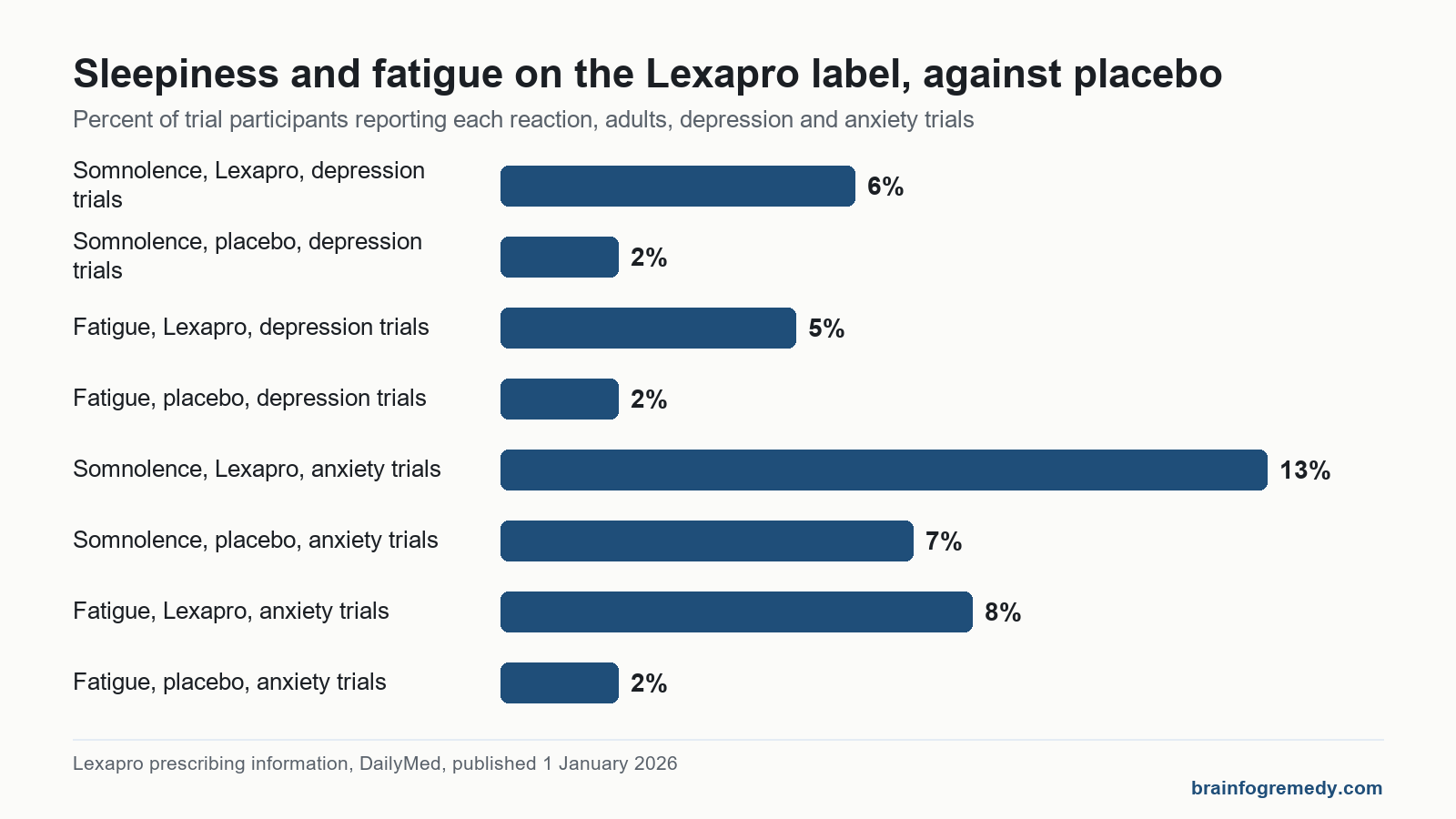
Lexapro brain fog is not a phrase the escitalopram label uses. Its trial tables list somnolence in 6 percent of people treated for depression against 2 percent on placebo, and 13 against 7 in anxiety trials, with no row for memory or concentration. Sleepiness is documented; slowed thinking was never measured as a rate.
Listen to this article, about 12 minutes. A synthetic voice reads the article and announces each section title as it begins; tables are read row by row and the questions at the end are left out.
Recorded 26 October 2026 from the article as published that day. Press a chapter to jump there; the highlighted line is what is playing. A play button sits beside every section heading, and once you scroll past this player a bar at the bottom of the screen keeps the controls in reach. Tap or click any sentence to hear the reading start from there.
On this page: the Lexapro label rows nearest to fog set beside the Zoloft rows, the dose table where sleepiness rose from 1 to 9 percent, the FDA report counts for escitalopram, and what forty dated WebMD reviews actually described.
Think you already know this? Five questions, one minute.
Every answer is on this page. Answer from what you know now; the page fills in the rest.
-
1. In the depression trials on the Lexapro label, how often was somnolence reported compared with placebo?
The Lexapro label on DailyMed lists somnolence at 6 percent against 2 percent in the depression trials; 13 against 7 is the anxiety trial row. Read the section
-
2. Which of these rows appears in the main trial tables of both the Lexapro and the Zoloft labels?
Fatigue appears on both: 5 against 2 percent in the Lexapro depression trials and 12 against 8 on the Zoloft label. Neither main table has a memory or brain fog row. Read the section
-
3. In the fixed dose trial on the Lexapro label, what was the somnolence rate at 20 mg a day?
Table 4 of the Lexapro label gives somnolence at 1 percent on placebo, 4 percent at 10 mg and 9 percent at 20 mg, in one trial of adults with depression. Read the section
-
4. In the 2023 trial by Langley and colleagues, 66 healthy volunteers took escitalopram or placebo for 21 days. What did the attention and memory tests show?
The Langley and colleagues trial found no group differences on attention and memory tests, and a drop in sensitivity to reward and punishment on learning tasks. Read the section
-
5. Where does the MedlinePlus escitalopram page place problems with thinking, concentration or memory?
The MedlinePlus escitalopram page, last revised 15 October 2025, lists them among the effects to call a doctor about immediately, and says not to stop escitalopram without talking to your doctor. Read the section
So the label and the search box are talking past each other. People type “brain fog”. The label says somnolence, fatigue and lethargy. Reviewers say tired, sleepy, numb. This page lines those words up, with the numbers each one actually comes with, and shows where the record simply goes quiet.
Does Lexapro cause brain fog?
Not by that name. The Lexapro label on DailyMed, in the version published on 1 January 2026, reports reactions from placebo controlled trials in 715 adults with depression and 429 with generalised anxiety. In the depression trials somnolence was reported by 6 percent on Lexapro against 2 percent on placebo, and fatigue by 5 against 2. In the anxiety trials both were higher: somnolence 13 against 7, fatigue 8 against 2, and lethargy 3 against 1. Those are the rows closest to what most people mean by fog.
Thinking itself gets two mentions, both thin. “Concentration impaired” appears in a supplementary list of reactions reported among 1,428 patients treated for up to a year, with no rate and no placebo comparison. And section 5.8 of the label says that in a study in normal volunteers, Lexapro 10 mg daily did not produce impairment of intellectual function or psychomotor performance, before adding that any psychoactive drug may impair judgment, thinking or motor skills. That is the label in full on cognition. Sleepiness has numbers. Slowed thinking has a caution and a shrug.
How do the Lexapro label rows compare with Zoloft?
Sertraline, sold as Zoloft, is another SSRI, and our page on what the Zoloft label lists for brain fog already read its table. Set side by side, the two labels describe the same kind of complaint and the same silence.
| Label row | Lexapro, depression trials | Lexapro, anxiety trials | Zoloft, pooled trials | Sources |
|---|---|---|---|---|
| Somnolence | 6% against 2% on placebo | 13% against 7% | 11% against 6% | Lexapro label; Zoloft label |
| Fatigue | 5% against 2% | 8% against 2% | 12% against 8% | Lexapro label; Zoloft label |
| Insomnia | 9% against 4% | 12% against 6% | 20% against 13% | Lexapro label; Zoloft label |
| Dizziness | 5% against 3% | Not in the table | 12% against 8% | Lexapro label; Zoloft label |
| Lethargy | Not in the table | 3% against 1% | Not in the table | Lexapro label |
| Yawning | Not in the table | 2% against 1% | Not in the table | Lexapro label |
| Memory, concentration, brain fog | No row | No row | No row | Lexapro label; Zoloft label |
The pattern across all three columns: sleepiness and tiredness sit a few points above placebo, insomnia sits above them, and memory has no row anywhere. The anxiety trials show higher sleepiness rates than the depression trials for Lexapro, which may reflect different people, doses or years rather than anything about anxiety itself. The label does not explain the gap, and this page will not invent a reason for it.

Does a higher Lexapro dose mean more sleepiness?
In the one trial the label reports by dose, yes. Table 4 of the Lexapro label comes from a fixed dose study in adults with depression. Overall reaction rates were 61 percent on placebo, 66 percent on 10 mg and 86 percent on 20 mg, and the rows below are the ones the label picked out as roughly doubling at the higher dose.
| Label row | Placebo | Lexapro 10 mg a day | Lexapro 20 mg a day |
|---|---|---|---|
| Somnolence | 1% | 4% | 9% |
| Fatigue | 2% | 2% | 6% |
| Insomnia | 4% | 7% | 14% |
| Dizziness | 2% | 4% | 7% |
Somnolence went from 1 percent on placebo to 4 at 10 mg and 9 at 20 mg. Fatigue did not move between placebo and 10 mg, then tripled at 20. That is one eight week trial, and it says nothing about what a dose does to any one person. It does explain why “since the dose went up” is a useful sentence to say out loud at an appointment. The same label adds that escitalopram has a mean terminal half life of about 27 to 32 hours, and that in people 65 and over it was about 50 percent longer.
Is Lexapro brain fog the same as feeling numb?
No, though the two get folded into one word. Feeling numb, or emotional blunting, is feelings turned down at both ends. In the Goodwin and colleagues, 2017 survey of 669 depressed patients on antidepressants, about 46 percent reported it, and the rate did not differ by drug class. Escitalopram was not reported on its own, so the class figure is the closest number available.
The best test of escitalopram by itself comes from Langley and colleagues, 2023, who gave 66 healthy volunteers escitalopram or placebo for 21 days. The University of Cambridge summary reports no group differences on attention and memory tests, and a drop in sensitivity to reward and punishment on learning tasks, which the authors offered as a possible mechanism for blunting. So in the one controlled test of this drug, the muffled feeling had a measurable trace and the slowed thinking did not. Three weeks in healthy volunteers is not years in people with depression, and the trial does not settle it.
Depression has its own fog, which complicates every number here. Our page on why depression makes your head feel foggy covers how the illness itself slows thinking, which is part of why a drug effect and a symptom are so hard to tell apart.
What do people taking Lexapro report about brain fog?
Forty patient reviews on WebMD were read for this page: the 20 most recent across all conditions, dated July 2024 to January 2026, and 20 from the depression reviews, dated September 2022 to August 2023. They come from a pool of 4,567 reviews. These are accounts, not findings, and nothing in them tells a reader what is happening to them.
The most striking result is a word that is missing. None of the forty called it brain fog. What they described instead matched the label more closely than the search term does. Sleepiness or tiredness came up in seven reviews: one person in their first month was sleeping almost all day, another felt sleepy all day after the first week, and a third said they crashed around 7pm into tiredness and irritability. Feeling numb or flat came up in four, including one reviewer who said their emotions had flatlined while their energy stayed normal, and another who accepted occasional numbness as a fair trade. These are in the depression reviews on WebMD and the most recent Lexapro reviews.
Thinking proper came up only a handful of times, and it cut both ways. One reviewer in September 2022 described getting stuck trying to recall things at a higher dose, and another in August 2024 described severe executive dysfunction. Against them, two reviewers said their mind felt quieter and that they liked how their brain processed things now. Twenty six of the forty mentioned none of these three things at all.
Reports to the regulator tell a similar story at a much larger scale. The FDA adverse event system holds voluntary reports from doctors, companies and patients, and among reports naming escitalopram these terms appear among the top sixty.
| Reaction term in reports naming escitalopram | Reports | Rank among all terms |
|---|---|---|
| Fatigue | 9,542 | 1st |
| Somnolence | 4,065 | 17th |
| Feeling abnormal | 3,187 | 28th |
| Confusional state | 2,917 | 32nd |
| Memory impairment | 1,917 | 54th |
Fatigue is the single most reported term of all, ahead of nausea. Memory impairment sits fifty fourth. These are reports, not rates, but the shape matches the reviews and the label: tiredness first, thinking further down, and no row anywhere called fog. The bupropion label is read the same way on our page on Wellbutrin brain fog and its label rows.

When should you talk to the prescriber about Lexapro brain fog?
The MedlinePlus escitalopram page, last revised 15 October 2025, lists problems with thinking, concentration or memory, and confusion, among the side effects to call a doctor about immediately. It says not to stop taking escitalopram without talking to your doctor, and not to drive or operate machinery until you know how the medicine affects you.
The label adds one reason that matters most for older readers. Section 5.6 says SSRIs, including Lexapro, have been linked to low blood sodium, with signs that include headache, difficulty concentrating, memory impairment, confusion, weakness and unsteadiness, and that elderly patients may be at greater risk. That is a reason to report new confusion promptly rather than wait. The label also says to reduce the dose gradually rather than stop abruptly whenever possible, and lists confusion and lethargy among the symptoms reported after stopping. Nothing on this page is a reason to change a dose on your own.
What makes the appointment useful is precision. Say whether the problem is sleepy, flat or slow, because each has different evidence behind it. Say when it started relative to starting or changing the dose. Say how you are sleeping, since insomnia is one of the larger rows on the label and brain fog from lack of sleep looks much like any other kind. And say what else has changed, because ordinary causes of fog keep going while a medicine is being tried.
What to tell the prescriber about Lexapro and fog
A list of things worth saying at the appointment. Tick what you have noted down. It scores nothing, it does not say what anything means, and it never suggests changing a dose.
General information only. Do not stop or change a medicine without talking to the prescriber.
Frequently asked questions
How long does Lexapro brain fog last?
The label gives no duration for sleepiness or fatigue. MedlinePlus says it may take several weeks to feel the full benefit. Reviewers describe tiredness that faded within weeks and tiredness that stayed, which is a range of reports, not a prediction.
Does Lexapro affect memory?
Its main trial tables carry no memory row. A healthy volunteer trial found no change on memory tests over 21 days. MedlinePlus lists problems with thinking, concentration or memory as effects to call a doctor about immediately.
Is Lexapro more sedating than Zoloft?
The labels cannot settle it. Lexapro depression trials show somnolence at 6 percent against 2 on placebo, and Zoloft pooled trials 11 against 6, but the trials used different people, conditions and years.
Can I drive if Lexapro makes me foggy?
MedlinePlus says not to drive a car or operate machinery until you know how escitalopram affects you, and the label gives the same caution for hazardous machinery, including cars.
Is Lexapro brain fog worse in older adults?
The label says escitalopram’s half life was about 50 percent longer in people 65 and over, and that older people may be at greater risk of low sodium, whose signs include confusion and memory impairment.
Does stopping Lexapro cause brain fog?
The label lists confusion and lethargy among symptoms reported after stopping, and advises reducing the dose gradually whenever possible. Any change belongs to a conversation with the prescriber.
Finished the page? The same five questions from the top, to see what stuck.
This article is general information, not medical advice, and is not a substitute for care from a qualified healthcare professional. Speak to your doctor about your own situation.
Leave a Reply