
Metformin brain fog is not a phrase on the label. The label does say B12 fell below normal in about 7 percent of trial patients over 29 weeks, and since June 2022 the UK regulator calls low B12 a common effect that can impair thinking. Whether that explains one person’s fog is a blood test question for the prescriber.
Listen to this article, about 14 minutes. A synthetic voice reads the article and announces each section title as it begins; tables are read row by row and the questions at the end are left out.
Recorded 23 October 2026 from the article as published that day. Press a chapter to jump there; the highlighted line is what is playing. A play button sits beside every section heading, and once you scroll past this player a bar at the bottom of the screen keeps the controls in reach. Tap or click any sentence to hear the reading start from there.
On this page: the metformin label as worded in April 2017 and December 2025 set beside the MHRA, NICE and ADA positions with their dates, the 13 year trial’s B12 numbers, the FDA report counts, and what twelve people on Reddit described.
Think you already know this? Five questions, one minute.
Every answer is on this page. Answer from what you know now; the page fills in the rest.
-
1. Which of these does the current US metformin label list as a common reaction from its trial?
The metformin label on DailyMed, revised December 2025, lists asthenia at 9 percent against 6 on placebo and has no row for memory or concentration. Brain fog is not a label term. Read the section
-
2. How did the MHRA classify reduced vitamin B12 on metformin in June 2022?
The MHRA Drug Safety Update of 20 June 2022 classed reduced B12 as common, meaning up to 1 in 10 people, with risk rising with dose and years on the medicine. Read the section
-
3. In the Diabetes Prevention Program Outcomes Study, what share of the metformin group had low or borderline low B12 at 5 years?
Aroda and colleagues, 2016 reported 19.1 percent low or borderline low at 5 years on metformin against 9.5 percent on placebo. The study did not test memory or concentration. Read the section
-
4. What did the 2022 pooled analysis of 28 observational studies find about cognitive impairment in people with diabetes on metformin?
Zhang and colleagues, 2022 found an adjusted hazard ratio of 0.92 for cognitive impairment and 0.90 for dementia, with no effect on Alzheimer’s disease, and asked for randomised trials because every study pooled was observational. Read the section
-
5. In the English GP practices studied, what share of metformin users had a B12 test in a given year after the June 2022 safety update?
Parsonage and colleagues, 2025 found annual testing rose from 34.5 percent to 38.2 percent across nine practices covering about 148,000 patients, so most metformin users still went untested in any given year. Read the section
People search this phrase from two directions. Some have felt slow since starting the tablets. Others have been on them for years and have just read that they can lower B12. The label, two regulators, two guidelines and a 13 year trial each have something to say, and they do not say the same thing. This page sets them side by side with their dates, then reports what people on the forums describe, which is a third thing again.
Does metformin cause brain fog?
Not by that name, and not directly in any document found for this page. The current US metformin label, December 2025, read on DailyMed on 23 October 2026, lists the common reactions from a 141 patient trial: diarrhoea in 53 percent against 12 on placebo, nausea or vomiting in 26 against 8, and asthenia, which is the medical word for weakness or tiredness, in 9 percent against 6. There is no row for memory, concentration or slowed thinking, and the postmarketing section mentions liver injury and nothing about the brain.
The route the label does describe runs through vitamin B12. Metformin can interfere with how B12 is absorbed, and B12 deficiency is a recognised reversible cause of poor concentration and memory, which is why it already has its own page on this site. So the honest chain is: the medicine can lower B12 in some people over time, low B12 can affect thinking, and nobody has measured how often the whole chain happens in one person. Each link has a number below. The chain as a whole does not.
What does the metformin label say about B12, and how has it changed?
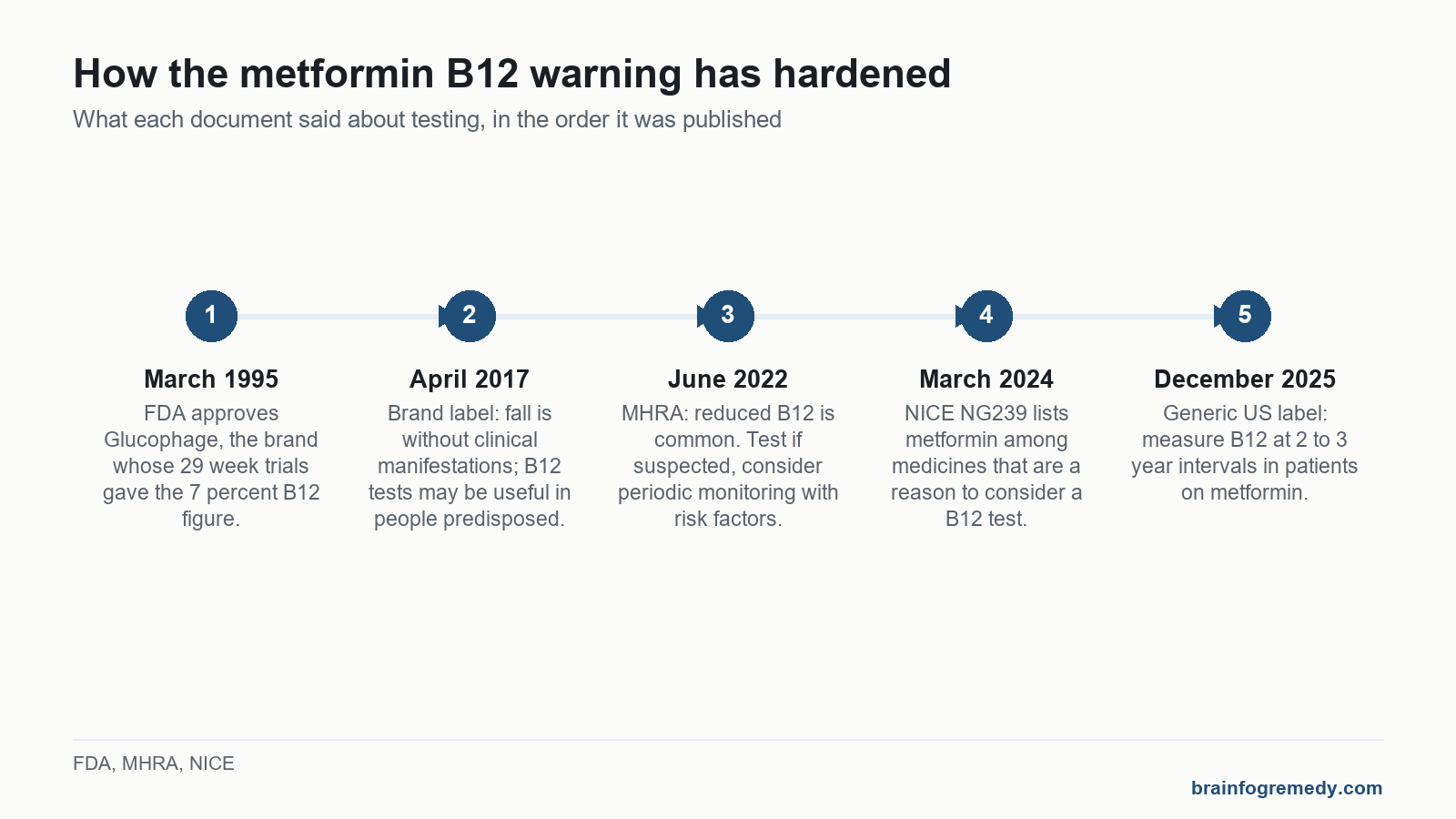
This is the part the ranking pages skip. The warning is old, but its tone has shifted, and the regulators have moved further than the label. The table reads each document in its own words, with the date of the version read.
| Document | Date | What it says about B12 | What it says about testing |
|---|---|---|---|
| Glucophage label, April 2017 | Revised April 2017 | B12 fell below normal in about 7 percent of patients over 29 weeks, “without clinical manifestations”, and the fall is “very rarely associated with anemia”. | Annual blood counts. B12 tests every 2 to 3 years “may be useful” in people predisposed to low B12. |
| metformin label, December 2025 | Revised December 2025 | Same 7 percent figure. The fall “may be associated with anemia”. The phrase “without clinical manifestations” is gone. | “Measure hematologic parameters on an annual basis and vitamin B12 at 2 to 3 year intervals in patients on metformin.” |
| MHRA Drug Safety Update, 20 June 2022 | 20 June 2022 | Reduced B12 is now a “common” side effect, meaning up to 1 in 10. Risk rises with dose and years on it. Lists cognitive impairment among the symptoms of deficiency. | Test B12 “if deficiency is suspected”. “Consider periodic vitamin B12 monitoring in patients with risk factors.” |
| NICE guideline NG239, March 2024 | 6 March 2024 | Metformin sits in the list of medicines that are a reason to consider testing for B12 deficiency, beside proton pump inhibitors and some anti seizure drugs. | Points clinicians to the MHRA advice. No fixed interval. |
| ADA Standards of Care 2026 | January 2026 | Metformin use is linked to B12 deficiency and can worsen neuropathy symptoms. | “Consider periodic assessment of vitamin B12 levels” on long term metformin, especially with anaemia or neuropathy; the older adults section says yearly after 4 years. |
Three changes are worth noticing. The 2017 brand label called the B12 fall a laboratory finding “without clinical manifestations” and said testing “may be useful” in people already inclined to. The 2025 generic label drops the reassurance and tells prescribers to measure B12 every 2 to 3 years in everyone on the drug. And the MHRA Drug Safety Update, 20 June 2022 went further than either: reduced B12 became common, reduced cognitive function was named among the symptoms of deficiency, and patients were told to seek advice for “extreme tiredness, a sore and red tongue, pins and needles, or pale or yellow skin”. The same advice says “do not stop your treatment without first discussing this with your doctor”.

How often does B12 fall on metformin, and does it matter for thinking?
The best long run numbers come from the Diabetes Prevention Program Outcomes Study, where 2,155 adults with prediabetes were randomised to metformin or placebo and followed for 13 years. Aroda and colleagues, 2016 reported the B12 results.
| Measure in the DPP Outcomes Study | Metformin group | Placebo group |
|---|---|---|
| Low B12 at 5 years | 4.3% | 2.3% |
| Low or borderline low B12 at 5 years | 19.1% | 9.5% |
| Low B12 at 13 years | 7.4% | 5.4% |
| Low or borderline low B12 at 13 years | 20.3% | 15.6% |
| Anaemia at 5 years | 14.3% | 10.5% |
The risk was highest when borderline cases were included, reaching twice the placebo rate after five years. The longer people took the medicine, the higher their risk of deficiency. However, the study did not test memory or concentration.
The one study that asked that question directly is small and old. Moore and colleagues, 2013 looked at 126 people with diabetes inside a larger Australian memory study and found worse cognitive test scores in those on metformin, with an odds ratio of 2.23 and a confidence interval that only just cleared 1. The authors called for prospective trials, which is the polite way of saying the result needs checking.
Does metformin make thinking worse or better over the years?
Here the evidence points the other way, which the forums have noticed and the worried searcher has not. Zhang and colleagues, 2022 pooled 28 observational studies and found people with diabetes on metformin had a slightly lower rate of cognitive impairment, with an adjusted hazard ratio of 0.92, and of dementia at 0.90, with no effect on Alzheimer’s disease. The studies disagreed widely, all were observational, and people who stay on metformin for years tend to be healthier than people who cannot, which flatters the drug. The authors asked for randomised trials. So did Moore. Nobody has run one large enough to answer either.
Reports to the FDA are a third kind of evidence, weaker than both. The adverse event reporting system holds voluntary reports from doctors, companies and patients, and the counts for terms near brain fog look like this.
| Reaction term in reports naming metformin | Reports | Rank among all terms |
|---|---|---|
| Fatigue | 4,355 | 4th |
| Dizziness | 3,091 | 12th |
| Confusional state | 1,389 | 40th |
| Anaemia | 1,240 | 49th |
| Somnolence | 1,077 | 63rd |
| Feeling abnormal | 1,055 | 64th |
Fatigue sits fourth, behind only diarrhoea, nausea and lactic acidosis, which matches the asthenia row on the label. Memory complaints, the thing the B12 warning is about, are not in the top 80. That could mean they are rare, or that nobody connects a slow memory to a tablet they have taken for eight years. The reports cannot tell those apart.
What do people taking metformin report about brain fog?
Three threads and one comment search on Reddit were read for this page, posted between May and October 2026, carrying twelve people’s own accounts. They are accounts, not findings, and nearly all come from people prescribed the medicine for polycystic ovary syndrome or insulin resistance rather than type 2 diabetes. Nothing in them tells a reader what is happening to them.
The surprise is the direction. Seven of the twelve described their fog getting better on the medicine. In a thread from September 2026 someone three months in said the clearing was gradual, until one day the heavy feeling behind the eyes had gone, with the energy following about six weeks later; a second reply reported a large change but only once they reached 1,500 mg. In a comment from September 2026 a person given metformin for migraines linked to insulin resistance said the migraines stopped eleven days in and the fog cleared by most of the way at the same time. In a thread from May 2026 a person with chronic fatigue and PCOS described the “concussed feeling” lifting within weeks, and creeping back whenever stomach side effects forced them to skip doses.
Four described the opposite, and all four were in the first weeks. In a thread from June 2026 the poster felt very tired ten days into an extended release tablet; a reply at two weeks felt sluggish, the poster came back a fortnight later to say they felt much better, a third person called the first two months awful, and a fourth at day thirteen wanted to give up. One account cut against both patterns: in a comment from October 2026 a person with PCOS listed exhaustion and fog among symptoms that metformin had done nothing for.
Where the accounts agree with the label: tiredness early on, which matches the asthenia row and the fatigue count. Where they go beyond it: the improvement reports, which fit the observational studies above but which the label does not claim. Where they are silent: not one of the twelve mentioned B12, a blood test, or fog arriving after years on the drug. That is the gap the regulators worry about, and it is invisible from the inside, because a slowly falling blood level does not feel like anything until it does.

What should you ask the prescriber about B12 monitoring?
The regulators agree the person to ask is whoever prescribes the tablets, and the evidence says the question often goes unasked. Parsonage and colleagues, 2025 checked nine English GP practices covering about 148,000 patients and found the share of metformin users with a B12 test in a given year rose from 34.5 percent before the June 2022 safety update to 38.2 percent after it. A companion survey of 124 primary care clinicians, 2026 found 87 percent knew of the link, 39 percent tested yearly, 55 percent tested only when a patient seemed symptomatic, and 36 percent thought the guidance was clear.
So the useful questions are factual: when B12 was last measured, whether the result sat in the low or borderline range the trial used, how long you have been on the medicine and at what dose, and whether anything on the MHRA’s risk list applies, such as a vegan diet, a stomach operation, or a proton pump inhibitor taken alongside. None of that decides anything on its own. The MHRA says a person can keep taking metformin while a low level is corrected, that correction is for the clinician to manage, and that the symptoms it lists can also come from diabetes itself or from something unrelated. If fog started in the first weeks, say so, because the prescriber will want the timing. And since the usual causes of brain fog do not pause while a tablet is being blamed, it is worth saying what else has changed, including how you are sleeping, before the appointment becomes a conversation about the medicine alone.
Questions to bring to the prescriber about B12 monitoring
Tick the ones you want answered at the next review. This list asks for facts and decides nothing; it names no dose and no supplement.
General information only. The MHRA says not to stop metformin without first discussing it with your doctor, and that any correction of a low B12 level is for the clinician to manage.
Frequently asked questions
Is metformin brain fog a known side effect?
Not under that name. The US label lists tiredness in 9 percent of trial patients against 6 on placebo and a fall in B12 in about 7 percent over 29 weeks. It has no row for memory or concentration. The UK regulator lists cognitive impairment as a symptom of the B12 deficiency the medicine can cause.
How long does it take for metformin to lower B12?
The label figure comes from 29 week trials. In the 13 year Diabetes Prevention Program study the gap between metformin and placebo was already present at 5 years, and the odds of deficiency rose by about 13 percent for each year on the medicine.
Does the metformin label say to test B12?
The current US label says to measure B12 at 2 to 3 year intervals in patients on metformin. The 2017 brand label said such tests may be useful in people already predisposed. The UK regulator says to test if deficiency is suspected and to consider periodic monitoring in people with risk factors.
Does metformin protect the brain instead?
A 2022 pooled analysis of 28 observational studies found slightly lower rates of cognitive impairment and dementia in people with diabetes on metformin, and no effect on Alzheimer’s disease. The studies disagreed widely and none was randomised, so the authors asked for trials.
Should I stop metformin if I feel foggy?
The MHRA patient advice says not to stop treatment without first discussing it with your doctor, and that a person can keep taking metformin while a low B12 level is being corrected. The decision belongs to the prescriber.
Does the extended release tablet cause less fog?
No document found for this page compares the two forms on thinking. The label lists the same B12 warning for both. The accounts read were split on which form people were taking and did not compare them.
Finished the page? The same five questions from the top, to see what stuck.
This article is general information, not medical advice, and is not a substitute for care from a qualified healthcare professional. Speak to your doctor about your own situation.
Leave a Reply