
Adderall brain fog is not a phrase the label uses. The current Adderall XR label lists insomnia in 27 percent of adults against 13 percent on placebo, and mentions daytime sleepiness only in a 2 to 4 percent note. Fog as a dose wears off, after short sleep, or after stopping has different evidence behind it.
Listen to this article, about 13 minutes. A synthetic voice reads the article and announces each section title as it begins; tables are read row by row and the questions at the end are left out.
Recorded 25 October 2026 from the article as published that day. Press a chapter to jump there; the highlighted line is what is playing. A play button sits beside every section heading, and once you scroll past this player a bar at the bottom of the screen keeps the controls in reach. Tap or click any sentence to hear the reading start from there.
On this page: the Adderall XR label rows nearest to fog with the April 2026 label date on each, the FDA report counts for Adderall, the timing behind the late day slump, three trials in healthy people, and what 14 people on Reddit reported between November 2025 and October 2026.
Think you already know this? Five questions, one minute.
Every answer is on this page. Answer from what you know now; the page fills in the rest.
-
1. In the adult trial on the Adderall XR label, how often was insomnia reported compared with placebo?
The Adderall XR prescribing information, revised April 2026, lists insomnia at 27 percent against 13 percent on placebo; 6 against 5 is asthenia and 7 against 0 is dizziness. Read the section
-
2. Where does somnolence, or daytime sleepiness, appear on the Adderall XR label for adults?
The Adderall XR label puts somnolence in the note under its adult table, among reactions reported by 2 to 4 percent of treated adults, with no figure of its own. Read the section
-
3. According to the label, about how long does Adderall XR take to reach its peak level in the blood?
The Adderall XR label gives about 7 hours for extended release, about 4 hours longer than immediate release, which peaks at about 3. Read the section
-
4. In the 2018 pilot by Weyandt and colleagues in 13 students without ADHD, what happened to the digit span forward working memory test on 30 mg of Adderall?
The Weyandt pilot in Pharmacy found digit span forward got worse on Adderall while one attention measure improved, and its authors ask for caution because the sample was small. Read the section
-
5. What does the MedlinePlus page on dextroamphetamine and amphetamine say about stopping the medicine?
The MedlinePlus page, last revised 15 July 2025, says not to stop taking it without talking to your doctor, who will probably lower the dose gradually. Read the section
People search this phrase from two opposite directions. Some take Adderall and feel slower, flatter or more scattered than they expected. Others feel foggy and wonder whether Adderall would clear it. The label, the trials and the people who post about it each answer a different part of that, and they do not always agree. This page keeps the parts separate.
Does Adderall cause brain fog?
The words do not appear on the label. The Adderall XR prescribing information on Drugs@FDA, revised April 2026, reports one 4 week trial in adults with ADHD. In it, 27 percent of the 191 people on the medicine reported insomnia against 13 percent of the 64 on placebo. Headache was 26 percent against 13, dizziness 7 against 0, and asthenia, the label’s word for weakness or lack of energy, 6 against 5. Somnolence appears only in a note listing reactions seen in 2 to 4 percent of treated adults, with no figure attached.
There is no row for memory, concentration or slowed thinking. That is not the same as proof that none of it happens. The trial asked people about reactions in general terms and did not test their thinking. So the fair reading is narrow: sleep loss is the documented problem, cognition was not measured, and fog by name is nobody’s row. The label also says Adderall XR should be taken on waking and that afternoon doses should be avoided because of the potential for insomnia.
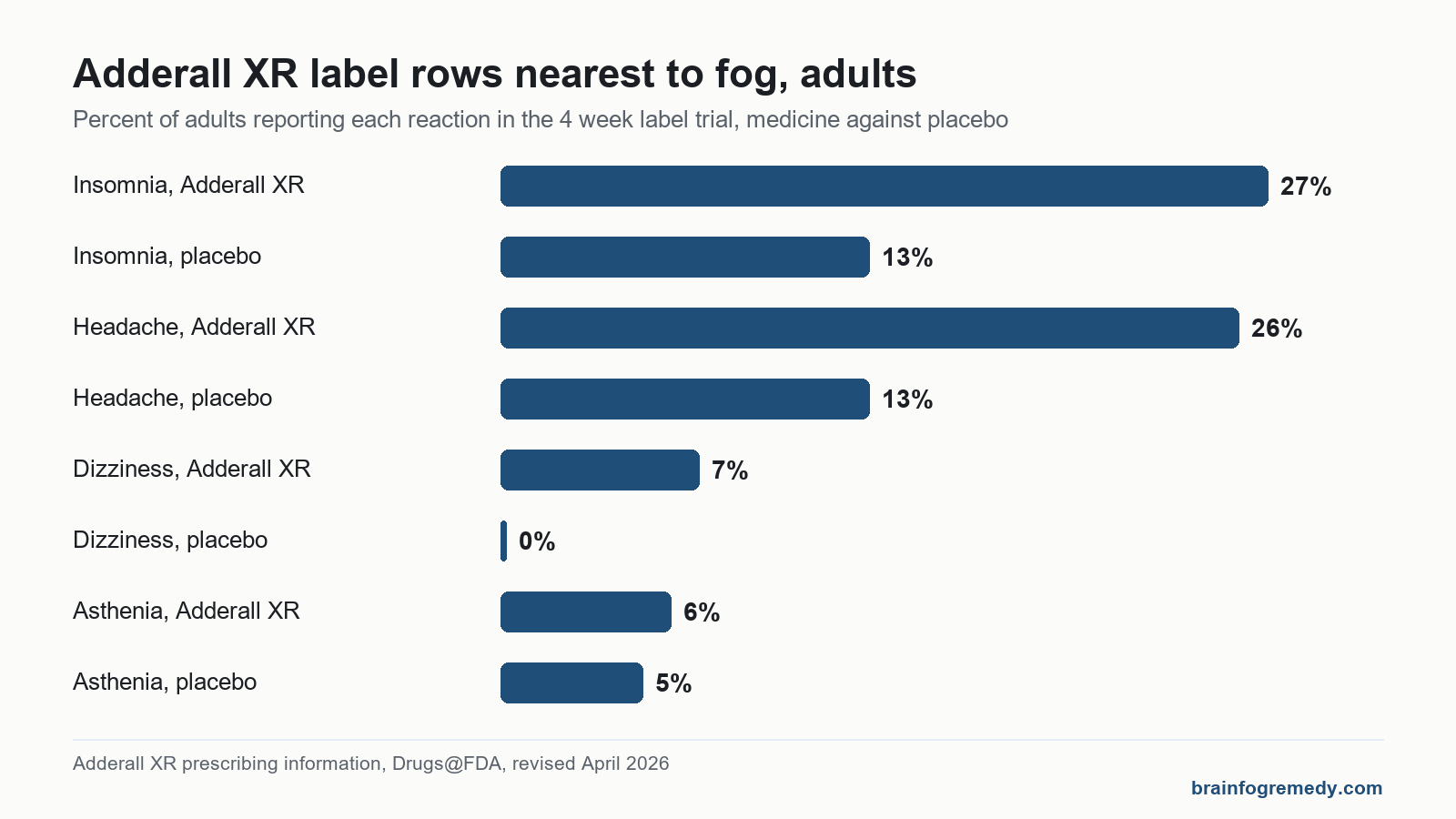
What does the Adderall label list against what people call brain fog?
Fog is a word people use for several different feelings. The table below matches the commonest ones to the nearest thing the label actually says, with the place on the label where each one sits.
| What a person might call fog | What the Adderall XR label says | Where on the label | Source |
|---|---|---|---|
| Bad sleep, then a slow day | Insomnia in 27% of adults against 13% on placebo | Table 3, adult trial | Adderall XR label, April 2026 |
| Tired, weak, no energy | Asthenia in 6% against 5% on placebo | Table 3, adult trial | Adderall XR label, April 2026 |
| Light headed, swimmy | Dizziness in 7% against 0% on placebo | Table 3, adult trial | Adderall XR label, April 2026 |
| Wired and scattered | Anxiety 8% against 5%; agitation 8% against 5% | Table 3, adult trial | Adderall XR label, April 2026 |
| Sleepy in the day | Somnolence, no figure, in the 2 to 4% note | Note under Table 3 | Adderall XR label, April 2026 |
| Flat, slowed, worn out after stopping | Dysphoric mood, depression, fatigue, psychomotor retardation | Section 9.3, withdrawal after abrupt stop | Adderall XR label, April 2026 |
| Brain fog, by that name | Not used anywhere | Whole label | Adderall XR label, April 2026 |

The same picture shows up in reports sent to the FDA. These are not trial results, and they cannot say how often anything happens, but they show which words people reach for.
| Reaction term in reports naming Adderall | Reports |
|---|---|
| Drug ineffective | 4,743 |
| Fatigue | 3,231 |
| Depression | 2,133 |
| Feeling abnormal | 2,015 |
| Somnolence | 1,717 |
| Insomnia | 1,626 |
| Memory impairment | 893 |
| Disturbance in attention | 885 |
| Confusional state | 514 |
Why can Adderall feel foggy as it wears off?
Timing is the part most pages skip. The label says Adderall XR reaches its peak level in the blood at about 7 hours, about 4 hours later than immediate release Adderall, which peaks at about 3. The mean half life of dextroamphetamine in adults is 10 hours, meaning half of a peak level is still in the blood 10 hours later. That is why the label warns against afternoon doses, and it is one plausible route from a pill to short sleep to a foggy next day.
The other route is the wear off itself. A review of adult ADHD treatment on PubMed Central describes a behavioural rebound as the effects of a short acting stimulant fade, and suggests some insomnia may follow from that rebound rather than from the drug in the blood. No study found for this page put a figure on how often adults get it, so it is a described pattern, not a measured rate.

Stopping is different again. Section 9.3 of the label lists what can follow an abrupt stop or a large dose cut after long use: dysphoric mood, depression, fatigue, vivid unpleasant dreams, insomnia or oversleeping, increased appetite, and psychomotor retardation, which means slowed movement and thinking. The MedlinePlus page on dextroamphetamine and amphetamine, last revised 15 July 2025, says not to stop taking it without talking to your doctor, who will probably lower the dose gradually.
Does Adderall clear brain fog in people without ADHD?
The trials in healthy people say: much less than people expect. In a placebo controlled crossover trial by Ilieva, Boland and Farah in Neuropharmacology, 2013, mixed amphetamine salts did not enhance any of 13 cognitive abilities for the group as a whole. Some lower scoring participants gained on a few tasks. Yet participants believed their performance was more enhanced on the active capsule than on placebo.
A smaller pilot by Weyandt and colleagues in Pharmacy, June 2018 gave 13 college students without ADHD 30 mg of Adderall or placebo. One attention measure improved, reading comprehension did not, and a working memory test, digit span forward, got worse. The drug raised mood, heart rate and blood pressure more than it moved any thinking score. The authors say the small sample means the results should be read cautiously.
Sleep may be where the cost lands. In a University of California, Irvine study reported in August 2019, 43 healthy young adults took 20 mg of dextroamphetamine, one of Adderall’s two active parts, or placebo at 9 in the morning. The stimulant gave a small attention gain 75 minutes later, cut total sleep that night, and left working memory worse than placebo 24 hours on. None of these studies tested people with ADHD, where the medicine is approved and the picture is different. If fog is the problem in someone without a diagnosis, the usual causes of brain fog are a better first question than a stimulant, and taking one that was not prescribed is the misuse the label’s boxed warning is about.
What do people taking Adderall report about brain fog?
Five threads were read for this page, posted on Reddit between November 2025 and October 2026, in which 14 people described their own thinking on or off a stimulant. These are accounts, not findings, and nothing in them tells a reader what is happening to them.
The most specific came in an October 2026 thread in r/ADHD. The poster said 10 mg of generic extended release raised their anxiety for about 8 hours with no gain in attention, while 5 mg of immediate release taken twice, 4 hours apart, left them clearer, and that the result held over several repeats. One reply blamed the fillers in generic versions. Another pushed back, saying the fillers are mostly the same and that expectation may play a part. Nobody in the thread could test either idea.
A January 2026 thread in r/ADHD described a three step pattern on the extended release form: it kicks in, it feels good, then fatigue and low mood follow a few hours later, with irritability and wanting to avoid people. Of the replies, one person said switching from extended to immediate release changed things for them, another suggested the dose or the medicine might not suit, and another said to talk to the doctor. In an April 2026 thread in r/ADHDmeds someone who had tried five stimulants said all of them made them foggier and worse at finding words, with Adderall XR leaving them zoned out. Others replied that their fog was mostly on extended release forms, and one said immediate release Adderall left them making more mistakes at work.
Two accounts cut against the idea that the pill is the cause. In a September 2026 thread in r/adhdwomen the poster said Adderall was not touching their fog or constant tiredness; a sleep study later found obstructive sleep apnea, and another commenter on a different stimulant asked how to get tested for the same reasons. And in a November 2025 thread in r/Adulting, from an account since deleted, someone who first took the drug without a prescription and later misused it described fog on every day they skipped it. The replies split between calling it dependence and urging a doctor and a slow, supervised taper.
Where the accounts match the label: poor sleep and tiredness come up again and again, and the worst hours cluster late in the dose. Where they go beyond it: extended against immediate release, and brand against generic, which the label does not compare. Where the label speaks and the threads echo it: fog when the drug is missed after long use, which section 9.3 covers.
What should you tell the prescriber about Adderall brain fog?
The MedlinePlus page lists confusion, agitation and depression among the effects that need a call to the doctor straight away or emergency care. It also says the medicine may make it hard to do things that need alertness and not to drive until you know how it affects you. Nothing on this page is a reason to change a dose or a schedule on your own.
What makes the appointment useful is detail. Say when the fog arrives in hours after the dose, because a mid afternoon slump and a foggy morning after short sleep point in different directions. Say how you are sleeping and what time the dose goes in, since insomnia is the label’s largest nervous system row and brain fog from lack of sleep can look like anything else. Say whether the pills are extended or immediate release and which maker is printed on the pharmacy label, since the threads above argue about both. Mention caffeine, because too much caffeine stacks on a stimulant. And if ADHD itself is part of the picture, ADHD brain fog covers what the condition does on its own. Other medicines that act on the brain carry their own labels too, such as what the Wellbutrin label lists and the Zoloft label rows nearest to fog, which helps if more than one medicine changed at once.
In May 2023 the FDA said it would require every prescription stimulant label to describe the risks of misuse, abuse, addiction and overdose the same way. That boxed warning now opens the Adderall XR label, and it is the reason a prescriber may ask more questions about any change than a reader expects.
What to note before the prescriber appointment
Tick each one once you have written it down. This list sorts nothing and suggests no change to any dose or schedule; it only helps the conversation start with detail.
Confusion, agitation or low mood that worries you is a reason to call the prescriber straight away, not to wait for the appointment.
Frequently asked questions
Is Adderall brain fog a listed side effect?
No. The label never uses the phrase. Its nearest rows are insomnia at 27 percent against 13 percent on placebo in adults, asthenia at 6 against 5, and somnolence in a note covering reactions seen in 2 to 4 percent.
Why do I feel foggy the morning after taking Adderall?
The label cannot say for any one person. It does say Adderall XR peaks at about 7 hours, that dextroamphetamine has a mean half life of 10 hours in adults, and that afternoon doses should be avoided because of insomnia.
Is extended release Adderall foggier than immediate release?
No trial on this page compared them for fog. Several Reddit posters report feeling clearer on immediate release, while others do well on extended release. That is a question for the prescriber, not a page.
Does Adderall improve memory in healthy people?
The trials found little. Ilieva and colleagues in 2013 found no group gain across 13 abilities, and a 2018 pilot in 13 students found one working memory test got worse, though attention improved slightly.
Can stopping Adderall cause brain fog?
The label lists fatigue, depression, dysphoric mood and psychomotor retardation among signs after an abrupt stop or large dose cut following long use. MedlinePlus says not to stop without talking to your doctor.
Can I drive if Adderall makes me foggy?
MedlinePlus says the medicine may make it hard to do things that need alertness and not to drive a car or operate machinery until you know how it affects you.
Finished the page? The same five questions from the top, to see what stuck.
This article is general information, not medical advice, and is not a substitute for care from a qualified healthcare professional. Speak to your doctor about your own situation.
Leave a Reply