
A fuzzy head is the sensation of thinking through something thick. Words arrive late, attention slides off what you are reading, and the world feels slightly muffled. It is not a diagnosis and no routine test measures it, which is part of why it gets waved away. The feeling is real. The vocabulary for it is the problem.
Listen to this article, about 11 minutes. A synthetic voice reads the article and announces each section title as it begins; tables are read row by row and the questions at the end are left out.
Recorded 25 September 2026 from the article as published that day. Press a chapter to jump there; the highlighted line is what is playing. A play button sits beside every section heading, and once you scroll past this player a bar at the bottom of the screen keeps the controls in reach. Tap or click any sentence to hear the reading start from there.
On this page: the five words 132 people with brain fog chose most often, a glossary of what fuzzy, lightheaded and off balance mean in a consultation, why 52 percent of patients change their own description within six minutes, and what to write down before an appointment.
Think you already know this? Five questions, one minute.
Every answer is on this page. Answer from what you know now; the page fills in the rest.
-
1. In the 2013 study of 132 people with postural tachycardia syndrome who reported brain fog, which descriptor was chosen most often?
Forgetful was chosen by 91 percent, ahead of difficulty thinking at 89 percent, per Ross and colleagues in Clinical Autonomic Research. Read the section
-
2. How does the NICE guideline on the long term effects of COVID treat the phrase brain fog?
NICE guideline NG188 lists cognitive impairment as a symptom and records brain fog as the patients’ word for it, which is the status the phrase has almost everywhere. Read the section
-
3. When 872 emergency patients with dizziness were asked to pick the single best description of it, what share picked a different one on retest about six minutes later?
That is the finding of Newman-Toker and colleagues, 2007, a study of dizziness rather than fog, used here only to show how normal it is to fail to name a sensation cleanly. Read the section
-
4. Across 67 countries, what range of average primary care consultation length did the 2017 BMJ Open review find?
Irving and colleagues pooled 178 studies covering more than 28 million consultations, from 48 seconds in Bangladesh to 22.5 minutes in Sweden. Read the section
-
5. Among US adults aged 45 and over who reported worsening confusion or memory loss in 2015 and 2016, what share had talked to a health professional about it?
That figure is the baseline for Healthy People 2030 objective DIA-03, whose target for the decade is 50.4 percent. Read the section
What does a fuzzy head actually feel like?
It is rarely dramatic, which is the first difficulty. You read a paragraph, reach the end of it, and realise none of it went in. You walk into the kitchen and stand there waiting for the reason to come back. Somebody says your colleague’s name and you know the name, you have known it for years, and it simply will not arrive. There is a half second delay between hearing a sentence and understanding it, and in that half second you have to decide whether to ask them to repeat it.
People reach for weather words for this, and it is not an accident. Cloudy. Foggy. Fuzzy. Woolly. What all of those describe is a change in the medium rather than in the content. The thoughts are still there. Getting to them costs more than it used to. A longer description of the experience, including how it typically shifts across a day, is in our piece on what brain fog actually feels like from the inside.
It is also worth saying what it is not. Most people describing a fuzzy head are not describing sleepiness, although the two can arrive together, and they are not describing sadness, although that can arrive together too. The complaint is about effort. Things that used to be automatic have started to require attention.


Why does a fuzzy head sound so vague to everybody else?
Because it is a description of an absence, and absences are hard to report. Pain has a location and a scale. A rash can be photographed. A fuzzy head has neither a place nor a number, and the very faculty you would use to describe it precisely is the one that is not working properly.
Then there is the status of the phrase itself. Brain fog is a patient word. It was not coined in a clinic and it does not appear as a diagnosis in the formal classification systems doctors code against. It has migrated upward into clinical documents over the last few years, usually in quotation marks and usually as a gloss on something else. NICE’s guidance on the long term effects of COVID lists cognitive impairment as a symptom and puts brain fog alongside it as the term patients use. That is roughly the status it has everywhere: recognised as a real report, not treated as a finding. Our explainer on what the phrase brain fog actually means goes through where it came from.
Which words do people actually reach for?
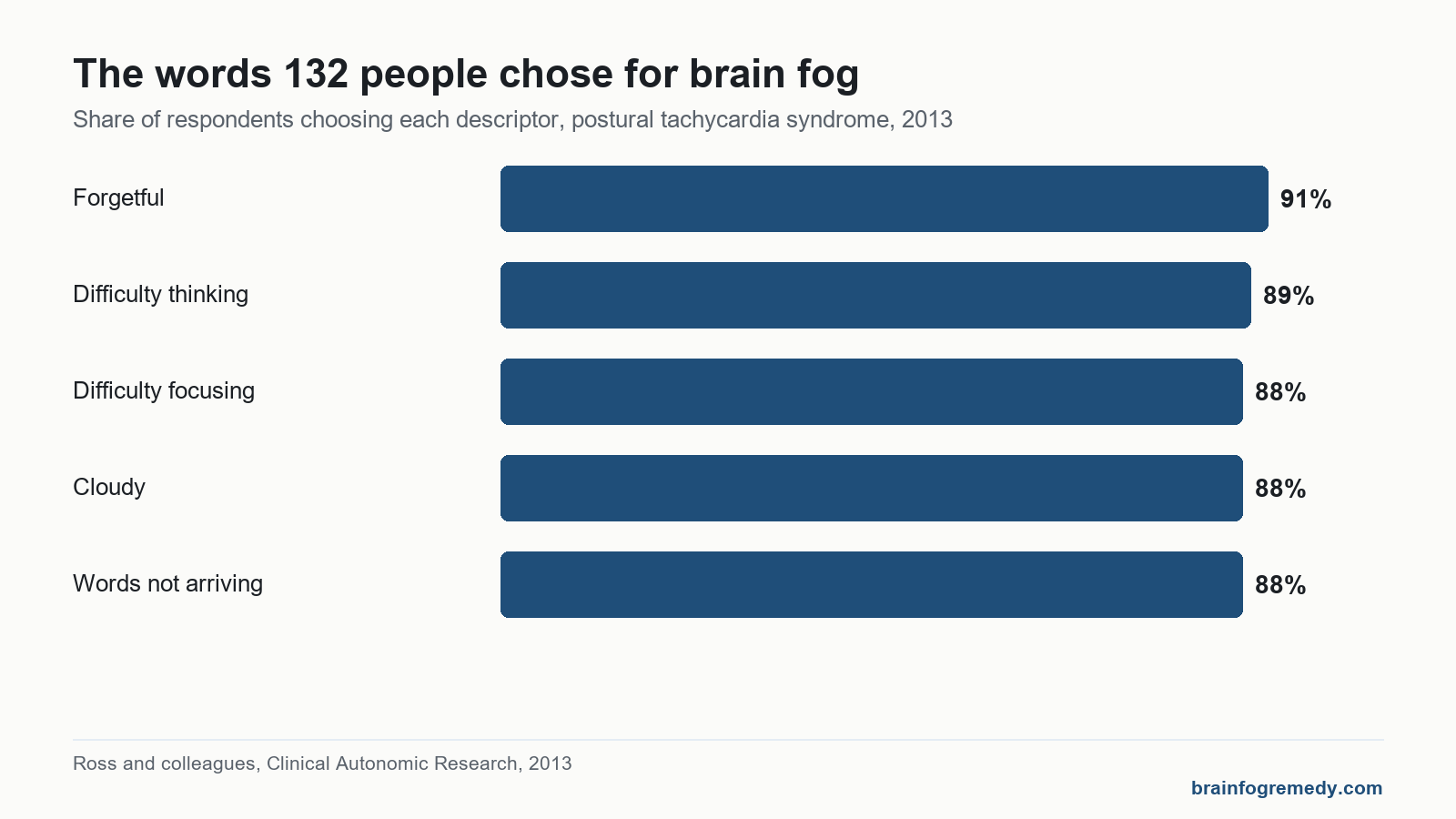
There is one study that asked directly. Ross and colleagues, publishing in Clinical Autonomic Research in 2013, gave a 38 item questionnaire to 138 people with postural tachycardia syndrome, aged 14 to 29 and 88 percent female. Of those, 132 said they experienced brain fog, and the researchers recorded which descriptors they chose.
| Descriptor chosen | Share of respondents |
|---|---|
| Forgetful | 91 percent |
| Difficulty thinking | 89 percent |
| Difficulty focusing | 88 percent |
| Cloudy | 88 percent |
| Difficulty finding words or communicating | 88 percent |
Two things are worth taking from that and one thing is worth refusing. Take the consistency: nearly nine in ten people landed on the same handful of words without coordinating. Take the shape of those words, which cluster around retrieval and effort rather than around mood. Refuse the temptation to read the percentages as general population figures. This was a young, mostly female group with one specific diagnosed condition, recruited through that community. The vocabulary travels further than the numbers do.
Is a fuzzy head the same as feeling dizzy or lightheaded?
Not usually, and this is where the choice of word does the most damage. Several quite different sensations get bundled into the same everyday phrases. The table below is a glossary of how the words are conventionally used, not a way of working out which one applies to you or what is behind it.
| Everyday phrase | How it is conventionally used clinically | What people often mean by it |
|---|---|---|
| Fuzzy head, brain fog | No standard clinical definition. Usually recorded as cognitive symptoms | Slowness, effort, muffled thinking, words not arriving |
| Lightheaded | A sense of being faint or about to pass out | Often just the fuzzy feeling, with no faintness involved |
| Vertigo | A false sense of movement, usually spinning | Frequently used for any dizziness at all |
| Off balance | Unsteadiness while standing or walking | Sometimes a mental unsteadiness rather than a physical one |
| Fatigue | Reduced capacity for effort, physical or mental | Sometimes tiredness, sometimes the fog, sometimes both |
If you have ever failed to pick the right word from a list like that, you are in overwhelming company. In 2007 Newman-Toker and colleagues interviewed patients arriving at two emergency departments with dizziness, 872 of them, and asked about symptom quality in four different formats. When asked to choose the single best description, 52 percent picked a different one on retest about six minutes later, and 54 percent left out a type they had volunteered moments earlier. The authors concluded that descriptions of symptom quality are unclear, inconsistent and unreliable. That was a study of dizziness rather than of fog, so read it as an illustration rather than as evidence about brain fog specifically. The illustration still holds: being unable to name a sensation cleanly is normal, and it is a well documented feature of how people report internal states.
Why does the word you pick change what happens next?
Because the conversation branches on it. Say lightheaded and one line of questioning opens. Say forgetful and a different one does. Say tired and you may get a conversation about sleep and stress that never reaches the thing you came in about. None of that is anybody acting in bad faith. It is what happens when a short appointment has to be steered from a single opening sentence.
And the appointments are short. A 2017 systematic review in BMJ Open by Irving and colleagues pooled 178 studies covering more than 28.5 million consultations across 67 countries, and found average primary care consultation length ranging from 48 seconds in Bangladesh to 22.5 minutes in Sweden. Wherever you sit in that range, the first thing you say carries a disproportionate amount of weight.
What tends to work better than hunting for the correct label is describing the change and an example of it. When it started, what you can no longer do that you could before, and one concrete instance from the past week. A sentence like “since about March I have been rereading the same work emails three times and I lost the thread halfway through a meeting on Tuesday” carries more information than any single adjective. If the fog arrives alongside exhaustion, our article on what the fatigue and fog combination means covers how those two get reported together.
Before you describe a fuzzy head to a doctor
The page argues that describing the change beats hunting for the right adjective. Tick each item once you have written it down, so the first sentence of the appointment carries the most information.
A list of what to say, not a way of working out what is causing it. Ticks are saved on this device only.
Why do so many people never mention it at all?
Silence is the norm rather than the exception here. The CDC’s Behavioral Risk Factor Surveillance System asks adults aged 45 and over whether they have had confusion or memory loss that is happening more often or getting worse. Among those who said yes in 2015 and 2016, 45.4 percent had talked to a health professional about it. That figure is the baseline for a national objective under Healthy People 2030, whose target for the decade is 50.4 percent, which tells you how entrenched the silence is thought to be. The same silence shows up among people with depression, as our page on how a foggy head can outlast the low mood of depression sets out with the survey figures by age.
The reasons people give are recognisable. Fear of what it might mean. An expectation of being told it is stress, or age, or a phase. A previous appointment where it went badly. And, running under all of them, not having a way to say it that sounds like a symptom rather than a complaint about modern life. None of that is a reason to keep it to yourself. A persistent change in how clearly you think is a legitimate thing to bring to a doctor, and finding the right words for it is their job as much as yours. Where the fuzziness comes with a physical weight or pressure, the published red flags for a head that feels heavy as well as foggy are worth reading before you book.
What is actually known about this, and what is not?
Honesty is more useful here than confidence. What is reasonably well established is that people with very different underlying conditions describe this sensation in strikingly similar language, and that the description clusters around retrieval, focus and effort. What is not established is almost everything else.
There is no agreed definition of brain fog and no validated bedside measure of it. It is not clear whether it is one phenomenon or several unrelated ones wearing the same word. Sources disagree on what it even is: the 2013 study above concluded that brain fog is a cognitive complaint closely resembling mental fatigue, while other researchers treat it primarily as a problem of attention and working memory, which is not the same claim. Neither camp has settled it.
This matters commercially, because the pages that promise certainty are usually the ones selling something. If a site names your cause in a headline and offers a capsule that fixes it, treat the confidence itself as the warning sign. A supplement manufacturer’s own page is weak evidence about its own product, whatever the citation count at the bottom. What the honest literature says is that the causes are plural and that ruling things in or out is a clinical job. We go through the ground that gets covered in the eight causes worth checking first, and the single best documented contributor has its own piece in brain fog from lack of sleep.
Meanwhile the fuzzy head feeling stays exactly as real as it was before anybody managed to define it. The words being imprecise is a fact about the words.
Frequently asked questions
Is a fuzzy head feeling the same thing as brain fog?
In everyday use they refer to the same experience. Fuzzy head is the sensation people describe, and brain fog is the label that has attached itself to that description. Neither is a formal diagnosis, so no clinical distinction rests on which one you use.
Is fuzzy head a medical term?
No. It is a patient description that has been adopted into clinical writing rather than the other way round. Doctors tend to record what it maps onto, such as cognitive symptoms, difficulty concentrating or subjective memory complaints, and note the patient’s own wording alongside it.
Why do tests come back normal when my head feels fuzzy?
Standard blood work and brief in clinic cognitive screens were designed to detect specific abnormalities and are not sensitive to the effortfulness people describe. A normal result means those particular things were not found. It is not a verdict that nothing is happening, and it is worth saying so out loud at the appointment.
Does calling it fuzzy make doctors take it less seriously?
The word itself is not the problem so much as the absence of detail around it. Research on how patients describe dizziness has shown that symptom quality words are inconsistent even minutes apart, which is why clinicians increasingly ask about timing, triggers and what has changed rather than leaning on the adjective.
How long does a fuzzy head feeling usually last?
There are no reliable figures, because it is not tracked as a distinct condition with a defined course. Reported experiences run from a single afternoon to something that persists for months. Anyone quoting a typical duration is extrapolating well beyond the evidence.
Is it worth seeing a doctor about a fuzzy head?
A change in thinking that persists, gets worse, or interferes with work or daily life is a reasonable thing to raise, and doing so does not require you to have named it correctly first. Anything sudden, or arriving with symptoms such as weakness, difficulty speaking, confusion or a severe headache, is treated as urgent rather than as something to watch.
Finished the page? The same five questions from the top, to see what stuck.
This article is general information, not medical advice, and is not a substitute for care from a qualified healthcare professional. Speak to your doctor about your own situation.
Leave a Reply