Anxiety fatigue is the exhaustion that comes with long spells of anxiety, and it is common: being easily fatigued is one of the listed symptoms of generalised anxiety disorder. Studies point mainly to broken sleep, which anxiety and insomnia each make worse, plus the effort of constant vigilance. The cortisol story is far less tidy than most pages claim.
Listen to this article, about 11 minutes. A synthetic voice reads the article and announces each section title as it begins; tables are read row by row and the questions at the end are left out.
Recorded 4 October 2026 from the article as published that day. Press a chapter to jump there; the highlighted line is what is playing. A play button sits beside every section heading, and once you scroll past this player a bar at the bottom of the screen keeps the controls in reach. Tap or click any sentence to hear the reading start from there.
On this page: five cited findings on how anxiety and poor sleep feed each other, with sample sizes, the cortisol result that contradicts the usual story, and a sleep and worry diary to take to a GP.
Think you already know this? Five questions, one minute.
Every answer is on this page. Answer from what you know now; the page fills in the rest.
-
1. In the 2025 meta-analysis of five studies, what share of people with generalised anxiety disorder had sleep disturbance?
The Journal of Psychosomatic Research meta-analysis pooled 5,875 people at 72%, with a 95% interval from 28% to 99%. Read the section
-
2. In the Swedish study by Jansson-Fröjmark and Lindblom, how much higher were the odds of new insomnia with high anxiety?
The 2008 study found an odds ratio of 4.27 for anxiety leading to new insomnia, and 2.30 for the reverse. Read the section
-
3. What did the 2017 meta-analysis find for women with a current anxiety disorder facing a stress task?
The Psychoneuroendocrinology meta-analysis found a blunted response in women with anxiety disorders and a raised one in men with social anxiety. Read the section
-
4. According to attentional control theory, as described on this page, what does anxiety cost more than accuracy?
The theory holds that people keep performance up by trying harder, so the cost shows up as effort and tiredness. The studies are set out in our anxiety and brain fog page. Read the section
-
5. In the 2021 meta-analysis of 65 trials, what happened to anxiety when sleep improved?
Scott and colleagues found a medium sized fall in anxiety (g = 0.51), larger where sleep improved more. Read the section
Most of the pages ranking for this phrase belong to online therapy services, and they tend to say the same three things: stress hormones, adrenaline, see a therapist. That last part is reasonable. What they skip is the actual research, how big the effects are, and where it contradicts the neat version. This page puts the numbers in, with every study linked, and is honest about the gaps. If the foggy thinking is the part that bothers you most, our companion piece on whether anxiety can cause brain fog covers the memory and concentration side in detail.
Why does anxiety make you so tired?
Partly because tiredness is built into how anxiety is defined. The US National Institute of Mental Health lists trouble falling or staying asleep, feeling fatigued, and aches or muscle tension among the signs of generalised anxiety disorder, and the NHS describes the condition as anxiety about a wide range of things that lasts, rather than about one event. Exhaustion is not a side issue in that picture. It is on the list.
How common is it? A systematic review published in BMC Psychiatry in 2026 pulled together 46 papers on fatigue across common mental health conditions, anxiety disorders among them, and found prevalence anywhere from 18% to 100% depending on the study and how fatigue was measured. That range is too wide to quote a single figure, and the authors’ own conclusion is the useful part: fatigue turns up across so many conditions that they treat it as a shared symptom rather than a marker of any one of them. So feeling wiped out tells nobody, including you, what is behind it.
Sleep is the most measured route. A 2025 meta-analysis in the Journal of Psychosomatic Research pooled five studies covering 5,875 people with generalised anxiety disorder and put the prevalence of sleep disturbance at 72%. Look at the uncertainty around that figure, though: the 95% interval runs from 28% to 99%, because the five studies disagreed a lot. “Most people with GAD sleep badly” is fair. “Exactly 72%” is not.
How do anxiety and poor sleep feed each other?
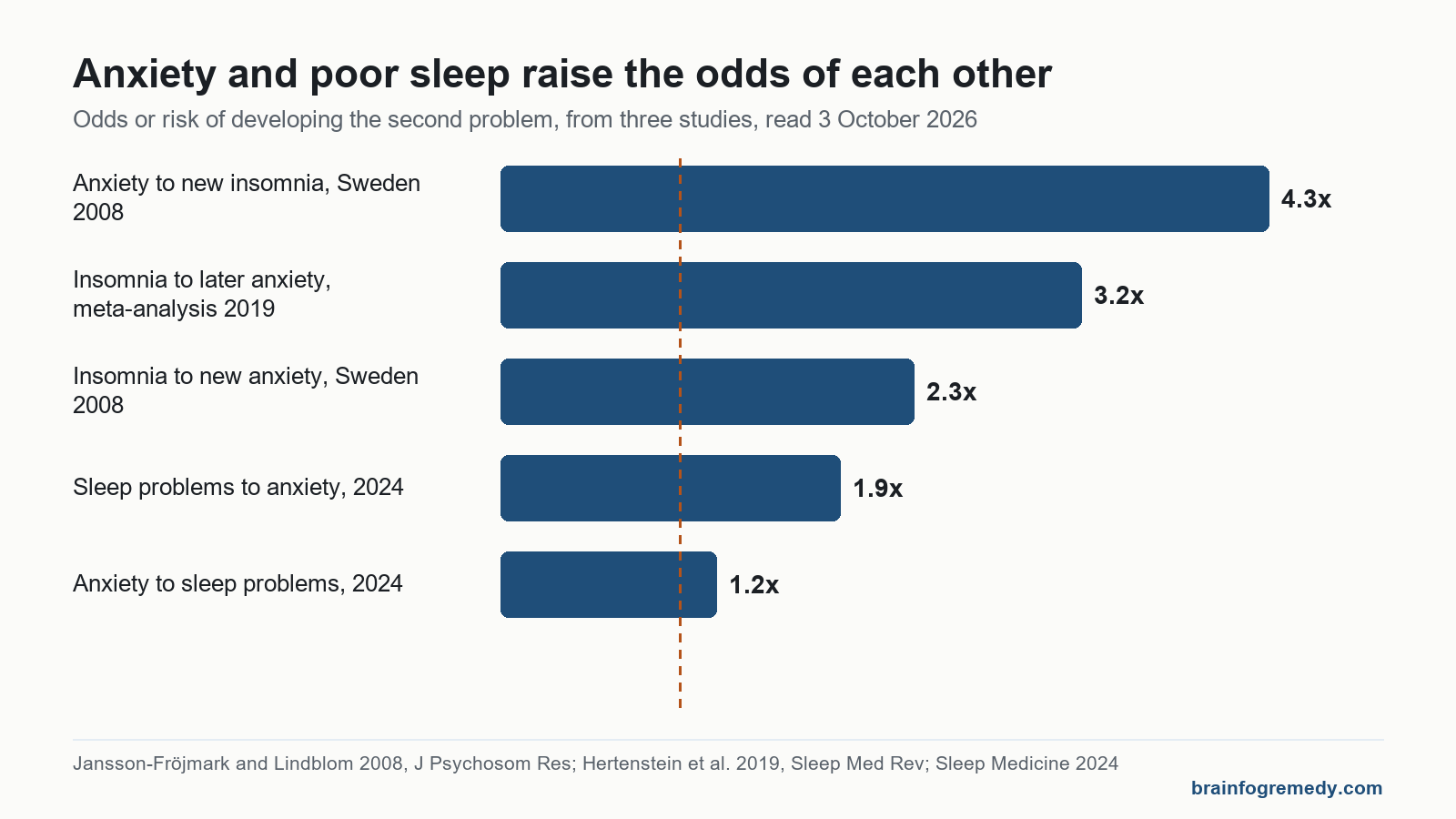
In both directions, and this is the best supported part of the whole topic. Researchers test it by measuring anxiety and sleep at one point, then checking who develops the other problem later. The answer keeps coming back as a loop rather than a one way street.
| Study | Who was followed | Direction tested | What it found |
|---|---|---|---|
| Jansson-Fröjmark and Lindblom, 2008 | 1,812 Swedish adults at baseline, 1,498 a year later | Anxiety, then new insomnia | Odds of new insomnia 4.27 times higher with high anxiety |
| Same study | Same group | Insomnia, then new high anxiety | Odds 2.30 times higher |
| Hertenstein and colleagues, 2019 | 13 studies, 181,798 people; 6 studies for anxiety | Insomnia, then later anxiety | Odds 3.23 times higher (95% range 1.52 to 6.85) |
| Sleep Medicine, 2024 | Middle aged and older adults in the community | Sleep disturbance, then anxiety | Risk 1.89 times higher |
| Same study | Same group | Anxiety, then sleep disturbance | Risk 1.20 times higher |
The interesting disagreement is about which half of the loop is stronger. The Swedish study found anxiety predicting new insomnia more strongly than the reverse, 4.27 against 2.30. The 2024 study in older adults found the opposite, 1.89 for sleep problems leading to anxiety against 1.20 the other way. Different ages, countries and questionnaires probably explain a lot of that, and nobody has settled it. What both agree on is the part that matters to someone lying awake at 3am: each problem raises the odds of the other.

Sleep studies in the lab back up the self reports. A meta-analysis of polysomnography research in Psychological Bulletin, the kind of study where people sleep wired to sensors, found that anxiety disorders, like several other mental health conditions, showed changes in how deep sleep was and in REM sleep, and concluded that a broad sleep disturbance is shared across many disorders rather than being unique to one. Our page on what lost sleep does to thinking covers the next step in that chain.
Is cortisol really the reason anxiety is exhausting?
Plenty of pages say so, as though the case were closed. The research is messier. A 2017 meta-analysis in Psychoneuroendocrinology pulled together studies of cortisol responses to a stressful task across psychiatric conditions. For anxiety disorders it had 9 studies and 732 people, and the result split by sex: women with a current anxiety disorder showed a blunted cortisol response, while men with social anxiety showed a raised one. “Anxiety floods you with cortisol until you are exhausted” does not survive contact with that finding.
The nervous system side is more consistent. A 2014 meta-analysis in Frontiers in Psychiatry found that people with anxiety disorders have lower heart rate variability than people without, a small to moderate difference (Hedges’ g of 0.29 to 0.45 depending on the measure). Lower variability is read as the calming, vagal branch of the nervous system doing less of the braking. It fits the idea of a body that stays switched on, but it is a correlation, and no study has shown that this is what makes people feel tired.
So the honest summary is that sustained arousal is real and measurable, sleep loss is real and measurable, and the link from either to the feeling of exhaustion is plausible but not proven step by step. Anyone who tells you the precise hormone responsible is ahead of the evidence, and anyone selling a supplement to fix that hormone is further ahead still.
Why does anxious tiredness hit thinking so hard?
Because worry uses the same limited attention that thinking needs. The leading account, attentional control theory, holds that anxiety costs effort more than it costs accuracy: people keep their performance up by trying harder, and pay for it in tiredness. Our anxiety and brain fog page sets out those studies and their effect sizes. Add a short night on top and the same task costs more again. The lab studies behind that idea, including the Paris experiment that tracked a brain chemical across a working day, are explained in our walk through the cognitive fatigue research.

That is also why anxious tiredness can feel different from the tiredness after a long walk. People often describe it as being wired and drained at once: too alert to rest, too spent to concentrate. It overlaps heavily with what we describe in what being mentally tired means and with the longer stress picture in our page on nervous exhaustion. Physical aches and muscle tension are on the NIMH symptom list too, though they have had far less study as a cause of fatigue than sleep has.
What does the evidence say helps with anxiety fatigue?
The sleep half of the loop has the strongest trial evidence. A meta-analysis of randomised trials by Scott and colleagues in Sleep Medicine Reviews, 2021 looked at 65 trials with 8,608 participants in which an intervention improved sleep, and asked what happened to mental health. Anxiety fell by a medium sized amount (g = 0.51), and the bigger the improvement in sleep, the bigger the drop. The trials varied a lot, so the size is an average across very different studies, but the direction was consistent.
For anxiety itself, the UK guideline is NICE guidance CG113, which sets out a stepped approach for generalised anxiety disorder: information and monitoring first, then low intensity psychological help such as guided self help, and then, if that has not been enough, a choice of cognitive behavioural therapy, applied relaxation or medication. Which step fits whom is a conversation with a GP or a therapist, not something a website can decide. What the guideline does not include is a supplement, a detox or a six question online quiz, which is a useful filter for the advertising that follows this search around.
Fatigue is rarely a trial’s main outcome in anxiety research, so there is little direct evidence on what lifts the tiredness itself. The reasonable reading is indirect: in those trials, when sleep improved, anxiety tended to improve with it. A sleep and worry diary, like the one on this page, gives a clinician something concrete to look at instead of “I am tired all the time”.
Sleep and worry diary
A plain record to show a GP or therapist how sleep, worry and tiredness move together over a few weeks. It does not score, interpret or diagnose anything.
Entries stay on this device and are not sent anywhere. Only a clinician can assess what is behind tiredness or anxiety.
When is tiredness with anxiety worth a GP appointment?
When it has gone on for weeks, or it is getting in the way of work or home life. The NHS advises seeing a GP if you have felt tired for several weeks with no obvious reason. Tiredness and anxiety can both come from conditions that are easy to miss when stress seems to explain everything, including anaemia, thyroid problems, diabetes and sleep apnoea, and those are usually checked with simple blood tests or questions. Our guide to extreme fatigue with brain fog walks through what a GP is likely to ask.
Anxiety itself is treatable, and needing help with it is common, not a failure. If anxiety comes with low mood, hopelessness or thoughts of self harm, speak to a doctor now, or in the UK call 999 or Samaritans on 116 123, rather than waiting for a routine appointment.
Frequently asked questions
Is anxiety fatigue a medical diagnosis?
No. It is an everyday phrase for the tiredness that comes with anxiety. Being easily fatigued is one of the listed symptoms of generalised anxiety disorder, but the fatigue itself is not diagnosed as a separate condition.
Can anxiety make you tired even when you sleep enough?
People often report that it can. The research link is clearest through sleep quality, but sustained vigilance and the extra effort of thinking while worried are also proposed explanations. A doctor can check for other causes of tiredness that sleep would not fix.
Why do I feel exhausted after a panic attack?
A panic attack is an intense burst of physical arousal, and many people describe feeling drained for hours afterwards. Research on the exact reason is limited, so treat any single explanation, hormonal or otherwise, with caution.
Does anxiety fatigue go away when the anxiety improves?
Often it eases, especially when sleep improves too, but there is little research measuring fatigue directly as an outcome. Tiredness that stays after anxiety settles is worth raising with a GP.
How common are sleep problems in generalised anxiety disorder?
Very common, though the exact figure is uncertain. A 2025 meta-analysis of five studies and 5,875 people put it at 72%, with a 95% interval from 28% to 99% because the studies disagreed widely.
Can a blood test show anxiety fatigue?
No test measures it. Blood tests are used to look for other causes of tiredness, such as anaemia or thyroid problems, which is one reason a GP visit is worthwhile.
Finished the page? The same five questions from the top, to see what stuck.
This article is general information, not medical advice, and is not a substitute for care from a qualified healthcare professional. Speak to your doctor about your own situation.
Leave a Reply