
ADHD brain fog is a real and widely reported experience, but it is not a clinical term: the phrase appears nowhere in the DSM-5-TR or ICD-11 criteria for ADHD. The closest research idea, cognitive disengagement syndrome, does describe feeling lost in a fog, yet it is studied as separate from ADHD and is not an official diagnosis.
Listen to this article, about 11 minutes. A synthetic voice reads the article and announces each section title as it begins; tables are read row by row and the questions at the end are left out.
Recorded 27 September 2026 from the article as published that day. Press a chapter to jump there; the highlighted line is what is playing. A play button sits beside every section heading, and once you scroll past this player a bar at the bottom of the screen keeps the controls in reach. Tap or click any sentence to hear the reading start from there.
On this page: a dated check of both diagnostic manuals for the word fog, a table setting ADHD beside the research construct that does use it, and what 34 forum posts reported.
Think you already know this? Five questions, one minute.
Every answer is on this page. Answer from what you know now; the page fills in the rest.
-
1. Under which ICD-11 code does the World Health Organization classify ADHD?
The WHO ICD-11 entry lists ADHD as 6A05. F90.0 is the older ICD-10 style code, and neither version uses the word fog. Read the section
-
2. How many symptoms in a domain does DSM-5 require for someone aged 17 or over?
The AAFP summary of the DSM-5 criteria sets five for ages 17 and over and six below that, alongside onset before 12 and two or more settings. Read the section
-
3. What was sluggish cognitive tempo renamed by the international work group?
The work group report chose cognitive disengagement syndrome and describes it as related to ADHD inattention but distinct, and not yet a recognised diagnosis. Read the section
-
4. Which point raised in the forum threads matches the wording of the diagnostic criteria?
A reply in the menopause and ADHD thread stressed onset before 12, which the DSM-5 criteria require. Forum posts are testimony, not evidence. Read the section
-
5. Who does NICE guideline NG87 say should make a diagnosis of ADHD?
NICE guideline NG87 reserves diagnosis for a specialist with training and expertise in ADHD, against DSM-5 or ICD-11 criteria. Read the section
Is ADHD brain fog a recognised medical term?
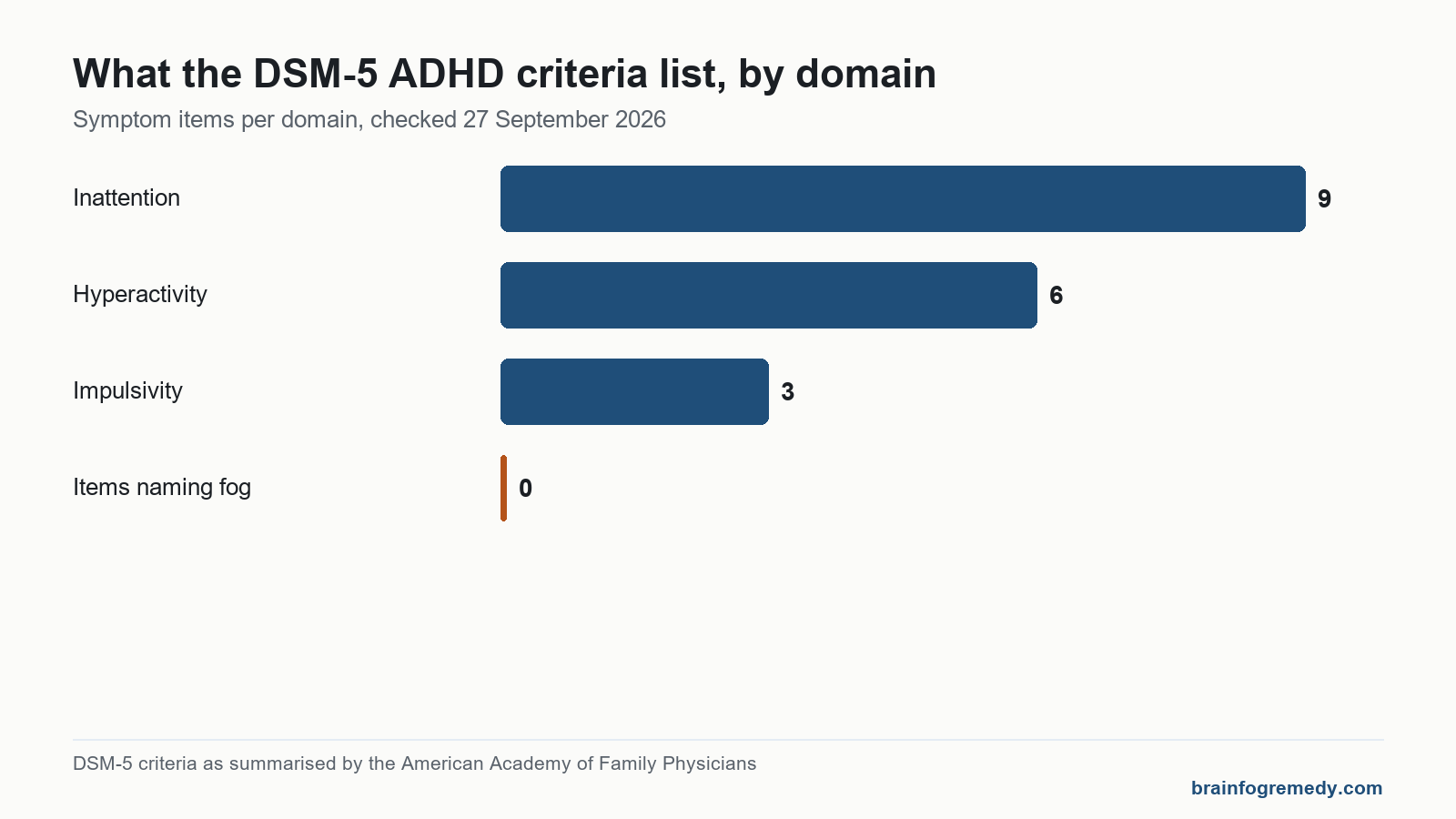
No. This page checked both of the manuals that define ADHD on 27 September 2026, and neither uses the word fog. The American Psychiatric Association’s DSM-5-TR, the 2022 text revision, kept the ADHD criteria of DSM-5 as they were; a 2023 review in Frontiers in Psychiatry went through what changed in the revision and what did not, and the symptom list was in the second pile. The World Health Organization’s ICD-11, under code 6A05, describes a persistent pattern of inattention and/or hyperactivity and impulsivity lasting at least six months. Fog is not in it either.
None of that makes the experience imaginary. Brain fog is an everyday phrase doing a great deal of work for two words, used for anything from long COVID to a bad week, and there is more on what the phrase brain fog usually covers elsewhere on this site. When people with ADHD use it, they are usually pointing at something the criteria do describe, just in more clinical language. The label is informal. The difficulty behind it can be entirely real. Neither fact cancels the other, and most of the pages ranking for this phrase quietly skip the first one.
What do the DSM-5-TR and ICD-11 criteria actually list?
The DSM-5 criteria, summarised in a one page table from the American Academy of Family Physicians, list eighteen symptoms in two domains. Nine are inattention: careless mistakes, trouble sustaining attention, not seeming to listen, not following through, trouble organising, avoiding tasks that need sustained mental effort, losing things, being easily distracted and forgetfulness in daily activities. The other nine are hyperactivity and impulsivity, six and three. The item on listening carries the example that the person’s “mind seems elsewhere”, which is probably the nearest the manual gets to fog.

The count is not the whole test. Adults aged 17 and over need five symptoms in a domain, children six, as the CDC’s clinical guidance also sets out. Several symptoms must have been present before age 12, in two or more settings, for at least six months, and they must interfere with functioning. They must also not be better explained by another condition, such as a mood or anxiety disorder. ICD-11 frames inattention as difficulty sustaining attention to “tasks that do not provide a high level of stimulation or frequent rewards”, which is a sharper description than most blog posts manage. Here is how the formal labels compare with the informal one.
| Label | Who defines it | Official diagnosis? | Does it use the word fog? | What it actually measures |
|---|---|---|---|---|
| ADHD, DSM-5-TR | American Psychiatric Association, summarised by the AAFP | Yes | No | Nine inattention and nine hyperactivity or impulsivity symptoms; five in a domain from age 17, six below it; present before 12, in two or more settings, for six months |
| ADHD, ICD-11 code 6A05 | World Health Organization | Yes | No | A pattern of inattention and/or hyperactivity and impulsivity for at least six months, with evidence before age 12, across several settings |
| Cognitive disengagement syndrome, formerly sluggish cognitive tempo | Researchers; renamed by a 13 member work group | No, a research construct | Yes, rating scale items include appearing lost in a fog | Daydreaming, mental confusion or fogginess, withdrawal, a sleepy appearance, slowed movement |
| Excessive mind wandering | Researchers at King’s College London | No, a 12 item research scale | No | Thoughts that jump about and are hard to switch off, rated by the person themselves |
| Brain fog | Nobody; an everyday phrase | No | It is the word | Whatever the speaker means by it, from a blank head to one that will not stop |
Is cognitive disengagement syndrome the same thing as ADHD brain fog?
It is the closest thing research has, and it is explicitly not ADHD. The construct used to be called sluggish cognitive tempo, a name nobody enjoyed carrying. In a report in the Journal of the American Academy of Child and Adolescent Psychiatry, a 13 member international work group from the United States, Spain and Canada agreed to rename it cognitive disengagement syndrome. Its core symptoms are daydreaming, mental confusion or fogginess, withdrawal and a sleepy appearance, with slowed or underactive behaviour, and the rating scales used to measure it include an item about appearing lost in a fog. So the word does appear in the research literature, just attached to a different construct.
The same report describes the two as related but separable. Symptom ratings correlated at about 0.63 in children and 0.72 in adults, high enough to overlap and low enough to be distinct. Elevated cognitive disengagement symptoms turned up in 25 to 40 per cent of young people with ADHD in the studies it reviewed, and in 46 per cent of adults with ADHD in one adult sample. It is not a recognised diagnosis, and the work group says more research is needed to decide whether it should become one. A separate line of work, the Mind Excessively Wandering Scale from Mowlem and colleagues, measures the opposite texture: a mind that will not stop rather than one that has gone quiet. It is a 12 item research questionnaire, not a diagnostic test.
What do people who describe ADHD brain fog actually report?
Reddit was out of reach for this page, so it read four public Mumsnet threads instead, 34 posts in all, dated March 2022 to October 2025. These are what people report, not findings, and nobody in them was assessed by anyone writing here.
- In a February 2025 thread titled Adult ADHD, the opening poster described staring at jobs, then returning to the sofa, and feeling mentally drained despite doing little, and could not tell whether it was ADHD or depression. A reply in October 2025, from an account describing itself as a coach, drew the line as wanting to act but being unable, against feeling that nothing matters.
- In a March 2022 thread, the poster compared thinking to trying to catch butterflies. Replies proposed ADHD, dyspraxia and autism; one asked about COVID, menopause and deficiencies before any of those.
- In a thread started in November 2023, the poster’s online quiz came back negative and they worried that meant there was no hope. Another poster said it took about a year from suspecting ADHD to a referral, and a third pointed out that assessment needs examples from childhood.
- In a September 2022 thread on menopause and ADHD, with 13 replies, one poster described thyroid, hormone and iron problems each being found over five years. Another stressed that symptoms have to be present before age 12 and suggested looking at menopause first.
The pattern is consistent. Fog was used for a busy head as often as an empty one, and replies reached for ADHD quickly. The cautious replies, the ones asking about childhood, hormones and deficiencies, are the ones that match the criteria, which demand onset before 12 and rule out better explanations. Where the forums and the guidance part company is on self identification and online quizzes, which several posters treated as enough, and which the guidance treats as a starting point at most.

Why does the label matter if the fog feels the same?
Because the label decides what gets looked at. The ADHD criteria require that symptoms are not better explained by something else, and the everyday feeling of fog has plenty of other candidates: short sleep and what it does to thinking, low mood, anxiety, hormonal change and thyroid problems among them. This page cannot say which, if any, applies to a particular person, and neither can a forum thread. The wider list is in the causes worth checking first, and perimenopause brain fog when the tests come back normal covers the midlife overlap the fourth thread kept circling.
A change in thinking that is new in adulthood, is getting worse, or comes with other new symptoms is a reason to see a GP, whatever it is called. That is not what the ADHD criteria describe, since they require a pattern that began in childhood. Some readers arrive already prescribed ADHD medicine; nothing on this page is a reason to start, stop or change it, and questions about it belong with the prescriber.
Which criteria text is closest to the words you would use?
Pick the sentence nearest to how the fog gets described. The result shows which published wording it sits closest to, and nothing more.
This maps words to published criteria text only. It cannot tell anyone whether they have ADHD or anything else; that takes an assessment by a qualified professional.
How is ADHD assessed in adults, and what can an online quiz tell you?
In England, NICE guideline NG87 says a diagnosis should be made only by a specialist psychiatrist, paediatrician or other appropriately qualified professional with training in ADHD. It requires the criteria of DSM-5 or ICD-11 to be met, with at least moderate psychological, social or educational impairment. The matching NICE quality standard says adults with symptoms who were not diagnosed as children are referred to an ADHD specialist for assessment.
An online quiz can tell someone that a conversation with a GP might be worthwhile. It cannot do the rest. A quiz that hands out a diagnosis in six questions has skipped age twelve, the second setting, the interference with daily life and every other explanation, which is most of the test. The same applies, with feeling, to anything sold as a focus stack by Friday.
Frequently asked questions
Is sluggish cognitive tempo just another name for inattentive ADHD?
No. The 2023 work group that renamed it cognitive disengagement syndrome describes it as related to ADHD inattention but empirically distinct, with symptom correlations of about 0.63 in children and 0.72 in adults. Many people have one without the other.
Can an online ADHD test say whether fog is ADHD?
No. A screening questionnaire can suggest that an assessment might be worth asking about. NICE guideline NG87 says a diagnosis is made by a specialist with training in ADHD, against the DSM-5 or ICD-11 criteria, including evidence from childhood.
Why do adults need fewer symptoms than children?
DSM-5 set the threshold at five symptoms in a domain from age 17 and six below it. The symptom list itself is the same eighteen items at every age, and the examples attached to several of them mention adult settings such as paying bills and keeping appointments.
Does ADHD have to begin in childhood?
Both manuals require evidence of symptoms before age 12. ICD-11 notes that some people only come to clinical attention later, which is why adult assessments ask about school years and commonly ask for accounts from someone who knew the person then.
Is menopause brain fog the same thing as ADHD brain fog?
They are separate questions, although forum threads often mix them. Menopause is a change in midlife; the ADHD criteria describe a pattern that began before age 12. Which applies to a particular person is a question for a clinician.
Why does this page not recommend supplements for ADHD brain fog?
Because this site does not recommend supplements for any condition, and because the criteria and the research covered here say nothing about them. The omega 3 pitch common on other pages is outside what this page set out to check.
Finished the page? The same five questions from the top, to see what stuck.
This article is general information, not medical advice, and is not a substitute for care from a qualified healthcare professional. Speak to your doctor about your own situation.
Leave a Reply