
UTI brain fog is far less settled than the internet suggests. Guidance does list new confusion as a possible sign of infection in older adults, but reviews find the underlying evidence poor, and roughly a third of delirium cases may be wrongly blamed on urine. In an older adult, sudden confusion needs urgent assessment whatever the cause.
Listen to this article, about 10 minutes. A synthetic voice reads the article and announces each section title as it begins; tables are read row by row and the questions at the end are left out.
Recorded 10 October 2026 from the article as published that day. Press a chapter to jump there; the highlighted line is what is playing. A play button sits beside every section heading, and once you scroll past this player a bar at the bottom of the screen keeps the controls in reach. Tap or click any sentence to hear the reading start from there.
On this page: a diagnostic checklist for delirium, an analysis of 22 clinical studies, and guidelines from the NHS and UKHSA.
Think you already know this? Five questions, one minute.
Every answer is on this page. Answer from what you know now; the page fills in the rest.
-
1. What should you do if an older adult suddenly becomes confused?
The NHS advises going to A&E or calling 999 if someone suddenly becomes confused, without waiting to identify a cause. Read the section
-
2. What did a review of 22 studies find regarding the link between UTIs and confusion?
A review published in BMC Geriatrics found that not one study used validated definitions for both confusion and UTI at the same time. Read the section
-
3. Why does official guidance advise against using urine dipsticks for adults over 65?
The UKHSA quick reference tool notes that up to half of older adults in long term care carry bacteria in the bladder without an infection, making dipsticks unreliable. Read the section
-
4. What did researchers find when healthy male volunteers were given bacterial endotoxin to cause inflammation?
In the study published in PLOS One, working memory accuracy did not fall at either a low or higher dose of endotoxin. Read the section
-
5. What was the main focus of the 2026 vanguard trial results on antibiotics for delirium?
The vanguard results in 2026 focused on whether the trial could recruit and hold its allocation, rather than final patient outcomes. Read the section
When is sudden confusion an emergency rather than something to watch?
This part is written straight, because it matters more than everything below it. The NHS advises going to A&E or calling 999 if someone suddenly becomes confused. That advice does not wait for a cause to be identified, and it does not change because a UTI seems like the obvious explanation.
Everything below argues that confusion is too often pinned on urine without evidence. Read that as an argument for more assessment, not less. Guidelines push back on the reflex precisely because a real and treatable cause gets missed while everyone relaxes about a positive dipstick.
Does a UTI actually cause brain fog and confusion?
Nobody has shown it cleanly, and the research community is unusually open about this. A 2021 systematic review and meta-analysis of adults aged 65 and over did find an association between delirium and urinary infection, commonly quoted at an odds ratio of around 2.17. An association is not a mechanism, and it says nothing about direction.
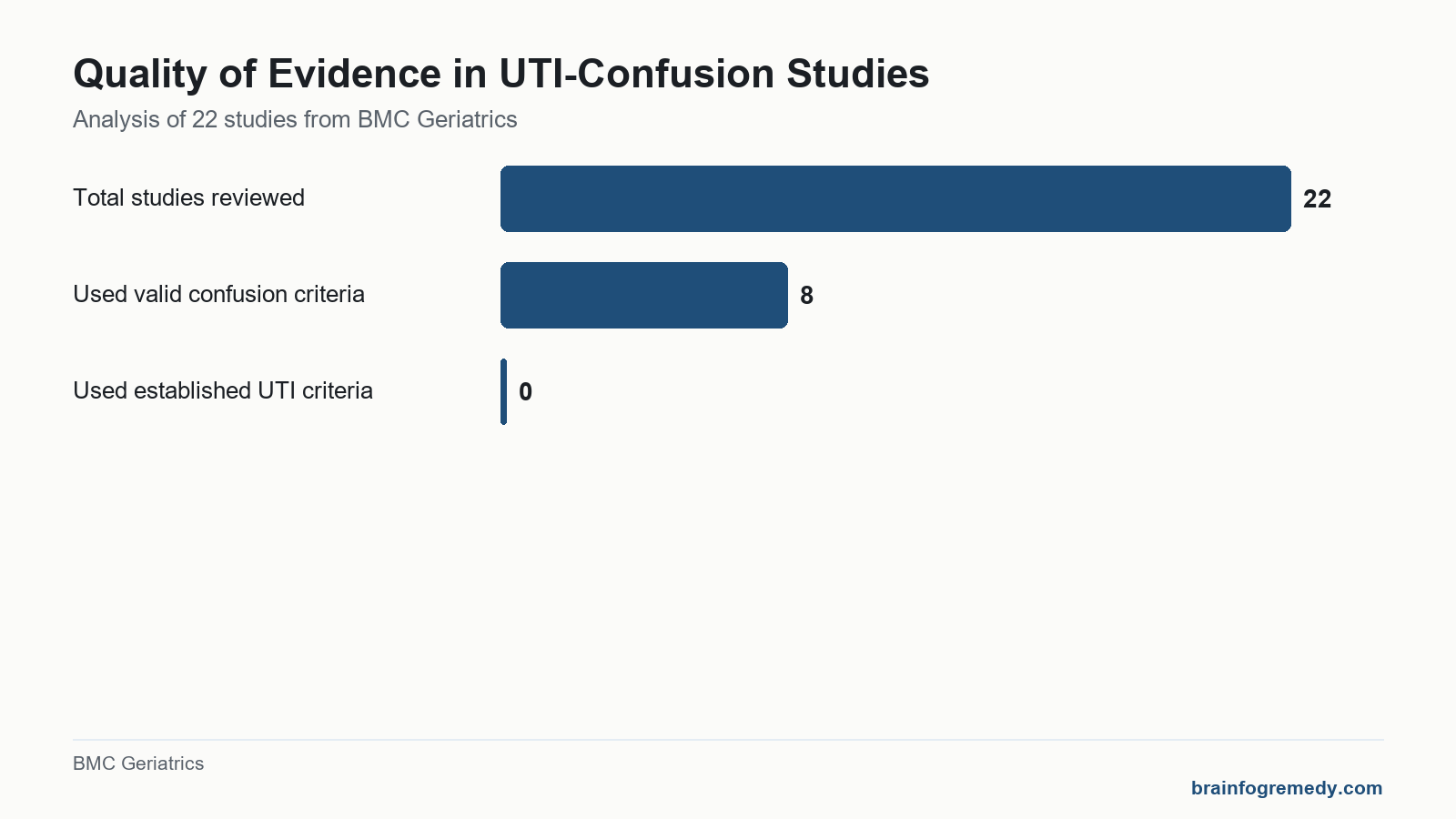
Pull the thread and it loosens. A review of 22 studies published in BMC Geriatrics in 2019 found that not one used validated definitions for both confusion and UTI at the same time. Only eight used valid criteria for confusion. None used established criteria for UTI. Several relied on discharge coding, which records what somebody wrote down rather than what was true. The authors concluded that current evidence appears insufficient to determine whether the two are associated at all. So the link most health sites assert in three confident paragraphs rests on research that the people who read it closely describe as unable to answer the question.

Why does guidance warn against blaming a positive urine dipstick?
Because in older adults a positive dipstick is close to background noise. The UKHSA quick reference tool for primary care, in its flowchart for men and women over 65, instructs clinicians not to perform urine dipsticks at all in that age group. The reasoning is blunt: they become more unreliable with increasing age, and up to half of older adults in long term care, along with most people who have had a catheter for over 30 days, carry bacteria in the bladder without an infection.
That state has a name, asymptomatic bacteriuria, and the guidance is clear that it is not harmful in itself, that it produces a positive dipstick anyway, and that antibiotics do not help. The Infectious Diseases Society of America goes further. Its 2019 guideline recommends that in older patients with functional or cognitive impairment who have bacteriuria and delirium, but no urinary symptoms and no fever or instability, clinicians assess for other causes and observe rather than prescribe. It is graded a strong recommendation on very low quality evidence, which is guideline writers saying the data are thin but the reasoning is not.
Testing and prescribing decisions belong to the clinician who can see the person. The point here is narrower: a positive dipstick alone is weaker information than it looks.
What is well supported, what is contested, and what is simply unknown?
Most pages on this topic present one undifferentiated block of confidence. Here is the same material sorted by how much weight each claim can carry, with the source on every row.
| Claim you will see online | Evidence status | What the source actually says |
|---|---|---|
| Many older adults carry bacteria in urine with no infection | Well supported | The UKHSA quick reference tool for over 65s states that up to half of older adults in long term care, and most people with a catheter in place over 30 days, have bacteria in the bladder without an infection. |
| Urine dipsticks get less reliable with age | Well supported | The same UKHSA flowchart tells clinicians not to perform urine dipsticks in people over 65, because they become more unreliable with increasing age. |
| Antibiotics fix the confusion when the only finding is bacteria in urine | Not supported | The IDSA 2019 guideline recommends assessment for other causes and careful observation rather than antimicrobial treatment, calling it a strong recommendation on very low quality evidence. |
| UTI and delirium occur together more often than chance | Contested | A 2021 meta-analysis in older adults reports an association, commonly quoted at an odds ratio of 2.17. A review of 22 studies in BMC Geriatrics found none of them used validated definitions for both UTI and confusion. |
| About a third of delirium blamed on UTI is misattributed | Reported once, not yet replicated | A 2025 systematic review presented in a supplement of Age and Ageing put the misdiagnosis rate at 36 percent, with a confidence interval of 29 to 42 percent. |
| UTIs cause brain fog in healthy younger adults | Unknown | No trial measuring cognition during an uncomplicated UTI in under 65s was located for this article. The pages making the claim are mostly selling something. |
| Antibiotics help delirium when there is no clear UTI | Being tested now | A multicentre randomised trial published its first 30 patients in 2026, which is the clearest sign available that the question is genuinely open. |
What else gets checked when an older adult becomes confused?
The same UKHSA flowchart carries a checklist clinicians use for other causes of delirium, under the mnemonic PINCH ME. It is worth a relative having seen, not so anyone works through it at home, but because it shows how much sits on the list alongside infection:
- P: Pain. Something hurting that the person cannot describe.
- I: Infection. Any infection, chest and skin included, not only urine.
- N: Nutrition. Poor intake, including meals missed during illness.
- C: Constipation. Mundane, easily missed, genuinely capable of causing confusion.
- H: Hydration. Covered in our piece on whether dehydration causes brain fog.
- M: Medication. New drugs, changed doses, or a combination that has shifted.
- E: Environment. A move, a hospital admission, a change in routine.
The flowchart is explicit that where fever and confusion are the only findings, other causes should be considered before treating for a UTI. Notice how mundane most of that list is. Constipation and a few thin days of drinking are not dramatic, which is part of why the infection story wins: it has a villain. Our piece on the eight causes of brain fog worth checking first covers the slower, non urgent version of the same sorting problem.

The PINCH ME Delirium Checklist
When an older adult becomes suddenly confused, clinicians use the PINCH ME flowchart to check for common, non-urinary causes of delirium. Use this checklist to note potential factors to discuss with a healthcare professional.
Ticks are saved on this device only.
Is there any evidence for brain fog during a UTI in younger adults?
Here the search gets quiet. Plenty of pages describe younger adults feeling foggy during a urinary infection, and the feeling is real enough that people go looking for an explanation. What is missing is a trial measuring cognition during an uncomplicated UTI in under 65s. None was located for this article, and the pages asserting the connection most confidently were, with tedious regularity, selling a supplement at the bottom.
The nearest genuine evidence is indirect and slightly awkward for the popular story. In a controlled experiment published in PLOS One in 2011, 34 healthy male volunteers received a low or higher dose of bacterial endotoxin to produce short lived inflammation. Working memory accuracy did not fall at either dose. Reaction time improved at the higher dose. Long term memory was impaired, but only for emotional images and only at the lower dose.
That is not the clean story of inflammation reaching the brain and switching off thinking. Feeling foggy while ill is common and plausible. Being measurably worse at cognitive tests because of it is a separate claim, and the measurements are messier than the explanation. Something similar shows up in our look at brain fog after flu.
What happened when researchers finally tested antibiotics for this?
They are still doing it, which is itself informative. If the question were settled, nobody would run the trial. A multicentre pragmatic randomised trial published its vanguard results in 2026, covering the first 30 hospitalised older adults with delirium and abnormal urine findings but no clear urinary infection, randomised to antibiotics or no antibiotics. Median age was 86.
Thirty patients settles nothing about whether antibiotics work, and the authors do not pretend otherwise: the vanguard phase tested whether the trial could recruit and hold its allocation, and their conclusion concerns adherence and recruitment rather than outcomes. If the fog is lingering rather than sudden, how long brain fog can reasonably last is the more useful question.
Frequently asked questions
Can a UTI cause brain fog in someone who is not elderly?
No trial has measured cognition during an uncomplicated UTI in adults under 65, so it is unproven. Feeling mentally slow while unwell is common and widely reported. Whether the infection itself causes it, rather than poor sleep, pain or fever, has not been separated out.
If my relative has confusion and a positive urine test, is it a UTI?
Not necessarily, and guidance warns against that inference. Up to half of older adults in long term care carry bacteria in urine without an infection, producing a positive dipstick regardless. It is a question for the clinician assessing them, who looks at symptoms and signs rather than the strip alone.
How quickly should sudden confusion be assessed?
Urgently. NHS advice is to go to A&E or call 999 when someone suddenly becomes confused, without waiting to work out why. Several causes are serious and time sensitive, and the possibility that it turns out to be a urinary infection is not a reason to wait.
Does treating the infection clear the confusion?
Where there is a genuine infection with urinary symptoms, treating it is standard care and a matter for the clinician. Where the only finding is bacteria in urine alongside confusion, the IDSA guideline recommends assessing for other causes and observing, because treatment has not been shown to improve the confusion.
Why do so many sites state the link as settled fact?
It is clinically familiar, memorable, and makes a tidy paragraph. The reviews that examined the underlying studies found poor case definitions, weak control of confounding, and reliance on discharge codes. A claim can be repeated everywhere and still rest on research that cannot support it.
Is urine tested at all in someone over 65?
The UKHSA flowchart advises against routine dipsticks in over 65s because of unreliability, while still advising urine culture in various situations. Testing decisions depend on the full picture and belong to the clinician, not to a checklist read at home.
Finished the page? The same five questions from the top, to see what stuck.
This article is general information, not medical advice, and is not a substitute for care from a qualified healthcare professional. Speak to your doctor about your own situation.
Leave a Reply