Low iron brain fog is plausible and thinly evidenced. The study behind the 2025 headlines had 27 women in it and could not show cause. The largest trial that actually measured cognition found no overall benefit from correcting iron. A ferritin test is cheap, and this is one of the few fog questions a blood test can settle.
Listen to this article, about 13 minutes. A synthetic voice reads the article and announces each section title as it begins; tables are read row by row and the questions at the end are left out.
Recorded 10 October 2026 from the article as published that day. Press a chapter to jump there; the highlighted line is what is playing. A play button sits beside every section heading, and once you scroll past this player a bar at the bottom of the screen keeps the controls in reach. Tap or click any sentence to hear the reading start from there.
On this page: a comparative table of clinical trials, a breakdown of conflicting ferritin thresholds, and an interactive tool to interpret blood test numbers.
Think you already know this? Five questions, one minute.
Every answer is on this page. Answer from what you know now; the page fills in the rest.
-
1. Does the official NHS list of iron deficiency anaemia symptoms include memory or concentration problems?
Concentration and memory are not on the NHS list of iron deficiency anaemia symptoms, although wellness pages frequently treat brain fog as a signature symptom. Read the section
-
2. How many women’s usable cognitive datasets were actually analyzed in the 2025 Nutrients study?
The study, published in Nutrients in 2025 screened 521 people but ended with only 27 usable cognitive datasets. Read the section
-
3. According to the 2023 JAMA analysis of US females aged 12 to 21, what percentage were classed as iron deficient when using a ferritin threshold under 50?
The 2023 JAMA analysis of US females aged 12 to 21 found that 77.5 percent were classed as iron deficient at a ferritin under 50, compared to only 6.3 percent with iron deficiency anaemia. Read the section
-
4. What did the PREFER trial find regarding cognitive scores after giving participants an intravenous iron infusion?
In the PREFER trial, cognitive scores did not separate from the placebo across the group as a whole, though power of attention improved in the subgroup with ferritin under 15. Read the section
-
5. Why is self-dosing iron without a blood test considered riskier than other nutrients?
Surplus iron is stored in the liver, heart and pancreas, and without treatment, the organs it accumulates in can fail. Read the section
Does low iron actually cause brain fog?
Nobody has shown that it does. What exists is an association, mostly measured at a single point in time, mostly in women, and mostly in people who were not anaemic.
There is a gap here that is easy to miss. The NHS list of iron deficiency anaemia symptoms runs to tiredness, breathlessness, palpitations, pale skin and headaches, with a longer tail of tinnitus, altered taste and restless legs. Concentration and memory are not on it. Meanwhile every wellness page treats brain fog as the signature symptom of low iron. The honest reading is that the cognitive side is real enough to keep studying and thin enough that official symptom lists have not adopted it. We rechecked the NHS page on 4 October 2026: it was last reviewed on 26 January 2024, is next due for review in January 2027, and still does not mention concentration, memory or brain fog anywhere.
What did the study behind the headlines actually find?
In April 2025 the University of Oklahoma published a release headed Low Iron Could Cause Brain Fog During Menopause Transition. The underlying paper is considerably more careful than its press cycle. The study, published in Nutrients in 2025, screened 521 people and ended with 27 usable cognitive datasets and 17 brain scans, in women aged 44 to 64. It was cross sectional, a snapshot rather than a before and after. Nobody in it met the criteria for iron deficiency and one participant was mildly anaemic. Within that narrow band, a higher ferritin percentile tracked with better accuracy and faster responses across four computer based tasks, at correlations around 0.5 to 0.66.
The reassuring finding got less attention than the headline. Higher iron in the blood showed no significant relationship with iron deposits in the brain, which is the thing people worry about when they read that brain iron is linked to neurodegenerative disease. The study’s own lead author told the university that iron supplements are usually not the best course of action, chiefly because of the gastrointestinal side effects. That sentence rarely survives into the aggregator versions.

What has each study measured, and what did it find?
This is the table the ranking pages do not print, because assembling it means admitting how little of the evidence is about thinking at all.
| Study | Design and size | What it measured | What it found |
|---|---|---|---|
| Nutrients, 2025 | Cross sectional, 27 cognitive datasets, women 44 to 64, none iron deficient | Ferritin percentile against four cognitive tasks | Higher ferritin tracked with better accuracy and faster responses. No significant link between blood iron and brain iron. |
| Randomised trial, 2012 | 198 menstruating women, ferritin under 50, 12 weeks of oral iron or placebo | Fatigue score only | Fatigue fell further on iron, a 3.5 point difference, 95 percent confidence interval 0.3 to 6.7. Cognition was not measured. |
| PREFER trial, 2014 | 290 fatigued iron deficient women, single intravenous iron infusion or placebo | Fatigue plus computerised attention and memory tests | Fatigue improved. Cognitive subscales did not differ overall. Only in the subgroup with ferritin under 15 did power of attention improve, by 38.4 milliseconds. |
| Meta analysis, 2010 | 14 randomised trials in children, adolescents and women | Attention, IQ, memory, psychomotor skill | Attention and concentration improved regardless of starting iron status. IQ rose about 2.5 points in anaemic groups only, with no effect on memory. |
Read down the third column. Two of the four main pieces of evidence never tested thinking at all, one tested it properly and found nothing except in the most depleted subgroup, and the one that found a broad association had 27 people in it. The full text of the 2010 meta analysis would not open for us, so those figures come from its indexed abstract.
What counts as low iron, and why do the numbers disagree?
Because the cut off is a decision, not a measurement. Ferritin is a continuous number, somebody has to draw a line across it, and the people drawing it do not agree.
| Ferritin | Where the number comes from | What it implies |
|---|---|---|
| Under 15 micrograms per litre | WHO cut off for apparently healthy adults aged 20 to 59 | The formal definition of depleted stores |
| Under about 25 | Derived from NHANES III against haemoglobin, 24.8 for nonpregnant women | Roughly 75 percent higher than the WHO line |
| Under 50 | Entry criterion for both randomised trials above | Where researchers went looking for symptoms |
| Under 70 | WHO cut off for adults with infection or inflammation | Ferritin rises with inflammation, so a normal number can sit on top of a real deficit |
| Above 150 in women, 200 in men | WHO threshold for risk of iron overload | The end of the scale nobody markets to you |
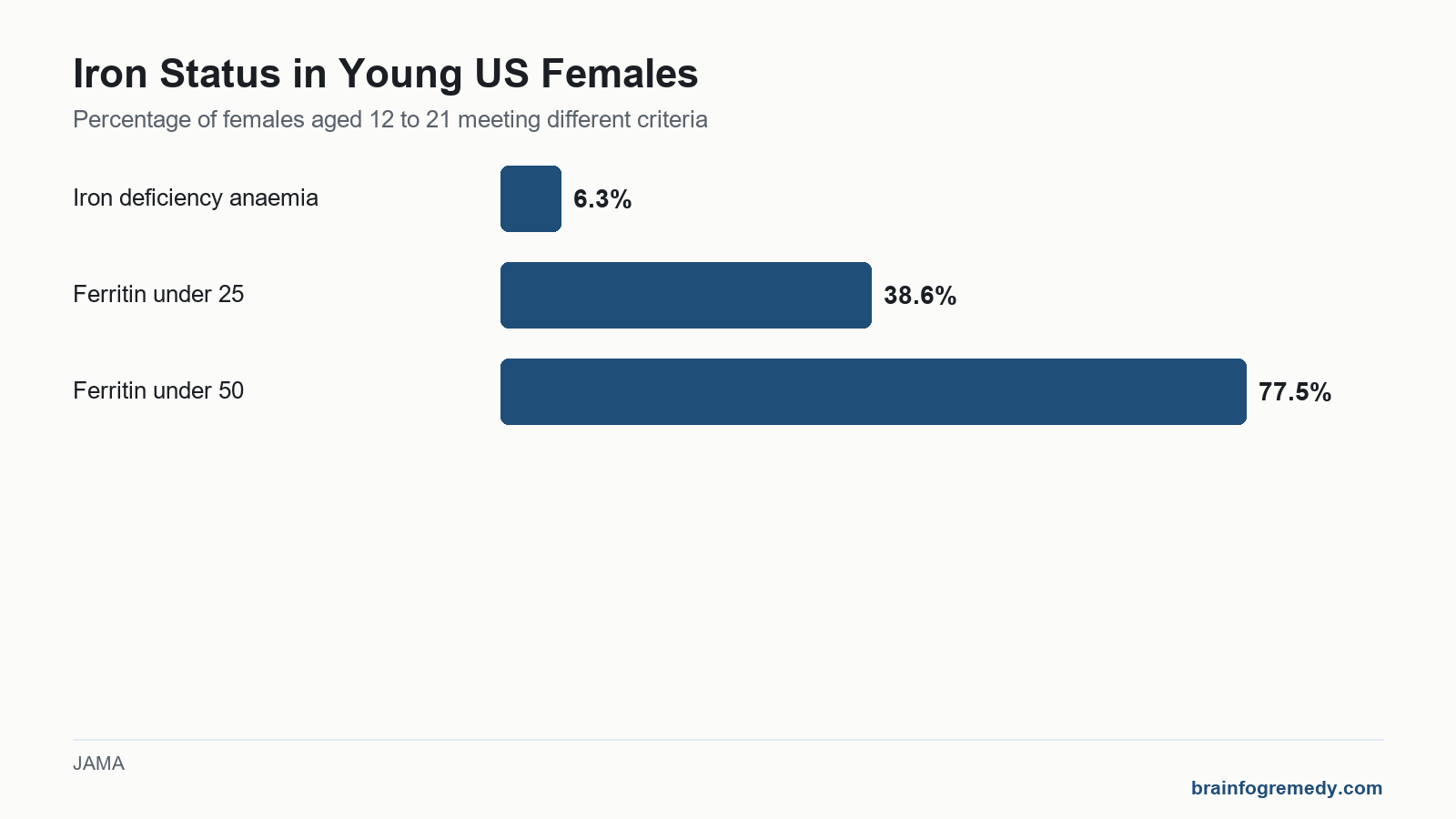
The practical size of that disagreement is startling. A 2023 JAMA analysis of US females aged 12 to 21 found 38.6 percent classed as iron deficient at a ferritin under 25, and 77.5 percent at under 50, while only 6.3 percent had iron deficiency anaemia. Same blood, three different stories depending on where the line falls. A page telling you that most women are iron deficient has usually picked the friendliest threshold and not mentioned doing so.
Ferritin Threshold Definitions
Compare how different clinical standards and research trials interpret ferritin levels in micrograms per litre.
Ferritin levels are interpreted by medical professionals alongside a full blood panel.
Does correcting low iron clear the fog?
For tiredness the evidence is decent. For thinking it is much thinner, and the two get run together constantly. The 2012 trial gave 198 non anaemic women with ferritin under 50 either 80 mg of iron or a placebo for twelve weeks, and fatigue scores fell 47.7 percent on iron against 28.8 percent on placebo. A real result, and cognition was never assessed. The PREFER trial went further, giving 290 women a single intravenous infusion and running proper computerised attention and memory tests. Fatigue improved. The cognitive scores did not separate from placebo across the group. Only among women whose ferritin was under 15 did one measure, power of attention, improve.
So the fairest summary available is this. If iron stores are genuinely at the floor, correcting them may sharpen attention. If they are merely lowish, the trials suggest a person will feel less tired and think about the same. That is not nothing, and it is also not the same as the fog lifting. Where fog arrives welded to exhaustion rather than merely alongside it, the pattern is worth reading about in extreme fatigue with brain fog.
What do people who have had their iron tested actually report?
We read six threads on the r/Anemia forum, posted between December 2025 and May 2026. These are accounts, not evidence. No forum post is a diagnosis, including the poster’s own.
- December 2025: a ferritin of 16, with fog, hair loss, cold feet and a lag between what their eyes see and what their head registers. The result sat inside the laboratory’s normal range.
- April 2026: a ferritin of 25, told everything was normal, describing constant fog and headaches. The first reply moves straight to self dosing zinc and B vitamins.
- May 2026: a UK poster whose deficiency turned up on a general blood panel, with a transferrin saturation of 3 percent against a normal range of 16 to 45. Their doctor moved within days to test for coeliac disease as the cause. They had spent years attributing the symptoms to ADHD.
- March 2026: the day after a first iron infusion, asking how long until energy and cognition change. Replies say a week to ten days, ten days, and two to three weeks. One regular adds that their own recent infusions produced no noticeable change at all.
- March 2026: someone weighing whether their daily fog is iron or ME and chronic fatigue syndrome, and unconvinced by either.
The accounts agree with official guidance on two things: ferritin is the number that matters, and improvement is slow rather than immediate. They part company on the cut off. Guidance treats a result above it as normal, and these posters describe significant symptoms at 16 and at 25. That is the threshold argument again, arriving from the opposite direction. The counterweight matters too. One person reports infusions that changed nothing, and another suspects iron is not their problem at all.
Why is guessing about iron riskier than guessing about most nutrients?
Because the body has no exit route. Surplus iron is stored, mainly in the liver, heart and pancreas, and without treatment the organs it accumulates in can fail. That is what hereditary haemochromatosis is: people who absorb more iron than they need and cannot get rid of it. The NHS also notes that an overdose of iron in a young child can be fatal, which is worth knowing if there are tablets in the house. So the sensible order is test, then treat. The internet’s favourite framing, that iron is a harmless thing to try, is the one claim in this area that is flatly wrong. On which nutrients genuinely earn a test, there is more in our piece on vitamins and brain fog.
Nothing here is a reason to start, stop or change an iron supplement. Dosing iron follows a blood test and a conversation with a doctor, in that order, and that holds whether the number turns out to be low or high.
What can a blood test settle that an article cannot?
Quite a lot, which is unusual. Most brain fog questions end in a shrug. This one ends in a number. A standard full blood count does not include ferritin. It measures haemoglobin and red cell indices, which is why people are told their blood work is fine while their stores are nearly empty. Ferritin has to be requested by name, and where inflammation is present the WHO guidance pairs it with an inflammation marker rather than reading it alone.
A low ferritin is a finding, not an explanation. The next question a doctor asks is why it is low, and the answers run from heavy periods to coeliac disease to slow gastrointestinal blood loss. That is the part the supplement aisle skips, and it is the part that matters most. Iron sits on the short list of things worth checking early for exactly this reason, alongside the others in the eight causes of brain fog worth checking first. For anyone in the menopause transition, where heavier periods and hormonal change arrive together, the interaction is covered in why menopause brain fog happens. Habit matters here too, because tea taken with meals binds iron in the gut, a point raised in our look at green tea and brain fog. Where coeliac disease turns out to be the reason behind the low stores, the order of the tests matters a great deal, which is the subject of celiac disease and brain fog, and why testing comes first.
The rest of the internet will sell you an iron flush, a quiz that diagnoses you in six questions, and a chelated formula promising focus by Friday. Not one of them can tell you your ferritin. A vial of blood can, though one result is not always the end of it, which is the argument made for another nutrient in why a single B12 blood test is not enough.
Frequently asked questions
Can you have low iron without being anaemic?
Yes, and it is common. Anaemia means haemoglobin has dropped. Iron deficiency means the stores feeding haemoglobin production are running down, which happens first. In the 2023 JAMA analysis, 38.6 percent of US females aged 12 to 21 were iron deficient at a ferritin under 25, against 6.3 percent with iron deficiency anaemia.
Does a full blood count show iron levels?
Not directly. It reports haemoglobin, red cell size and related indices, and it can look entirely normal while stored iron is low. Ferritin is a separate test that has to be asked for by name.
How long does it take to feel different once iron is corrected?
Slower than most people expect. The oral iron trial ran twelve weeks and the intravenous trial measured its main outcome at day 56. Forum posters after an infusion report noticing something between one and three weeks, and some report noticing nothing.
Can too much iron cause brain fog?
Iron overload causes fatigue, joint pain and weakness, and untreated it damages the liver, heart and pancreas. Whether it produces brain fog specifically is not established. What is established is that the body cannot excrete surplus iron, which is why guessing upward is the dangerous guess.
Does eating more iron rich food raise ferritin?
It can, slowly. Iron from meat and fish is absorbed more readily than iron from plants, vitamin C alongside a meal helps, and tea and coffee with food hinder it. Diet moves stores over months rather than weeks. What any individual needs is a question for their doctor.
Is brain fog on its own a reason to ask about iron?
Brain fog is not specific to iron and is not on the standard symptom list for iron deficiency anaemia. It is still reasonable to raise, particularly alongside heavy periods, breathlessness on stairs or a restricted diet. Persistent fog is worth a proper appointment rather than a search bar.
Finished the page? The same five questions from the top, to see what stuck.
This article is general information, not medical advice, and is not a substitute for care from a qualified healthcare professional. Speak to your doctor about your own situation.
Leave a Reply