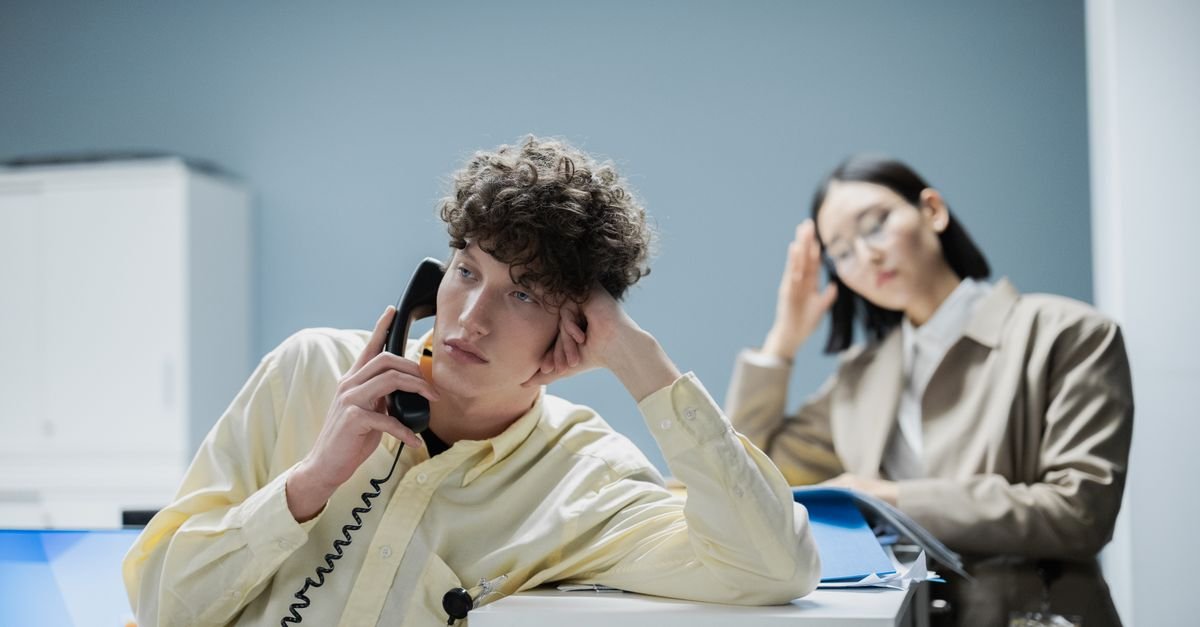
Mentally tired meaning, in plain terms: the machinery you use to concentrate has run down, while the drive to sleep has not. Sleep researchers separate three states that English mashes into one word. Sleepiness is how easily you would drop off. Physical fatigue lives in the muscles. Mental fatigue is the one that makes answering an email feel like lifting furniture.
Listen to this article, about 10 minutes. A synthetic voice reads the article and announces each section title as it begins; tables are read row by row and the questions at the end are left out.
Recorded 4 October 2026 from the article as published that day. Press a chapter to jump there; the highlighted line is what is playing. A play button sits beside every section heading, and once you scroll past this player a bar at the bottom of the screen keeps the controls in reach. Tap or click any sentence to hear the reading start from there.
On this page: the three states English calls tired, the dark room test that separates sleepiness from mental fatigue, the trial where 90 minutes of hard thinking cut cycling endurance by about 15 percent, and the one consultation in fifteen that opens with the word.
Think you already know this? Five questions, one minute.
Every answer is on this page. Answer from what you know now; the page fills in the rest.
-
1. When 96 undergraduates rated the words sleepy, drowsy, tired and fatigued, which word sat in the middle and belonged to neither camp?
Drowsy sat much closer to sleepy than to fatigued, and tired belonged to neither, per the 2022 study in the Journal of Clinical Sleep Medicine. Read the section
-
2. Which question separates sleepiness from mental fatigue?
Sleepiness is sleep propensity, measured with sleep latency tests and the Epworth Sleepiness Scale; mental fatigue leaves you wide awake and unable to think, as Shen and colleagues argued in 2006. Read the section
-
3. After six hours of demanding cognitive work in the 2022 Current Biology study, what had built up in the lateral prefrontal cortex?
Thirty nine people, one lab, and a proposed mechanism rather than a proven one, per Current Biology, 2022. Read the section
-
4. Fatigue is the principal complaint in roughly what share of primary care consultations?
That estimate comes from a review in the British Journal of General Practice. Read the section
-
5. When does the NHS advise seeing a GP about tiredness?
The NHS page on being tired all the time, reviewed in June 2023, also names weight loss, mood changes and gasping or choking noises in sleep. Read the section
What does being mentally tired actually mean?
The trouble starts with the word tired, which is doing three jobs at once and none of them well. When 96 undergraduates were asked to rate the words sleepy, drowsy, tired and fatigued on the same scales, all four came out significantly different in meaning, and drowsy sat much closer to sleepy than to fatigued. Tired sat in the middle and belonged to neither camp, according to the 2022 study in the Journal of Clinical Sleep Medicine. So when you say you are tired, you have told the listener almost nothing.
Researchers have tried to tidy this up. A widely used taxonomy proposed by Kluger and colleagues in Neurology splits fatigue into perceived fatigue, the sensation itself, and performance fatigability, the measurable decline in how well you do a task as you keep doing it. Those two come apart all the time. You can feel wrecked and still perform, or feel fine and watch your accuracy slide. The same split turns up in Sweden’s stress diagnosis, where patients report large memory problems that formal tests barely register, as our page on nervous exhaustion and the labels that replaced it explains.
Sleepiness is the tidier of the two. Researchers at the National Institute for Occupational Safety and Health reviewed both concepts in 2023 and noted that sleepiness has a single widely used definition, sleep propensity, while fatigue still has no agreed one. Their working definition of fatigue is a suboptimal psychophysiological condition caused by exertion. The distinction matters because the two states behave differently: sleepiness builds and keeps building until you sleep, while fatigue eases when the demand that caused it is removed.
How is mental tiredness different from being sleepy?
Here are the three states side by side, with the source for each row. This is the table the dictionary definitions leave out.
| State | What it is | Brought on by | The giveaway | Measured with |
|---|---|---|---|---|
| Sleepiness | Sleep propensity, the pull towards falling asleep | Time awake and the body clock | You would fall asleep quickly if you lay down | Sleep latency tests and the Epworth Sleepiness Scale |
| Physical fatigue | Reduced capacity to produce force or keep going | Bodily exertion | Your limbs feel heavy and slow | Performance fatigability, meaning measured decline over a task (Kluger, Neurology) |
| Mental fatigue | Reduced capacity to sustain attention and control | Prolonged demanding cognitive work | You are wide awake and still cannot think | Time on task and workload measures (NIOSH review) |
The practical test people arrive at on their own is the one clinicians use: if you lay down right now in a dark room, would you fall asleep? If yes, that is sleepiness, and it is measured by how fast you drop off. If you would lie there wide awake and furious with your own brain, it is not sleepiness, whatever the word tired suggested. Shen and colleagues in Sleep Medicine Reviews made the same argument back in 2006, and the two words are still used interchangeably today. If your nights are the problem rather than your afternoons, the separate question of how one bad night of sleep lingers is worth reading alongside this.

What is happening in the brain when you are mentally tired?
The honest answer is that nobody is certain. The most interesting recent attempt comes from a 2022 study in Current Biology, which put 39 people through either six hours of demanding cognitive work or an easier version, and scanned their brains. The hard group finished with higher glutamate concentrations in the lateral prefrontal cortex, the region that does effortful control. The authors propose that fatigue is not the tank running empty but the exhaust building up, and that clearing it is what rest is for. One study, one lab, 39 people, and a proposed mechanism rather than a proven one. Treat it as a promising idea, not a settled fact. We walk through that study’s design, and the scientists who doubt it, in our page on what the cognitive fatigue research found.
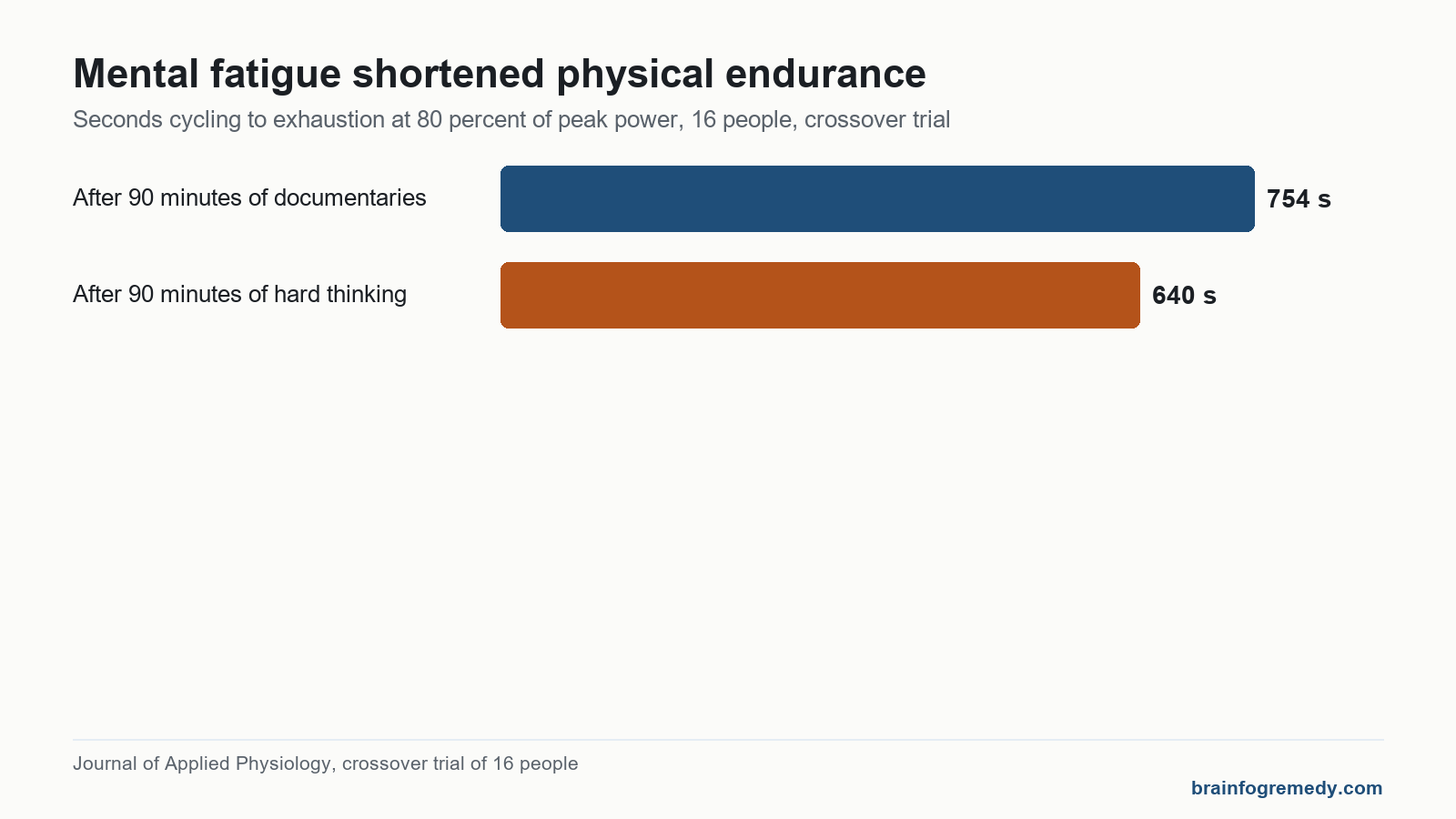
What is better established is that mental fatigue is not confined to the mind. In a crossover trial published in the Journal of Applied Physiology, 16 people cycled to exhaustion at 80 percent of peak power after either 90 minutes of a demanding cognitive task or 90 minutes of neutral documentaries. After the cognitive task they lasted 640 seconds on average, against 754 seconds after the documentaries, roughly 15 percent less. Their heart and lung responses were essentially unchanged. Thinking hard made their legs give out sooner without touching the physiology of their legs.

What do people who live with this actually report?
We read four public threads on r/BrainFog and r/ChronicIllness, roughly 60 posts and comments in total, dated between December 2025 and April 2026. These are accounts, not evidence, and none of them is a finding about anyone else. What is striking is that people separate the states unprompted, and reach for the same test the researchers use.
A poster in r/BrainFog in April 2026 described 18 months of it after moving to a fully remote desk job: a wall arriving between one and three in the afternoon, work still visible on the screen, nothing firing. They were explicit that it was not sleepiness, comparing it to running through mud. Standard bloods came back normal, which they said made it harder rather than easier. A reply put it in six words: not tired, just no processing power. The only thing this person reported as reliably useful was moving demanding work to the morning.
A second r/BrainFog thread from January 2026 described the loop that confuses people most: sleeping enough, waking tired, then finding the brain switching on at night. In a December 2025 r/ChronicIllness thread asking what level of tiredness counts as normal, one commenter drew the line neatly, saying tired is what follows a workout or a short night, while fatigue is what healthy people get with flu. Another described being exhausted yet unable to fall asleep, with heavy limbs and a brain that would not switch off. A third simply linked the Epworth Sleepiness Scale and said it measures the sleepiness part objectively, which is exactly right.
Two accounts cut against the pattern, and they are the important ones. In that same thread, one person said rest had stopped working for them and a sleep study eventually found severe sleep apnoea. Another was annoyed that their doctor ordered a sleep study before blood tests, and several commenters pushed back and said the sleep study was the sensible first move. So the forum is not unanimous, and the people assuming their problem was purely cognitive were sometimes wrong.
One more thing worth saying plainly. The same thread that described the state with real precision also produced krill oil, wasabi extract, and a suggestion to soak poppy seeds in olive oil and drink it. Forums are excellent at describing what something feels like and poor at explaining why, and the gap between those two skills is enormous. Nothing in this section is a recommendation, a diagnosis or a finding. It is what people wrote about themselves.
When does the wall arrive?
One poster on this page found the only reliable help was moving demanding work to the morning, and got there by noticing when the wall came. Keep a few days of notes and the pattern, if there is one, shows itself.
A diary, not an assessment. It scores nothing and cannot tell you what is behind the tiredness. Kept on this device only.
Why does this get lost in a ten minute appointment?
Fatigue is a common reason to book. It is the principal complaint in an estimated 5 to 7 percent of primary care consultations, according to a review in the British Journal of General Practice. That is roughly one consultation in fifteen opening with a word that means three different things.
There is some evidence that patients hold the distinction more firmly than the language allows. In a 2025 qualitative study in Health and Quality of Life Outcomes, 30 people with obstructive sleep apnoea were interviewed, and all of them described fatigue and sleepiness as separate things. Around 58 percent of the non treated group rated fatigue as their most bothersome symptom, against 5 percent who said sleepiness. That is a small sample with one specific condition, so it does not generalise to everyone, but it does suggest the vocabulary is failing people rather than the people being vague. Being specific helps, and we have a longer piece on how to describe brain fog so a doctor takes you seriously, along with a plain list of what brain fog actually feels like from the inside.
When is being mentally tired worth seeing a doctor about?
This is the part written straight. The NHS advises seeing a GP if you have felt tired for a few weeks and do not know why, if the tiredness affects your daily life, or if it comes with other symptoms such as weight loss or mood changes, or if you have been told you make gasping, snorting or choking noises in your sleep. That page was last reviewed in June 2023.
Nothing on this page can tell you what is causing your own symptoms, and it is not trying to. Persistent mental tiredness has a long list of possible causes, several of which are found with ordinary tests, and working out which applies to you is a job for a clinician who can examine you. If the tiredness is severe or has arrived alongside other changes, our piece on what extreme fatigue with brain fog can mean covers what tends to get investigated. Getting it looked at is the right move, not an overreaction.
Frequently asked questions
Is being mentally tired the same as burnout?
No. Burnout is an occupational syndrome describing chronic workplace stress that has not been managed, and it includes cynicism and reduced professional efficacy alongside exhaustion. Mental tiredness is a much narrower state: reduced capacity to sustain attention and control after cognitive effort. Burnout usually contains mental fatigue, but plenty of mental fatigue has nothing to do with work.
Can you be mentally tired without feeling sleepy at all?
Yes, and it is common. Sleepiness is sleep propensity, the pull towards falling asleep, and it is measured by how quickly you drop off. Mental fatigue is a decline in cognitive capacity. The two often occur together, and they also occur apart, which is why people describe being wide awake and completely unable to think.
Does sleeping fix mental tiredness?
Sleep reliably reduces sleepiness. Its effect on mental fatigue is less predictable, because fatigue eases mainly when the demand that produced it is removed, and rest may or may not include sleep. If your tiredness is not improving with adequate sleep over a period of weeks, that is one of the situations the NHS lists as a reason to see a GP.
How long should ordinary mental tiredness last?
Work related fatigue is generally described as temporally tied to what caused it, so it should ease once you are away from the demand, typically over an evening or a weekend. There is no agreed number of hours, and it varies with the person and the task. Tiredness lasting several weeks without an obvious cause is worth a medical opinion.
Is mental fatigue the same thing as brain fog?
They overlap but are not identical. Mental fatigue describes reduced capacity after cognitive effort, so it has a cause and usually a recovery. Brain fog is a broader everyday term for slowed thinking, poor recall and difficulty concentrating, which may be present from the moment you wake and without any preceding effort at all.
Can mental tiredness really affect physical performance?
Yes, and there is trial evidence for it. In a crossover study of 16 participants, 90 minutes of a demanding cognitive task cut time to exhaustion on a bicycle by roughly 15 percent compared with watching neutral documentaries, while heart and lung responses stayed largely unchanged. Perceived effort rose, so the same work felt harder.
Finished the page? The same five questions from the top, to see what stuck.
This article is general information, not medical advice, and is not a substitute for care from a qualified healthcare professional. Speak to your doctor about your own situation.
Leave a Reply