
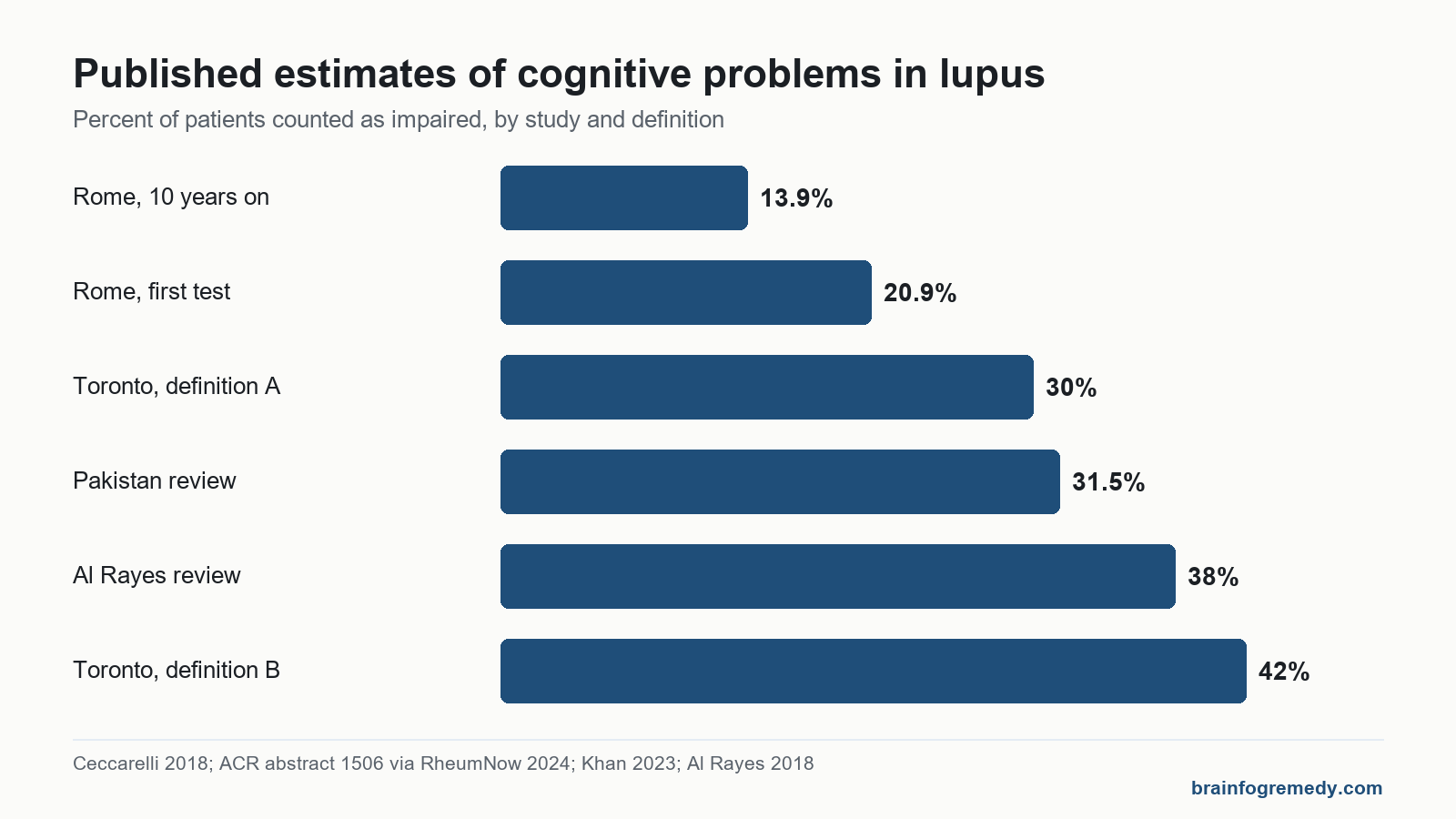
Lupus brain fog is common, but nobody can tell you exactly how common. Published estimates for cognitive problems in lupus run from about 14 percent to over 40 percent in clinic studies, and from 15 to 79 percent across single studies, mostly because each one defined “impaired” differently.
Listen to this article, about 12 minutes. A synthetic voice reads the article and announces each section title as it begins; tables are read row by row and the questions at the end are left out.
Recorded 10 October 2026 from the article as published that day. Press a chapter to jump there; the highlighted line is what is playing. A play button sits beside every section heading, and once you scroll past this player a bar at the bottom of the screen keeps the controls in reach. Tap or click any sentence to hear the reading start from there.
On this page: six published estimates of lupus brain fog side by side with the definition each study used, a hospital leaflet’s list of contributors and red flags, and about 20 accounts from people with lupus read in October 2026.
Think you already know this? Five questions, one minute.
Every answer is on this page. Answer from what you know now; the page fills in the rest.
-
1. In the Rome study that retested the same patients about ten years apart, what happened to the share with measurable cognitive impairment?
Ceccarelli and colleagues found 20.9 percent at the start and 13.9 percent at retest, and concluded that impairment improved in most patients who had it. Read the section
-
2. When the Toronto group scored the same test battery under two definitions of impairment, what did they get?
RheumNow’s report of ACR abstract 1506 gives 30 to 42 percent depending on the definition, from the same patients. Read the section
-
3. In the March 2026 r/lupus thread, which symptom did several people describe as the most frightening?
In the thread, replies described word swapping as the symptom that scared them most. These are personal reports, not findings. Read the section
-
4. What does the Cambridge University Hospitals leaflet say about significant cognitive dysfunction from an underlying medical cause in lupus?
The leaflet says cognitive symptoms are commonly reported but significant dysfunction from an underlying medical cause is uncommon. Read the section
-
5. According to the leaflet, which of these needs prompt or urgent assessment?
Cambridge University Hospitals lists sudden onset as needing rapid assessment because it could be a stroke. Read the section
Most pages on this give a single confident number, then a list of tips. The number changes from page to page, which ought to make anyone suspicious. This one lines the studies up side by side, shows the definition each one used, and says plainly where the evidence stops. It cannot tell you whether your own fog is lupus, a flare, a medicine, poor sleep or something else. A rheumatologist who knows your history can start on that question, and our overview of the causes a doctor usually checks first covers the wider list.
How common is lupus brain fog, really?
Here is every figure we could trace to a source, with the definition behind it. Read the third column before the fourth. That is where the disagreement lives.
| Source | Who was studied | How “impaired” was defined | What it found |
|---|---|---|---|
| Ceccarelli and colleagues, PLoS One, 2018 | 43 adults at a Rome lupus clinic, tested and retested about 10 years apart | A neurologist’s battery across five domains, scores graded against normal values | 20.9 percent at the start, 13.9 percent a decade on |
| Toronto lupus cohort, ACR Convergence 2024 abstract 1506 | Adults in a long running lupus clinic cohort | The ACR neuropsychological battery, scored under two different definitions | 30 percent under one definition, 42 percent under the other |
| Khan and colleagues, Frontiers in Psychiatry, 2023 | 208 patients in the 3 Pakistani studies that counted cognition | Not stated; the authors note there is no universal definition | 31.5 percent, with a 95 percent confidence interval of 1.3 to 76.3 |
| Al Rayes and colleagues, Seminars in Arthritis and Rheumatism, 2018 | Adults with lupus in studies using a named test | Only studies that used a specified neuropsychological instrument | Reported as pooled at 38 percent; single studies ranged from 15 to 79 percent |
| Petri and colleagues, Journal of Rheumatology, 2008 | 111 recently diagnosed patients and 79 healthy controls | A computerised test battery compared group against group | Worse on 4 of 9 subtests; no percentage of people given |
| Lupus Foundation of America, 2017 | People with lupus generally | Noticing changes in their own thinking | 20 to 60 percent; no study cited for it |
The Rome study is the one to sit with. It tested the same people twice, about ten years apart, and the share with measurable impairment fell from 20.9 to 13.9 percent. The authors concluded that cognitive impairment improved in most of the patients who had it. That runs against the common assumption that lupus fog only ever gets worse, although 43 people is a small group and the change was not statistically significant.
At the other end, the Pakistani review pooled just 208 patients from 3 studies for cognition, and its 95 percent confidence interval runs from 1.3 to 76.3 percent. In plain words, the true figure could be almost anything. The authors say so themselves.
Why do the published estimates disagree so much?
Three reasons, and none of them is that one study is lying. The first is the cut off. The Toronto group ran the same battery on the same patients and got 30 percent under one definition of impairment and 42 percent under another, as RheumNow reported from the 2024 ACR meeting. Same people, same afternoon of tests, a 12 point gap from a choice made on paper.
The second is who gets tested. Some studies test everyone in a clinic; others test only people who already reported a problem, which pushes the figure up. The Rome authors give a published range of 3 to 80 percent and put it down to exactly that, plus different tests and missing control groups.
The third is what is being counted. A large international cohort, the SLICC inception study reported in Annals of the Rheumatic Diseases, found that 40.3 percent of 1,206 newly diagnosed patients had at least one neuropsychiatric event, but only 13.0 to 23.6 percent had events attributed to lupus itself. That covers headaches, mood and seizures as well as thinking, which is how a figure about “the brain” turns into a figure about brain fog on a less careful page.

Then there is the difference between noticing and measuring. The Lupus Foundation of America puts it at 20 to 60 percent of people noticing changes in their thinking, which is a self report, not a test score. A second abstract at the same meeting, on self reported thinking, found the people who rated their own cognition worst also reported more fatigue and poorer sleep. Feeling foggy and scoring low on a test overlap, but they are not the same measurement, and no study has pinned down how well one predicts the other.
What do people with lupus actually report about brain fog?
We read three recent r/lupus threads, containing about 20 accounts from people flaired as diagnosed, plus one Lupus UK blog post and an older Lupus Foundation collection of seven accounts from 2017, which we left out as dated. These are what people describe, not findings, and none of them can say what is happening inside anyone else’s head.
The symptom described most vividly was not forgetting. It was words. In a March 2026 thread, the original poster described saying a completely wrong word for two days running and was messaging their rheumatologist about it. Several replies described the same thing as their most frightening symptom: swapping words, losing them mid sentence, and close friends noticing before strangers did. One said their doctor called it brain fog, but that it felt different from the fog she already knew.
In an April 2026 thread, a poster ten years past diagnosis and in remission asked whether others had lost whole stretches of memory, not just fog. Replies split the two cleanly. People who had had seizures or small strokes described gaps they linked to those events, and one called them quite distinct from the day to day fog. Others urged them to get baseline cognitive testing from a neurologist.
In a January 2026 thread about working with lupus, a newly diagnosed researcher of 23 said she could no longer keep up with simple tasks, and a therapist with seven years to retirement wondered whether it was ethical to keep seeing clients through the fog. Others said remote work and understanding managers made it workable. And in a May 2024 Lupus UK post, a writer called Maryann listed brain fog with anxiety and intrusive thoughts as the signs that a flare was coming.
Where the accounts agree with the guidance: fog tracks flares for some people, and family notice changes early, which the hospital leaflet below lists as a reason for prompt assessment. Where they cut across it: nobody in the set reported a test result, and the one thing the clinical pages say least about, word finding, is the thing people fear most.
What could be behind it, according to lupus specialists?
The most useful plain English source we found is not a ranking page but a hospital leaflet. Cambridge University Hospitals says cognitive symptoms are commonly reported in lupus, but that significant dysfunction from an underlying medical cause is uncommon. It lists possible contributors, and it lists more than one on purpose.
| Factor named by the lupus team leaflet | Why it is on the list |
|---|---|
| Lupus affecting the brain, especially with antiphospholipid syndrome | Antibodies and clotting can affect brain tissue directly |
| Lupus activity elsewhere in the body | A flare can make thinking worse even when the brain is not the target |
| Medicines, including long term high dose steroids and strong painkillers | Several common lupus treatments can dull thinking |
| Fatigue, stress and poor sleep, including sleep apnoea | Each of these blunts attention in anyone, with or without lupus |
| Depression or anxiety | Both affect concentration and memory and are common alongside lupus |
Organ damage seems to matter more than how active the lupus is on a given day. In the Rome study, cognitive scores tracked the SLICC damage index and did not track disease activity. Petri’s group found measurable differences in attention and reaction time soon after diagnosis, in patients with mild disease. So fog is not proof of a flare, and a quiet blood test does not rule fog out. Working out which factor applies to whom is a clinician’s job, sometimes with a closer look at cognitive fatigue along the way.
Is lupus brain fog an early sign of dementia?
Usually not, and the Cambridge leaflet says so in nearly those words: these symptoms are usually not a sign of early dementia, and a lupus team can arrange neurology and neuropsychology assessment if there is doubt. The Rome retest, where most impaired patients improved, fits the same picture. Memory that is steadily getting worse is still a reason to see a doctor, lupus or not. People with multiple sclerosis hear the same advice, and our page on MS brain fog and what 116 forum posts report covers the neuropsychological assessment route in that condition.
The Lupus Foundation page on memory, medically reviewed in July 2013, adds that people with both lupus and fibromyalgia are more likely to have cognitive problems. It is worth knowing how old that page is: much of what ranks for this subject was last checked a decade ago.
Which changes need urgent medical attention?
Fog that comes and goes over weeks is one thing. The Cambridge leaflet lists changes that need prompt or urgent assessment: thinking problems that start suddenly, which could be a stroke; sudden severe trouble speaking or finding words; disorientation or hallucinations; blackouts; losing all memory of a significant event; and concerns raised by family or friends. Sudden confusion or speech problems are an emergency. In the UK call 999.
Outside those, the NHS lupus page advises seeing a GP if lupus symptoms keep coming back. If you already have a diagnosis, the leaflet suggests contacting your specialist team between appointments. Do not stop or change steroids on your own; the leaflet says they should not be stopped suddenly.
How can you describe lupus fog to a rheumatologist?

The leaflet suggests keeping a symptom diary and bringing a relative or friend who can give an independent account. A diary does two things a ten minute appointment cannot: it shows whether the fog tracks sleep, flares or medicine changes, and it remembers on the days you do not. The logger on this page records and nothing more. Our guide on the brain fog symptoms people describe may help with words, and the rheumatoid arthritis brain fog page shows the same measurement problem in a neighbouring disease.
The honest summary is short. Lupus brain fog is real, common and badly counted. The research has not settled how often it happens, why, or what reliably helps, and the leaflet describes no specific treatment for it. What it does offer is a route: tell the lupus team, bring the diary, and ask whether formal testing makes sense.
A symptom and activity diary to show your lupus team
The Cambridge leaflet suggests bringing a symptom diary to clinic. This one records what you enter and nothing else. It does not score, interpret or diagnose anything.
Entries stay on this device and are not sent anywhere. A diary cannot say whether fog is lupus, a flare, a medicine or something else; only a clinician reviewing it with you can. Sudden confusion or speech problems need urgent help, not a diary entry.
Frequently asked questions
Does lupus brain fog go away?
It can. In a Rome study that retested patients about ten years apart, most of those with measurable impairment had improved, and the share fell from 20.9 to 13.9 percent. Some people report it lasting for years.
Can a blood test show lupus brain fog?
No single blood test shows it. The Cambridge leaflet lists blood tests, scans and neuropsychological assessment that a lupus team may use to look for contributing causes.
Is brain fog a sign of a lupus flare?
For some people it arrives with flares, but studies have linked thinking problems more closely to organ damage than to activity on the day. A flare is for your lupus team to assess.
Can lupus medicines cause brain fog?
The Cambridge leaflet names medicines, especially long term high dose steroids and strong painkillers, among possible contributors. Any change to medicine is a decision for the prescriber.
Who tests thinking problems in lupus?
A lupus team can refer to a neurologist or neuropsychologist. Formal testing can take from ten minutes to three hours, depending on how detailed it is.
Is lupus brain fog the same as fibromyalgia fog?
They can overlap. The Lupus Foundation of America says people with both conditions are more likely to have cognitive problems, but the two have not been cleanly separated in research.
Finished the page? The same five questions from the top, to see what stuck.
This article is general information, not medical advice, and is not a substitute for care from a qualified healthcare professional. Speak to your doctor about your own situation.
Leave a Reply