
Cognitive fatigue is the research term for the tiredness that builds during long, demanding mental work, and it is not the same as sleepiness. In lab studies it shows up in choices as well as feelings: fatigued volunteers pick easier, quicker rewards. Why it happens is still argued over, and the glutamate explanation is promising but unreplicated.
Listen to this article, about 12 minutes. A synthetic voice reads the article and announces each section title as it begins; tables are read row by row and the questions at the end are left out.
Recorded 4 October 2026 from the article as published that day. Press a chapter to jump there; the highlighted line is what is playing. A play button sits beside every section heading, and once you scroll past this player a bar at the bottom of the screen keeps the controls in reach. Tap or click any sentence to hear the reading start from there.
On this page: the designs of four key cognitive fatigue studies side by side, the critics of the glutamate finding in their own terms, and a checklist built from the Paris team’s own advice for one demanding day.
Think you already know this? Five questions, one minute.
Every answer is on this page. Answer from what you know now; the page fills in the rest.
-
1. In the 2022 Psychophysiology study of 90 people, when did grip strength start to fall after a demanding task?
Fatigue ratings rose within the first 10 minute block, and force fell from the second block onwards, according to Dallaway, Lucas and Ring. Read the section
-
2. Where did glutamate rise in the hard work group of the Paris study?
The Current Biology study found higher glutamate in the lateral prefrontal cortex relative to the easy group and to the primary visual cortex. Read the section
-
3. Once fatigued, what did people in the 2025 Journal of Neuroscience study do more often?
The study by Steward, Looi and Chib found fatigued participants more likely to forgo higher rewards that required more effort. Read the section
-
4. What effect size did the 23 lab replication of the willpower depletion effect find?
The multilab replication in Perspectives on Psychological Science tested 2,141 people and found d = 0.04. Read the section
-
5. According to the NICE guideline on ME/CFS, when do symptoms typically worsen after activity?
The NICE guideline describes post exertional malaise typically worsening 12 to 48 hours after activity. Read the section
Most pages on this phrase do one of two things. Medical sites define it in a sentence and move on to conditions; science news sites reported one headline from 2022, that thinking hard builds up a toxic chemical, and stopped there. This page reads the actual experiments: who was in them, what they were asked to do, what changed, and where other scientists think the conclusions run ahead of the data. If what you are after is the everyday difference between being sleepy and being mentally spent, our plain guide to what being mentally tired means covers that ground.
What does cognitive fatigue mean in research?
In the lab it is a state brought on by the work itself, not by a short night or the time of day. A 2025 review in Trends in Cognitive Sciences by the Paris Brain Institute group lists the ways researchers try to catch it: what people say they feel, how their performance changes, which choices they make, and what their bodies and brains do. The interesting finding of the last decade is that these markers often disagree. People can report feeling wrecked while scoring normally, or carry on feeling fine while their choices quietly change.
It also arrives faster than most people assume. In a 2022 Psychophysiology study of 90 people, those doing a demanding attention task or a memory updating task reported more fatigue than a control group within the first 10 minute block, and from 20 minutes onwards they squeezed a hand grip with less force, even though the muscle activity in their forearms looked no different. Thinking hard made the hands give up sooner. That is the same pattern as the cycling trial described on our mentally tired page, in a different body part. Sound is one thing people reach for to push through that slump, and our look at binaural beats and concentration covers a study that played them during a 20 minute tiring task and found no difference on fatigue scales.
What did the Paris glutamate study actually do?
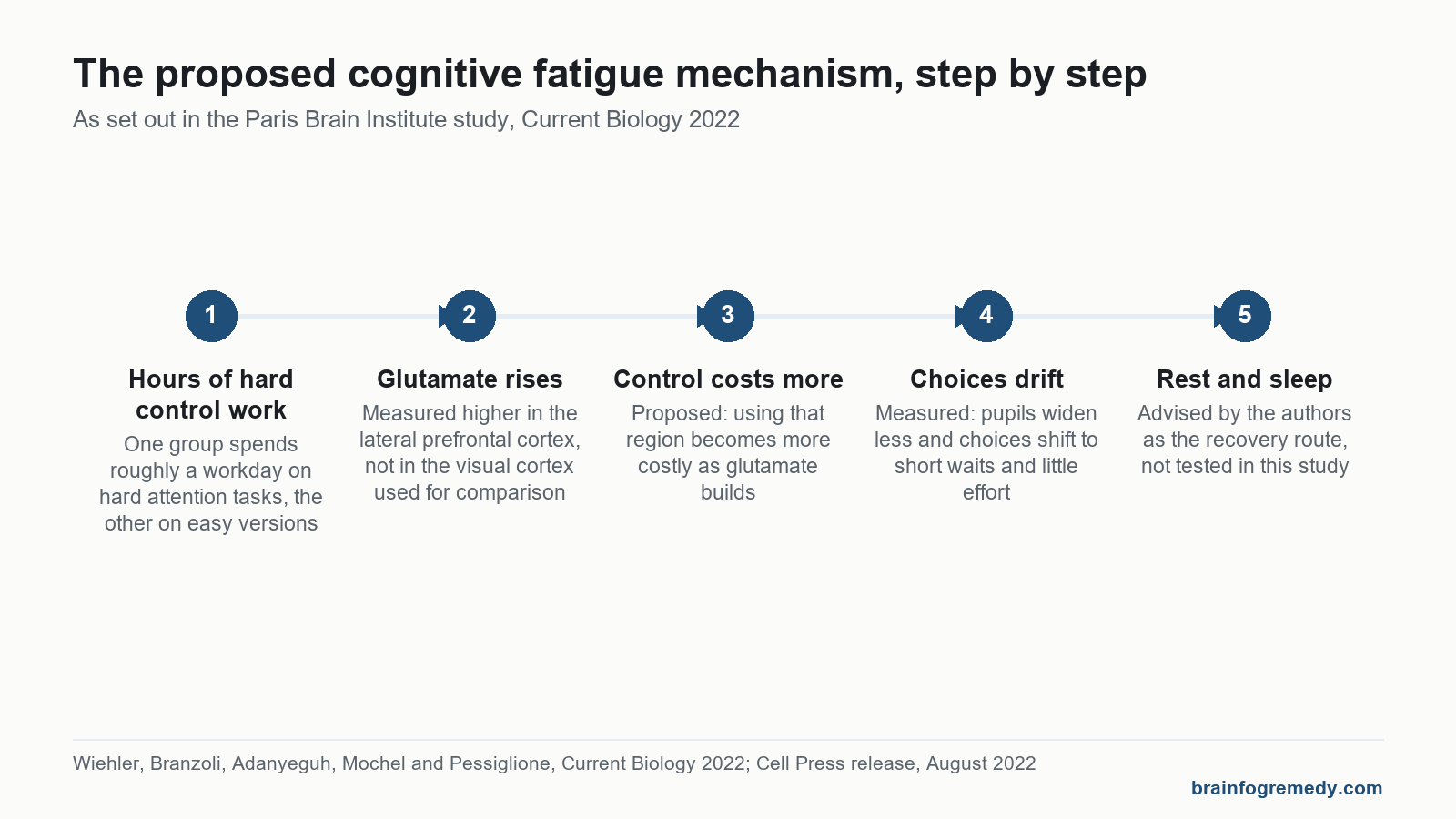
This is the 2022 study behind most of the headlines, published in Current Biology by Antonius Wiehler, Mathias Pessiglione and colleagues. The design is cleverer than the coverage made it sound. Volunteers were split into two groups and spent roughly a working day on attention tasks: one group got hard versions, the other easy versions of the same kinds of task. Between work sessions everyone made small money choices, such as a little cash now against more later, or a reward that needed less effort against one that needed more. The researchers measured chemicals in two brain regions with magnetic resonance spectroscopy: the lateral prefrontal cortex, which handles effortful control, and the primary visual cortex as a comparison.
By the end of the day, only the hard group showed the fatigue markers. Their pupils widened less while they decided, and their choices drifted towards the short wait and the little effort. They also had higher glutamate, a signalling chemical, in the prefrontal region, and not in the visual one. The authors proposed that fatigue is a regulation signal: using that region becomes more costly as glutamate builds, which nudges you to stop. Asked by Cell Press in the press release what to do about it, Pessiglione offered “good old recipes: rest and sleep”, and the release advises against making important decisions when tired. Science, it turns out, has also discovered the nap.
Here is how that study compares with three others that shaped the field, including the one that knocked the old willpower story off its pedestal.
| Study | Who took part | What they did | What changed | What it cannot tell you |
|---|---|---|---|---|
| Wiehler and colleagues, Current Biology, 2022 | 40 volunteers in two groups | About a workday of hard or easy attention tasks, with money choices in between and brain scans | The hard group chose quicker, easier rewards, pupils widened less, glutamate rose in the prefrontal cortex | Whether the glutamate causes the fatigue or simply travels with it |
| Steward, Looi and Chib, Journal of Neuroscience, 2025 | 28 adults (18 women, 10 men) | Repeated blocks of a letter memory task in a scanner, choosing whether to work for rewards before and after | Once fatigued, people turned down bigger rewards that needed more effort | Anything about fatigue lasting longer than one session |
| Dallaway, Lucas and Ring, Psychophysiology, 2022 | 90 people in three groups | Four 10 minute blocks of a demanding task or an easy one, each followed by a grip exercise | Feeling fatigued after 10 minutes; weaker grip from 20 minutes onwards | What happens across a whole day, or in anyone who is ill |
| Hagger and colleagues, Perspectives on Psychological Science, 2016 | 2,141 people in 23 labs | A standard version of the classic willpower depletion experiment, run identically everywhere | Almost nothing: an effect size of 0.04, statistically indistinguishable from zero | Whether other versions of the depletion idea hold up |
What did the effort choice study in the Journal of Neuroscience add?
It asked a narrower question: once you are cognitively fatigued, how does the brain decide whether more effort is worth it? In the 2025 study by Steward, Looi and Chib, 28 adults made choices about working for rewards inside a scanner, before and after bouts of a working memory task, the kind where you watch a stream of letters and flag any that matches the one shown a few places earlier. Once fatigued, they were more willing to turn down a bigger reward if it came with more effort.

The brain data suggested a relay. Activity in the dorsolateral prefrontal cortex, the region doing the memory work, rose as the fatiguing blocks piled up, and that signal appeared to feed into the insula, which the authors describe as computing what effort is worth. The neat point is that fatigue here is not a broken engine. Ability is still there; the price tag on using it has gone up. That fits the Paris finding closely, from a different lab and a different method.
Why do some scientists doubt the glutamate explanation?
Because one study is one study, and the method has real limits. A 2023 commentary in the Journal of Cerebral Blood Flow and Metabolism by Möller pointed out that spectroscopy estimates total glutamate in a patch of tissue; it cannot show whether the extra glutamate is outside the cells, which is where the toxic version of the story needs it to be. In 2025, Embrey and Inzlicht argued in Trends in Cognitive Sciences that motivational and computational theories already explain fatigue without any chemical waste, and that support for the metabolic part is still minimal. The Paris authors replied that there is no need to set the two kinds of theory against each other.
The field has been here before. For years the leading explanation was that self control drains a limited tank. Then a preregistered replication across 23 laboratories and 2,141 people found an effect so small it could not be told apart from zero. Meanwhile the opportunity cost model from Robert Kurzban and colleagues reframed effort as the brain pricing what else it could be doing. Here is where the main explanations stand.
| Explanation | The idea in one line | Where the evidence stands |
|---|---|---|
| Willpower as a fuel tank | Self control uses up a limited resource, so the second hard task goes worse | The 23 lab replication found almost no effect, which badly damaged it |
| Opportunity cost | Effort feels costly because the brain is weighing what else it could be doing | Influential and widely cited, but it predicts behaviour more readily than it predicts biology |
| Metabolic build up | Hours of control work leave glutamate in the prefrontal cortex, and fatigue makes you stop | One study, 40 people, a correlation; critics question both the scanner method and the need for it |
| MetaMotiF, the combined model | Fatigue starts for biological reasons and then shows up as changed motivation | A 2025 proposal from the Paris group; a framework to test, not a result |
The honest summary: everyone agrees cognitive fatigue changes how people weigh effort. Nobody yet agrees on the biology, and anyone selling a supplement to clear brain glutamate is several replications ahead of the evidence.
Where does the term turn up outside the lab?
Mostly in illnesses where people say thinking itself wears them out. In multiple sclerosis, a 2025 perspective in Frontiers in Neurology calls cognitive fatigue one of the most disabling symptoms and argues that short standard tests miss it, because people often score normally in a brief session and fade over a longer one. Its title sums it up: tired minds, normal scores. That is worth knowing if a quick memory test came back fine and you left the appointment feeling disbelieved.
In ME/CFS, the NICE guideline describes symptoms that can worsen after minimal cognitive or physical activity, typically 12 to 48 hours later, and it lists cognitive difficulties among the four key symptoms. That delay is quite unlike the lab version, which shows up within minutes or hours and eases with rest. One public account fits the guideline’s description: in a May 2026 post on the Humanistic Systems blog, a writer with long COVID and ME/CFS described webinars bringing on a crash within hours and wrote that a week of workshops took a week to recover from. That is one person’s report, not a finding, and we found no other recent first hand account we could link and date. Similar wording on a page does not mean the same thing is happening to you; only a clinician can work that out. For the wider picture, see our page on what extreme fatigue with brain fog can mean.
What do the researchers suggest doing with this?
Not much beyond the obvious, and they say so. The practical advice from the Paris team amounts to rest, sleep, and keeping big decisions away from the end of a draining day, because that is when choices drift towards whatever is quickest. None of that is a treatment, and none of the studies here tested a cure. If worry is part of what drains you, our page on why anxiety is so exhausting covers how that kind of tiredness works, and how one bad night lingers covers the sleep side. The checklist below turns the study’s advice into something you can use for one demanding day.

One demanding day: a planning checklist
Built from the Paris team’s own advice: rest, sleep, and keeping important decisions away from the tired end of the day. It plans a day; it does not assess or treat anything.
Ticks stay on this device. Tiredness that does not ease with rest, or worsens a day or two after effort, is worth raising with a GP.
When is cognitive fatigue worth seeing a doctor about?
Tiredness after a hard day of thinking is normal. The NHS advises seeing a GP if you have felt tired for several weeks without knowing why, if it is affecting daily life, or if it comes with other changes such as weight loss or low mood. Tell them if mental effort makes you worse a day or two later, if tiredness has arrived after an infection, or if thinking feels slower than it used to.
Nothing on this page can tell you why you feel the way you do, and it is not trying to. If you want help putting it into words for an appointment, our guide on how to describe brain fog so a doctor takes you seriously was written for exactly that.
Frequently asked questions
Is cognitive fatigue the same as mental fatigue?
Researchers mostly use the two terms for the same state: tiredness brought on by sustained demanding mental work. Some reserve cognitive fatigue for the measurable change in performance or choices rather than the feeling.
How long does it take for cognitive fatigue to set in?
Faster than most people expect. In a 2022 study of 90 people, fatigue ratings rose within the first 10 minutes of a demanding task, and grip strength fell from 20 minutes.
Does cognitive fatigue make you worse at everything?
Not necessarily. In the studies on this page the clearest change was in choices, with people less willing to spend effort, and in multiple sclerosis people often score normally on short tests while still fading.
Can a brain scan show cognitive fatigue?
Only in research settings. The Paris study used magnetic resonance spectroscopy to measure glutamate, but there is no clinical scan that diagnoses cognitive fatigue.
Is the glutamate finding proven?
No. It comes from one study of 40 people, it shows a correlation, and other scientists have questioned the method. It needs replicating before it can be treated as settled.
Does sleep clear cognitive fatigue?
The Paris researchers pointed to rest and sleep as the main recovery routes. Ordinary fatigue from a hard day usually eases with rest; tiredness that does not is worth discussing with a GP.
Finished the page? The same five questions from the top, to see what stuck.
This article is general information, not medical advice, and is not a substitute for care from a qualified healthcare professional. Speak to your doctor about your own situation.
Leave a Reply