
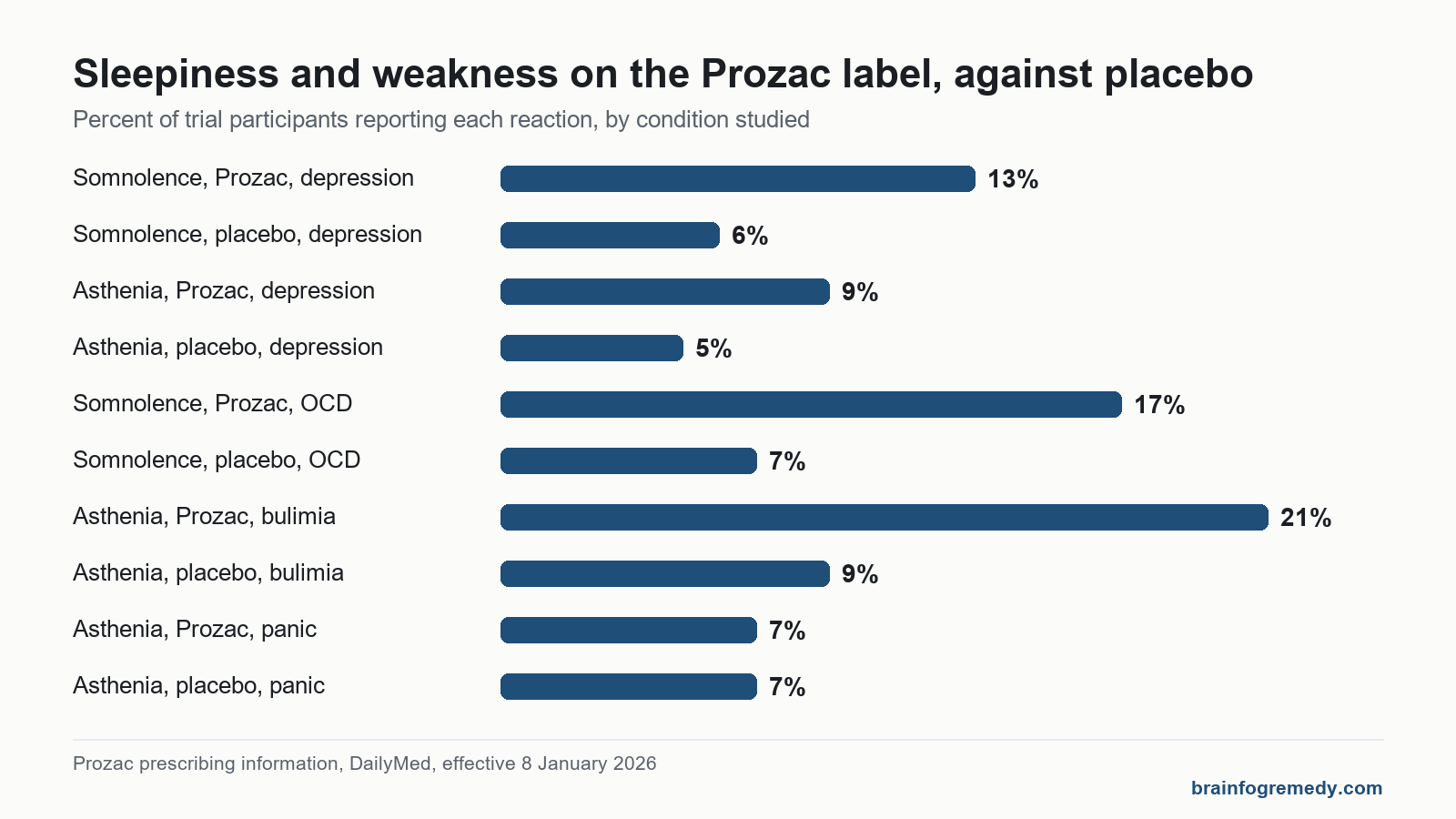
Prozac brain fog is not a phrase the fluoxetine label uses. Its depression trials list somnolence in 13 percent of people against 6 percent on placebo, and asthenia, or weakness, in 9 against 5. “Thinking abnormal” appears at 2 against 1. And because fluoxetine lingers for weeks, any change arrives slowly.
Listen to this article, about 13 minutes. A synthetic voice reads the article and announces each section title as it begins; tables are read row by row and the questions at the end are left out.
Recorded 27 October 2026 from the article as published that day. Press a chapter to jump there; the highlighted line is what is playing. A play button sits beside every section heading, and once you scroll past this player a bar at the bottom of the screen keeps the controls in reach. Tap or click any sentence to hear the reading start from there.
On this page: the Prozac label rows for sleepiness and weakness split by condition, the half life figures that explain why changes arrive weeks late, the FDA report counts for fluoxetine, and what forty dated WebMD reviews and two recent Reddit threads described.
Think you already know this? Five questions, one minute.
Every answer is on this page. Answer from what you know now; the page fills in the rest.
-
1. Across all four conditions pooled on the Prozac label, how often was somnolence reported compared with placebo?
The Prozac label on DailyMed gives somnolence at 12 percent on Prozac against 5 percent on placebo in the pooled trials, with 2,869 and 1,673 people. Read the section
-
2. In which trials on the Prozac label was asthenia reported at the same rate on Prozac and placebo?
Table 3 of the Prozac label lists asthenia at 7 percent against 7 percent in the panic disorder trials, against 21 percent and 9 percent in the bulimia trials. Read the section
-
3. What half life does the Prozac label give for norfluoxetine, the active metabolite?
The Prozac label gives norfluoxetine an elimination half life of 4 to 16 days, and says dose changes will not be fully reflected in the blood for several weeks. Read the section
-
4. How many of the nine trials in the Rosenblat, Kakar and McIntyre meta-analysis tested fluoxetine?
The Rosenblat, Kakar and McIntyre meta-analysis pooled nine trials with 2,550 people, and none of them tested fluoxetine, so it says nothing direct about Prozac. Read the section
-
5. Where does the MedlinePlus fluoxetine page place problems with thinking, concentration or memory?
The MedlinePlus fluoxetine page, last revised 15 November 2025, lists them among the effects to call a doctor about immediately, and says not to stop fluoxetine without talking to your doctor. Read the section
That last point is what makes Prozac different from its cousins. Most of what you will read about SSRI brain fog treats the drugs as interchangeable. On the one thing that shapes how fog comes and goes, timing, fluoxetine is in a class of its own. This page sets out what the label measured, what it did not, and why the clock matters.
Does Prozac cause brain fog?
Not by that name. The Prozac prescribing information on DailyMed, in the version effective from 8 January 2026, reports reactions from placebo controlled trials in depression, OCD, bulimia and panic disorder. Across all four, 2,869 people took Prozac and 1,673 took placebo. Somnolence was reported by 12 percent on Prozac against 5 percent on placebo, and asthenia, the label’s word for weakness or lack of energy, by 11 against 6.
Thinking itself gets one row and two mentions. The pooled table lists “thinking abnormal” at 2 percent against 1 percent. Memory impairment turns up only in a list of reactions reported after approval, with no rate and no placebo to compare against. And section 5.13 says that, as with any drug acting on the brain, Prozac has the potential to impair judgment, thinking or motor skills. That is the label in full on cognition. Sleepiness and weakness have numbers. Slowed thinking has one small row and a general caution.
What do the Prozac label rows show for each condition?
The label is unusual in splitting its main table by condition, which shows how much the numbers move depending on who was in the trial. These are the two rows closest to what people mean by fog.
| Trials on the label | People on Prozac and placebo | Somnolence | Asthenia (weakness) | Source |
|---|---|---|---|---|
| Depression | 1,728 and 975 | 13% against 6% | 9% against 5% | Prozac label, January 2026 |
| OCD | 266 and 89 | 17% against 7% | 15% against 11% | Prozac label, January 2026 |
| Bulimia | 450 and 267 | 13% against 5% | 21% against 9% | Prozac label, January 2026 |
| Panic disorder | 425 and 342 | 5% against 2% | 7% against 7% | Prozac label, January 2026 |
| All four pooled | 2,869 and 1,673 | 12% against 5% | 11% against 6% | Prozac label, January 2026 |
The spread is wide. In the bulimia trials asthenia ran at 21 percent on Prozac against 9 on placebo. In the panic trials it was 7 against 7, no difference at all. Somnolence ran from 5 percent in panic disorder to 17 in OCD. The label does not explain the gaps, and they may reflect doses, trial lengths or the people enrolled rather than the conditions themselves. This page will not invent a reason. Insomnia, worth noting beside sleepiness, ran at 16 against 9 in the depression trials, so the same drug appears on both sides of the sleep ledger.
Why does the long half life of Prozac matter for brain fog?
Because it changes the timeline of everything. The Prozac label gives fluoxetine an elimination half life of 1 to 3 days after a first dose and 4 to 6 days in chronic use. Its active metabolite, norfluoxetine, has a half life of 4 to 16 days. Steady levels arrive only after about 4 to 5 weeks of dosing.
Section 5.14 of the label draws the consequence plainly: changes in dose will not be fully reflected in the blood for several weeks. It adds that, even after dosing stops, active drug will persist in the body for weeks. For anyone trying to work out whether a foggy spell lines up with the medicine, that matters. A change made this week may not show itself until next month. The comparison with the two SSRIs this site has already covered makes the point.
| Label fact | Prozac (fluoxetine) | Lexapro (escitalopram) | Zoloft (sertraline) |
|---|---|---|---|
| Somnolence against placebo | 13% against 6%, depression trials | 6% against 2%, depression trials | 11% against 6%, pooled trials |
| Tiredness row against placebo | Asthenia 9% against 5% | Fatigue 5% against 2% | Fatigue 12% against 8% |
| Memory or concentration row | None | None | None |
| Half life stated on the label | 4 to 6 days in chronic use, plus 4 to 16 days for norfluoxetine | About 27 to 32 hours | Not compared here |
| Label read | January 2026 version | January 2026 version | August 2023 version |

Our pages on what the Lexapro label lists for brain fog and the Zoloft label rows nearest to fog carry the full tables for those drugs. The pattern repeats on all three labels: sleepiness and tiredness a few points above placebo, and no row for memory anywhere.
Do antidepressants slow thinking, according to the trials?
The pooled trial evidence points, if anything, the other way, though not for Prozac specifically. A meta-analysis by Rosenblat, Kakar and McIntyre in the International Journal of Neuropsychopharmacology pooled nine placebo controlled trials with 2,550 people with depression. Antidepressants showed small benefits on psychomotor speed and delayed recall, and the psychomotor result lost significance once vortioxetine was removed. None of the nine trials tested fluoxetine, so it says nothing direct about this drug.
Feeling numb is a separate question that often gets folded into fog. In the Goodwin and colleagues, 2017 survey of 669 people taking antidepressants for depression, about 46 percent reported emotional blunting, and the rate did not differ by drug class. Depression has its own fog too, covered on our page about why depression can make your head feel foggy, which is part of why a drug effect and a symptom are so hard to tell apart.
What do people taking Prozac report about brain fog?
Forty patient reviews on WebMD were read for this page, the first two pages of the site’s own listing, dated March 2023 to January 2026, from a pool of 2,282. Two threads from the r/prozac forum on Reddit, posted in September and October 2026, were read alongside them. These are accounts, not findings, and nothing in them tells a reader what is happening to them.
Not one of the forty WebMD reviewers used the phrase “brain fog”. What they described instead was mostly about feeling. Six described feeling numb, flat or like a zombie: one in January 2026 said the medicine eased irritability by leaving them unable to feel much at all, and a long term reviewer in December 2023 said higher doses brought more fatigue and a little numbness, a trade they accepted. Three described tiredness. Only two touched thinking: one in September 2024 felt confused and exhausted in their second week, and one in April 2023 said their memory got worse at the start and later returned to where it was. Two more cut the other way, one describing a quieter mind, and one saying they had stopped sleeping all day after switching from Zoloft. Thirty one of the forty mentioned none of these things. These are in the WebMD fluoxetine reviews and the second page of them.
Reddit is where the phrase lives. In an October 2026 thread on r/prozac, a poster on fluoxetine for 15 years asked whether others found it fogging. Of the six replies from other users, two said it caused some fog and four said their thinking was clearer than before, or never foggy at all. The poster later wondered whether the fog came from a recent dose reduction rather than the drug itself, which is exactly the kind of question the long half life makes hard to answer alone. In a September 2026 thread, a poster two weeks in described feeling calmer but tired and foggy at work. Five days later they reported more energy after changing the time of day they took it, a change for a prescriber or pharmacist to weigh in on, not one to copy from a forum.
Reports to the regulator show the same shape at scale. The FDA adverse event system holds voluntary reports from doctors, companies and patients, and among reports naming fluoxetine these terms rank as follows.
| Reaction term in reports naming fluoxetine | Reports | Rank among all terms |
|---|---|---|
| Fatigue | 7,713 | 3rd |
| Asthenia | 3,641 | 20th |
| Somnolence | 3,572 | 22nd |
| Confusional state | 2,649 | 31st |
| Memory impairment | 1,995 | 52nd |
| Disturbance in attention | 1,349 | 79th |
Fatigue is the third most reported term of all, behind only “drug ineffective” and nausea. Memory impairment sits fifty second. Tiredness first, thinking further down, and no term called fog: the same order as the label and the reviews. The bupropion label shows a similar gap, set out on our page on what the Wellbutrin label says about brain fog.

When should you talk to the prescriber about Prozac brain fog?
The MedlinePlus fluoxetine page, last revised 15 November 2025, lists headache, unsteadiness, and problems with thinking, concentration or memory among the effects to call a doctor about immediately. It says not to stop taking fluoxetine without talking to your doctor, and not to drive or operate machinery until you know how the medicine affects you.
The label gives one reason that matters most for older readers. Section 5.9 says SSRIs, including Prozac, have been linked to low blood sodium, with signs that include headache, difficulty concentrating, memory impairment, confusion, weakness and unsteadiness, and that elderly patients may be at greater risk. New confusion is a reason to call promptly rather than wait. Section 5.15 lists confusion and lethargy among symptoms reported after stopping SSRIs and recommends reducing gradually rather than stopping abruptly whenever possible. Nothing on this page is a reason to change a dose on your own.
What makes the appointment useful is precision. Say whether the problem is sleepy, flat or slow, because each has different evidence behind it. Say when it started relative to starting or changing the dose, and remember that with fluoxetine the two can sit weeks apart. Say how you are sleeping, since brain fog from lack of sleep looks much like any other kind. And say what else has changed, because ordinary causes of fog keep going while a medicine is being tried.
What to tell the prescriber about Prozac and fog
A list of things worth saying at the appointment. Tick what you have noted down. It scores nothing, it does not say what anything means, and it never suggests changing a dose.
General information only. Do not stop or change a medicine without talking to the prescriber.
Frequently asked questions
How long does Prozac brain fog last?
The label gives no duration for sleepiness or weakness. MedlinePlus says it may take 4 to 5 weeks or longer to feel the full benefit, and the label says steady levels take about the same. Reviewers describe tiredness that faded and tiredness that stayed, which is a range of reports, not a prediction.
Does Prozac affect memory?
Its trial tables carry no memory row. Memory impairment appears only in the label’s list of reports after approval, with no rate. MedlinePlus lists problems with thinking, concentration or memory as effects to call a doctor about immediately.
Is Prozac more sedating than Lexapro?
The labels cannot settle it. Prozac depression trials show somnolence at 13 percent against 6 on placebo and Lexapro depression trials 6 against 2, but the trials used different people, doses and years.
Can I drive if Prozac makes me foggy?
MedlinePlus says not to drive a car or operate machinery until you know how fluoxetine affects you, and the label gives the same caution for hazardous machinery, including cars.
Why might fog show up weeks after a Prozac dose change?
The label says changes in dose will not be fully reflected in the blood for several weeks, because fluoxetine and norfluoxetine leave the body slowly. That delay is worth mentioning when describing the timeline to a prescriber.
Does stopping Prozac cause brain fog?
The label lists confusion and lethargy among symptoms reported after stopping SSRIs, notes that fluoxetine levels fall gradually, and recommends reducing rather than stopping abruptly whenever possible. Any change belongs to a conversation with the prescriber.
Finished the page? The same five questions from the top, to see what stuck.
This article is general information, not medical advice, and is not a substitute for care from a qualified healthcare professional. Speak to your doctor about your own situation.
Leave a Reply