
B12 deficiency brain fog is recognised in official guidance: NICE lists cognitive difficulty, and uses the phrase brain fog, among the common signs. The contested part is the blood test. A result between 180 and 350 ng/L is officially indeterminate, guidelines disagree about which second test should follow, and laboratories disagree about where normal starts.
Listen to this article, about 14 minutes. A synthetic voice reads the article and announces each section title as it begins; tables are read row by row and the questions at the end are left out.
Recorded 26 September 2026 from the article as published that day. Press a chapter to jump there; the highlighted line is what is playing. A play button sits beside every section heading, and once you scroll past this player a bar at the bottom of the screen keeps the controls in reach. Tap or click any sentence to hear the reading start from there.
On this page: the band NICE calls indeterminate, the four manufacturers’ own reference limits that move where normal starts, a table of what each guideline says should follow, and what 1,117 people reported about the wait for an answer.
Think you already know this? Five questions, one minute.
Every answer is on this page. Answer from what you know now; the page fills in the rest.
-
1. Under NG239, which range of total B12 is labelled an indeterminate result?
NICE guideline NG239 calls below 180 ng/L confirmed deficiency and above 350 ng/L unlikely. The band between them is labelled indeterminate, meaning possible deficiency. Read the section
-
2. The lower reference limits that assay manufacturers state for serum B12 span roughly which range?
A 2025 analysis in the Journal of Laboratory and Precision Medicine lists 145 ng/L for Beckman and 211 for Siemens, with Abbott and Roche in between, and notes that results from different immunoassays are not interchangeable. Read the section
-
3. What does NICE say should be considered after an indeterminate result in someone who has symptoms or signs?
NICE guideline NG239 says consider a further test measuring serum MMA. Its own rationale adds that there are no generally accepted reference ranges for serum MMA or plasma homocysteine. Read the section
-
4. In the survey of 1,117 Pernicious Anaemia Society members, how long did most of the highest symptom group say their symptoms had run before diagnosis?
Morris and colleagues in Frontiers in Medicine report 56.9% of that group saying more than two years, against 2.5% diagnosed inside six months. The authors note that society members self select towards severe cases. Read the section
-
5. What did the largest pooled analysis of B12 supplementation find for cognitive function?
Markun and colleagues in Nutrients pooled 16 randomised trials and 6,276 participants, rated the evidence moderate quality, and found no association between the effect and anyone’s starting B12 level. Read the section
Can a B12 deficiency really cause brain fog?
Yes, and unusually for this subject the guidance says so in the reader’s own words. NICE guideline NG239, published on 6 March 2024 and still current when this page was checked on 26 September 2026, lists among the common symptoms and signs of vitamin B12 deficiency “cognitive difficulties such as difficulty concentrating or short-term memory loss (sometimes described as ‘brain fog’)”, adding in the same line that those can also be symptoms of delirium or dementia.
The same guideline then sets a gate. Testing is offered to people with at least one common symptom and at least one common risk factor, with clinical judgement deciding for people who have symptoms and no risk factor. The list is specific: a diet low in or excluding animal foods, atrophic gastritis, coeliac disease or another autoimmune condition, previous gastric or ileal surgery, a family history, recreational nitrous oxide use, and medicines including metformin and long term acid suppression. Those are risk factors, not reasons to change a prescription. This question sits beside the low iron one as the other half of the deficiency pair, and inside the causes worth checking first.
What does a borderline B12 result actually mean?
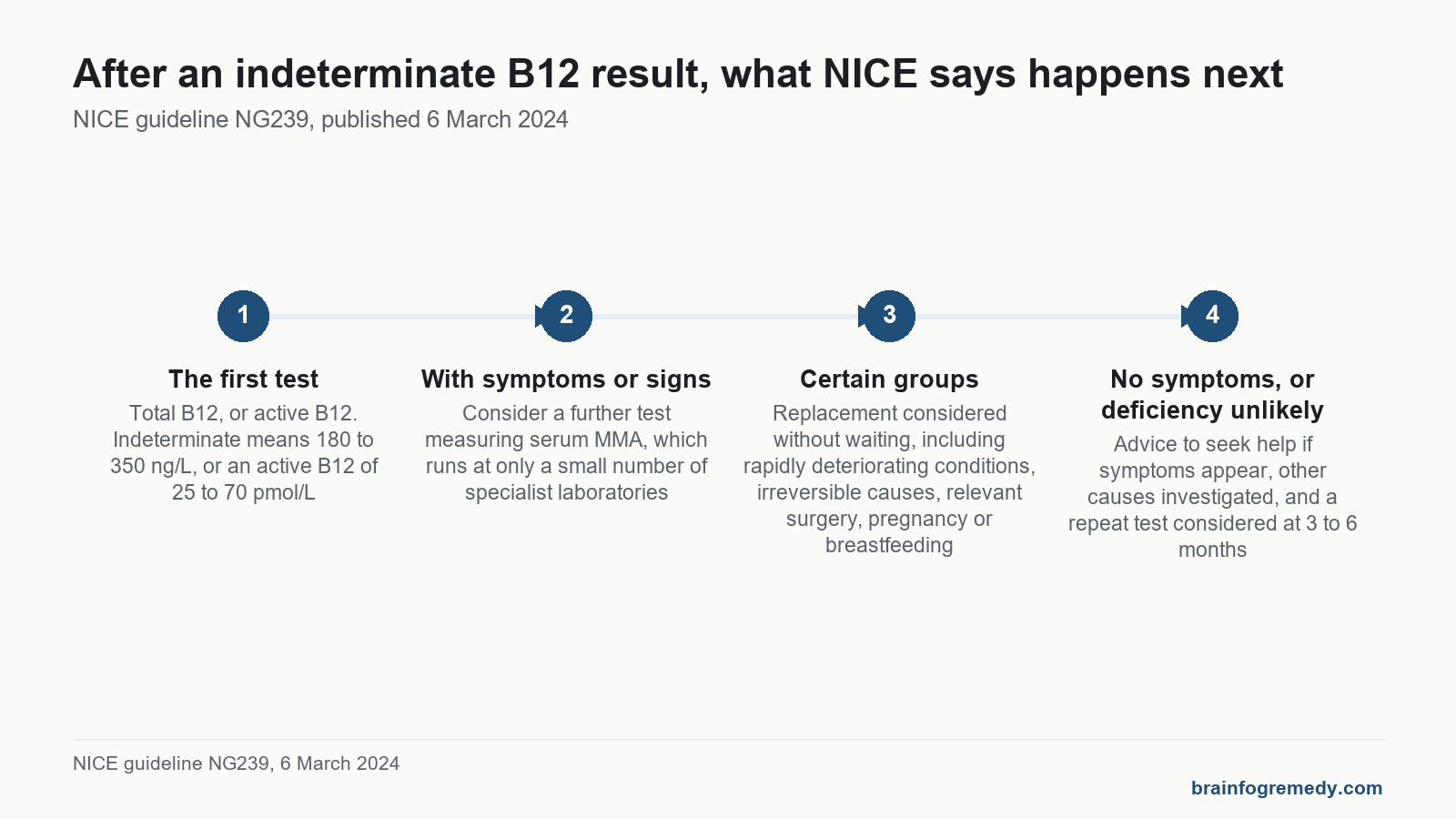
It means the number landed in a band the guideline itself calls indeterminate. NG239 splits total B12 three ways: below 180 ng/L, which is 133 pmol/L, is confirmed deficiency; 180 to 350 ng/L, or 133 to 258 pmol/L, is indeterminate, meaning possible deficiency; above 350 ng/L means deficiency is unlikely. Where active B12, or holotranscobalamin, was measured instead, the same three verdicts sit below 25 pmol/L, at 25 to 70 pmol/L, and above 70.
That middle band is wide because the standard test measures more than it needs to. Serum B12 counts total cobalamin, about 80% of which is bound to haptocorrin and unavailable to your cells; holotranscobalamin, the fraction that is available, makes up 6% to 20% of the total, per Hannibal and colleagues in Frontiers in Molecular Biosciences in 2016. NICE’s own committee put the consequence plainly: a low total B12 does not necessarily indicate deficiency, a high one does not necessarily exclude it, and it is not known how B12 in the blood relates to B12 in the central nervous system. For an article about thinking, that last clause is the whole problem.
Why do two laboratories disagree about the same sample?
Because they are allowed to. NG239’s own table offers the alternative of using laboratory thresholds, and the British Society for Haematology guideline on cobalamin and folate disorders states that definitive cut off points are not possible given the variety of methodologies, so local reference ranges should be established.
The size of the gap is measurable. A 2025 analysis in the Journal of Laboratory and Precision Medicine listed the lower reference limits the manufacturers state themselves: 145 ng/L for Beckman, 187 for Abbott, 197 for Roche and 211 for Siemens, and noted that results from different immunoassays are not interchangeable even after the WHO international standard was adopted. A result of 190 ng/L is below normal on one platform and comfortably normal on another. The BMJ therapeutics review of vitamin B12, from 20 November 2023, adds day to day movement: a serum B12 of 150 pmol/L one day may read 120 pmol/L the next. NG239 notes UK cohort evidence that people of Black ethnicity may have a higher reference range than people of White or Asian ethnicity, while one range is still used for everyone.
That is a great deal of variation to hang a verdict on, and considerably more than the six question online quiz that diagnosed you in ninety seconds and recommended a detox.

Which follow up test does each guideline recommend?
Three of the four bodies below land on the same second test, serum methylmalonic acid, which rises when cells are short of B12 even while the serum number looks acceptable. They disagree about the band that triggers it, about what else belongs alongside it, and about how much weight the first number deserves at all.
| Guidance | What it calls a borderline result | What it says should follow | The catch it admits |
|---|---|---|---|
| NICE guideline NG239, UK, 6 March 2024 | Total B12 of 180 to 350 ng/L, or active B12 of 25 to 70 pmol/L, labelled indeterminate | Consider a further test measuring serum MMA in people who have symptoms or signs | Its own rationale says there are no generally accepted reference ranges for serum MMA or plasma homocysteine |
| British Society for Haematology guideline on cobalamin and folate disorders, 2014 | No single band. Above 148 pmol/L, roughly 200 ng/L, can still be deficiency, and 110 to 148 pmol/L is called an indeterminate zone | MMA, total homocysteine or holotranscobalamin, graded 1C, with the serum test repeated after one to two months where the result is of uncertain significance | Says plainly that the clinical picture matters most because no gold standard test exists, and that local reference ranges should be set locally |
| American Academy of Family Physicians review, US, 2017 | 200 to 350 pg/mL described as low normal | Serum MMA to confirm deficiency in asymptomatic patients at high risk | Notes that about half of patients with subclinical disease have a B12 result inside the normal range |
| BMJ therapeutics review of vitamin B12, 20 November 2023 | 148 to 300 pmol/L treated as borderline | MMA and homocysteine may help establish deficiency at those levels | MMA was normal in 52% of people whose active B12 was below 20 pmol/L, a level taken to indicate deficiency |
Two things follow from those rows. The first is arithmetic: 180 ng/L is the same number as 180 pg/mL, so NICE’s confirmed deficiency line sits below the 200 that both the haematology guideline and US practice treat as the floor of normal. A result of 190 is worth an MMA test in one system and probable deficiency in the other. The second is logistics: the Association for Laboratory Medicine’s summary of NG239 warned its members that MMA analysis runs at only a small number of specialist laboratories, so the recommended confirmation means a referral and a cost, against a marker NG239 admits has no agreed reference range.
What do people with a borderline B12 result actually report?
Read this section as testimony rather than evidence. It is what people say happened to them, not a finding about what B12 does, and none of it establishes a cause for anyone’s symptoms.
The largest published collection is a survey of 1,117 members of the Pernicious Anaemia Society, reanalysed by Morris and colleagues in Frontiers in Medicine on 18 September 2026, which sorted the answers into three groups. In the highest symptom group of 334 people, 98.5% reported poor concentration and 97.9% memory loss, and 56.9% said symptoms had run for more than two years before a diagnosis arrived, with 2.5% diagnosed inside six months. The lowest group of 170 cuts against that: 32.4% reported poor concentration and 21.8% were diagnosed within six months. The authors are candid that society members self select towards severe cases, that answers were self reported rather than taken from records, and that the survey ran from 2010 to 2012, before the 2024 guideline existed.
Three public threads, carrying about ninety replies between them, say something a survey cannot. On Mumsnet in June 2024, a poster with fatigue, tingling and brain fog reported a B12 of 161 ng/L against a laboratory range printed as 145 to 910, and being told it was in range. That range’s floor sits 35 ng/L below NICE’s confirmed deficiency line, which is the reference range problem arriving in somebody’s kitchen. Forty eight replies followed and not one mentioned MMA or active B12. In March 2025, another poster was told the result was borderline, neither in nor out, and found their own records had sat at the low end since 2005 unflagged. In April 2026, a thread of 37 replies turned on serum against active B12, and on samples taken after treatment reading high while symptoms continued, the masking effect NG239 warns clinicians about.
Where the accounts and the guidance agree: the indeterminate band is an unresolved place to sit, and NG239’s committee said so itself when it named the unmet need of people with borderline total B12 results. Where they part company: several of those threads contain people arranging treatment for themselves. Nothing in the evidence supports doing that, and a neurological symptom is not the place to experiment. Take the number and the printed reference range to a clinician instead.
Does correcting a low B12 clear the fog?
The trials have not shown that it does, which is not the same as showing that it does not. The largest synthesis is Markun and colleagues in Nutrients in 2021: 16 randomised trials and 6,276 participants, no evidence of an effect of B12 alone or a B complex on any subdomain of cognitive function, rated moderate quality, with no association between the effect and anyone’s starting B12 level. The older Cochrane review of vitamin B12 for cognition, from 2003, found no significant effect across three trials in people who had dementia and a low B12, and said uncertainty about the diagnostic criteria for deficiency made pooling the trials difficult.
Both were largely run in older adults, often with dementia, and scored on cognitive test batteries. That is neither the population nor the outcome of a forty year old who cannot hold a sentence together by Thursday afternoon, and nobody has run a trial of B12 in people whose main complaint is brain fog, because brain fog is not a scored outcome in this literature. A confirmed deficiency is treated for reasons that reach well beyond thinking, including nerve damage that does not always reverse, and that decision belongs with a clinician. What the evidence does not support is buying a high dose supplement off a borderline number and expecting the fog to lift by Friday, which is covered on whether brain supplements work and in what the vitamin evidence actually shows.

What is worth asking at the appointment?
Nothing below interprets a result, because a result is not interpretable from a web page. These are the questions the guideline text itself makes worth asking: which test was run, total B12 or active B12; what the laboratory’s own reference range is, in the units it reported; whether the number falls inside the 180 to 350 ng/L indeterminate band; whether serum MMA or homocysteine is available locally and indicated here; whether any supplement containing B12 was being taken before the sample; which NG239 risk factors apply; and whether a repeat test has a role, and when.
Those seven will not tell you what you have. They tell you what was measured, which beats a number with no range beside it. For the vocabulary underneath all of this, what brain fog actually means is the place to start.
Seven questions to take to the appointment
Drawn from the wording of NG239 and the haematology guideline, not from anyone’s opinion. Nothing here scores, interprets or diagnoses a result.
Ticks are saved on this device only. These are questions to ask, not a result: nothing here interprets your own numbers.
When should brain fog be taken to a doctor?
Straight answer, no jokes here. Seek medical help urgently for new numbness or pins and needles, unsteadiness on your feet, sudden confusion, or problems with vision. Those are the neurological signs the guideline treats as time critical, and NG239 is explicit that replacement should not be delayed while waiting for results where megaloblastic anaemia and neurological symptoms are suspected.
Book an ordinary appointment for fog lasting weeks, for fog alongside any NG239 risk factor, and for any new change in memory or concentration. Never stop or change a prescribed medicine on the strength of anything you have read online, including this page. If an earlier result was called borderline and the symptoms are still there, that is a reason to go back, not a verdict.
Frequently asked questions
Is active B12 a better test than total B12?
NICE treats total B12 and active B12 as alternatives for the first test, and prefers active B12 in pregnancy. The BMJ therapeutics review notes that active B12 also has a wide indeterminate window and that its reference values depend strongly on the assay used, so it narrows the problem rather than removing it.
Can brain fog come from a B12 problem when the result is normal?
Guidance accepts that a result inside the reference range does not exclude deficiency, which is why second line tests exist. That is not the same as a normal result meaning nothing: it means the number is one input, weighed against symptoms, risk factors and, where indicated, a functional marker such as MMA. Only a clinician can do that weighing.
How quickly would thinking improve if a deficiency were treated?
There is no reliable figure, and the trials that measured cognition in supplemented adults found no average effect. Accounts from patients range from weeks to years, and the largest patient survey found more than half of the most affected group had symptoms for over two years before diagnosis. Treatment and its timing are decisions for a clinician.
Does a vegan diet make a B12 test more likely to be offered?
Under NG239 a diet that excludes or is low in animal source foods is one of the listed common risk factors, and a test is offered when at least one risk factor and at least one symptom or sign are present. Diets excluding meat for religious reasons and restricted diets are listed in the same group.
Is recreational nitrous oxide use relevant to a B12 result?
NG239 lists it as a common risk factor because nitrous oxide inactivates B12 in the body, and the guideline says to measure plasma homocysteine or serum MMA first, rather than B12, where recreational use is suspected. The committee also noted the evidence base here is thin, because prospective studies are hard to run.
Is a high B12 result reassuring?
Not on its own. The guidance is explicit that a high concentration does not necessarily exclude deficiency, and NG239 warns that an over the counter preparation containing B12 can raise the measured concentration without treating a deficiency, masking it. The combined oral contraceptive pill works the other way, lowering total B12 without causing deficiency. A high result with continuing symptoms is a reason to ask what else was measured.
Finished the page? The same five questions from the top, to see what stuck.
This article is general information, not medical advice, and is not a substitute for care from a qualified healthcare professional. Speak to your doctor about your own situation.
Leave a Reply