
Keto brain fog covers two separate questions with two different answers. Fog in the first days of a ketogenic diet is widely reported, turning up in about one in ten adult accounts. Whether keto lifts fog you already had is a different matter, and the controlled trials in adults without dementia found no cognitive change at all.
Listen to this article, about 12 minutes. A synthetic voice reads the article and announces each section title as it begins; tables are read row by row and the questions at the end are left out.
Recorded 25 September 2026 from the article as published that day. Press a chapter to jump there; the highlighted line is what is playing. A play button sits beside every section heading, and once you scroll past this player a bar at the bottom of the screen keeps the controls in reach. Tap or click any sentence to hear the reading start from there.
On this page: the eight forum posts behind the famous keto flu timeline, a table of what each of five trials actually measured, and the line a 2025 review drew under the electrolyte explanation.
Think you already know this? Five questions, one minute.
Every answer is on this page. Answer from what you know now; the page fills in the rest.
-
1. The confident keto flu day counts on product pages trace back to what kind of source?
Bostock and colleagues read 448 posts from 300 accounts and found 101 personal descriptions. Only eight said outright when their symptoms stopped, spanning day 3 to day 30. Read the section
-
2. How many of the five studies in the table measured brain fog with a validated scale?
Every one scored cognitive tests instead. A twelve item brain fog scale was validated in 2024, for coeliac disease, and nobody has yet used it in a ketogenic diet trial. Read the section
-
3. What did the 52 week randomised trial in 115 adults with type 2 diabetes find?
The British Journal of Nutrition trial found no difference between the two diets, and the gains that did appear over time looked like practice effects. Read the section
-
4. What did the 2025 review conclude about linking keto flu symptoms to electrolyte loss?
The 2025 scoping review reported that it did not identify one study documenting both, and concluded the causal relationship still needs confirming. Read the section
-
5. In the 2026 pooled analysis of exogenous ketones, how well did the studies agree with each other?
The pooled analysis found a small overall effect, a standardised mean difference of 0.29, with heterogeneity of 91%, so the single number should be held loosely. Read the section
Does starting keto cause brain fog?
Reported, yes. Measured, barely. A 2025 scoping review of symptoms during ketogenic diet initiation pulled together 89 studies on what happens in the first weeks and found brain fog described by roughly 10% of adults in healthy populations, alongside fatigue in 18% to 25%, headache in 8% to 25% and muscle cramps in 3% to 37%. In children on a supervised ketogenic diet, no cases of brain fog were reported at all, which is a clue worth holding onto: children on the diet are usually fed it precisely, indoors, by a dietitian.
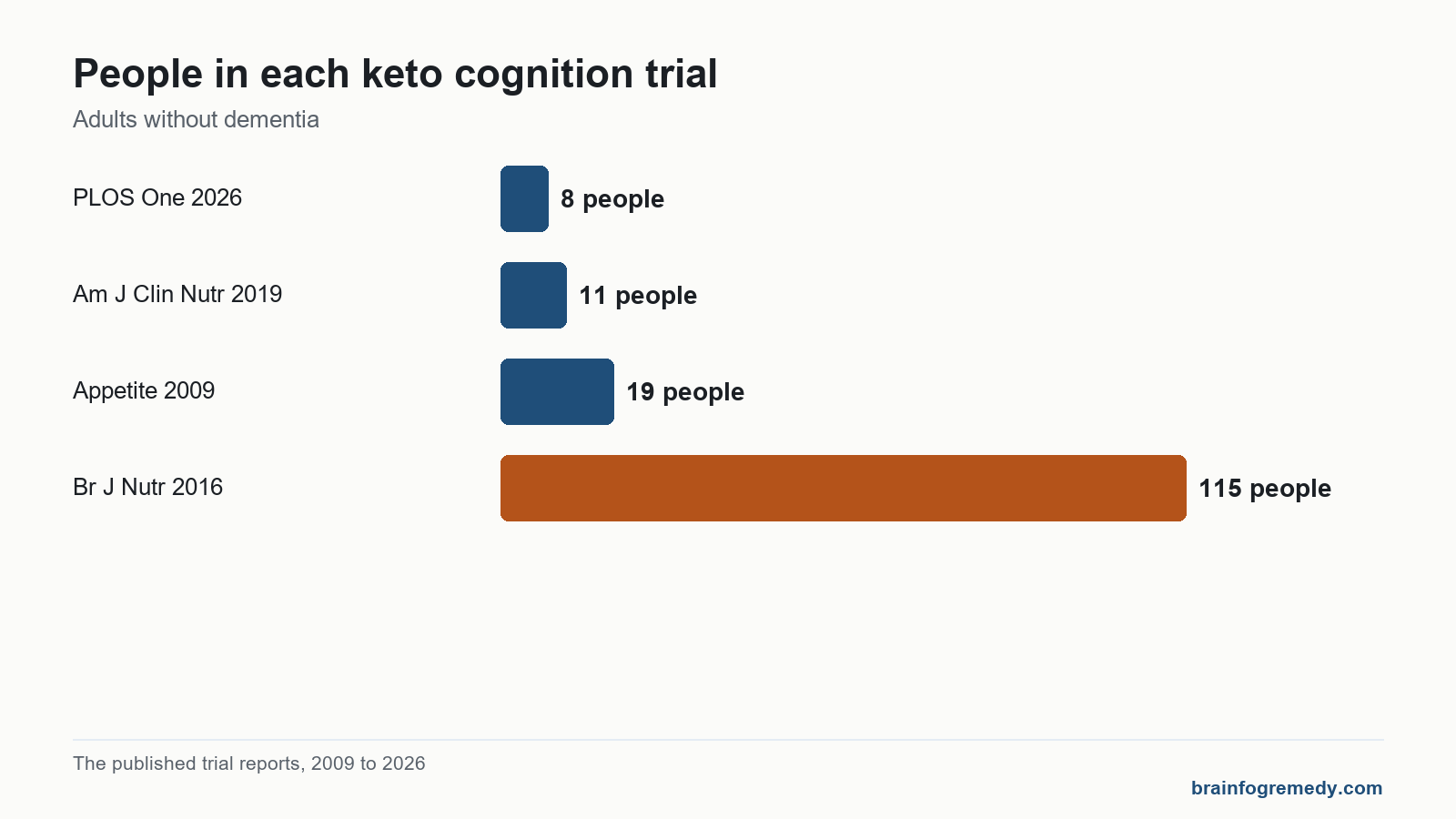
The one study built around the exact question, D’Anci and colleagues, writing in Appetite in 2009, followed 19 women who had chosen either a low carbohydrate diet or a balanced reduced calorie one, and tested them at 48 hours and then weekly. The low carbohydrate group did worse on memory based tasks during complete carbohydrate withdrawal, and performance came back when carbohydrate did. Nineteen self selected women is not a randomised trial, and the authors did not pretend otherwise. It is still the closest thing anyone has run.
The proposed mechanism is unglamorous and plausible: for a few days dietary glucose has been cut and ketone production has not caught up, leaving the brain briefly between fuels. That is a hypothesis about supply, not a diagnosis, and worth reading beside the causes worth checking first before assuming the diet is the culprit.
Where does the week one timeline come from?
Here is the part the product pages never mention. Those confident day counts, fog from day two, clears by day five, gone in a week, trace back to a single 2020 paper by Bostock and colleagues in Frontiers in Nutrition that read 43 online forums. The researchers collected 448 posts from 300 accounts and found 101 people describing their own experience of what the forums call keto flu. Reports peaked in the first week and dwindled after four weeks. Of the eight users who said outright when their symptoms stopped, the range was day 3 to day 30.
Eight people. That is the evidentiary base under a timeline now printed as fact beside electrolyte sachets. The authors were candid about it, writing that online user comments are taken at face value and that there is no objective measure of whether anyone was in ketosis at all. The same review puts onset at two to three days and resolution at two to four weeks, and is equally clear that this rests on observational work with limited objective monitoring.
None of which makes the timeline wrong. It makes it unmeasured, which is a different thing. The honest version is that people commonly report it clearing inside a month.

What did each trial actually measure?
Every study below measured scores on cognitive tests: timed attention, memory and processing speed tasks, chosen because they are reliable, not because they capture the feeling of wading through porridge at three in the afternoon. Not one measured brain fog, because brain fog is not a scored outcome in this literature, a gap we go into when explaining what brain fog actually means. There is now a validated twelve item brain fog scale, built and validated for coeliac disease in 2024, and nobody has yet pointed it at a ketogenic diet.
| Study | Who, and how many | How long | What it measured | What it found |
|---|---|---|---|---|
| Appetite, 2009 | 19 women dieting by choice, 9 low carbohydrate and 10 balanced | 3 weeks, tested at 48 hours and weekly | Visuospatial memory, vigilance attention, memory span, mood | Memory tasks were worse during complete carbohydrate withdrawal and recovered once carbohydrate came back |
| Am J Clinical Nutrition, 2019 | 11 healthy adults, average age 30, randomised crossover | 3 weeks per diet, 1 week washout | Cognitive function, sleep and mood | No effect at all against a high carbohydrate, low fat diet |
| British Journal of Nutrition, 2016 | 115 adults with type 2 diabetes, randomised | 52 weeks | Nine tests including Stroop, digit symbol and operation span | No difference in any cognitive domain. Gains over time looked like practice effects |
| PLOS One, 2026 | 8 undergraduate students, no control group | 3 weeks, ketosis checked on urine strips | Digit span, trail making, Stroop, operation span | Faster on most timed tasks, less accurate on working memory span and mental arithmetic |
| J Nutrition, Health and Aging, 2024 | Pooled: 10 trials, 691 people with Alzheimer’s disease | 3 to 15 months | Mostly MMSE and ADAS Cog | MMSE better by 1.20 points (95% CI 0.40 to 2.00). Blood lipids tended to rise |
Does keto clear brain fog you already have?
On the best available evidence in adults without dementia, no, and that answer is unusually consistent. Three weeks of nutritional ketosis in 11 healthy adults produced no effect on cognition, sleep or mood in a randomised crossover trial in the American Journal of Clinical Nutrition. Fifty two weeks of a very low carbohydrate diet in 115 adults with type 2 diabetes produced no difference in any cognitive domain in the British Journal of Nutrition, which remains the longest and largest look at the question. The only recent study pointing the other way, eight undergraduates in PLOS One in January, had no control group.
The exception is a different population answering a different question. A 2024 pooled analysis in the Journal of Nutrition, Health and Aging combined 10 trials and 691 people with Alzheimer’s disease and found MMSE scores 1.20 points better, with a confidence interval of 0.40 to 2.00. Real, modest, and about established dementia rather than about a 34 year old losing the thread of a sentence by Thursday afternoon. The same analysis noted blood lipids tending to rise.
Is the electrolyte explanation proven?
This is the claim with the widest gap between confidence and evidence. The physiology is real: cutting carbohydrate lowers insulin, insulin promotes sodium reabsorption in the kidney, and sodium and potassium losses are largest between days 1 and 4.
What has never been shown is the link. The 2025 review searched for it and reported that it did not identify a single study documenting both the symptoms of keto induction and the accompanying changes in serum or urinary sodium and potassium, or in body water, concluding that the causal relationship still needs confirming. The same review describes electrolyte supplementation as encouraged but with little rigorous study behind the amounts, notes that no study has experimentally shown extra fibre reduces the constipation, and says the advice to drink more fluid lacks experimental evidence. The best supported item in the whole list is simply not starting the diet in a fasted state.
So the sachet may help. It may also be an expensive way to salt your water while a self limiting symptom resolves on its own schedule. This site recommends no supplement, including that one, for the same reason it holds back on vitamins sold for brain fog: the evidence is not there.

What do people starting keto actually report?
Two published collections have gone looking, and between them they are the only place where keto and brain fog appear together by name in the literature. Read them as testimony, not findings.
- In the 43 forums Bostock and colleagues analysed, 101 people described their own experience and 54 distinct symptoms were logged. Brain fog appeared in 10.9% of those accounts, behind general flu like feelings at 44.6%, headache at 24.8% and fatigue at 17.8%.
- Of the 60 users who described how bad it was, 15 called it mild, 23 moderate and 22 severe. Well over a third of those who rated it chose the top category, which is not the brief inconvenience the selling pages describe.
- The eight who said when it ended spanned day 3 to day 30, median four and a half days. A distribution that wide is a warning against any promised date.
Where the accounts and the official picture agree: symptoms cluster in the first days and most people report them settling within a month. Where they part company: the accounts carry a substantial severe tail, and no account anywhere confirms the person was in ketosis, was eating what they said, or had nothing else going on. Nobody has read a thread and learned a cause from it. If fog is not settling, that is a conversation with a doctor rather than a forum.
Do exogenous ketones and MCT oil change the answer?
Slightly, and not in the direction the labels imply. An April 2026 systematic review of exogenous ketones and cognition pooled 29 protocols covering 1,117 people and found a small overall benefit to cognitive test performance, a standardised mean difference of 0.29 with a confidence interval of 0.16 to 0.41. Healthy participants did better than people with Alzheimer’s disease, 0.36 against 0.15. The catch is a heterogeneity figure of 91%, which means the studies disagree with each other so much that the single pooled number should be held loosely.
Two further things keep this honest. Drinking ketones is not the same intervention as eating a ketogenic diet, however thoroughly the marketing blurs them. And Diet Doctor, a low carbohydrate site with every reason to find an effect, reported from its own informal testing, on a page updated in August, that perceived mental clarity barely differed between the supplements and placebo, and energy levels went down. A small average lift on a timed test is not the same promise as the fog lifting, and only one of those is being sold.
Claim checker: what was actually measured
Pick a claim you have seen on a product page and see what the published evidence measured against it.
This compares marketing claims with published evidence. It recommends nothing, rules nothing out, and cannot tell you what is behind your own symptoms.
When should brain fog be taken to a doctor?
Straight answer, no caveats dressed up as reassurance. Get medical help urgently for confusion that comes on suddenly or gets worse quickly, and for fog arriving with weakness on one side, trouble speaking, changes in vision, a severe headache, a fever or a stiff neck. Book an appointment for fog that is persistent, getting worse, or accompanied by memory changes that worry you or the people around you.
A ketogenic diet is also a clinical therapy in its own right. The British Dietetic Association describes medical ketogenic diets as delivered with specialist dietetic supervision, and the Cochrane review of ketogenic diets for drug resistant epilepsy pooled 13 trials and 932 participants in that setting, rating the certainty of even those results low to very low. If you take medicines for diabetes or blood pressure, are pregnant or breastfeeding, have kidney or liver disease, or have a history of disordered eating, the diet is a conversation with a clinician first. Never stop a prescribed medicine to try a diet.
What to write down before a GP appointment
If fog is persistent or getting worse, that is a conversation for a clinician. These are details doctors commonly ask about, easier to gather before you go than on the spot.
Ticks are saved on this device only. This is a note taking aid, not an assessment of anything.
Frequently asked questions
Is keto flu the same thing as keto brain fog?
Not quite. Keto flu is the forum name for a cluster of early symptoms, and brain fog is one item in that cluster, appearing in about 10.9% of the 101 accounts Bostock and colleagues analysed. Neither term is a clinical diagnosis, and neither has a case definition you could test against.
Does eating carbohydrate again reverse it?
In the 2009 Appetite study, memory task performance in the low carbohydrate group returned once carbohydrate was reintroduced. That is one small self selected study, so treat it as suggestive rather than settled, and it says nothing about fog that started for some other reason.
Can urine strips tell me whether I am in ketosis?
They detect ketones in urine, which is why the 2026 PLOS One study used them to check adherence at a threshold above 4 mg per litre. They indicate ketones are being excreted rather than measure blood levels, and they say nothing at all about how clearly anyone is thinking.
Is this the same diet used to treat epilepsy?
Related but not interchangeable. Medical ketogenic diets for drug resistant epilepsy are prescribed and monitored, and the Cochrane review of 13 trials and 932 participants found the certainty of that evidence low to very low. A self started diet for mental clarity is a different intervention in a different population.
Do children starting a ketogenic diet report brain fog?
The 2025 scoping review found no reported cases of brain fog in paediatric populations, while constipation, nausea and fatigue were all reported. Those children are usually on a precisely planned, supervised diet, so this is not a fair comparison with an adult starting on their own.
Why do the numbers differ so much between reviews?
Because the studies being pooled differ wildly. The exogenous ketone meta analysis reported a heterogeneity figure of 91%, and the scoping review flagged small samples, mixed designs and reliance on self reported symptoms. When sources disagree this much, the range is the finding.
Finished the page? The same five questions from the top, to see what stuck.
This article is general information, not medical advice, and is not a substitute for care from a qualified healthcare professional. Speak to your doctor about your own situation.
Leave a Reply